20 Apr 2016 | Americas, Honduras, Magazine, mobile, Volume 45.01 Spring 2016
[This article is also available in Spanish]
A year after returning from exile, Honduran gay rights activist Donny Reyes still fears a murderous attack at any minute.
“I’ve been imprisoned on many occasions. I’ve suffered torture and sexual violence because of my activism, and I’ve survived many assassination attempts,” he said, in an interview with Index on Censorship.
Activists in Honduras must contend with a constant barrage of threats and, often fatal, attacks. Reyes, the coordinator of the Honduran lesbian, gay, bisexual, and transgender advocacy group Arcoíris (Rainbow), had spent 10 months abroad for his own safety, but felt an obligation to return to the frontline of the fight against discrimination.
“To be able to continue with my personal life and my work I have to be conscious that [death] could come at any moment,” he said. “The truth is it doesn’t worry me anymore. What worries me is that things won’t change.”
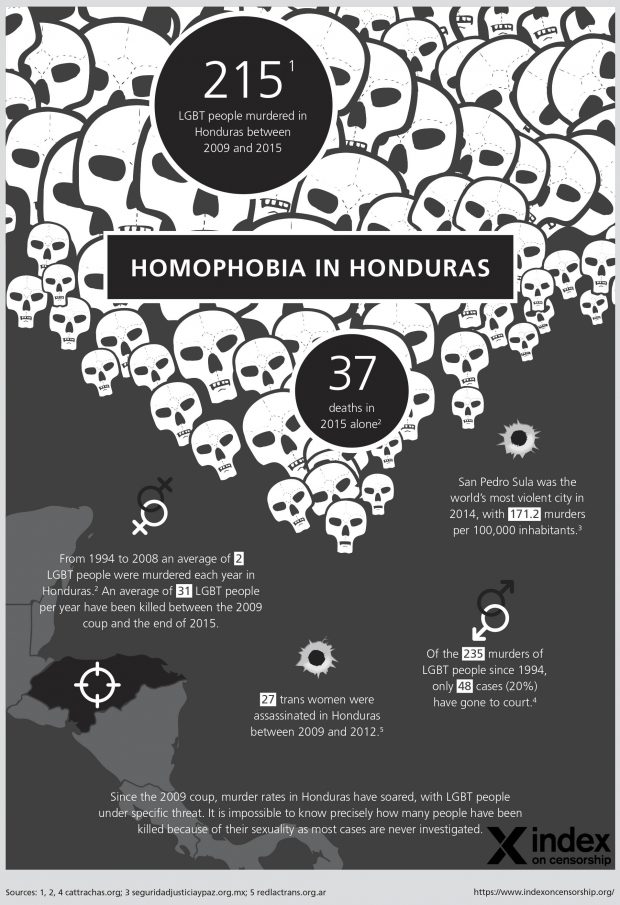
Dozens of LGBT Hondurans are murdered each year, with few of the killers brought to justice, according to figures from respected Honduran NGO Cattrachas. Journalists and activists who speak out are often attacked. One of these was Juan Carlos Cruz Andara who died after being stabbed 25 times by unknown assailants last June.
Arcoíris reported 15 security incidents against its members during the second half of 2015, including surveillance, harassment, arbitrary detentions, assaults, robberies, theft, threats, sexual assault and even murder. Other LGBT activists have experienced forced evictions, fraudulent charges, defamation, enforced disappearances and restrictions of right to assembly.
The activists consulted by Index all said that the level of homophobic violence exploded after the ousting of liberal President Manuel Zelaya in the military coup of 2009. The election of right-wing candidate Porfirio Lobo Sosa the following year coincided with the militarisation of Honduras, a rise in gang-related violence, and a clampdown on human rights.
The records from Cattrachas show that on average two LGBT people were murdered each year in the country from 1994 to 2008. After the 2009 coup that rate rocketed to an average 31 murders per year, according to figures from Arcoíris. In early 2016 there were signs the situation was escalating further with the murder of Paola Barraza, a member of Arcoiris’s group, on 24 January. In reality though it is impossible to know precisely how many people have been killed because of their sexuality because the vast majority of cases remain unsolved.
Erick Martínez Salgado, who volunteers with LGBT advocacy group Kukulcanhn, told Index that gay activists protested heavily against discrimination and the coup. He believes the government came to view his group as a threat to the traditional social order and started targeting them to “send a message” to other protesters.
One of the most prominent gay rights activists of the time, Walter Tróchez, was killed in a drive-by shooting in December 2009. Human rights groups noted that he had previously been kidnapped, beaten and threatened for demonstrating against the coup and advocating for gay rights. Four years later, Tróchez’s friend and fellow gay rights activist Germán Mendoza was arrested and charged with his murder.
Mendoza told Index he was held in deplorable conditions and repeatedly tortured in a bid to make him plead guilty. Eventually he was released after proving his innocence last year. Mendoza believes he was arrested because the government wanted to use him “as a scapegoat to wash their hands of the responsibility” for Tróchez’s death, which remains unsolved. The Honduran government did not respond to requests for comment.
Gang warfare was a massive contributor to Honduras status as the nation with the world’s highest murder rate in 2012, however the gay community’s main concern is not gangs, but the state security forces.
“The police constitute the primary perpetrator of violations of the rights of the LGBT community,” the Coalition Against Impunity, an alliance of 29 Honduran NGOs, warned last year, citing alleged “police policy of frequent threats, arbitrary arrests, harassment, sexual abuse, discrimination, torture and cruel or degrading treatment”.
As a result many vulnerable activists are reluctant to ask for protection, for fear that contact with the police would expose them to greater security risks or reprisals.
The journalists who document homophobic violence in Honduras also risk their lives. Dina Meza, an independent investigative reporter who has covered the issue extensively, was nominated for an Index on Censorship Freedom of Expression Award in 2014 for her journalism. Meza said the country’s mainstream media often portrays the LGBT community in a negative light.
Meza, who launched the independent news site Pasos de Animal Grande last year to draw attention to the hardships facing the most vulnerable sectors of society, said reporters who cover violence against the LGBT community are also targeted. She said not only do journalists get physically assaul-ted by the security forces and expelled from public events, but they are also targets of government-led smear campaigns.
“It’s extremely common here for them to link human rights defenders to drug trafficking and organised crime, in a bid to sow doubts in people’s minds about the work that we’re doing,” she explained. “If we speak out at an international level they say we’re trying to undermine Honduras, discourage investment and see the country burn.”
Peter Tatchell, director of the London-based LGBT campaigning group the Peter Tatchell Foundation, called for the world to pay more attention to the killings. He said: “This extensive, shocking mob violence against LGBT Hondurans is almost unreported in the rest of the world. The big international LGBT organisations tend to focus on better-known homophobic repression in countries like Egypt, Russia, Iran and Uganda. What’s happening in Honduras is many times worse. Is this neglect because it is a tiny country with few resources and no geo-political weight? The UN, Organisation of American States and foreign aid providers need to do more to press the Honduran government to crackdown on anti-LGBT hate crime and to educate the public on LGBT issues to combat prejudice.”
Meza and the activists interviewed by Index also believe that Catholic and Evangelical Christian groups have become increasingly influential in Honduran society. Reyes from Arcoíris described the state, the church and the mainstream media as a triumvirate which has fuelled “impunity, fundamentalism, machismo and misogyny” across the country, with disastrous consequences for the LGBT community.
“At home and at school are the first two places where we’re attacked and discriminated. We flee home at very young ages because the family is built on religious values. Our families punish us in a cruel manner and this has a terrible psychological impact,” Reyes said. “Our educational and employment opportunities are diminished every day. We can be sex workers or street vendors, or stay in the closet in the hope of getting a job, but if they find out about your sexual orientation you’ll almost certainly be fired.”
Despite the risks he and his fellow activists face, Reyes said the drastic need for change is what gives them the strength to keep fighting discrimination: “We need a Honduras that’s free from violence and homophobia. We believe it’s our responsibility to fight for this so the next generation have a space to live in a better world.”
This article is from the latest issue of Index on Censorship magazine. Order your copy here, or take out a digital subscription via Exact Editions (free trial or £18 for the year). Copies are also available at the BFI and Serpentine Gallery (London), News from Nowhere (Liverpool), Home (Manchester) and on Amazon. Each magazine sale helps Index on Censorship fight for free expression worldwide.
12 Apr 2016 | About Index, Bahrain, Bahrain Letters, Campaigns, Statements
12 April 2016
HM Hamad bin Isa al-Khalifa
King of Bahrain
Riffa Palace
Manama, Bahrain
Dear King Hamad,
We, the undersigned Bahraini and international non-governmental organizations (NGOs), would like to unequivocally condemn your government’s arrest of human rights defender Zainab Al-Khawaja along with her infant son. The implementation of Ms. Al-Khawaja’s prison sentence for merely exercising her right to free expression and assembly amounts to arbitrary detention is wholly unacceptable. While Foreign Minister Sheikh Khaled bin Ahmed Al-Khalifa indicated an intention to release her, she has not yet been freed from prison and we are concerned that these arbitrary charges remain against her. We therefore call on the Government of Bahrain to secure her immediate and unconditional release.
On 14 March 2016, security forces raided the home of Ms. Al-Khawaja’s parents-in-law looking for her. When they did not find her there, they went to her apartment and arrested Ms. Al-Khawaja along with her 15-month-old son, Abdulhadi. After they temporarily detained her and her son at the Al-Hoora police station, the authorities informed Ms. Al-Khawaja that she would be taken for a medical examination at the Ministry of Interior before being transferred to the Isa Town Detention Center to serve out her prison term. From the time of her arrest at 3:45 pm until her midnight arrival at the detention facility, security services denied Ms. Al-Khawaja any food for her son, despite repeated requests. Isa Town Detention Center has recently suffered an outbreak of Hepatitis C which puts both mother and son at risk. The demeaning and dangerous conditions of the detention center where Ms. Al-Khawja and her infant son are kept indicate a gender specific attempt to destabilize and hinder her peaceful human rights advocacy.
Bahraini courts sentenced Ms. Al-Khawaja to a total of three years and one month in prison, as well as a BHD 3,000 fine, on several charges related to her peaceful dissent and free expression. In December 2014, a court sentenced Ms. Al-Khawaja to three years and three months in prison on charges related to allegedly insulting a police officer during a peaceful protest and insulting the king by tearing up a photograph. In October 2015, Bahrain’s appeals court confirmed her conviction for insulting the king but reduced her sentence to one year in prison. Additionally, on 2 February 2016, the appeals court upheld a 9-month prison sentence against Ms. Al-Khawaja after she tried to visit her father, human rights defender Abdulhadi Al-Khawaja, in Jau Prison when he was on a hunger strike in August 2014.
The international community has repeatedly expressed grave concern over your government’s decision to prosecute Ms. Al-Khawaja for exercising her right to free expression and assembly. In 2014, the UN Chair-Rapporteur of the Working Group on Arbitrary Detention and the UN Special Rapporteurs on freedom of opinion and expression, human rights defenders, and freedom of peaceful assembly and of association urged your government to drop all charges against Ms. Al-Khawaja, warning that her detention could be considered arbitrary. A year later, these same Special Procedures issued a joint communication to your government stating that Ms. Al-Khawaja’s sentencing appears to “indicate a prima facie violation of the rights to freedom of opinion and expression and to freedom of association, as set forth in articles 19 and 22 of the ICCPR [International Covenant on Civil and Political Rights].” The United States Government has previously expressed concern over the fairness of Ms. Al-Khawaja’s trial, and – most recently – the Government of Denmark has raised Ms. Al-Khawaja’s case at the 31st session of the Human Rights Council in Geneva, insisting that she and her son be released. Furthermore, Ms. Al-Khawaja’s arrest comes during a session of the UN Committee on the Status of Women, where your government is taking part in discussions on how to protect women rights globally, while targeting women human rights defenders locally.
On 7 April 2016, the Foreign Minister, Sheikh Khaled bin Ahmed Al-Khalifa, stated that the authorities intend to release Ms. Al-Khawaja on humanitarian grounds. Sheikh Khaled provided no timeline for her release and her family has received no further guarantee that the government will release Ms. Al-Khawaja from prison. However, the foreign minister did indicate that the government will not drop any of the charges against Ms. Al-Khawaja, leaving her vulnerable to her re-arrest at any time.
We would like to join this growing chorus of international voices in calling for the immediate and unconditional release of Zainab Al-Khawaja and her infant son. The broad criminalization of peaceful dissent and free expression in Bahrain, as well as the government’s continued harassment and detention of human rights defenders, contravenes your obligations under international law, and is wholly unacceptable.
Sincerely,
Americans for Democracy & Human Rights in Bahrain (ADHRB)
Arab Center for the Promotion of Human Rights (ACPHR)
Association for Women’s Rights in Development (AWID)
Bahrain Center for Human Rights (BCHR)
Bahrain Institute for Rights and Democracy (BIRD)
Canadian Journalists for Free Expression (CJFE)
Cartoonists Rights Network International
CIVICUS World Alliance for Citizen Participation
Electronic Frontier Foundation (EFF)
European-Bahraini Organisation for Human Rights (EBOHR)
European Center for Democracy and Human Rights (ECDHR)
Freedom Forum
Gulf Centre for Human Rights (GCHR)
Human Rights Network for Journalists – Uganda
Human Rights Sentinel
Index on Censorship
Institute for the Studies on the Free Flow of Information (ISAI)
Institute of the Press and Freedom of Expression (IPLEX)
International Federation for Human Rights (FIDH)
International Federation of Journalists (IFJ) Asia Pacific
Justice Human Rights Organization (JHRO)
Khiam Rehabilitation Center for Victims of Torture
Lawyers Rights Watch Canada (LRWC)
Maharat Foundation-Lebanon
MARCH
National Union of Somali Journalists (NUSOJ)
Nazra for Feminist Studies (Egypt)
Observatorio Latinoamericano para la Libertad de Expresión (OLA)
Pacific Islands News Association
Pakistan Press Foundation (PFF)
PEN America
PEN Canada
Saudi Organization for Rights and Freedoms
Salam for Democracy and Human Rights
Social Media Exchange (SMEX)
Vigilance for Democracy and the Civic State
World Association of Newspapers and News Publishers
8 Apr 2016 | Awards, Europe and Central Asia, Turkey
Turkish journalist Ferit Tunç quit his advertising job in 2013 to found the newspaper Yön Gazetesi, covering the Kurdish Batman province of Turkey. Since its inception, the newspaper has been the subject of nearly 40 lawsuits, and Tunç has been taken close to bankruptcy.
“Being a journalist in Turkey is very difficult,” he told Index. “But being a journalist in the Eastern provinces of Turkey is more difficult, especially these days.”
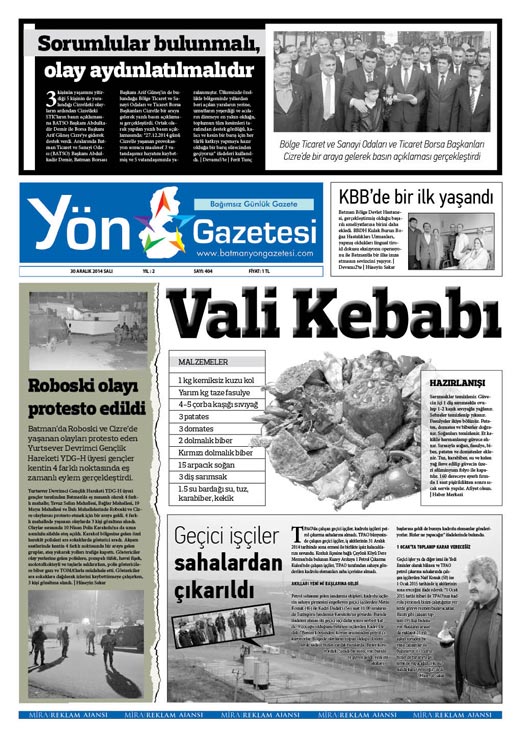
However he has refused to give up fighting for press freedom in Turkey. In protest to the crippling lawsuits – all of which had been eventually dropped – Tunç began to devote his front pages to recipes for traditional Turkish dishes.
The recipes contained references to government corruption and media censorship, with readers were informed about the best way to prepare “governor kebab” and a sherbet treat the paper satirically-titled “deputy’s finger.”
“They [the authorities] love to eat so we give them recipes. After they understood our protest, they appropriated the newspaper more than before. We will continue our protest until there is a free local media,” Tunç said.
The protest gained local and international attention, and Tunç eventually won a three-month sponsorship from a group of local businessmen, allowing Yön Gazetesi to stay open.
In 2015 Tunç also ran as an independent parliamentary candidate in Batman in the June general election.
“In reality, my reason for being a candidate was not to be elected, it was completely a reaction towards those in authority and against the political parties,” he said. “During our campaigning our main slogan was “No to Corruption”.
Even his campaign van was emblazoned with the demand: “Stop Corruption!”.
Tunç believes politics and the media need to be reformed in Turkey: “People feel they’re being denied the right to know and discuss local issues, but first, you have to have a form of media that can focus on them without being destroyed.”
“Freedom of speech is essential for me and I am of those that believe that there will not be development, happiness and peace in a place without freedom of speech.”
Recipe: Governor Kebap
The name of the food that I have given in the recipe is “Governor’s Kebap.” The Governor’s Kebap is one of the most expensive foods we have and the poor have not had much of a chance to eat it. And the small message we are giving through this is that while the poor are unable to eat this food, the rich are only thinking about their stomachs while abusing the rights of the poor and dealing corruptly.
 Ingredients:
– 1 kg boneless leg of lamb
– half kg green beans
– 4-5 tablespoons vegetable oil
– 3 potatoes
– 3 tomatoes
– 2 bell peppers
– a red bell pepper
– 15 pearl onions
– 3 garlic cloves
– 1.5 cups water
– Salt, black pepper, thyme
Preparation:
Peel the garlic cloves. Rub the inside of a stew dish (güveç) with one clove of garlic and then grease it with 1-2 tablespoons of vegetable oil. Peel and wash the vegetables. Cut the beans in half. Slice the potatoes, tomatoes, and peppers. Peel the onions.
Coat the meat with thyme and put it in the stew dish (güveç). In order, add onions, beans, peppers, potatoes, and tomatoes. Add the salt, black pepper, water and remaining oil, and then cover the stew dish (güveç) with aluminum foil. Serve hot after cooking it for one hour in an oven set to 160 degrees.
6 Apr 2016 | Asia and Pacific, Awards, Pakistan
Since becoming a journalist almost 30 years ago, Pakistani journalist Hamid Mir has had to choose between his life and his career. Mir is now one of Pakistan’s best-known journalists, the host of Geo Television’s flagship political show Capital Talk. He also now lives under armed guard, recovering from yet another assassination attempt, with his family sent abroad for their safety.
“My family is not happy with me,” he told Index. “They think that my life is more important than the profession.” Mir does not agree.
“I think that if I leave Pakistan, it’s like I surrender, and I don’t want to surrender to the Taliban, I don’t want to surrender to the rogue elements in our intelligence agencies and the security agencies. I don’t want to surrender to the enemies of democracy.”
Mir became a journalist after his father, who himself taught journalism at the University of the Punjab, died in mysterious circumstances in 1987. Mir saw his career as a continuation of his father’s fight for democracy, human rights and minorities’ rights in Pakistan.
“When I decided to become a journalist, Pakistan was ruled by a military dictator,” Mir told Index. It was not long after he started at a small paper in Lahore that Mir first met the violent opposition to his reporting that would characterise his career and life.
“When I started facing trouble, I was not aware that I was touching some controversial subject,” he said. “I was only doing my job as a reporter.”
In 1990, Mir broke a story about the military establishment and the then-president trying to remove the democratically elected Prime Minister Benazir Bhutto.
“I was kidnapped by the intelligence agency and they tortured me and asked me to tell them who is my source.” Bhutto’s government was removed days later.
Fast forward 30 years and Mir is still reporting on issues many Pakistani journalists won’t touch.
His tireless and outspoken reporting has earned him enemies in Pakistan’s intelligence agency, the Inter-Services Intelligence, the Pakistani Taliban and local terrorist groups, and Pakistan’s political parties.
It has also earned him a lifetime of assassination attempts – the latest a near-fatal attack in 2014 which saw him shot six times as he drove to work – has left Mir living under constant protection. He is driven to and from work in a bulletproof vehicle, alternating between cell phones and residences, and away from his two children, who were sent abroad after a car they were riding in was attacked.
But, for Mir, reporting on these untouchable-topics is not a question. “Maybe it’s controversial for the others but it’s not controversial for me,” he says.
“If a military dictator is suspending the constitution of Pakistan which was approved by the elected parliament, and I, being a journalist and a TV anchor, am opposing that, for me it’s not controversial,” he says.
“And again, if some intelligence agency is trying to dictate me – you should report this and you should not report that – and if the religious extremists, the Taliban, they are issuing threats to women, they are bombing the girls’ schools, and I am criticising the Taliban. I don’t think that it’s controversial.”
Threats to his life intensified in late 2015, and under pressure from his family, Mir planned to take three months off-air.
“After one month, I realised that it’s too much, I have to come back.”
For Mir, if not for his family, his duty to Pakistan and to his colleagues, will always outweigh his own safety. The guilt he feels for those journalists who have died for their work is too great to ever allow him to stop, he says.
“There were some colleagues who used to come to me and take advice about what should we do because we are facing pressures. Should we continue our job as a journalist? I used to advise them, yes you must continue your job as a journalist, nothing bad will happen. But they were killed, they were kidnapped.”
“If I leave Pakistan today, on the pressure of my family, maybe I will leave a very safe life in London or in Berlin or in Paris or in any other country. But it will be very difficult for me to live a normal life, because the ghosts of my martyred friends, they will not allow me to have a comfortable sleep.”
Mir believes he is one of the lucky ones in Pakistan – he has survived. And life in Lahore is a lot easier for journalists than for those living outside the city, he says.
Although he sees media freedom in Pakistan getting worse, with pressures from the extremist forces and state agencies intensifying, his long-view is an uplifting one.
“The good thing is that the people, the majority of the people of Pakistan, the civil society, is the main source of our strength. If I am living in Pakistan, if I am surviving in Pakistan, it’s only because the common man is supporting me,” he said.
“The common man believes in democracy, they don’t like extremist ideology, they don’t like dictatorship, they want rule of law. There is a ray of hope for me in Pakistan.”



