Turkish journalist Ferit Tunç quit his advertising job in 2013 to found the newspaper Yön Gazetesi, covering the Kurdish Batman province of Turkey. Since its inception, the newspaper has been the subject of nearly 40 lawsuits, and Tunç has been taken close to bankruptcy.
“Being a journalist in Turkey is very difficult,” he told Index. “But being a journalist in the Eastern provinces of Turkey is more difficult, especially these days.”
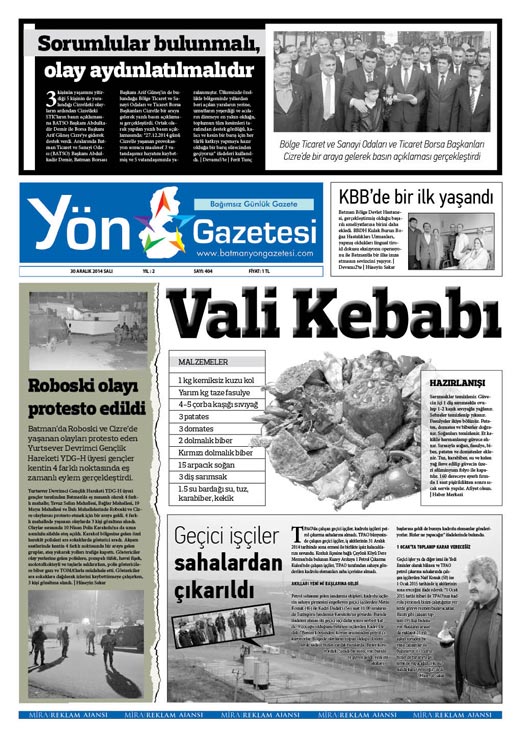
However he has refused to give up fighting for press freedom in Turkey. In protest to the crippling lawsuits – all of which had been eventually dropped – Tunç began to devote his front pages to recipes for traditional Turkish dishes.
The recipes contained references to government corruption and media censorship, with readers were informed about the best way to prepare “governor kebab” and a sherbet treat the paper satirically-titled “deputy’s finger.”
“They [the authorities] love to eat so we give them recipes. After they understood our protest, they appropriated the newspaper more than before. We will continue our protest until there is a free local media,” Tunç said.
The protest gained local and international attention, and Tunç eventually won a three-month sponsorship from a group of local businessmen, allowing Yön Gazetesi to stay open.
In 2015 Tunç also ran as an independent parliamentary candidate in Batman in the June general election.
“In reality, my reason for being a candidate was not to be elected, it was completely a reaction towards those in authority and against the political parties,” he said. “During our campaigning our main slogan was “No to Corruption”.
Even his campaign van was emblazoned with the demand: “Stop Corruption!”.
Tunç believes politics and the media need to be reformed in Turkey: “People feel they’re being denied the right to know and discuss local issues, but first, you have to have a form of media that can focus on them without being destroyed.”
“Freedom of speech is essential for me and I am of those that believe that there will not be development, happiness and peace in a place without freedom of speech.”
Recipe: Governor Kebap
The name of the food that I have given in the recipe is “Governor’s Kebap.” The Governor’s Kebap is one of the most expensive foods we have and the poor have not had much of a chance to eat it. And the small message we are giving through this is that while the poor are unable to eat this food, the rich are only thinking about their stomachs while abusing the rights of the poor and dealing corruptly.
Ingredients:
– 1 kg boneless leg of lamb
– half kg green beans
– 4-5 tablespoons vegetable oil
– 3 potatoes
– 3 tomatoes
– 2 bell peppers
– a red bell pepper
– 15 pearl onions
– 3 garlic cloves
– 1.5 cups water
– Salt, black pepper, thyme
Preparation:
Peel the garlic cloves. Rub the inside of a stew dish (güveç) with one clove of garlic and then grease it with 1-2 tablespoons of vegetable oil. Peel and wash the vegetables. Cut the beans in half. Slice the potatoes, tomatoes, and peppers. Peel the onions.
Coat the meat with thyme and put it in the stew dish (güveç). In order, add onions, beans, peppers, potatoes, and tomatoes. Add the salt, black pepper, water and remaining oil, and then cover the stew dish (güveç) with aluminum foil. Serve hot after cooking it for one hour in an oven set to 160 degrees.
Gökhan Biçici is a Turkish reporter and was one of the most active reporters of the 2013 anti-government Gezi Park protests in Istanbul. While covering the protests Biçici was beaten severely by police and then dragged through the streets. Observers in apartments overlooking his arrestcaptured footage of the attack, which quickly went viral.
“The censorship in Turkey is stronger now than ever,” Biçici told Index. “There is no period in history where political power had reached this level of domination over the media. And there is no period in history where disinformation has reached these levels.”
Biçici’s arrest and the Gezi Park protests became a symbol of the state of democracy and free speech in Turkey.
The wave of public engagement was huge, Biçici says, and after the protests were over and people left the streets, he sought to build something more permanent.
“It was necessary to go through the resistance protests and realise the size of the censorship and the imposition of self-censorship and the corruption in the press.”
“In these resistance protests, millions of people went out to the streets. Hundreds of thousands, or even millions, went out to the largest square in Istanbul, Taksim Square, and when they came back home a penguin documentary was on TV instead of the truth,” he said.
“The younger generation was politicised by Gezi. At the same time, their relationship with the social media became politicised, too. All conditions were ready to appear citizen news agency in Turkey.”
Dokuz8Haber aims to be just that.“Dokuz8Haber is a foundation that brings together the journalists and the national reporters of digital activism, in a unified network,” he said.
Launched in March 2015, Dokuz8Haber is a journalism network that gathers various independent citizen journalism outlets to create a common newsroom. Volunteers and citizen journalists send their stories to professional editors, and the news stories are then broadcasted domestically and internationally via Dokuz8Haber. They understand the importance of disseminating news in new, modern ways – using social media, video and live-stream coverage and translation to get information out to the people of Turkey.
They have also organised numerous training programs for potential citizen journalists in all regions in Turkey, to train a network of reporters around the country.
“Freedom of expression is a right we will never give up on,” said Biçici. “It’s an nonnegotiable right and it’s also a pursuit that requires hard work. Personally speaking, it’s what I’ve spent my whole life working on. This is why I chose this career.”
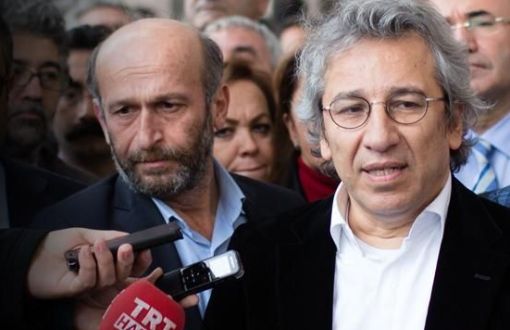
Journalists Erdem Gül and Can Dündar (Photo: Bianet)
On the eve of a trial scheduled to start on March 25, 2016, a coalition of leading international free expression and press freedom groups condemns the criminal case targeting Cumhuriyet journalists Can Dündar and Erdem Gül, and calls on authorities in Turkey to drop all charges against them.
Dündar, editor-in-chief of Cumhuriyet, and Gül, the newspaper’s Ankara representative, face accusations of aiding a terrorist organisation, espionage and disclosure of classified documents for reports in Cumhuriyet claiming that Turkey’s intelligence agency secretly armed Islamist rebel groups in Syria. Although those claims previously had been reported widely by other media outlets in Turkey, a criminal case against Dündar and Gül was initiated after Cumhuriyet published a report on May 29, 2015 that included a video purportedly showing Turkish security forces searching trucks owned by the country’s intelligence agency that were travelling to Syria containing crates of ammunition and weapons.
Dündar and Gül were detained in November 2015 and held for nearly 100 days in Turkey’s Silivri Prison until the country’s Constitutional Court ruled that the journalists’ pre-trial detention violated their human rights. Both journalists were subsequently released pending trial following a criminal court order. Nevertheless, Turkish President Recep Tayyip Erdoğan vowed that he would neither recognise nor obey the Constitutional Court’s ruling. Moreover, prominent supporters of the ruling Justice and Development Party (AKP) demanded that Dündar and Gül be returned to prison and they called for Turkey’s citizens’ right to turn to the Constitutional Court to redress violations of their human rights to be curtailed.
The persecution of these two journalists – a gross abuse of government authority in clear violation of the right to press freedom – is by no means an isolated case. At least 13 journalists languish behind bars in Turkey in direct retaliation for their work, and recent months have seen the state seizure of opposition media outlets – including the March 2016 takeover of the Zaman newspaper and Cihan News Agency. Recent months have also seen numerous violations of the right to press freedom in Turkey, including, among many others, the continued misuse of defamation and insult law, as well as anti-terrorism law, to target and silence those who publicly express their dissent from government policies.
Members of the coalition accordingly urge Turkish authorities to drop all charges against Dündar and Gül, and to free all other journalists currently detained in connection with their journalism or the opinions they have expressed. The coalition further renews its previous call on lawmakers in Turkey to take steps to reverse the country’s trend toward authoritarianism, and its call on governments of democratic countries to pressure the Turkish government to end its crackdown on independent media and to meet its human rights commitments under both domestic and international law.
– The International Press Institute (IPI)
– The Committee to Protect Journalists (CPJ)
– Reporters Without Borders (RSF)
– The European Federation of Journalists (EFJ)
– ARTICLE 19
– Index on Censorship
– The Ethical Journalism Network (EJN)
– PEN International
– The South East Europe Media Organisation (SEEMO)
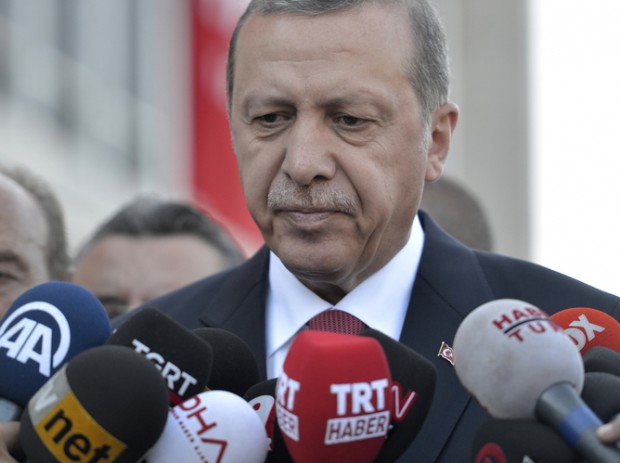
The increasingly autocratic government of Recep Tayyip Erdogan, president of Turkey, has clamped down on press freedom and opposing political viewpoints. Index on Censorship has condemned the ongoing attack on freedom of expression and, through its project Mapping Media Freedom, monitored the growing threats to the media. Below is a roundup of our recent reporting on media violations in Turkey.
Below is a roundup of our recent reporting on the ongoing media freedom crisis in Turkey.
Letter: EU must not ignore collapse of media freedom in Turkey
Press freedom and media organisations wrote to Donald Tusk, president of the European Council ahead of the meeting between EU leaders and Ahmet Davutoğlu, prime minister of Turkey, to express their concern over the collapse of media freedom in Turkey. Read the full letter
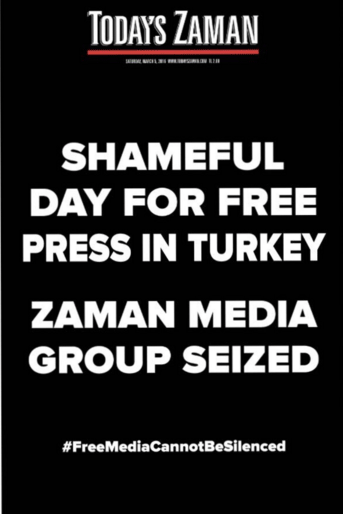
Turkish court orders seizure of Zaman news group
The seizure of Turkey’s biggest opposition newspaper is the latest move against press freedom in the country. Since the election of Turkey’s president Recep Tayyip Erdoğan in 2014, the increasingly autocratic politician has waged an ongoing war with voices critical of his government. Read the full article
Zaman: The murder of a newspaper
On Friday night, security forces stormed Zaman, the widest-circulating Turkish newspaper. Though many Turkish news outlets studiously avoided covering the raids, the screens of international news channels were full of images of Turkish police using tear gas and water cannon against protestors trying to protect their paper. Particularly striking were the injuries to young women wearing Islamic headgear, the very segment of the community, which the ruling Justice and Development Party (AKP) once vowed to defend. Read the full article
Turkey: A long line of press freedom violations
Turkey’s government and courts have demonstrated their unwillingness to adhere to basic values on press freedom and media pluralism. From judicial harassment and seizing media companies to silencing Kurdish and critical media, Turkey’s government has been used by President Recep Tayyip Erdogan to silence critical voices in the country. Read the full article
Zaman’s censored writers The following columns were submitted to and rejected by the new management of the seized Zaman and Today’s Zaman.
Yavuz Baydar: Bid farewell to journalism, and lose Turkey
Following the presidential attacks on Turkey’s top judicial body, the Constitutional Court, stemming from its pro-freedom ruling over the case of Can Dündar and Erdem Gül of Cumhuriyet, and the unplugging two opposition channels from Türksat satellite, the dramatic seizure of Zaman and this newspaper, Today’s Zaman, both highly influential in their own ways, is one of the final nails in the coffin of journalism in Turkey. Read the full column
Nicole Pope: A lack of free media allows Turkish authorities to control the narrative
How do you write a column for a newspaper that still exists nominally but has been taken over by trustees appointed by an “independent” court? Such are the dilemmas in a country where democratic standards are slipping rapidly. No journalism school or manual of ethical journalism prepares one for such a situation. Read the full column
Suat Kınıklıoğlu: Europa Europa
Turks who are putting up a brave fight confronting the authoritarianism in this country every day are simply aghast at the show put on in Brussels. Turkey’s democrats have been thoroughly exposed to the crude pragmatism of the EU. Read the full column
Doğu Ergil: Turkey, the humanitarian crisis and erratic responses
The numerical figures of the reality of Syrian refugees in Turkey are as follows: 2.2 million of the 4.3 million displaced Syrians who have been registered as persons of concern by the Office of the United Nations High Commissioner for Refugees (UNHCR) currently reside in Turkey. There is an estimated 400,000 who have settled in various parts of Turkey relying on their own financial resources. The total number of Syrian refugees in Turkey is higher than the entire population of six of the EU’s 28 member states. Read the full column



 Ingredients:
 Zaman’s censored writers