
One year after murder of Khashoggi, NGOs renew call for justice
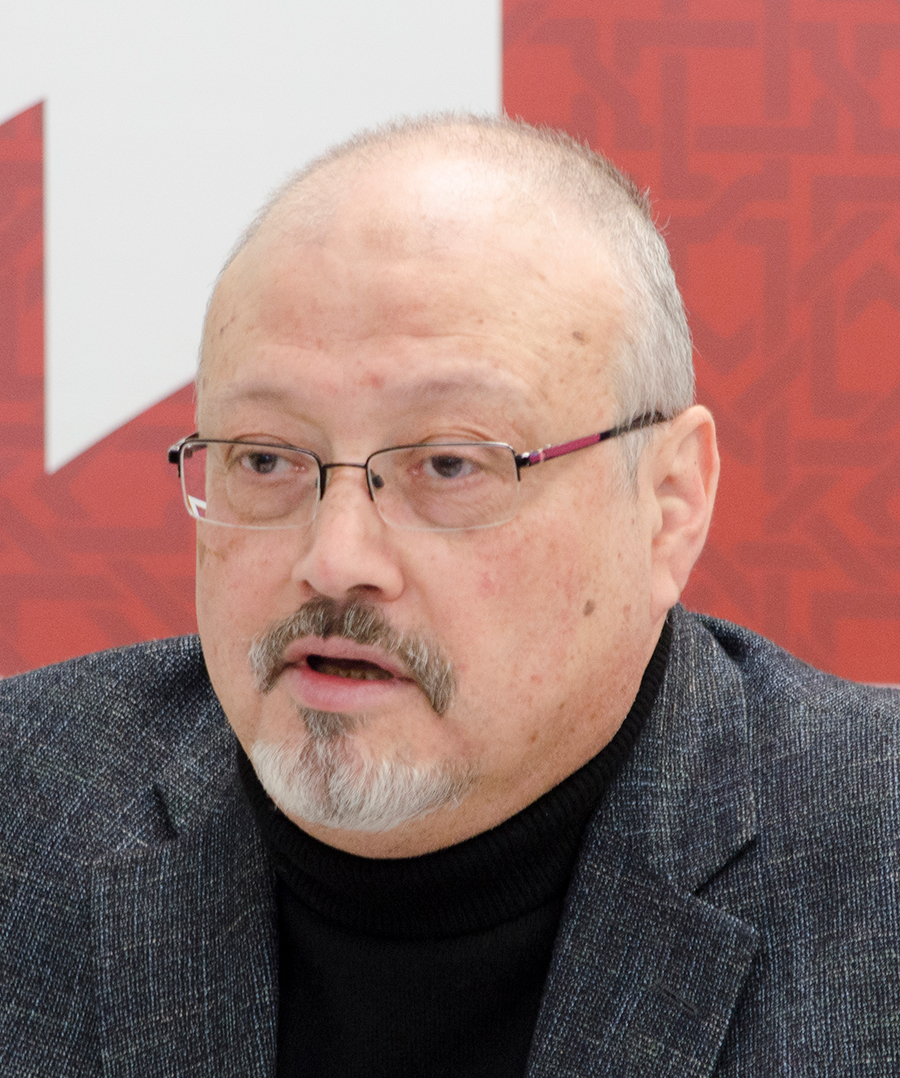
Saudi journalist, Global Opinions columnist for the Washington Post, and former editor-in-chief of Al-Arab News Channel Jamal Khashoggi offers remarks during POMED’s “Mohammed bin Salman’s Saudi Arabia: A Deeper Look”. March 21, 2018, Project on Middle East Democracy (POMED), Washington, DC.

Saudi journalist, Global Opinions columnist for the Washington Post, and former editor-in-chief of Al-Arab News Channel Jamal Khashoggi offers remarks during POMED’s “Mohammed bin Salman’s Saudi Arabia: A Deeper Look”. March 21, 2018, Project on Middle East Democracy (POMED), Washington, DC.

Jamal Khashoggi entered the Saudi consulate in Istanbul on 2 October, 2018, to obtain official documents in order to get married, but he did not make it out alive. He was brutally killed inside the consulate in what the UN Special Rapporteur on extrajudicial, summary or arbitrary executions, Agnes Callamard, called a “premeditated extrajudicial killing” for which the state of the Kingdom of Saudi Arabia is responsible.

Khashoggi was a well-known Saudi journalist and intellectual who, due to safety concerns and the inability to continue his work inside Saudi Arabia, decided to live in self-imposed exile in the United States. He was a firm promoter of freedom of speech and press freedom in the Arab world.

While he was no outright opponent of the Saudi royal family and did not call for regime change in the country, he criticised the arrest of human rights defenders and the reform plans of the crown prince. This alone may have been enough to seal his fate.

After more than two weeks of deception and denial about his death, on 19 October 2018 the Saudi authorities admitted that Khashoggi had been killed inside the consulate by a group of men connected to the authorities, but continued to deny any direct knowledge or responsibility for the crime. One year after his murder, the remains of Khashoggi’s body are still missing and have not been returned to his family.

The Saudi authorities implicated 11 individuals responsible for Khashoggi’s killing, some of whom face the death penalty. They are currently being tried in the Specialised Criminal Court, a jurisdiction notorious for violations of fair trial guarantees. The trial proceedings remain in large part secret, and criminal responsibility in the chain of command has not yet been established.

Khashoggi’s death sparked outrage and was widely condemned. In the days and weeks following his killing, the international community began to ask questions and to demand clarity. The UN Office of the High Commissioner for Human Rights issued several press releases, while the UN Special Procedures on enforced disappearance, summary executions and freedom of expression issued a joint Urgent Appeal. Moreover, the UN Secretary-General, Antonio Guterres, stressed the need for a prompt, thorough and transparent investigation into the circumstances of Khashoggi’s death and full accountability for those responsible.

On 24 October 2018, the EU Parliament issued a resolution urging the Saudi authorities to disclose the whereabouts of Khashoggi’s remains. In addition to demanding an independent and impartial international investigation into the journalist’s death, the resolution also classified it as being part of a pattern of a widespread crackdown against prominent human rights defenders, women activists, lawyers, journalists, writers and bloggers, which has intensified since Mohammad bin Salman began consolidating control over the country’s security institutions.

It stated that the systematic practice of enforced disappearances and extrajudicial killings could amount to a crime against humanity. Lastly, it requested that the perpetrators of Khashoggi’s murder be identified and brought to justice, following a fair trial held in accordance with international standards before an impartial court and with international observers present.

On 5 November 2018, Saudi Arabia’s human rights record was examined by UN Member States as part of the third cycle of the Universal Periodic Review. The killing of Khashoggi was raised extensively during the review and featured heavily among the 258 recommendations the Saudi authorities received to improve the human rights situation in the country. At least 27 states raised concerns about Khashoggi’s extrajudicial killing, with many reiterating the need for a transparent, impartial, independent and effective investigation.

In January 2019, Callamard decided on her own initiative and under the terms of her mandate as UN Special Rapporteur on extrajudicial executions to open a special human rights investigation into Khashoggi’s killing.

On 7 March 2019, in a landmark initiative, a group of 36 UN Member States led by Iceland delivered a joint statement during the 40th session of the Human Rights Council expressing serious concern over the human rights situation in Saudi Arabia and condemning in the strongest possible terms the killing of Khashoggi. The statement reiterated the call for a prompt, independent, impartial and transparent investigation into his murder and stressed the need to protect journalists and to uphold the right to freedom of expression.

During the 41st session of the HRC, on 19 June 2019, Callamard presented her report, which concluded that the murder of Khashoggi was “overseen, planned and endorsed by high-level state officials of Saudi Arabia”. The Special Rapporteur found that both the investigations conducted by Saudi Arabia and Turkey failed to meet international standards and that the ongoing trial in Saudi Arabia of 11 suspects, while seemingly an important step towards accountability, also fails to meet international fair trial standards.

Callamard believes that the killing of Khashoggi constitutes an international crime over which states should claim universal jurisdiction. Asserting that her human rights inquiry is not a substitute for a criminal investigation or a court of law, the UN Special Rapporteur called on the Human Rights Council, the Security Council or the UN Secretary-General to demand a follow-up criminal investigation.

Most recently, on 23 September 2019, during the 42nd session of the HRC, Australia delivered a joint statement on behalf of 23 UN member states raising concerns over the persecution and intimidation of activists, the practice of enforced disappearance and arbitrary detention, and reports of torture and unfair trials as well as extrajudicial executions.

Furthermore, the statement called for an end to impunity over the murder of Khashoggi and highlighted the need for the truth to be established and accountability achieved. We deeply regret that a number of states that had joined the March 2019 statement have now decided to no longer support this immediate call for action. We would like to highlight that states still have the possibility to become co-signatories until 11 October 2019.

Additionally, during the course of the past year and as a response to Khashoggi’s murder as well as the war in Yemen, some governments have suspended weapon sales to Saudi Arabia.

While we welcome the appeals, pledges and measures taken by some states over the past year and consider them as steps in the right direction towards accountability for the murder of Khashoggi, more tangible actions must follow. There is an undeniable risk that with big events scheduled to take place in Saudi Arabia in 2020, such as the G20 summit and the famous Dakar Rally, state-to-state relations could normalise. We cannot stand by and allow the return of business as usual as this would mean that Khashoggi died in vain and that there is little hope for hundreds of other unlawfully disappeared, detained, tortured or executed activists whose cases failed to attract similar levels of international attention.

As Callamard rightly said during a side event at the 42nd session of the HRC: “While one year must feel like a lifetime to Khashoggi’s family and friends, in human justice time and the search for truth it is very brief. Thus we should not lose sight of what we are trying to achieve; we should not lose hope and courage that justice can be attained.”

In that spirit, the undersigned organisations renew their call for action, demanding the following:

We call on the international community, and in particular the UN, to:

  1. Take action to ensure that a further impartial, prompt, thorough, independent and effective criminal investigation into the murder of journalist Jamal Khashoggi is opened;
  2. Ensure that all perpetrators of the crime, including those at the head of the chain of command, are identified and prosecuted in a fair and transparent trial without recourse to the death penalty;
  3. Establish an immediate moratorium on all arms sales and exports of surveillance technology to Saudi Arabia;
  4. Co-sign the joint statement led by Australia on behalf of 23 UN Member States by 11 October;
  5. Introduce and endorse a UN resolution establishing a monitoring mechanism over the human rights situation in Saudi Arabia; and
  6. Urge the authorities in Saudi Arabia to implement the recommendations below.

We call on the authorities in Saudi Arabia to:

  1. Return the remains of Khashoggi’s body to his family;
  2. Invite independent international experts to oversee investigations into his murder; cooperate in good faith with all UN mechanisms; and ensure that those responsible for his death are brought to justice;
  3. Immediately and unconditionally release all human rights defenders, writers, journalists and prisoners of conscience in Saudi Arabia whose detention is a result of their peaceful and legitimate work in the promotion and protection of fundamental human rights;
  4. Establish a moratorium on the death penalty, including as punishment for crimes related to the exercise of the rights to freedom of opinion and expression, and peaceful assembly;
  5. Guarantee in all circumstances that all human rights defenders and journalists in Saudi Arabia are able to carry out their legitimate human rights activities and public reporting without fear of reprisals; and
  6. Ratify the International Covenant on Civil and Political Rights, and bring all national laws limiting the rights to freedom of expression, peaceful assembly and association into compliance with international human rights standards.

List of signatories:

ALQST

Americans for Democracy and Human Rights in Bahrain

Amnesty International

Article 19

Bahrain Institute for Rights and Democracy

CIVICUS

English PEN

European Center for Democracy and Human Rights

European Saudi Organisation for Human Rights

Gulf Center for Human Rights

IFEX

Index on Censorship

International Service for Human Rights
MENA Rights Group

No Peace Without Justice

PEN America

Rights Realisation Centre

Vigilance for Democracy and the Civic State

World Organisation Against Torture

Playlist: Beats and borders

[vc_row][vc_column][vc_video link=”https://www.youtube.com/watch?v=ewRjZoRtu0Y&list=PLlUhPA3TuB56RH9Ly-mqvPHDVBHZ42gyL&index=3&t=0s”][vc_column_text]

Borders – not so great for free speech, but not so bad for music it turns out. This is the theme of our latest playlist, which ties in with the autumn 2019 Index on Censorship magazine. The magazine looks at how borders stop the flow of information, movement and speech, whether you be a South Korean wanting to be in touch with your loved ones in the north or an artist being denied a visa to perform in the UK. And we highlight how this trend is getting worse, specifically how border officials are demanding access to individuals’ social media accounts at frontiers around the world.

Enjoy the below songs. Just remember to be vigilant when crossing state lines. In fact for tips on how to keep your personal information just that – personal – click here.

[/vc_column_text][/vc_column][/vc_row][vc_row][vc_column][vc_column_text]

M.I.A, Paper Planes

British-Sri Lankan rapper M.I.A has made a name for herself exploring the trials of life as a refugee through her music. The Sri Lankan government previously accused M.I.A of being a liar, while her song Paper Planes is inspired by her difficulties obtaining a visa to work in the USA, a problem Jan Fox highlights in her article. Despite her own trials she has stayed vigilant and continues to use her voice to call for political change.

The Police, Every Breath You Take

“Every move you make, every step you take, I’ll be watching you,” sings Sting in the 1983 classic by English rock band The Police. His lyrics bare a striking resemblance to the theme of this issue, in which we reveal the extent to which border forces are snooping into your own personal information and data. Ela Stapley gives advice on what you can do to keep your information safe when crossing borders.

Icehouse, Cross the Border

Australian electronic rock band Icehouse take you to a border crossing in their hit song from their album Measure for Measure. Against edgy beats and a dreamy synth, lead singer Iva Davies talks about walls standing still and freedom fading away, specifically at the border. It’s musical escapism on many levels. 

Neil Diamond, America

 Also known as Coming to America, this song written and performed by the legendary musician Neil Diamond in 1980 presents a positive depiction of immigrating to the USA. Flash forward to the USA of 2019 and Diamond might struggle to muster as much optimism. The increasing difficulties people face when trying to enter the USA are detailed in Mexican-based journalist Stephen Woodman’s article for the magazine. 

Elton John, Breaking Down Barriers

Elton John tries to break down barriers – cultural, sexual – in this 1981 single. His lyrics have many connotations, with some alluding to his identity as a homosexual man and having to build a wall around his heart “to keep the pain away”. Unfortunately this is still the case for many LGBT people, who are having to hide their sexuality when crossing borders, something Mark Frary highlights in magazine piece “Hiding your true self”.

The Doors, Break On Through (To the Other Side)

This signature song from The Doors illuminates the beauty of breaking on through to the other side. What that other side is has never been clarified, although given the drug references throughout the song it is probably safe to assume this is about psychedelic experiences. Drug references aside, the song’s lines about a country with “arms that chained us” and “eyes that lied” have universal implications that reverberate throughout the current issue.

The Rolling Stones, Gimme Shelter 

A track that captures the tensions of 1969, when the war in Vietnam was intensifying and the threat of nuclear devastation from the Soviet Union painted a bleak future for the world. The desire to seek shelter is no less relevant today than it was when the Stones wrote this song. And it’s still inspiring art, as Irene Caselli shows in her article on artists trying to tell the stories of migrants in the Mediterranean. 

System of a Down, Fuck the System

It’s exactly what you think the song is about: a big two-fingered salute to the system. The politically charged lyrics express how the government gets to decide what is acceptable and what is not, just like some governments do today within a country and at its borders. Turkish contributing editor Kaya Genç reports on how travellers to Turkey are being restricted in what they can take into the country and what they can read. Wikipedia? Forget about it. 

Snow Patrol, Set Fire to the Third Bar

In this haunting track from Snow Patrol, lead vocalist Gary Lightbody and featured artist Martha Wainwright sing about being miles from their loved one and the pain that comes with such separation. It’s a feeling that is all too familiar for those in South Korea who have had their relationships and families torn apart by the North and South border, and who can face prison if they try to get in touch with them, as Steven Borowiec reports.

Wazimbo, Nwahulwana 

This choice is less about the song than the singer. Mozambique-musician Wazimbo is one of many artists who have had their UK visas denied this year. He was forced to pull out of an appearance at Peter Gabriel’s Womad Festival back in July as a result. Charlotte Bailey discusses Wazimbo in the magazine as she looks at how UK border policy is forcing artists to stop visiting the country, and how the UK’s cultural scene is losing out as a result. 

[/vc_column_text][/vc_column][/vc_row][vc_row][vc_column][vc_basic_grid post_type=”post” max_items=”4″ element_width=”6″ grid_id=”vc_gid:1568990225205-426f193c-fdf1-1″ taxonomies=”7819″][/vc_column][/vc_row]

China seeks to influence academic freedom on foreign campuses

[vc_row][vc_column][vc_video link=”https://youtu.be/b21faoXVpM4″][vc_column_text]“Students in the United States must be free to express their views, without feeling pressured to censor their speech…We can and will push back hard against the Chinese government’s efforts to chill free speech on American campuses.” This is what Marie Royce, US assistant secretary of state for educational and cultural affairs, said in her address welcoming Chinese students to American universities in July 2019. 

As much a warning as a welcome, the speech illustrates the balancing act America and other western countries often perform when engaging with Chinese people and organisations on campus. The presence of the Chinese Communist Party on campuses severely limits the free expression of Chinese students, and threatens more broadly to curtail academic freedom, the right to protest, and the ability to engage with the uncomfortable truths about the Chinese government honestly. 

To understand the situation, one must first understand the unique nature of the party apparatus. The CCP attempts to control not only China’s political arena but every aspect of Chinese citizens’ lives, at home and abroad, including on US campuses. Dr Teng Biao, a well-known Chinese human rights activist and lawyer, tells Index on Censorship: “It’s quite unique. The party’s goal is to maintain its rule inside China at all costs, and so it sets about making the world safe for the CCP. It is all-directional.” 

That control looks very different abroad than it does at home. CCP does not control much of its foreign influence network directly. “It has different ways of implementing influence,” Teng explains. Some Chinese organisations “are directed by the Chinese government and don’t have much independence in making decisions.” However, other organisations, such as alumni networks and Chinese businesses, as well as Chinese students, have their own agency and goals, and operate largely independently. 

Sources from US intelligence agencies to the New York Times have reported that the Confucius Institutes, which teach Chinese language skills to non-Chinese people, and the Chinese Students and Scholars Associations, which are student-led organisations that provide resources for Chinese students and promote Chinese culture, are directed by the CCP. The CSSA has worked closely with Beijing to promote its agenda and suppress critical speech. According to Royce, “there are credible reports of Chinese government officials pressuring Chinese students to monitor other students and report on one another” to officials, and the CSSA often facilitates this spying

Similarly, the Confucius Institutes, have a history of stealing and censoring academic materials, have been accused of attempting to control the Chinese studies curriculum, and have been implicated in what FBI director Cristopher Wray recently described to Congress as “a thousand plus investigations all across the country” into possible CCP-directed theft of intellectual property on campuses. 

Beijing’s influence is perhaps the most indirect and complex with regard to Chinese students themselves. The same day Royce made her welcome address, 300 Chinese nationalists disrupted a demonstration against China’s Hong Kong extradition bill at the University of Queensland, Australia, leading to violent clashes. On 7 August 2019 more violence between detractors of the extradition law and supporters of the CCP occurred at the University of Auckland, New Zealand, in what China’s consul general in Auckland calls a “spontaneous display of patriotism”. Earlier this year, Chinese students at MacMaster University in Canada, incensed by a lecture on the Chinese government’s treatment of the Uigher ethnic minority, allegedly filmed the event and sent the video to the Chinese consulate in Toronto, which denied involvement but praised their actions as patriotic[/vc_column_text][vc_video link=”https://youtu.be/kW3c211dy8g”][vc_column_text]Speaking to Index about the Queensland protest, Dr Jonathan Sullivan, director of China Programs at the University of Nottingham Asia Research Institute, said “Many Chinese students have passionately held views and they sometimes mobilise to voice them. I don’t think it’s helpful to see such mobilisations as being the work of the party, although there is also evidence that party/state organisations sometimes provide help.” Sullivan notes, however, that their passion and convictions “are themselves a product of the authoritarian information order created by the party-state” and that “there is among Chinese students potential to react in an organised way.”  

Isaac Stone Fish, a prominent journalist and a senior fellow at the Asia Society’s Center on U.S.-China Relations in New York City told Index “[The party is] very effective generally at keeping students in an ideological framework,” convincing them, for instance, that “the communist party and China are the same” and thus motivating them to protect the party. However,he agrees that students’ convictions belong to them. “It’s ok for Chinese students to feel that Beijing’s policies are correct,” he says. Problems only arise when they try to control the conversation.

As the extent of the CCP’s influence is gradually revealed to the public, there have been fears that governments will retaliate indiscriminately and restrict visas for all Chinese students abroad, or withhold them specifically from members of the CSSA. Tensions over immigration, especially in the US, mean such a reaction is possible, but as Sullivan says: “We should keep in mind that most Chinese students care about their degree and getting on in life, and we all must resist any temptation to homogenise — let alone demonise — them.” Stone Fish concurs. “There is…a danger of a racially-tinged backlash against Chinese people, which would be an ethical and strategic mistake.”

Sullivan is concerned that many universities treat Chinese students like an easy source of income instead of treating them as students with unique and pressing needs. They have that in common with the party itself. One of the biggest dangers in dealing with the CCP, explains Stone Fish, is “its willingness to use Chinese students as bargaining chips” directing them to some universities and way from others to encourage political conformity. Western institutions are vulnerable to such a tactic, Teng claims, because they “care about money more than universal values,” and “They don’t profoundly realise” that the CCP “has become an urgent threat.”

So far, the western response to the issue has been inconsistent and uncertain. “I think universities need to develop a much clearer understanding of the issues,” Sullivan says. “These can be complex and university administrators are not generally China specialists who are able to identify the nuances, which makes policy and provision inadequate and potentially unbalanced.” Going forward, Stone Fish asserts, we should be “Educating college administrators about how the party works,” and “having universities work together.” Cooperation is essential, because “Beijing prefers to negotiate one-on-one,” but as a bloc, Universities have leverage of their own. 

Demand for western education in China is strong and continues to grow, especially among the Chinese elite and middle class. However, universities can only use that demand to resist pressure from the CCP if they coordinate their response. Stone Fish concludes, “I think the greatest danger is giving in to Beijing’s demands not to have certain speakers, or allow the party to prevent certain voices from being heard.” [/vc_column_text][vc_basic_grid post_type=”post” max_items=”4″ element_width=”6″ grid_id=”vc_gid:1566913121795-e09fc4f8-7d31-10″ taxonomies=”8843″][/vc_column][/vc_row]

Cartoonists Rights Network International continues to monitor the loss of cartoonists from media outlets around the world

[vc_row][vc_column][vc_column_text]
Cartoonists around the world continue to be subjected to censorship, imprisonment, violence, threats, harassment and, in the worst cases, even death. Although a small organisation, Cartoonists Rights Network International has had a big impact on challenging threats and abuses against editorial cartoonists worldwide. 

Since winning the 2019 Index on Censorship Freedom of Expression Award for Campaigning in April, CRNI has, among other things, been monitoring the situation with Badiucao, a Chinese dissident cartoonist living in exile in Australia who this year revealed his identity after years of anonymity, Terry Anderson, deputy executive director of CRNI, tells Index.

The Index award has so far helped the organisation raise its profile, as well as putting them in contact with allies.  [/vc_column_text][/vc_column][/vc_row][vc_row][vc_column][vc_basic_grid post_type=”post” max_items=”4″ element_width=”6″ grid_id=”vc_gid:1565342514848-bfb45a07-da03-0″ taxonomies=”30547″][/vc_column][/vc_row]

SUPPORT INDEX'S WORK