1 May 2015 | Campaigns, mobile, Statements
On World Press Freedom Day, 116 days after the attack at the office of the satirical newspaper Charlie Hebdo that left 11 dead and 12 wounded, we, the undersigned, reaffirm our commitment to defending the right to freedom of expression, even when that right is being used to express views that we and others may find difficult, or even offensive.
The Charlie Hebdo attack – a horrific reminder of the violence many journalists around the world face daily in the course of their work – provoked a series of worrying reactions across the globe.
In January, the office of the German daily Hamburger Morgenpost was firebombed following the paper’s publishing of several Charlie Hebdo images. In Turkey, journalists reported receiving death threats following their re-publishing of images taken from Charlie Hebdo. In February, a gunman apparently inspired by the attack in Paris, opened fire at a free expression event in Copenhagen; his target was a controversial Swedish cartoonist who had depicted the prophet Muhammad in his drawings.
A Turkish court blocked web pages that had carried images of Charlie Hebdo’s front cover; Russia’s communications watchdog warned six media outlets that publishing religious-themed cartoons “could be viewed as a violation of the laws on mass media and extremism”; Egypt’s president Abdel Fatah al-Sisi empowered the prime minister to ban any foreign publication deemed offensive to religion; the editor of the Kenyan newspaper The Star was summoned by the government’s media council, asked to explain his “unprofessional conduct” in publishing images of Charlie Hebdo, and his newspaper had to issue a public apology; Senegal banned Charlie Hebdo and other publications that re-printed its images; in India, Mumbai police used laws covering threats to public order and offensive content to block access to websites carrying Charlie Hebdo images. This list is far from exhaustive.
Perhaps the most long-reaching threats to freedom of expression have come from governments ostensibly motivated by security concerns. Following the attack on Charlie Hebdo, 11 interior ministers from European Union countries, including France, Britain and Germany, issued a statement in which they called on internet service providers to identify and remove online content “that aims to incite hatred and terror”. In the UK, despite the already gross intrusion of the British intelligence services into private data, Prime Minister David Cameron suggested that the country should go a step further and ban internet services that did not give the government the ability to monitor all encrypted chats and calls.
This kind of governmental response is chilling because a particularly insidious threat to our right to free expression is self-censorship. In order to fully exercise the right to freedom of expression, individuals must be able to communicate without fear of intrusion by the state. Under international law, the right to freedom of expression also protects speech that some may find shocking, offensive or disturbing. Importantly, the right to freedom of expression means that those who feel offended also have the right to challenge others through free debate and open discussion, or through peaceful protest.
On World Press Freedom Day, we, the undersigned, call on all governments to:
• Uphold their international obligations to protect the rights of freedom of expression and information for all, especially journalists, writers, artists and human rights defenders to publish, write and speak freely;
• Promote a safe and enabling environment for those who exercise their right to freedom of expression, especially for journalists, artists and human rights defenders to perform their work without interference;
• Combat impunity for threats and violations aimed at journalists and others threatened for exercising their right to freedom of expression and ensure impartial, speedy, thorough, independent and effective investigations that bring masterminds behind attacks on journalists to justice, and ensure victims and their families have speedy access to appropriate remedies;
• Repeal legislation which restricts the right to legitimate freedom of expression, especially such as vague and overbroad national security, sedition, blasphemy and criminal defamation laws and other legislation used to imprison, harass and silence journalists and others exercising free expression;
• Promote voluntary self-regulation mechanisms, completely independent of governments, for print media;
• Ensure that the respect of human rights is at the heart of communication surveillance policy. Laws and legal standards governing communication surveillance must therefore be updated, strengthened and brought under legislative and judicial control. Any interference can only be justified if it is clearly defined by law, pursues a legitimate aim and is strictly necessary to the aim pursued.
PEN International
Adil Soz – International Foundation for Protection of Freedom of Speech
Africa Freedom of Information Centre
Albanian Media Institute
Article19
Association of European Journalists
Bahrain Center for Human Rights
Belarusian PEN
Brazilian Association for Investigative Journalism
Cambodian Center for Human Rights
Canadian Journalists for Free Expression
Center for Media Freedom and Responsibility
Centre for Independent Journalism – Malaysia
Danish PEN
Derechos Digitales
Egyptian Organization for Human Rights
English PEN
Ethical Journalism Initiative
Finnish PEN
Foro de Periodismo Argentino
Fundamedios – Andean Foundation for Media Observation and Study
Globe International Center
Guardian News Media Limited
Icelandic PEN
Index on Censorship
Institute for the Studies on Free Flow of Information
International Federation of Journalists
International Press Institute
International Publishers Association
Malawi PEN
Media, Entertainment and Arts Alliance
Media Institute of Southern Africa
Media Rights Agenda
Media Watch
Mexico PEN
Norwegian PEN
Observatorio Latinoamericano para la Libertad de Expresión – OLA
Pacific Islands News Association
PEN Afrikaans
PEN American Center
PEN Catalan
PEN Lithuania
PEN Quebec
Russian PEN
San Miguel Allende PEN
PEN South Africa
Southeast Asian Press Alliance
Swedish PEN
Turkish PEN
Wales PEN Cymru
West African Journalists Association
World Press Freedom Committee
World Press Freedom Day 2015
• Media freedom in Europe needs action more than words
• Dunja Mijatović: The good fight must continue
• Mass surveillance: Journalists confront the moment of hesitation
• The women challenging Bosnia’s divided media
• World Press Freedom Day: Call to protect freedom of expression
2 Nov 2014 | Campaigns, Russia, Statements
Aleksandr Bastrykin
Head of the Investigative Committee of Russian Federation
The Investigative Committee of Russian Federation
105005, Russia, Moscow, Technicheskii Lane, 2
Sunday 2 November 2014
Dear Mr Bastrykin,
RE: Request for investigation into the murder of Akhmednabi Akhmednabiyev to be transferred to the Central Investigative Department of the Russian Federation’s Investigative Committee.
On the International Day to End Impunity for Crimes against Journalists (2 November) we, the undersigned organisations, are calling upon you, in your position as Head of the Investigative Committee of the Russian Federation, to help end the cycle of impunity for attacks on those who exercise their right to free expression in Russia.
We are deeply concerned regarding the failure of the Russian authorities to protect journalists in violation of international human rights standards and Russian law. We are highlighting the case of Ahkmednabi Akhmednabiyev, a Russian independent journalist who was shot dead in July 2013 as he left for work in Makhachkala, Dagestan. In his work as deputy editor of independent newspaper Novoye Delo, and a reporter for online news portal Caucasian Knot, Akhmednabiyev, 51, had actively reported on human rights violations against Muslims by the police and Russian army.
His death came six months after a previous assassination attempt carried out in a similar manner in January 2013. That attempt was wrongly logged by the police as property damage, and was only reclassified after the journalist’s death. This shows a shameful failure to investigate the motive behind the attack and prevent further attacks, despite a request from Akhmednabiyev for protection. The journalist had faced previous threats, including in 2009, when his name was on a hit-list circulating in Makhachkala, which also featured Khadjimurad Kamalov, who was gunned down in December 2011. The government’s failure to address these threats is a breach of the State’s “positive obligation” to protect an individual’s freedom of expression against attacks, as defined by European Court of Human Rights case law (Dink v. Turkey).
A year after Akhmednabiyev’s killing, with neither the perpetrators nor instigators identified, the investigation was suspended in July 2014. As well as ensuring impunity for his murder, such action sets a terrible precedent for future investigations into attacks on journalists in Russia. ARTICLE 19 joined the campaign to have his case reopened, and made a call for the Russian authorities to act during the United Nations Human Rights Council (HRC) session in September 2014. During the session, HRC members, including Russia, adopted a resolution on safety of journalists and ending impunity. States are now required to take a number of measures aimed at ending impunity for violence against journalists, including “ensuring impartial, speedy, thorough, independent and effective investigations, which seek to bring to justice the masterminds behind attacks”.
While the Dagestani branch of the Investigative Committee has now reopened the case, as of September 2014, more needs to be done in order to ensure impartial, independent and effective investigation. We are therefore calling on you to raise Akhmednabiyev’s case to the Office for the investigation of particularly important cases involving crimes against persons and public safety, under the Central Investigative Department of the Russian Federation’s Investigative Committee.
Sadly, Akhmednabiyev’s case is only one of many where impunity for murder remains. The investigations into the murders of journalists Khadjimurad Kamalov (2011), Natalia Estemirova (2009) and Mikhail Beketov (who died in 2013, from injuries sustained in a violent attack in 2008), amongst others have stalled. The failure to bring both the perpetrators and instigators of these attacks to justice is contributing to a climate of impunity in the country, and poses a serious threat to freedom of expression.
Cases of violence against journalists must be investigated in an independent, speedy and effective manner and those at risk provided with immediate protection.
Yours Sincerely,
ARTICLE 19
Amnesty International
Albanian Media Institute
Association of Independent Electronic Media (Serbia)
Azerbaijan Human Rights Centre
Center for Civil Liberties (Ukraine)
Center for National and International Studies (Azerbaijan)
Civic Assistance Committee (Russia)
Civil Society and Freedom of Speech Initiative Center for the Caucasus
Committee to Protect Journalists
Glasnost Defence Foundation (Russia)
Helsinki Citizens’ Assembly – Vanadzor (Armenia)
Helsinki Committee of Armenia
Human Rights House Foundation
Human Rights Monitoring Institute (Lithuania)
Human Rights Movement “Bir Duino-Kyrgyzstan”
Memorial (Russia)
Moscow Helsinki Group
Norwegian Helsinki Committee
Index on Censorship
International Partnership for Human Rights
International Press Institute
International Youth Human Rights Movement
IREX Europe
Kazakhstan International Bureau for Human Rights and Rule of Law
Kharkiv Regional Foundation – Public Alternative (Ukraine)
PEN International
Public Verdict Foundation (Russia)
Reporters without Borders
The Kosova Rehabilitation Center for Torture Victims
World Press Freedom Committee
cc.
President of the Russian Federation
Vladimir Putin
23, Ilyinka Street, Moscow, 103132, Russia
Prosecutor General of the Russian Federation
Yury Chaika
125993, GSP-3, Moscow, Russia
st. B.Dmitrovka 15a
Minister of Justice of the Russian Federation
Alexander Konovalov
Ministry of Justice of the Russian Federation
119991, GSP-1, Moscow, street Zhitnyaya, 14
Chairman of the Presidential Council for Civil Society and Human Rights
Mikhail Fedotov
103132, Russia, Moscow
Staraya Square, Building 4
Head of the Investigative Committee of the Russian Federation for the Republic of Dagestan
Edward Kaburneev
The Investigative Committee of the Russian Federation for the Republic of Dagestan
367015, Republic of Dagestan, Makhachkala,
Prospekt Imam Shamil, 70 A
Ambassador of the Permanent Delegation of the Russian Federation to UNESCO
H. E. Mrs Eleonora Mitrofanova
UNESCO House
Office MS1.23
1, rue Miollis 75732 Paris Cedex 15
17 Jul 2014 | News, Politics and Society, Religion and Culture, United Kingdom
Three years ago this week, David Cameron announced that a public inquiry into phone hacking would be set up, under the guidance of Lord Justice Leveson.
It may be difficult to imagine now, given how acrimonious the fallout has been, but this was generally seen as a positive step. Something had gone very wrong, it seemed, in public life. Hacking was merely the embodiment of a secretive threeway between politicians, the Metropolitan Police and News International. A judge-led inquiry would clear the air, we hoped. No one, not even the people behind Hacked Off, (which, after all, was not set up to lobby for a new state-backed regulator, or for enhanced privacy, but merely for an inquiry) could have foreseen the impasse we are now at, with a ludicrous Royal Charter for press regulation, punitive press laws on the statute books, two proposed regulators (the industry’s IPSO and the pro-Royal Charter IMPRESS), and at least one paper, the Financial Times, deciding to opt out of the argument entirely – while the police and politicians have walked away from the inquiry unscathed.
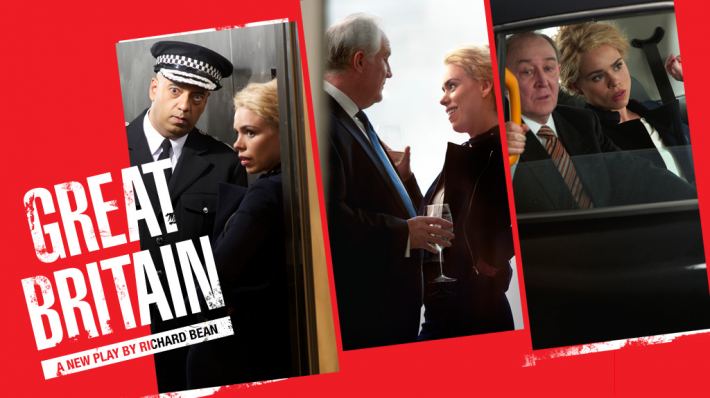
Richard Bean’s new play Great Britain, currently showing at the National Theatre, could be seen as the first artistic response to the phone-hacking scandal and the fallout from it.
It was reportedly developed and auditioned under wraps as the hacking trial was under way at the Old Bailey, and opened shortly after Andy Coulson was found guilty and Rebekah Brooks acquitted.
But there is more to this than just phone hacking. As the title suggests, Great Britain sets out to be a state-of-the-nation address, examining the interconnections and relations between the press, police and politicians. It is the Leveson Inquiry on stage (as if the Leveson Inquiry were not theatrical enough). And as with the Leveson Inquiry, it is the press who come out worst. The police are incompetent, the politicians are pathetic, but the journalists are venal.
The plot centres on Paige Britain (geddit??!!??) a young news editor on a tabloid called the Free Press (geddit??!!??), who discovers how to hack phones and hence supplies her paper with a series of scoops.
Britain, played by Billie Piper, at first seems sort of composite of Rebekah Brooks and Andy Coulson. Except she’s not, because a Brooks character is introduced into the plot and kept entirely ignorant of Britain’s voicemail shenanigans (Brooks was, after all, found innocent of conspiracy to hack phones).
Robert Glenister plays Free Press editor Wilson Tikkel, who may be Andy Coulson or may be Kelvin Mackenzie. Tikkel is the classic tabloid geezer of the popular imagination, and by classic I mean archaic. He swears and cajoles and judges stories at morning conference on whether they give him a “hard-on” or not (though this does lead to one of the play’s funnier lines — “no one ever got a hard on from assonance”). Though Private Eye likes to remind readers of Daily Mail editor Paul Dacre’s frequent “Vagina Monologues,” the stereotype still feels worn.
Then there is a driven Irish proprietor who made his money from advertising the, er, adult industry and has his eye on the broadcast market.
The play is riddled with these portmanteau characters and scenarios. A thick Lancashire cricketer is framed as an adulterer after Free Press reporters misinterpret a message left on his phone suggesting he had slept with a person who was not his partner, which turned out to be thanks for support at a funeral. This scenario was in fact what happened to Gordon Taylor, head of the Professional Footballers’ Association. There is also a rough assemblage of several child murder stories and anti-paedophile campaigns.
This might not seem important – after all, it’s not one of those David Hare verbatim plays, but it becomes troubling when stories and scenarios are thrown together to create a broad mush of bad stuff. The satire feels too broad, too generalised. Just as Leveson expanded from being a “hacking inquiry” to an investigation of every single aspect of the press, so Great Britain chucks everything in together. And as with Leveson, the whole press is punished for the crimes of a few.
Meanwhile, in its attempt to parody the cynicism of the tabloid world, Great Britain becomes quite nasty itself. There’s a thin line between mocking un-PC attitudes and actually laughing along with them, and Great Britain gallumphs across it carelessly. A gay half-Welsh, half-Chinese police officer is called Bryn Wong. Hilarious apparently. The security guard at the newspaper is Lithuanian. Got to be a gag in that. A black police officer is called Sergeant Ojo; the audience sniggers, and then properly guffaws when his superior calls him a “daft African twat”. The Irish character is, inevitably, a former IRA terrorist.
And then there’s the misogyny: major female characters are inevitably scheming, using their, er, feminine charms to get what they want. In one particularly nasty joke, Piper explains the origin of the term “Brazilian” for pubic hair pruning, before going on to wink that if she named her newly-trimmed area after where she went to get the trimming done, her underwear-area would be known as the Isle of Dogs.
That’s the level Great Britain operates at. Unsubtle and unpretty. At the start of the second act, Piper emerges dressed in Margaret Thatcher blue, complete with handbag, and delivers a clunky lecture on how things really work in the corridors of power. At the end, we get another lecture, “provocatively” pointing out the apparent complicity of the audience in the Free Press’s crimes, and in doing so equating the expenses expose with phone hacking (both being founded in illegality) and effectively showing utter contempt for the idea of public interest.
But the archaicness of it all is simply a reflection of the way the entire true story, from initial phone-hacking allegations to the government’s Royal Charter on press regulation, proceeded.
A criminal problem became a political issue; actions at one newspaper became the fault of the whole press; and ultimately, the issue became about the wars that started in the mid 80s, when Thatcher and Rupert Murdoch took on the miners and the printers, events long predating the hacking scandal that first broke in the mid-2000s.
The arguments are from the 80s, the jokes are from the 80s. There is barely a nod to the press and the web of today, apart from the aping of the autotuned “Leveson The Musical” video everyone loved in 2012.
In spite of the relative recency of the Leveson Inquiry and the hacking trial, Great Britain largely fails to address the present and the future. It contributes little apart from cheap laughs to the ongoing discussions on how our media should run itself, or be run by others. But this playwright Bean is not operating in a vacuum. Perhaps we’ll get the play about the press we need when we get the debate about the press we need. Much of that debate so far, much like Great Britain, has been rushed, crude, and played to stereotype.
This article was posted on July 17, 2014 at indexoncensorship.org