14 Jan 2013 | Uncategorized
On 10 January, three Pakistani media professionals were killed in a suicide bomb blast in Quetta. Imran Shaikh, Saif ur Rehman and Mohammad Iqbal were killed by the attacks against the Hazara Shia community whilst reporting on an explosion which had took place a few minutes earlier. Militant group Lashkar-e-Jhangvi are said to be responsible for the attacks, after a suicide bomber blew himself up, followed by his car detonating remotely. Police and emergency workers were also killed and three further media workers have been injured. Satellite vans for a number of TV networks have also been damaged.
A freelance journalist has been kept in custody in Somalia since Thursday (10 January), for interviewing a woman who alleged she was raped by Somalian authorities. Abdiaziz Abdinuur, who has reported for publications such as The Telegraph, is being held in Mogadishu after he was arrested for his January 6 interview, in which a woman claimed she was raped by several government soldiers in a camp for displaced women in December. No warrant for arrest was issued, and charges have yet to be made. Police arrested the alleged victim on Thursday, but have released her until further questioning.

Abdiaziz Abdinuur’s interviewee said she was raped by government soldiers
A Gambian journalist arrested on 7 January has been released on Bail. Abdoulie John, editor of news website Jollof News, was released from the National Intelligence Agency headquarters in Banjul on 10 January but must return today (14 January). Security agents screened his laptop, phone and emails in connection with his reporting for Jollof News, a banned website critical of the government in Gambia. John has allegedly been harassed by authorities since early December.
Turkey has attempted to censor John Steinbeck’s Of Mice and Men, deeming it “immoral” for a reference made to brothels. A group of teachers in the western city of Izmir asked their ministry for sections of the book to be censored, which has been on the education ministry’s list of recommended literature for decades. A parent in Istanbul also complained that My Sweet Orange Tree by José Mauro de Vasconcelos was obscene, calling for the teacher who issued the book to be investigated. On 9 January, Education Minister Omer Celik denied the book would be censored, but critics remain sceptical.
The US porn industry is using the free speech defence to protect against new Californian law Measure B, which requires performers to wear condoms during scenes. On 11 January Vivid Entertainment, one of the biggest pornography producers in America, filed a lawsuit against Los Angeles County over the referendum passed in November 2012. Vivid claims the law violates their 1st amendment rights, preventing them from recreating historically accurate scenes – a swashbuckling adventure, for example. It is estimated that since 2004, 350,000 scenes have been shot without a condom, with not one case of HIV being transmitted by performers.
8 Jan 2013 | Awards
Hillsborough Family Support Group: UK lobbying group
 For more than 20 years, the Hillsborough Family Support Group lobbied the UK government for a second investigation into the Hillsborough disaster, the human crush at the Sheffield Wednesday stadium, which claimed 96 lives in 1989.
The group, set up by families who had lost loved ones in the disaster, worked tirelessly to keep the case open and to make public information that had been suppressed by the authorities following the disaster. This included the alteration of 164 police statements, 116 of them to delete or change reports, as police sought to shift the blame on to the victims. Their years of effort won the group an Amnesty ‘Long Walk’ award.
Families were integral to a process that focused on finding and publishing documents, rather than a judicial inquiry-style cross-examination of witnesses.
James Jones, the Anglican bishop of Liverpool, who chaired an independent investigation panel into the case, told the Financial Times: “The documents speak for themselves.”
Their work has promoted freedom of expression in the UK by challenging the police cover up and persevering in their campaign for the truth behind the disaster. Following the publication of the independent panel’s report in September 2012, the HFSG has called for fresh inquests to be held and for criminal prosecutions to be brought against those responsible both for the deaths and for perverting the course of justice.
As a result of their combined efforts, the Independent Police Complaints Commission has launched an investigation into police action following the disaster. In December, a high court accepted the attorney general’s application to quash the verdict of a disputed 1990 enquiry, opening the way for new inquests to take place.
Malala Yousafzai, Pakistani education campaigner
 15 year old Pakistani schoolgirl Malala Yousafzai has received global attention for her courage in standing up to the Taliban and her defence of girls’ education. Yousafzai first came to attention when, at the age of 11, she wrote a pseudonymous diary for BBC Urdu, describing the Taliban’s closure of her school in the city of Mingora.
The closure followed the destruction of more than 100 schools in the district. Later in 2009, a journalist and filmmaker from the New York Times made a film about Yousafzai and her struggle to keep up her education. The same year, she began to make public appearances including on television, to advocate for girls’ education.
In October 2012, a Taliban gunman shot Yousafzai in the head and chest for her activism, as she was returning home from school in Pakistan’s Swat district. After receiving life-saving surgery in Pakistan, she was flown to a Birmingham hospital for specialist medical care. She was released in January but will return to undergo cranial reconstruction surgery.
Yousafzai’s rise in prominence has been rapid. In 2011, she chaired a session of the Unicef-supported Child Assembly in Pakistan’s Swat district, was nominated for the International Children’s Peace Prize by Bishop Desmond Tutu and won Pakistan’s National Youth Peace Prize. Following the attempt on her life, in November 2012, more than 60,000 people called for her to be awarded the Nobel peace prize.
In 2012, Yousafzai was named by Foreign Policy magazine on its 2012 list of top global thinkers and nominated for Time magazine’s Person of the Year.
Ales Bialiatski, Belarusian human rights defender
 Ales Bialiatski is a prominent human rights defender in Belarus. As chairman of the Viasna Human Rights Centre and vice president of the International Federation for Human Rights, he dedicated his life to helping victims of human rights until his imprisonment in August 2011. Bialiatski was sentenced to four and a half years for alleged tax evasion.
A defender of freedom of expression and human rights since Soviet days, when he led efforts to memorialise Belarusian victims of Stalin’s purges, Bialiatski founded the human rights NGO Viasna in Minsk in 1996 to provide financial and legal aid to prisoners of conscience and their families.
The vice president of the International Federation for Human Rights, his work was honoured internationally several times before his arrest. Bialiatski was jailed for using money in personal bank accounts in Lithuania and Poland to support Viasna’s human rights work in Belarus. The organisation was unable to register in Belarus, and therefore unable to open a bank account there.
The Minsk authorities claimed he had been tried and jailed lawfully. In December 2012 a UN Working Group rejected this position and ruled that Bialiatski was in fact being arbitrarily detained by the government in contravention of UN Human Rights conventions and that he should be immediately released and awarded compensation.
Bialiatski’s arrest was part of an on-going crackdown against critics of President Alexander Lukashenko, known as Europe’s last dictator. Following his disputed re-election in December 2010, seven opposition candidates were arrested.
Meanwhile freedom of expression continues to be severely restricted in Belarus. Lukashenko’s regime has passed several laws to muzzle critics, including one to ban silent protests and even clapping in the streets.
Girifna, Sudanese youth movement
 Girifna, a Sudanese youth movement calling for non-violent resistance, has been taking the country by storm. The group, whose name comes from the Arabic for “We are fed up”, was set up by university students in October 2009 to encourage their peers to vote in the 2010 election.
Combining demands for freedom of association with monitoring and information campaigns, members distribute information about human rights violations and organise peaceful protests.
Girifna stands apart not just because of the age of its members but also its ethnic diversity.
Though women’s voices are widely suppressed in Sudan, they play an important role in Girifina’s campaign and information work. In July 2012, mothers, daughters and sisters marched alongside each other as part of the Kandake Protest (the Protest of Strong Women). As well as traditional methods of campaigning such as leafleting and organising youth forums on issues of social justice, Girifna uses the power of the internet to spread its message.
One of the group’s most successful campaigns involved posting the testimony of a woman who was kidnapped and gang-raped by members of the security forces on YouTube – an unprecedented move in a country where speaking out about rape is considered shameful. But Girifna’s actions have not been without repercussions. Around 2,000 people were arrested following the June protests with detainees held incommunicado and without access to lawyers. Many members of the group have been arrested, detained, tortured and sexually assaulted.
Girifna has been targeted by the Sudanese authorities following a wave of demonstrations that began in June 2012. Several members of Girifna have been detained without being able to speak to their families or lawyers. Some say they were tortured in detention. Despite this attempt to silence them, Girifna continue to distribute information and organise activities, including peaceful protests calling for the respect and protection of human rights in Sudan.
7 Jan 2013 | Asia and Pacific, China
A propaganda chief has caused widespread outrage by censoring a Chinese newspaper’s New Year editorial. Southern Weekly, one of the most daring media outlets in the country, has fought back and attracted the support of netizens as well as ordinary folk, who protested today [7 January], calling for press freedom.
The Guangdong Provincial Propaganda Chief, Tuo Zhen, is said to have changed the heading and content of a 2013 new year editorial originally written by Southern Weekly editors. “China’s Dream is a Dream of Constitution” became “We Are Closer to Our Dream Than Ever Before.” No Southern Weekly editor knew until they saw the print edition.
Indignant, Chinese bloggers started discussing this as early as 2 January. In the next few days, noted figures were calling for Tuo’s resignation. Among them was Zhang Yihe, the writer whose memoirs have been banned on the mainland.
Today, after a night of criticisms of microblog platform Sina Weibo’s censoring of Southern Weekly journalists’ accounts — many of whom have either staged a walk out or spoken out — ordinary people in Guangzhou gathered and protested at the headquarters of Southern Weekly.
Wen Yunchao, a rights activist has collected over 100 photos of the protest on Google+. Most people held signs in support of Southern Weekly and in defiance of Tuo Zhen.

Photo of protesters outside the Southern Weekly office by Husker on Sina Weibo
Netizens were also also outraged by a leaked microblog by the journalist Wu Wei, who wrote that he was forced to hand over the password to the Southern Weekly Sina microblog account to the editor-in-chief of the newspaper, Huang Can. Under guidance, a statement was then tweeted from the account, alleging that the New Year’s greeting was “drafted by personnel at Southern Weekly,” extending its apologies to readers for the errors on the front page that were committed due to “lack of time and negligence.”
This caused an uproar, not least because the errors were obviously caused by the propaganda chief, who slotted in his own comments, writing what he wanted without having it checked by news editors. Tuo Zhen is accused of deliberately condensing 2012 as he saw fit, for toeing the Party line, and putting a controversial passage on the front page the prestigious newspaper. The passage began:
Great Yu Controls the Flood, a story from two thousand years ago, taught us the Chinese people’s dream of peace, prosperity, and happiness, fought for through uniting in strength and indomitability.
Not only is this contrary to the message of the original Southern Weekly piece — asking for a “constitution realised and power effectively checked” — but there were two basic mistakes in the opening sentence: One was a wrong character — akin to a typo in English — used for the phrase “uniting in strength”; the other was that Great Yu controlled the flood four thousand years ago, not two.
Dozens of ex-Southern Weekly interns sent out an open letter condemning these mistakes. It was soon deleted by microblog censors. Other journalists at the paper have also commented on how angry they were at these mistakes.
They also rallied at the inside editorial, slashed and re-written without permission from editors.
Wang Xiaoshan, a noted journalist, wrote about holding a vigil for the many Southern Weekly journalists who are facing retribution for their outspoken defiance, with their jobs on the line.
In an open letter from 5 January, Southern Weekly staff wrote:
What happened three days ago was only a trigger. An incomplete calculation has showed that in 2012 Southern Weekly had 1,034 articles changed or killed. In the last year, the newspaper has suffered through unmatched censoring, killing off of articles or even whole pages.
We’re not afraid to offend because we think this concerns the fundamental position of the news media. And because it’s so fundamental, we must be plainspoken. We’re not acting as a result of holding a grudge, but due to the sense of dignity, responsibility, and feeling of achievement that one person should accord another.
Meanwhile, on 4 January Foreign Ministry spokeswoman Hua Chunying said during a weekly press conference:
There is no such thing as so-called media censorship in China. The Chinese government protects press freedom according to the law, and enables full supervision of opinion in the media and of its citizens.
4 Jan 2013 | Middle East and North Africa, Tunisia
Free speech in Tunisia will continue to remain in jeopardy as a new year kicks off.
During the next few months, the National Constituent Assembly (NCA) is scheduled to adopt Tunisia’s new constitution. Last December, the NCA published a second draft constitution which guarantees the right to free speech and prohibits prior censorship. Yet a vague and repressive legal framework created by former President Zeine el-Abidin Ben Ali to silence dissident voices is still in place, and free speech advocates remain concerned over Islamist vows to criminalise blasphemy.
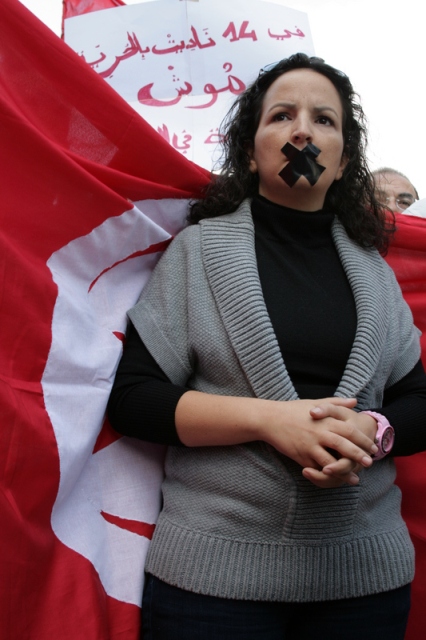
A woman protests against censorship, Tunis, October 2011. Wahida Sannene | Demotix
Although Ben Ali’s autocratic rule ended almost two years ago, his legacy remains on the books. Ben Ali-era laws represent a serious threat to free speech. Last year, the public prosecutor’s office used Article 121 (3) of the Tunisian Penal Code to take legal actions against Nessma TV boss Nabil Karoui over the broadcast of the animated film Persepolis and a newspaper director for publishing a nude photo. The article prohibits the distribution of publications “liable to cause harm to the public order or public morals”. As 2012 ended without any serious political will to amend or abolish this article and other anti-free speech laws, journalists, bloggers and artists risk facing more “public disorder” and “morality” charges.
Media executives and journalists’ unions expect that 2013 will bring an end to the legal void that characterises the audio-visual media landscape through the putting into effect decree-law 116, dated 2 November 2011. Implementing this decree would establish an independent body tasked with organising the audio-visual media landscape in a “pluralistic, democratic and transparent manner”.
Over the last year, street attacks on free speech in the name of religion increased dramatically. This trend is expected to continue in 2013, given a staggering level of impunity. Tunisia’s current government has always expressed its condemnation of violence and its commitment to guaranteeing free speech. Yet, every time free expression comes under attack, officials turn a blind eye to the perpetrators and blame the victims. When ultraconservative protesters attacked the Spring of Arts fair last June, the Minister of Culture rushed to blame the artists for attacking Tunisians’ sacred religious symbols and vowed to take legal action against the fair’s organisers.
Last August, the ruling Islamist Ennahdha Movement, which controls 40 per cent of parliamentary seats, vowed to “legally protect the sacred” and filed a blasphemy bill. The party has already agreed to drop an anti-blasphemy clause from the new constitution after negotiations with the other two parties in the ruling coalition, the Congress for the Republic and the Democratic Forum for Work and Liberties. Will the Islamists also abandon their plans to criminalise blasphemy?
