7 Dec 2012 | Turkey
In Turkey, television drama is big business. A handful of big-budget productions attract millions of viewers every week, both at home and abroad. According to Abdullah Çelik, the head of property rights department in the culture ministry, more than 65 million dollars were received from foreign television companies in acquisitions of TV dramas, with more than ten thousand hours of screen time exported overseas. Such costly, and bankable, television productions thrived over the last decade, partly thanks to the entrepreneurial spirit that came with the governing AK Party’s policies of economic liberalisation.
But according to Turkish prime minister and leader of the AK Party, Recep Tayyip Erdoğan, the industry’s success story has a sinister undercurrent that needs looking into. Erdoğan believes that one particular show is toying with the national values of Turkey’s Ottoman past. “We alerted the authorities on this and we are waiting for the judicial decision on it,” he said during a public speech last month. “Those who toy with these values should be taught a lesson within the premises of law.”

Erdogan was referencing The Magnificent Century, a show that is currently the biggest production television drama in Turkey. The latest season of the series had a production budget of over three million liras with an all-star cast featuring some of Turkey’s most famous actors. Last month, the Turkish edition of GQ magazine honoured the show’s producer and two of its leading actors in its Men of the Year event.
The Magnificent Century, which first aired in January 2011, has long been subject to controversy and Erdogan’s pointed comments about its “false depiction” of the private lives of Ottoman rulers was but the latest, and probably the most high-profile, example of complaints about the show. Every episode of the drama series narrates another chapter in the life of Suleiman the Magnificent, the longest reigning sultan and caliph of the Ottoman Empire, acknowledged by historians as one of its most successful rulers.
Although many people I talked to about the issue seemed to share Erdoğan’s complaints about the show’s historical inaccuracies, none of them agreed with the idea of taking any form of legal action against it. In fact, even the descendants of the Ottoman empire are against such a move. In an interview with Vatan newspaper, Prince Şehzade Orhan Osmanoğlu, a descendant of the last Ottoman sultan Abdul Hamid II, said their family wouldn’t take legal action against the programme because it was not “a documentary but a work of fiction.” However Osmanoğlu added that his family was very disturbed by scenes which depict the harem, resulting in some of the juiciest moments of the show. Osmanoğlu said they would go to court if his ancestors were portrayed as figures involved in immoral acts, including having extra-marital affairs and fathering illegitimate children.
The centerpiece of Erdoğan’s complaint was that while most of Suleiman’s life had been spent on horseback and in battle fields, the show had continually depicted him in the middle of sexual intrigues taking place in the harem. When I asked Sonat Bahar, who writes a weekly column on Turkish television series for the popular Sabah newspaper, about her take on the issue she said production conditions of the show might be dictating this choice.
“Shooting battle scenes is costly, that’s why they can’t do it,” she said. “The real problem is the discrepancy between the show’s title which claims portraying magnificence and the limited view of the emperor’s life presented to us. I would rather they named the show Roxelana.” Roxelana, Hürrem Sultan’s name before she married Suleiman, is widely agreed to be the central figure in the series, and it is her charming and often times deceitful depiction that draw many to their television sets.
Although critics and historians acknowledge problems with the show’s historical approach, more worrying is the preparation of a new bill presented to the parliament last week, introducing fines for television producers who “misrepresent” historical figures.
“This show begins with a disclaimer that says its characters were ‘inspired’ by historical figures,” a popular television blogger who writes under the pseudonym Ranini told me. She said such bills, if they become law, would ignore the fact that those series were, after all, intended as entertainment. “If people really want to learn about real lives of Ottoman rulers, then they should read books, instead of watching these soap operas,” she said.
This is a point shared by Ümit Ünal, one of Turkey’s most successful film directors and scriptwriters. “This is just a harmless soap opera, nothing more,” he said. “Like many television series, it intermingles a set of complex love affairs with a faux-historical decor. It is a highly commercial work. I can understand why prime minister is angry about it but I am also at a loss to understand the new standards of censorship in this country.”
According to Ünal, all Turkish artists are born with the knowledge that their works will be subject to political restrictions, which leads to the graver problem of self-censorship. “If a Turkish artist comes to tell you he doesn’t apply self-censorship in his work, then he is lying,” he said. “When the field of artistic freedoms get even smaller, how can we, as storytellers, produce works without being subject to the wrath of politicians afterwards?”
Kaya Genç is a journalist and novelist
3 Dec 2012 | Digital Freedom, News, Volume 41.04 Winter 2012

It’s late January 2012. Governments all over the world are considering signing up to a new US-led trade proposal intended to curtail copyright violation, the Anti-Copyright Trade Agreement (ACTA). There have been widespread protests, on and offline: the loose-knit collective of activists, hackers and internet denizens of all stripes known as ‘Anonymous’ believe ACTA represents an attempt by governments to limit and control the core freedoms of the internet, in particular the massive cultural exchange of ideas and information made possible by file-sharing online.
In Poland, the agreement has already been signed off; all that is needed for it to be adopted into law is a majority vote in parliament. The government website is offline, taken down by a distributed denial of service (DDoS) attack launched by Anonymous, which sends a message to politicians who are considering voting in favour. By the final week of January, over 10,000 people gather in Krakow in a last-ditch protest to influence the vote.
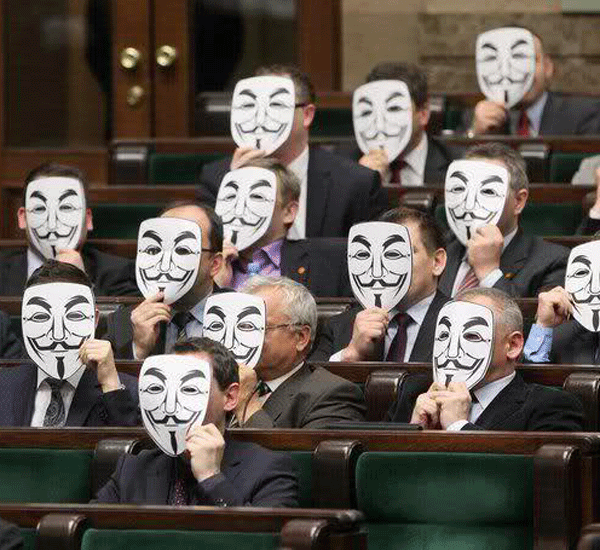
Members of the Palikot Movement Party protest against the ratification of the Anti-Counterfeiting Trade Agreement
And then something unexpected happens: on 26 January 2012, while casting their votes in parliament, some members of the Polish government conceal their faces with paper Guy Fawkes masks. The mask, by now the signature icon for Anonymous, has become common protest regalia among rabble-rousers across the globe, from Egypt’s Tahrir Square to London’s Occupy protests. But this is the first case of public servants adopting the symbol. The image is circulated far and wide on social media platforms. Although Polish politicians used it to launch a specific protest against ACTA, the gesture and its photographic memorialisation worked in a much broader capacity to legitimate Anonymous. ‘These parliamentarians were wearing Anonymous Guy Fawkes masks,’ one Anonymous activist blogged, ‘while the parliament’s website was down due to DDoS by Anonymous. We can’t emphasise that point enough – this is a game-changer.’
Less than a month later a very different image of Anonymous was circulated. On 21 February 2012, the Wall Street Journal reported that General Keith Alexander, the director of the United States National Security Agency (NSA), had briefed officials at the White House in secret meetings, claiming Anonymous ‘could have the ability within the next year or two to bring about a limited power outage through a cyberattack’. So only weeks after the ‘game changer’, the group was described as an imminent and credible threat.
The ‘ability’ to bring about a power outage was undefined. Could it mean that hackers had already acquired passwords that would give them access to power facilities? Or was the warning based on information supplied by an informant who had been working with Anonymous? Either way, General Alexander’s claims were frightening and bold, as well as vague. An attack on the power grid systems would cause havoc and potentially even threaten lives.
It is unlikely that we will ever find out whether the NSA assessment was based on credible intelligence or whether it was simply meant to smear and discredit Anonymous. Further news reports quoted activists and security experts and dismissed NSA claims as ‘fear-mongering’. The group, for all its varied tactics, both legal and illegal, has to date never been known to publicly call for such an attack – and there is no evidence to suggest that it would so much as consider it. A tactic like this would be very out of character for the collective, which, though often subversive, generally conforms to ethical norms and defends civil liberties.
While Anonymous has never occupied a controversy-free place on the world stage, by February 2012 it began to be portrayed as an open source brand of radical protest politics and not necessarily as hooligans hell-bent on unleashing extremist, chaotic acts like taking down power grids. More significantly, while the name has been used to pull together a range of unrelated causes, from environmental rights to snuffing out paedophilia rings, Anonymous activists are most effective and forceful when fighting censorship.
With campaigns like Operation Payback, which targeted corporations like MasterCard when it stopped providing services to WikiLeaks, OpTunisia, which responded to Tunisian government tactics against protesters and journalists, and OpJapan and OpMegaupload, launched in response to proposed copyright legislation, it is when Anonymous activists defend the internet’s core freedoms and expose the shadowy workings of state and corporate surveillance that it has the most impact. The NSA news story about the exigent threat from Anonymous failed to gain traction in the public consciousness. Perhaps it would have if it had come earlier, for instance between May and July 2011, at the height of attacks led by Lulzsec.
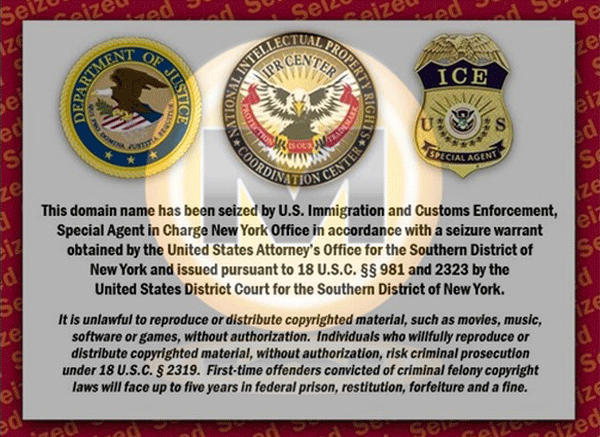
Anonymous launched Operation Megaupload
In contrast to most Anonymous actions, Lulzsec, a break-away hacker group, acted whimsically, its hacks not always tethered to a political issue. Lulzsec sometimes hacked to make a political statement and, in other instances, for lulz, internet slang for laughs. During this period, media attention, which was colossal, was most heavily focused on Anonymous as hackers rather than as a general protest group. Activities under the Anonymous banner, such as those of Lulzsec, show that even though Anonymous has gained a measure of respect because it champions free speech and privacy causes, it is also notorious for its irreverent and controversial approach to dissent.
To be sure, most of its activities are legal, but a small subset of tactics – such as DDoS attacks and hacking – are illegal, a criminal offence under all circumstances. These tactics also score the most headlines. Some, like ‘doxing’ (the leaking of personal, sensitive information, such as social security numbers and home addresses), reside in a legal grey zone because mined information is found on publicly accessible websites. During the course of a single operation different participants might deploy all three modes – legal, illegal and legally grey tactics.
Take Operation Bart, in August 2011. Anonymous focused on getting the word out when San Francisco Bay Area Rapid Transit (BART) officials disabled mobile phone reception on station platforms to thwart planned anti-police brutality protests. Soon after, Anonymous helped organise street demonstrations. But a couple of individuals also hacked into BART’s computers and released customer data in order to garner media attention – at least that’s how one participant explained the incident to Amy Goodman on television and radio programme Democracy Now. Someone also found a racy, semi-nude photo of BART’s official spokesperson Linton Johnson on his personal website, which was then republished on the ‘bartlulz’ website with considerable fanfare, along with the brazen rationalisation: ‘if you are going to be a dick to the public, then I’m sure you don’t mind showing your dick to the public.’
During the course of an operation, vulnerability and weakness is often identified and exploited. These sorts of actions provoke controversy (even within Anonymous) and also find their way into headlines, boosting the group’s public profile. At times, members of the loose collective are purposely deceitful and propagate false information about their activities. This can be a tactic for self-protection in some cases, and in other cases an antic to coax headlines out of the media, which can be somewhat enamoured with hacking.
Antisec, one of the more well-known hacker groups affiliated with Anonymous, might claim an exploit without having actually been involved in the activity. Hackers will often rely on botnets – networks of compromised computers – to momentarily knock a website offline, but won’t advertise this fact in press releases. Between 10 and 11 September 2012, for instance, Antisec claimed to have procured 12 million unique device identification numbers from Apple iOS devices by hacking into an FBI agent’s laptop computer. As it turns out, while the identification numbers were verified, the source turned out to be an iPhone and iPad app developer, Blue Toad. Because tactics range from the frivolous to the controversial to the illegal and because it has been known to generate hype around its own activities, it can be easily targeted itself. Obfuscation and deceit contributes to Anonymous’s mystique and its power, but also makes it vulnerable to misinformation campaigns spread by others.
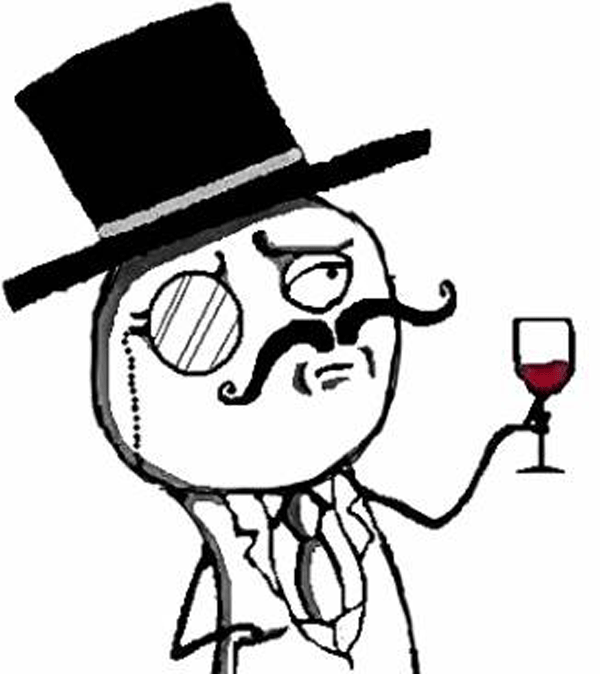
Antisec – One of the more well-known hacker groups affiliated with Anonymous
The biggest lesson that can be learned from Anonymous is that the internet will judge – often quite swiftly – the actions of individuals, corporations and governments. And by the internet I mean the countless hackers and geeks from São Paulo to Sydney who understand how the web works, a smaller class who know how to subvert routers and protocols, and a larger number who will rally when the internet and values associated with it are in danger.
This is not to say that every geek and hacker supports Anonymous. In fact, many rather dislike it or its controversial tactics, such as DDoS; some hackers are resolute and unyielding in their view that DDoS is a species of censorship in itself. There are also many different ways to defend the internet, such as writing open source software or joining the Pirate Party. Anonymous is a distinct, emerging part of this diverse and burgeoning political landscape. Its real threat may lie not so much in its ability to organise cyberattacks but in the way it has become a beacon, a unified front against censorship and surveillance.
It might be best thought of as the irascible and provocative protest wing of the internet’s nascent free speech and privacy movement. Though it works to publicise specific issues at the most inconvenient time for the individual, group or company being exposed, it also brings into sharp focus an important trend, dramatising the value of privacy and anonymity in an era where both are rapidly eroding.
Anonymous, of course, champions anonymity, and this is echoed in both the iconography associated with it and its ethical codes. Seeking individual recognition and especially fame is taboo, for example; you are expected to do work for the team, not for one’s own personal benefit or status. The movement, therefore, provides a rare countermeasure in deeds, words and symbols against a world that encourages people to reveal their lives, where the internet remembers everything about us, where our histories are permanently stored in search indexes and government databases – and at a time when governments’ ability to surveil its citizens has grown exponentially thanks to low-cost, ubiquitous digital technologies and new public-private partnerships.
However explosive Anonymous is today, its continued presence on the world stage is certainly not guaranteed to last. It is plagued by infighting, fragmentation, as well as brand fatigue. Paranoia exploded in spring 2012 after the news broke that Hector Xavier Monsegur, known more commonly by his hacker handle ‘Sabu’, had been exposed as an FBI informant. Most troubling for its long-term survival is government crackdown: since summer 2011, over 100 alleged participants have been arrested around the globe, from Romania, Turkey, Italy, the UK, the US, Chile and Germany. But even if the loose-knit collective fades away, irreverent political protest on the internet is unlikely to end.
Since 2008, when individuals started to organise diverse collective actions under the banner of Anonymous, a living model was created, demonstrating to the world what a radical politics of dissent on the internet looks like. Even if Anonymous was to vanish, its history, exploits and propaganda material are here to stay; there will likely be others — in different forms and with distinct twists — who will take its place.
What is a little less clear is what will eventually become of freedom of expression online, given the increasing capabilities for surveillance, censorship and control all over the world. Is Anonymous merely the party at the funeral of online freedom? Or does it represent the irreverent clowns, rabble rousers, and tricksters who are keeping the reaper at bay and enabling others, from protesters on the street to elected representatives in parliament, to join the raucous political carnival and challenge threats to personal privacy and freedom?
Gabriella Coleman is Wolfe Chair in Scientific and Technological Literacy at the Department of Art History and Communication Studies at McGill University. She tweets from @BiellaColeman
21 Nov 2012 | Egypt, Middle East and North Africa
The ideological battle for Egypt’s soul has intensified in recent weeks. Rising tensions threaten to polarise a country wracked by deep divisions over the role Islam will play in the “new” Egypt. Many of the revolutionary activists who participated in the January 2011 mass uprising envisioned the new Egypt as a secular, civil state. These hopes were dashed by Islamist victories in the post-revolution parliamentary and presidential elections. Islamists won about two-thirds of 508 seats in the parliamentary election at the end of last year — the Muslim Brotherhood won 38 per cent of seats, and the Salafist Al Nour party secured 29 per cent. As an Islamist-dominated assembly debates the country’s new constitution — a charter that will shape Egypt’s future — liberals fear that Egypt may evolve into an Iranian-style theocracy.

— Egyptian Salafists filled Tahrir Square earlier this month to demand that Sharia law be enshrined in the country’s constitution (Demotix)
Thousands of protesters filled Tahrir Square on 8 November to demand that Islamic Sharia law be enshrined in Egypt’s new constitution. Sharia has been the subject of heated debate among members of the panel engaged in drafting the constitution. Liberals favour preserving the wording of the 1971 Constitution which states that “the principles of Sharia are the basis of all legislation”. Hardline Islamists are demanding the wording be changed to declare that “the rulings of Sharia” law serve as the source of legislation. This more stringent interpretation of Islamic law would include implementing Hudood laws — a set of punishments under Islam’s Penal Law that include punishing theft by cutting off a hand, stonings for adultery, and death for apostates (former Muslims who reject the faith).
The inflexibility of Islamist members on the Constituent Assembly over this issue led liberal rights activist Manal El Tibi to resign from the assembly in September.
As the 12 December deadline for the document approaches, thirty liberal members of the 100-member assembly have quit in protest, complaining that their voices were being ignored by Islamist members determined to use the constitution to turn Egypt into an Islamic state. Representatives from Egypt’s churches also withdrew from the panel on Saturday, rejecting the idea of a “religious state”.
Salafists have wrangled with liberal assembly members over other articles of the draft charter, namely those on the role of Islamic institution Al Azhar (Liberals want to establish the 1,000-year-old Sunni institution as the only authority allowed to interpret Sharia), on women’s rights, and civil and religious freedoms. Liberals are concerned that a strict interpretation of Sharia may usher in restrictive policies for women, such as the imposition of an Islamic dress code, and forced segregation between men and women in public.

— Egyptian woman in Tahrir Square carries sign saying “our rights, now” during marches for women’s rights in Cairo’s Tahrir Square last year (Demotix)
Liberals hoped to eliminate all forms of gender-based discrimination in the new charter, but activist Ziad Ali says that the new charter “is a dismal compromise, which is no better than the previous (1971) constitution.” The draft constitution makes a patronising promise to “help women strike a balance between their family duties and their work in society”, — a pledge slammed by rights activists as “discriminatory” as it would make women second-class citizens.
While women’s rights have been the bone of contention in the constitutional debate, religious freedom too has been at the centre of the controversy. Article 8 on freedom of belief has been revised to read: “Freedom of belief is absolute and religious rights are to be practised if they do not disturb public order”. The added provision, “if they do not disturb public order”, has worried secularists who describe it as “restrictive”. The previous constitution simply stipulated that “the state shall guarantee the freedom of belief and the freedom of practice of religious rites”.
The draft constitution only recognises three religions — Islam, Christianity, and Judaism. According to Article 8, “The state shall ensure freedom to establish places of worship for adherents of Abrahamic religions in accordance with the law.” Adherents to non-Abrahamic faiths will be denied the right to build places of worship.

— Egyptian secularists rallied in Tahrir Square in October to protest against Islamist control of the country’s new constitution (Demotix)
Especially worrying are anti-blasphemy laws outlined in draft articles 40 and 38, which prohibit the “defamation of messengers and prophets”, without specifying what could be classed as “defamation”. The vague definition leaves room for wide interpretation of the law. The draft charter also does not outline what counts as “blasphemous”, making it unclear what would be punishable by law. “With no clear definitions, such laws may potentially threaten and restrict free speech”, complains Mona Makram Obeid, a liberal former MP.
While the draft constitution falls short in the realms of religious freedoms and women’s rights, it makes sizeable progress when it comes to press freedom. The draft includes draft articles safeguarding freedom of thought and expression — and if it is endorsed by a popular referendum next month — it would also protect the right of journalists to work freely through a ban on jail terms for publication offences. It would also allow for new media organisations to launch without restrictions.
While allowing more room for press freedom, the draft charter severely restricts freedoms in many realms, and its vague and ambiguous language opens the door to potentially harmful interpretations — making it a disappointment for some of the pro-reform activists who led last year’s protests in Tahrir Square.
“The Islamists have stolen the revolution. The new constitution is a far cry from the progressive, tolerant state that we had aspired to create”, says revolutionary activist Hazem Mahmoud, who works for the Ministry of Foreign Trade.
Whether or not the new Egypt with fit Mahmoud’s description, or become an Islamic state depends on who emerges as the stronger force in the constitutional battle: the ultra-conservative Islamists, or secular, liberal and pluralistic forces.
Journalist Shahira Amin resigned from her post as deputy head of state-run Nile TV in February 2011. Read why she resigned from the “propaganda machine” here.
7 Nov 2012 | Middle East and North Africa, Opinion
Bahrain is preparing for the first anniversary of the Bahrain Independent Commission for Inquiry (BICI) by placing even greater restrictions on free expression.

A Bahraini woman holds up the victory sign at a rally in May | Demotix
As violence escalates in the Gulf kingdom, the country’s government has taken new measures in the name of national security. According to an announcement made last night on the state-run Bahrain TV, the country’s government has decided to strip 31 activists of their citizenship for “being a threat to national security”. The list is mostly made up of political activists, including UK-based Saeed Shehabi and Ali Mushaima, who have been outspoken in criticising the country’s regime, and Al-Wefaq National Islamic Society member Jawad Fairouz, who was a member of parliament before resigning in protest of the country’s brutal response demonstrations that began on 14 February last year.
This is not a new tactic for Bahrain: The country also revoked the citizenship of outspoken activists in the 1980s and 1990s, forcing them into exile. The latest move, however, violates Article 17 of Bahrain’s 2002 constitution:
a. Bahraini nationality shall be determined by law. A person inherently enjoying his Bahraini nationality cannot be stripped of his nationality except in case of treason, and such other cases as prescribed by law.
b. It is prohibited to banish a citizen from Bahrain or prevent him from returning to it.
The decision comes after the tragic death of two migrant workers and the injury of another on 5 November following a bomb blast in Bahrain’s capital, Manama. While none of the 31 activists have been linked to the explosion, Bahrain continues to make efforts to portray the country’s uprising as violent.
Earlier this year, the attention around the hunger strike of imprisoned human rights activist Abdulhadi Alkhawaja and a brutal crackdown on protesters squashed Bahrain’s chances of whitewashing its public image with the Formula One race in April. After the BICI report was presented in November 2011, Bahrain’s government was determined to make the uprising history, but its unfulfilled pledges to reform came back to haunt it in the lead up to the race.
As Alkhawaja’s health deteriorated, the international community placed immense pressure on the Bahraini government to release him to Denmark, where he is also a citizen. Denmark granted Alkhawaja asylum in 1991, and the country’s government has been active in lobbying for his release. The activist moved back to Bahrain in 2001, and was jailed for his role in the country’s uprising in 2011. An editorial published in the Gulf Daily News in the race lead-up explored the “problem” of dual-citizens, claiming it was a “get out of jail free card” for criminals.
Bahrain’s failure to follow through on promised BICI-related reforms, as well as a disregard for its own constitution, signals a chilling next stage for the country. The country’s most recent violence is testament to Bahrain’s failure to diffuse unrest with reforms, rather than force.
Sara Yasin is an editorial assistant at Index on Censorship. She tweets at @missyasin