7 Jan 2022 | News, Opinion
Happy New Year!
At the start of every year, I have a renewed sense of hope – that maybe, just maybe this year will be different. That the news won’t be filled with egregious breaches of our human rights. That our leaders will embrace their responsibilities to their citizens and that the values outlined in the Universal Declaration of Human Rights will be the minimum standards adopted around the world, rather than an aspiration.
This naïve wish typically lasts until I turn the news on.
We are hardly one week into 2022 and already dozens of democratic protesters in Kazakhstan have been brutally murdered, thousands hurt and 3,000 people have been arrested for initially campaigning against the cost of fuel. Russian military forces have been deployed to put down the riots and an internet blackout implemented; Nigerian journalists have received suspended jail sentences for publishing reports of organised crime in Niger; In Sudan military efforts to stop democracy protesters have led to one fatality, numerous injuries and restrictions to the internet and communications systems.
Then there is Hong Kong. There a pro-democracy campaigner has been sentenced to 15 months in jail for trying to organise a vigil to commemorate the Tiananmen Square massacre and the pro-democracy website Citizen News has closed following the raid on StandNews at the end of last year. They fear a similar fate, and their closure represents another sign of the end of media freedom and plurality in Hong Kong.
Finally, images of the Capitol riots from a year ago are dominating the news, reminding us of when protest became criminal and deadly at one of the iconic centres of liberal democracy.
These stories are those of just the last week, the stories that have managed to break through our ongoing Covid horror.
The situation in totalitarian regimes from Afghanistan to Nicaragua, from Belarus to Kashmir and too many others remains grim. There are simply too many regimes that seek to exploit and suppress their populations.
Our role at Index is to make sure that the voices of the persecuted are heard. That every effort to silence them is countered and that every day they know that they are not alone, that there is support and solidarity with their plight.
Because we must never forget that behind each of the headlines is a person, a family, a story of a life lived and in too many cases a life threatened or taken.
The year 2022 marks the 50th anniversary of Index on Censorship magazine – 50 years of telling the stories of those who cannot tell their own stories. Fifty years of documenting attacks on free speech and free expression in every corner of the globe. In the coming months Index will be celebrating our birthday, but also commemorating those that we have lost in the fight for free speech during our history. We will telling some extraordinary stories – and we will need you to help us amplify them.
Happy New Year and I hope you and yours have a safe and happy 2022.
6 Jan 2022 | China, Hong Kong, News, United Kingdom, Volume 50.04 Winter 2021, Volume 50.04 Winter 2021 Extras
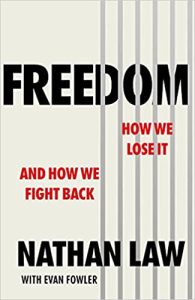
Nathan Law has been imprisoned, disqualified from political office and forced to seek political asylum in the UK – all for fighting for democratic rights in Hong Kong, his home city. But, in spite of it all, he remains optimistic.
“As an activist I’m not entitled to lose hope,” he tells Index on Censorship. “I still believe that maybe in a decade’s time I can set foot in Hong Kong, when it’s democratic and free.”
Law, 28, fled to London in the summer of 2020 after the passing of the National Security Law, a draconian piece of legislation that criminalises even a whisper of criticism against Beijing’s rule.
Given the chance, what would he tell Communist Party leaders in Beijing?
“I would say, ‘There is no totalitarian regime that can remain forever. All of them will collapse’, and I’d say, ‘That is your fate if you continue to do what you are doing’.”
Law’s face and name are synonymous with the struggles in Hong Kong. Alongside Joshua Wong, Alex Chow and Agnes Chow, he has helped drive the recent protest movement.
The son of a construction worker and a cleaner, he first became interested in democratic values at secondary school when the late writer and human rights defender Liu Xiaobo won the Nobel Peace Prize in 2010. Liu was serving his fourth prison sentence in China and was unable to accept the prize in person. An image of an empty chair soon went viral, a stark reminder of how bad human rights were in China.
“I grew up in a family that did not talk about politics, did not talk about social affairs,” Law says. Although he studied in a pro-Beijing school, he was “not heavily brainwashed to believe in the Communist Party”. He adds: “I was apolitical. I was not involved.” But when Liu won the prize, the principal of his school publicly denounced the writer in morning assembly.
“It triggered my curiosity because I thought people getting the Nobel Prize are the ones who are good in their field. So how come such a person – a Chinese [person] – would be criticised in that fashion? It really triggered my curiosity and got me to look into the work that he had been doing. He opened up a gate for me to understand all these concepts.”
That gate first led Law to the Tiananmen Square vigil, held in Hong Kong every year since 1989, and then to him leading the 2014 Umbrella Movement (which later landed him in prison on charges of “unlawful assembly”).
After this, Law became the youngest legislator in Hong Kong’s history, a position from which he was quickly disqualified when he modified his oath of allegiance to China during the swearing-in ceremony in October 2016.
In the same year, he founded Demosistō, a pro-democracy political party, with Agnes Chow and Wong.
But time was up when the National Security Law was passed. Demosistō was disbanded, Law was forced out of Hong Kong and Chow and Wong were jailed, alongside scores of others connected to the democracy movement.
Today, dissent is in a straitjacket in Hong Kong. And yet not all have given up fighting. In Law’s recently published book – Freedom: How We Lose It And How We Fight Back – he writes: “Even during this most bitter of times the spirit of ordinary Hong Kong people continues to shine, even if it must do so in the shadows.”
Law lists the people who refuse to have their prison sentences lessened by agreeing to the charges against them and instead “defend themselves in order to narrate their story at the risk of heavy sentencing”. He lists those who attend court hearings to show support to the defendants, those who write letters to the imprisoned and those who advocate for any policy that might remotely challenge the government.
“The hope lies in these people. Even though we are in the darkest time and change is seemingly impossible, people are still doing things because they feel that it is the right thing to do,” he says.
Law might have an admirable sense of hope, but his is not an easy life. He had to publicly sever ties with his family when he moved to the UK and has been unable to talk to Agnes Chow and Wong, too. He misses the people and he misses the place.
“I always dream about Hong Kong,” he says. “You’re familiar with everything. You don’t have to think. Like when you step into the MTR [the subway]. It’s in your muscles, in your memory. You understand everything. You understand all the slang. The background noise with people’s hectic walk, the hectic talk of Cantonese and bus horns, those noises from the stores and from restaurants. It’s just unique.”
Law has been granted asylum in the UK – a move that angered Beijing, which declared him a criminal suspect. Even though he is thousands of miles from Hong Kong, he still has to look over his shoulder. He takes extra precautions: he never mentions where he lives and he takes detours when he leaves and returns home – measures that have come to define the life of China’s dissidents. He simply doesn’t feel safe “because of how extensive China’s reach can be”.
“We’ve got cases like Navalny; the Russian dissident forced to land in Belarus; we’ve also got a lot of cases of Uyghur activists around the world being arrested or extradited back to China. There are a lot of things that can happen to dissidents. It is not a secret that I am almost at the top of the list of national enemies that China portrays, so things like this could happen,” he says.
“On the other hand, I don’t want any of these fears to hinder my activities and my activism. So I will try to be vigilant to protect myself, but I will also try 100% to promulgate the agenda of the Hong Kong democratic movement.”
One of the ways that he wants to do this is through publishing his book. A blend of personal experience and broader context, Law wants it to appeal to as many people as possible and for these people to “act after reading it”.
“I’m an author, of course, but at the end of the day my essential identity is an activist. By definition, an activist is someone who tries to empower people to act in order to precipitate social changes. I intend to appeal to people to be more aware of their own democratic states,” he says.
As for what we can do to help Hong Kong, Law puts it simply: “Get involved. Pay more attention to Hong Kong and to China. Start to look into campaigns that could help, like boycotting the Olympics, supporting political prisoners or even reading news – just supporting the news agencies who produce these fantastic stories for Hong Kong and for China.
“After that, if you really want to be a campaigner that supports Hong Kong then get organised. Find your local grassroots organisation and be a volunteer and try to explain that to your friends and your neighbours.”
It might be the darkest chapter in Hong Kong’s story, but – to channel Law’s optimism – let’s hope it’s not the last.
How I exposed Beijing’s big lie
Young activist Nathan Law’s election to the Legislative Council in 2016 shattered the myth that the people of Hong Kong did not desire freedom and democracy, he says in an extract from his new book
 In August 2016, a month before the election, our team were starting to worry. The polls suggested I had little support in the constituency I was running in. Hong Kong Island is a wealthy and generally conservative district, known for electing prominent members of Hong Kong’s professional and elite class – lawyers, public intellectuals and former government officials. To make things more difficult, my constituency happened to have the highest number of elderly residents. It was also an important ‘super seat’ that would return six places in the legislature by proportional representation, so fifteen parties had fielded candidates.
While we were hopeful, our expectations were low. I may have been a public figure, but I was known only as a student activist. Going straight from student activism to the first tier of Hong Kong politics was not easy. I had to adjust my mindset. I was no longer representing students like me, but having to appeal to and present myself as someone who could represent a much broader range of people. I needed to demonstrate that I had the ability to understand the complexity of realpolitik, and accommodate the diverse needs and views of constituents. I also had to convince people that I was able to represent them in the city’s highest chamber.
In the last two weeks of the election, I worked as hard as I could to outline my beliefs and analyse heated debates about policy. I wanted to prove that age, education and experience are not the deciding factors in what constitutes a proper lawmaker: determination, vision and eloquence are what matter most.
The 2016 election saw an unprecedented turnout: 2.2 million voters, 58 per cent of the registered electorate, cast their vote. Despite the constant hectoring of Beijing’s loyalists, the silent majority had spoken, and it was in favour of pro-democracy candidates. A new force had emerged in local politics, with new, progressive localist candidates winning six seats. And I won my seat, by a far greater margin than polls had suggested, to become Hong Kong’s youngest ever lawmaker.
I was so proud of what we had achieved. We had exercised our right to stand for election, and in voting for us the people of Hong Kong had exercised their right to elect representatives who shared their concerns. The legislature may have been designed to ensure a pro-establishment majority, making it more of a debating chamber than a true law-making body. But to be one of thirty-five directly elected legislators still mattered.
My election represented an expression of the limited political rights Hong Kong people enjoyed – an expression of our freedom. I had a democratic mandate and no one in government could claim otherwise. Even if all I could do was be one voice in the chamber, this voice would be heard throughout the city; and for so many people of my generation, and for all those who had voted for me, that mattered.
At twenty-three years of age, I was Hong Kong’s youngest legislator. Often, babies of the House, as the youngest parliamentarians are called in the UK, go on to have long careers in politics. Mine in Hong Kong would be one of the shortest.
Legislative Council members are elected to serve a four-year term. As my team moved into our new offices in the Legislative Council Complex, there was no reason to suppose we would not be there for at least that long. We did our best to make ourselves feel comfortable in room 901. As an activist I had met and worked with many legislators, but to be sitting in the Council building now as one of them felt different. I watched political aides come and go, and my staff hovering busily about, and could not help but wonder if I truly belonged there. Was this the right place for an activist? Could it accommodate us?
Well-known democratic lawmakers stopped by to welcome me. They did their best to make me feel I belonged. Many were politicians and campaigners I looked up to and had worked with during the protests. They had fought hard for a better Hong Kong – for labour rights, civil liberties and for other important freedoms. Still, any pride I might have felt was overridden by the realisation of what I was up against. Though my allies in the democratic camp were capable and respected in the wider community, they were operating within a system designed to ensure they would never have power. And those who did have power would seek to silence and destroy us.
My election had been a terrible loss of face for Beijing and their loyal supporters. It shattered one of their principal lies: that the majority of Hong Kong people are loyal patriots who place the ‘nation’ (meaning the CCP) over local issues and a desire for freedom and democracy. It was a lie that had served the interests of the powerful, from the officials and secret Communist Party members who dominated Hong Kong’s elites to international businesses who had throughout Hong Kong’s history suppressed the will of the people in order to promote so-called stability and a favourable commercial environment. It was a lie that Hong Kong’s last governor, Chris Patten, had bravely challenged by going directly to the people, refusing the assurances of an elite who insisted that Hong Kong people were apolitical. It was a lie that had become increasingly pernicious as Beijing encroached on our freedoms, making democratic representation even more important. And my presence in the Legislative Council, alongside other new and progressive lawmakers, told the world that it was a lie. Beijing would not forgive me for that.
Extracted from Freedom: How We Lose it and How We Fight Back, by Nathan Law, published by Transworld in November 2021
This interview and the extract appeared in the winter issue of Index on Censorship. Click here for more information on this issue
27 Dec 2021 | Artistic Freedom, Magazine, News, United Kingdom, Volume 50.04 Winter 2021, Volume 50.04 Winter 2021 Extras
In June 2015, a national newspaper in Britain started a campaign to have a play banned. This surprised me for two reasons. One: clearly no one had told the Daily Mirror about the Theatre Act 1968, which abolished the state’s censorship of the stage and did away with the quaintly repressive (if that’s not an oxymoron) notion of the Lord Chamberlain’s red pen. Two: the play in question was mine.
I wrote An Audience With Jimmy Savile to show how the late entertainer managed to get away with a lifetime of sexual offending. But despite the play’s very public service intentions, the Mirror started a petition to stop it. And so, for a moment, I found myself in some exalted, unwarranted company: Ibsen and George Bernard Shaw had plays banned (Ghosts and Mrs Warren’s Profession, respectively). Inevitably, however, the Mirror’s cack-handed attempt at censorship failed and the play went ahead.
The episode was instructive, however. Because while it’s true that “we” – that is, the British state – don’t ban plays any more, a powerful and unhealthy censorious reflex still exists and there are clear signs that the urge to stifle and to repress has been growing stronger over the last few years. That repression takes many forms: a social media backlash here, a not-very-subtle government threat there – but it’s real, it’s unhealthy and it’s profoundly worrying.
Censorship in the West is real
We are not, of course, in the same league as China – where a play bemoaning their treatment of Uyghur Muslims, for example, would never be officially sanctioned – but as playwright David Hare told me in an email exchange for this article, censorship in the West is real. It just isn’t called that anymore.
“Is there censorship in the sense that there is censorship in Iran, Russia or China? Of course not. Nobody’s physical survival is threatened,” he said.
But he does seem to say that the BBC has, in effect, become a censorious government’s useful idiot. (My phrase, not his.)
“The BBC has a current policy of deliberately not alienating the government,” he said. “They have chosen the path of ingratiation rather than asserting their independence. The result is, effectively, a range of subjects [which is] hopelessly narrowed. Hence the ubiquity of cop shows. Even medical dramas are forbidden if they stray into questions of ministerial health policy.”
Some might accuse Hare of pique, given that a TV adaptation of his most recent play, Beat the Devil, starring Ralph Fiennes, was turned down by the BBC. He says it was rejected because of the subject matter: Covid-19. (Hare became gravely ill with the virus and the play depicts him on his sickbed, despairing of the government’s response to the pandemic as they “stutter and stumble” on the airwaves.)
Indeed, when Hare went public with his attack on the corporation for turning him down, it refused to comment and the inference was that this was an editorial judgment and not a political one. But, says Hare, they would say that wouldn’t they?
“Censorship in the West,” he said, occurs “in the impossible grey area between editorial judgment and active prohibition.”
He’s right. The most egregious recent example of censorship-in-all-but-name occurred in 2015 when the National Youth Theatre (NYT) cancelled a production of the play Homegrown, about the radicalisation of young Muslims, two weeks before it was due to open. The executive who made the decision cited “editorial judgment” as a factor.
But, thanks to Freedom of Information requests from Index on Censorship, a fuller explanation emerged soon afterwards. An email from the NYT executive responsible for cancelling the production contained the following line: “At the end of the day we are simply ‘pulling a show’ … at a point that still saves us a lot of emotional, financial and critical fallout.”
In other words: “Yes, we might be censoring an important piece of work featuring the two most underrepresented groups on stage – Muslims and young people – because we are worried about defending ourselves from a backlash which hasn’t happened yet, but we don’t really fancy defending free speech and trying to ride out the storm because it’s too much hassle. So, let’s just cancel it and put it down to editorial judgment. Oh yeah – and safeguarding. Even though putting on work like this should be our raison d’etre.”
The director of the piece, Nadia Latif, was understandably shellshocked. A few weeks after the cancellation she said the creative team were “genuinely still reeling. The gesture of someone silencing you is a really profound one. You give your heart and soul to something, and someone comes and shuts it down. It’s like they’re saying my thoughts and feelings are no longer valid.”
And to refer the audience to my earlier point, it’s happening more and more. Albeit behind the scenes, and sometimes in ways you don’t get to hear about. There are two reasons for this: the pandemic and the nature of the current government.
Covid and censorship
The pandemic first. Although Hare’s Covid-19 polemic made it to the stage, that was the exception not the rule. I can’t find any other examples of plays critical of the current government being either staged or commissioned.
That would seem to be directly related to the fact that, during lockdown, every theatre in the country was desperate for financial assistance from the Treasury. So regrettably, but perhaps not surprisingly, few gave the go-ahead to works which bit, or even nibbled, the only hand that could feed them.
This isn’t speculation. When the producers of my play The Last Temptation of Boris Johnson – an unashamed takedown of the prime minister – tried to book it into theatres for a national tour post-pandemic, more than one theatre said, in effect: “We are worried we will lose our Covid grants if we put on a play like that.”
Which brings us on to the current Conservative government and its attempt to take a long march through our cultural, creative and editorial institutions.
When the Tories couldn’t get the former Daily Mail editor Paul Dacre installed as the new boss of the broadcasting regulator Ofcom, they simply scrapped the selection process and ordered that it start again, putting Dacre’s name forward once more – even though, first time round, the selection panel described him as “not appointable”. Dacre has now voluntarily withdrawn and gone back to the Mail.
Someone who was appointable and acceptable, however – to the government, that is – was Nadine Dorries, the new secretary of state for digital, culture, media and sport. Putting Dorries in charge at DCMS was a bit like getting Herod to run the local nursery. Within days of taking over she reportedly started issuing threats against our premier creative organisation – the BBC – which, in her view, was guilty of not sufficiently toeing the line.
After the BBC radio presenter Nick Robinson hectored Johnson in an interview – “Stop talking, prime minister” – it’s said that Dorries told her advisers that Robinson had “cost the BBC a lot of money”.
A bit like the take on Aids policy from the satricial show Brass Eye – is it Good Aids or Bad Aids? – there is Good Censorship and Bad Censorship. The decision to ban Homegrown falls into the latter category.
The social media backlash
But the act of self-editing – in effect, self-censorship – has more going for it. As Hare puts it: “There is all sorts of subject matter I wouldn’t tackle – but entirely because I’m not good enough. I have always refused anything which represents life in Nazi concentration camps, since I don’t trust myself to do it well enough to do justice to what happened. If I don’t think I can do justice to the real suffering of real people, then I avoid, [although] I take my hat off to great writers who are able to expand subject matter at a level where it vindicates the idea of writing about absolutely everything. More power to them.”
But it’s complicated, of course. The worry is that more and more writers, terrified of a vicious social media backlash, are self-editing to an extent that is unhealthy. There are few, for example, who would now dare to pen a play that took a critical, coolly objective look at both sides of the argument over transgender rights – even though tackling difficult subjects and representing “problematic” points of view is, arguably, one of theatre’s prime functions. What could be more relevant, and on point, than a play like that?
One playwright who did sail into these waters was Jo Clifford. Her play, The Gospel According to Jesus, Queen of Heaven, casts Jesus as a trans woman. During its 2018 run at Edinburgh’s Traverse Theatre, an online petition demanding the play be banned garnered a healthy – or rather unhealthy – 24,674 signatures. Soon after that she spoke of how artists and writers were “on the front line of a culture war that will only deepen and strengthen as the ecological and financial crisis worsens and the right feel more fearfully that they are losing their grip on power”.
So, at a time when writers and playwrights need to be bolder, the signs are that they’re becoming more and more cowed; hence Sebastian Faulks’s bizarre announcement that he will no longer physically describe female characters in his novels. Fortunately, most of his peers seem to disagree with him. A recent open letter signed by more than 150 eminent writers, artists and thinkers including JK Rowling, Margaret Atwood and Gloria Steinem warned of “a fear spreading through arts and media”.
“We are already paying the price in greater risk aversion among writers, artists and journalists who fear for their livelihoods if they depart from the consensus, or even lack sufficient zeal in agreement,” it said.
Then again, not everyone agreed with the letter. Author Kaitlyn Greenidge said she was asked to sign it but refused, saying: “I do not subscribe to [its] concerns and do not believe this threat is real. Or at least I do not believe that being asked to consider the history of anti-blackness and white terrorism when writing a piece, after centuries of suppression of any other view in academia, is the equivalent of loss of institutional authority.”
Like I said, it’s complicated.
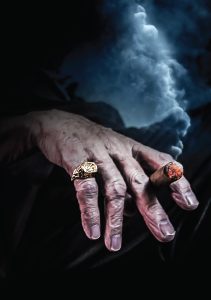
Promotional material for An Audience With Jimmy Savile. Photo: Boom Ents
The big question for writers, then, is this – if, like me, you believe that anything goes on stage, provided it’s not proscribed by law, how far should you go? Where do the (self-imposed) limits of free expression lie?
Those limits are different for each writer, of course. I would draw the line at, for example, depicting sexual assault on stage. My Jimmy Savile play showed the effects of it, clearly, on the main character – a young woman who’d been abused by him at Stoke Mandeville Hospital – but left the rest to the audience’s imagination. Sometimes it’s more powerful that way.
I would, however, defend the right of other playwrights to go further and include vivid scenes of sexual assault, provided it was for the “right” reasons. There would need to be a coherent dramatic justification for it and the creative team would be advised to have plenty of flak jackets ready. Anyone who tests the boundaries in this way will inevitably face accusations of prurience, unjustified provocation or worse.
The actor’s “thumb”
In 1980, when Howard Brenton showed a scene of homosexual rape in The Romans in Britain, the production found itself being prosecuted for gross indecency by Mary Whitehouse as part of her attempt to “clean up” Britain. (The prosecution failed when a key witness admitted that, from the back of stalls, what he thought was a penis might have been an actor’s thumb.)
A similar court case today would be unlikely. But then again there is always the Court of Public Opinion, powered by the rotten fuel of social media, which is arguably more scary and intimidating than the real thing.
I wouldn’t draw the line at giving free expression on stage to anti-Semitism, either. Sometimes the best way to destroy an argument is to bring it into the light. With one crucial proviso, which I will come to in a moment.
As a Jew who lost relatives in the Holocaust I am fascinated by the subject. I would love to see a play which explained where anti-Semitism came from. Or whether the definitions of it are justified. Are there internal contradictions there? (We fought the war to preserve our freedoms, but isn’t using the label “anti-Semitic” a destruction of one of our most cherished freedoms? As in, the freedom of speech?)
Any play which seeks to answer these questions would need characters espousing anti-Semitism – the more articulately the better, in my view – if they are to work properly.
My proviso would be that the anti-Semitism would need to be both contextualised and rigorously challenged. This could be done within the play – two characters arguing – or in the form of a post-show debate.
I would, for example, even have defended the right of writer Jim Allen and director Ken Loach to stage Perdition, their controversial 1987 play for the Royal Court, despite its disgusting anti-Semitic tropes.
The play accused Jews of “collaborating” with the Nazis during the Holocaust (is there a more loaded, insulting, inappropriate word in this context than “collaborated”?) and was based on the story of Rudolf Kastner, who negotiated with Adolf Eichmann to let more than 1,600 Jews flee Hungary for the safety of Switzerland.
Kastner, it is argued, should have done more to warn more Jews (not just the 1,600 that he rescued) of what was happening. Hence Allen’s line: “To save your hides, you [a Jew] practically led them to the gas chambers.” Disgusting, misjudged and morally wrong.
In the resulting furore, the Royal Court cancelled the play. But the decision to ban it, paradoxically, only increased support for it, and the poison it contained. I would have let it go ahead but tried to persuade Allen to make editorial changes. And if that didn’t work (and I doubt it would have done, although some controversial lines were excised during rehearsals) then I would have staged a debate, forming part of the show, which allowed the Jewish community to explain why the play was so offensive and misjudged. Education beats defenestration, every time.
The stage would be the perfect place to explore the arguments on both sides, but in particular to highlight the muddy thinking of the anti-Israel lobby, as personified by Sally Rooney, who recently decided to punish the Jews by forbidding a Hebrew translation of her latest novel. (Although making them read it might have been a more effective punishment.)
British theatre is not in a good place today. Where are the revolutionaries? The new, angry young men and women, the new John Osbornes? We don’t need to Look Back In Anger: it’s all in front of us, now.
Would a film like 2009’s Four Lions, a deeply moral but, to some, hugely offensive Jihadi satire, get made today? I very much doubt it.
We – all of us: writers, commissioners and directors – need to be braver.
21 Dec 2021 | Artistic Freedom, Belarus, Magazine, News, Volume 50.04 Winter 2021, Volume 50.04 Winter 2021 Extras
In a skyscraper in the heart of the City of London, a surprisingly airy rehearsal space hosts a group of Europe’s boldest theatre-makers.
In the centre of the room, a woman trudges in a circle with the juddering, formal rhythms of a fatigued sergeant-major, a vacuum-cleaner held out before her like a rifle. On the other side of the “stage”, an actor playing a surgeon is operating on a seemingly conscious patient.
Two stage-managers watch from the front: behind an otherwise conventional rehearsal table littered with sound equipment and notes, someone has hung the white-and-red flag, or byel-chyrvona-byely s’tsyah, which has become the emblem of Belarusian resistance to the dictator Alyaksandr Lukashenka.
I spot a souvenir water-bottle from the Human Rights Foundation’s Oslo Freedom Forum. On a small chair at the side of the room, a voice issues from a Zoom video running on a laptop. This is Nikolai Khalezin, founder with his wife Natalia Koliada of the Belarus Free Theatre company, directing a rehearsal over video link.
Virtual rehearsals
Today Khalezin is leading his company by Zoom because he seems to have a cold – and, in the time of Covid, no one can be too careful. But unlike most directors working in London, he has long practised in making theatre remotely. Since 2011, Khalezin and Koliada have held political asylum in the UK, a necessity for survival in the face of repeated harassment and imprisonment at the hands of Lukashenka’s regime.
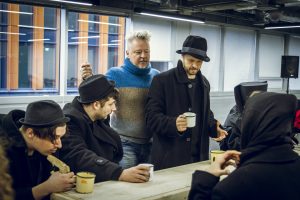
Nicolai Khalezin (centre) directs rehearsals of Dogs of Europe pre-Covid. Photo: Mikalai Kuprych
Khalezin was a journalist before he became a theatre-maker, working for three independent Belarusian newspapers successively closed as the autocracy tightened its grip. But in all the years in the UK, Khalezin and Koliada have never stopped co-ordinating their theatre company, keeping in close but covert contact with artists on the frontline of Belarusian resistance, who have risked their freedom and even their lives to perform “unregistered” theatre in garages and private homes around their homeland.
Long before the pandemic, directing his actors by video-link had become Khalezin’s norm. Now, given the vicious repression which followed Lukashenka’s attempt to assert himself in August 2020 as the “winner” of a sixth term as president, the rest of the 16-member Belarus Free Theatre, and their families, have fled their native land to reunite in London.
Ostensibly, the artists of the Belarus Free Theatre are now refugees. “What can foundations and activists in the West specifically do to help?” I ask Khalezin, perhaps naively.
“What can you do to help? Imagine 20 people arriving in a new country without a roof, without spare clothes, with nowhere to go – then it becomes quite easy to picture what you can do to help.”
But they are also rehearsing in London as prestigious invited artists, programmed to premiere their latest production at the Barbican Centre in March 2022. Dogs of Europe, first performed in an early version in Minsk in 2019 – crowds of supporters turned up in spite of the fear of arrest – is an adaptation of Alhierd Bacharevic’s mammoth novel set in a dystopic Europe of 2049.
In the book, most of Asia has fallen under a secret-service dominated Russian “reich”, while an ever more fragmented western Europe grapples with a refugee crisis. The title seems to recall W H Auden’s poem on the death of Yeats: “In the nightmare of the dark / All the dogs of Europe bark / And the living nations wait / Each sequestered in its hate.”
The novel was published in 2017, but as a long-term collaborator of Bacharevic, Khalezin first saw a version in 2014 – since then, he says, “it has become closer to our contemporary world even quicker than I had imagined.” He is still working on condensing Bacharevic’s 900 pages into a 150 minute show and on scaling up his company’s flexible rehearsal versions to fit the Barbican Theatre’s 1,162-seat main space.
Not that the Belarus Free Theatre’s audiences have ever been small. Part of the problem of performing for years in secret scratch locations around Minsk has always been the sheer number of people who regularly turn up, hungry for intellectual immediacy. The level of direct intervention by Lukashenka’s thugs has varied on and off – part of any surveillance state’s strategy is always to fuel uncertainty and surprise – but in 2007, for example, the entire company were arrested in the middle of a performance of Edward Bond’s Eleven Vests.
Ironically, Bond’s play for young people explores the abuse of liberty by state institutions, both school and army – the arrests came within three weeks of a summit on political liberty in eastern Europe at which Vaclav Havel had hosted the Belarus Free Theatre at his country home in the Czech Republic.
Theatre on the streets
With the eruption of protests in 2020, however, the theatre company found themselves performing on open streets. “Minsk is full of courtyards,” says Svetlana Sugako, the company’s general manager. “We went on to the streets, and so did everybody else, so there we were, performing to the crowds of protesters, and they were performing back in the form of their protest.”
Sugako discovered the Belarus Free Theatre in 2007, after being taken by a friend to a bar and rolling her eyes at the mere concept of theatre. “I had only seen the official, patriotic stuff – the state produces these long shows of official history and calls it theatre.”
Inside, the company were performing their internationally acclaimed version of Sarah Kane’s 4.48 Psychosis. “It was about suicide, and psychosis, and pain – and the government doesn’t allow us to have plays which show this, because we are supposed to be a perfect society, so officially we don’t have suicide, we don’t have psychosis, we don’t have pain. And it was right up in my face, performed at the bar, just like I’m talking to you now.”
Sugako immediately got involved. Shortly afterwards she was arrested with the group, and when I look at accounts of her imprisonment she has given elsewhere, I read harrowing stories about being humiliated while naked, and forced to listen to male prisoners being raped with objects in the next room. So I don’t press her. But she alludes to that particular stint in prison later in our conversation, when she talks about the experiences of being detained again last year in the aftermath of Lukashenka’s crushing of the courtyard protests.
‘‘It was bad before. But even compared to that first time, now it is hell. There are no human rights outside prison. So imagine what happens inside.”
There are still more than 600 political prisoners in Belarus (Lukashenka, in a recent interview with the BBC, called them “criminals”.) The Belarus Free Theatre have been working with Index on Censorship to smuggle letters from prison and publish them on the Index website as Letters from Lukashenka’s Prisoners.
What feels frustrating, observing the Belarus Free Theatre’s development, is how many times it seems to have dropped from the Western radar over the past few years. Ten years ago, they were a liberal cause célèbre – I first encountered their work at an event at the Young Vic in London hosted by Index on Censorship in 2010, which seemed to have every progressive theatre luminary in attendance.
Many friends have stood firm, including the actor Samuel West and the playwright Sir Tom Stoppard, who also has a long-standing relationship with Index. But often, attention seems to flicker fashionably. Khalezin attributes this in part to the sheer wave of people in crisis globally: “You have people in need from Afghanistan, you have people from Syria – we shouldn’t be competing with each other for help, but our stories should all be reason to look beyond your borders, to build more bridges.”
Far from home
Most of the company – all of whom have hair-raising tales about escaping Belarus – are likely to be based in Poland for the foreseeable future, partly because living in London is more expensive.
Conversely, the infectiously hopeful aspect of the Belarus Free Theatre is its unfettered advertisement for the power of theatre as rebellion. Critical conversations about art as freedom of expression inevitably revolve around the naysayers’ question: “yes, but does it actually change anything?”
For 15 years, Khalezin and Koliada have been bringing people together in a nation whose government goes to extreme lengths to keep people apart. Theatre is shared experience – this much we know – and one of the markers of Lukashenka’s regime is his attempt to deny citizens shared experience.
In October 2020, during the height of the election protests, people were forbidden from gathering in public places in groups of more than three and private gatherings were banned outright. (This supposedly was a health measure – but, as Sugako observes, “Belarus has no coronavirus. Officially. We are a perfect country, remember?”).
Whether gathering people in private spaces, or engaging inquiring minds at a public protest, the Belarus Free Theatre brings people together. And when people come together, things begin to happen.
