23 Sep 2015 | Magazine, mobile, Volume 44.03 Autumn 2015
Today the bulk of the media in the Balkans has “been bought by people with no history in, or understanding of, the media business; they promote narrow interests of their owners or new political elites; sometimes without even pretence of objectivity,” said Kemal Kurspahic, former editor of Oslobodjenje, an independent newspaper published during the Bosnian war, reflecting on the development of media freedom over the past 25 years.
While in the 1990s nationalism was the order of the day, today a whole host of challenges – including murky media ownership – face independent journalists across the region. The Balkan Investigative Journalism Network in Serbia, for instance, has documented the campaign against them from authorities and pro-government press on a dedicated website, BIRN Under Fire. Television journalist Jet Xharra and BIRN Kosovo took the government to court over the right to report on the prime minister’s accounts, and to set a legal precedent for press freedom in the state. But Xharra, country director of BIRN in Kosovo, said there is a sense of disbelief among those who had to report during war, that these kinds of battles still need to be fought.
“We cannot understand why, 20 years later, you have to deal with [such] a strain on your reporting,” said Xharra.
During the war years that tore Yugoslavia apart, press freedom, like pretty much every other aspect of society, experienced a profound crisis. Large swathes of the media in the former republics became propaganda tools for ruling elites, even before the fighting started. In fact, concerted media campaigns of hate and fear-mongering played an important part in priming people who had lived side by side for decades for war. As British historian Mark Thompson put it in his 1999 book Forging War, on the media’s role in the conflicts in Bosnia, Croatia and Serbia: “War is the continuation of television news by other means.”
|
Dangers of reporting in the Balkins
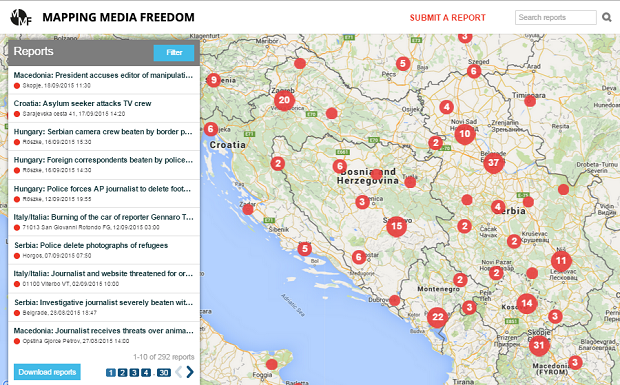
Attacks on journalists and journalism in the Balkans, compiled from Index’s Mapping Media Freedom project
SERBIA
Independent online news outlet Peščcanik has been targeted on several occasions after reporting in June 2014 that a senior minister had plagiarised parts of his doctoral dissertation. The site has faced distributed denial-of-service (DDoS) attacks, and hackers have altered text and blocked IP addresses, thus preventing readers from accessing content.
MONTENEGRO
In May 2015, after reporting on corruption in local government, journalist Milovan Novovic’s car was vandalised. In June, journalist Alma Ljuca’s car was attacked in a similar way. This comes after a car belonging to the daily Vijesti was torched in early 2014.
BOSNIA
In December 2014, police raided the Sarajevo offices of news site Klix.ba, looking for a recording in which the prime minister of the country’s Republika Srpska entity spoke about “buying off” politicians. This came after the site’s director and a journalist were interrogated and asked to reveal their source for the recording, which they refused to do.
CROATIA
In May 2015, journalist and blogger Željko Peratović was attacked by three men outside his home, and hospitalised with head injuries. Peratović is known for his investigative reporting, and has covered the trial of two agents of the former Yugoslav Security Agency.
MACEDONIA
Deputy Prime Minister for Economic Affairs Vladimir Peshevski was filmed physically assaulting Sashe Ivanovski, a journalist and owner of the news site Maktel, who has been critical of the government.
SLOVENIA
In March 2015 photojournalist Jani Bozic received a suspended prison sentence for publishing a photo of Alenka Bratusek, then prime minster elect, which showed him receiving a congratulatory text message from a prominent businessman 20 minutes before results were announced.
KOSOVO
Express journalist Visar Duriqi, who has covered radical Islamists in Kosovo, has received a number of death threats, including threats of beheading.
Index on Censorship’s Mapping Media Freedom project launched as in 2014 to record threats to media freedom throughout the European Union and EU candidate countries. It has recently expanded to cover Russia and Ukraine. |
Yet during the Balkan wars beginning in the 1990s there were local journalists who, in the face of enormous pressure, rejected nationalist and propagandist lines, and attempted to sift truth from lies and distortion. Beyond the daily struggle that came with just existing in a war zone, independent journalism was dangerous work. As Human Rights Watch points out in a new report on the state of media freedom in the Balkans, journalists who were, at the time, “critical of official government positions were often labelled as traitors or spies working on behalf of foreign interests and against the state”.
Serbia’s B92, a rare dissenting voice in a media landscape shaped by President Slobodan Milosevic’s propaganda strategy, is perhaps the most famous example of independent journalism. Set up in 1989 as a youth-focused radio station (later branching out into TV and web platforms), B92 bravely covered a turbulent time – from the war in Bosnia, to the Nato bombing of Serbia, to the protest movement that eventually saw Milošević ousted. For this, it was continuously hounded by the government. At one point in 1999 authorities commandeered its offices and radio frequency, forcing the station off air, before it could resume broadcasting from a different studio and frequency, under the name B2-92.
In Croatia, President Franjo Tudjman also made sure ultra-nationalism had a place in column inches and on airwaves. Feral Tribune, which started out in 1983 as a satirical supplement in the newspaper Slobodna Dalmacija, had other ideas. Under sustained pressure from the authorities, it covered stories of human rights and conflict that many other outlets avoided, in addition to its biting satire. It was taken to court, publicly burned, and one journalist was even drafted into the army after Feral published an edited photo of Tudjman and Milosevic in bed together on the front page.
Bosnia was the country in the region that would be by far the hardest hit by fighting. But even as war came to Sarajevo, independent journalism survived in some small way. Oslobodjenje, which started out as an anti-Nazi paper in 1943, had a track record of editorial independence. In 1988, staff for the first time voted for their own editor – Kemal Kurspahic – instead of accepting one appointed by the authorities. Just three years later they fought for their freedom again, this time in the constitutional court, as the newly elected nationalist parties agreed to adopt a law whereby they could appoint the editors and managers of Bosnian media. In 1992 came their toughest challenge yet. With the two towers of their office building under fire – in one night they lost six floors on one side and four on the other – they decided to go underground, and continue their work from a nuclear bomb shelter, with no newsprint supplies and no phone links.
“If dozens of foreign journalists could come to report on the siege of Sarajevo and Bosnian war, how could we – whose families, city and country were under attack – stop doing our job?” Kurspahic, now managing editor of Connection Newspapers, told Index. They felt an obligation to their readers: “We could not leave them without news at the worst time of their lives.”
Oslobodjenje even celebrated its 50th anniversary during the war, with 82 papers around the world printing some of their stories. With that they achieved “the ultimate victory”, Kurspahic said, “if the aim of the terror against Oslobodjenje was to silence us as a voice of multiethnic Bosnia”.
“People were getting killed, so we were reporting it. The risk was physical at that time to journalists,” Xharra told Index. Today she hosts Kosovo’s most watched current affairs programme, as well as fulfilling her role at BIRN Kosovo. But she cut her reporting teeth as a translator, fixer and field producer for UK broadcasters – the BBC and Channel 4 – during the Kosovo war. She recalled going through frontlines for a story, and hiding tapes from paramilitary checkpoints, painting a vivid picture of a time when practicing journalism in the western Balkans meant near constant risk of physical harm.
Journalists could be caught in crossfire, or targeted specifically for their work. Kurspahic remembers the Oslobodjenje reporter Kjasif Smajlovic in Zvornik, who sent his wife and children away, and stayed to report on the fall of the town until he was killed by Serbian paramilitary forces in April 1992. In 1999, Slavko Curuvija, known for his critical reporting, was shot 17 times in a Belgrade side street, just days after a pro-government daily had labelled him a Nato supporter. In many cases, there has been little to no accountability for such crimes, breeding a culture of impunity that still hangs over the region.
Because while the darkest days for press freedom in the Balkans came during wartime, peace has not brought the improved conditions many hoped for. At a talk in March, Dunja Mijatovic, the OSCE’s free expression representative, went as far as to say that the situation now is worse than in the aftermath of the conflicts.
And today the media itself remains part of the problem, especially when journalists turn on their colleagues. One prominent example is the story of BIRN Serbia. Following their critical investigation into a state-owned power company, Prime Minister Aleksandar Vucic labelled the group liars who had been funded by the EU to speak against his government. That attack was then taken forward by the pro-government Serbian press, including in the newspaper Informer. Just one example where the media has been a less than staunch defender of its own rights.
Data from Index’s Mapping Media Freedom project, which tracks media freedom across Europe, indicates that worries of threats to media rights are justified. In just over a year it has received more than 170 reports of violations from the countries of the former Yugoslavia. Incidents included a Croatian journalist who received a letter saying she would “end up like Curuvija”; a Bosnian journalist threatened over Facebook by a local politician; Kosovan journalists depicted as animals on several billboards; a Montenegrin daily that had a company car torched; a Macedonian editor who had a funeral wreath sent to his home; and a Slovenian who faced charges for reporting on the intelligence agency. Online and offline, physical and verbal, serious threats to press freedom remain, some 20 years on.
© Milana Knezevic
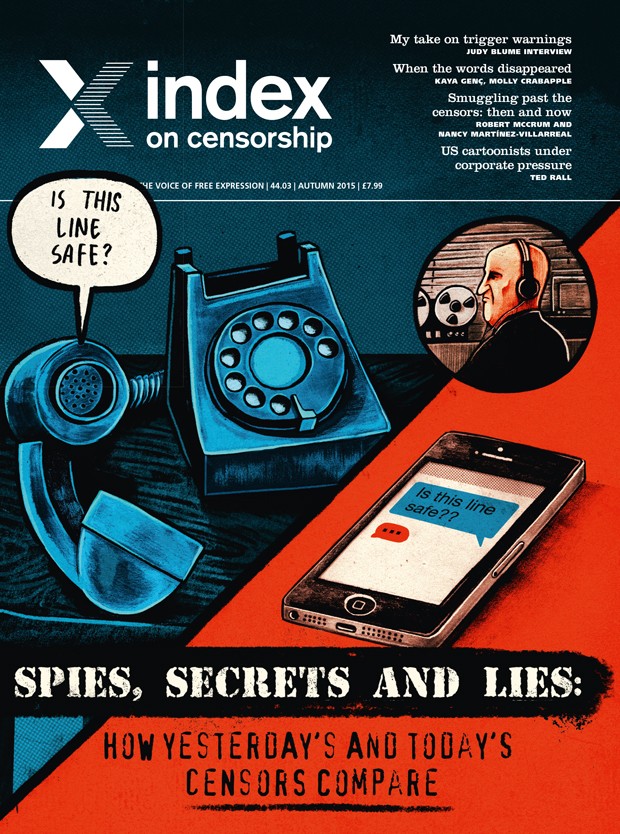
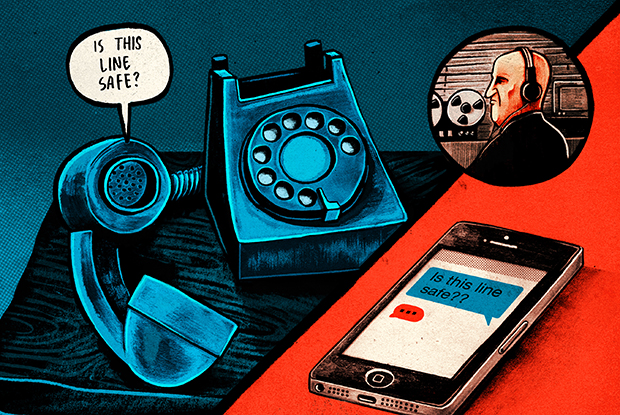
This article is part of the autumn issue of Index on Censorship magazine looking at comparisons between old censors and new censors. Copies can be purchased from Amazon, in some bookshops and online, more information here.
17 Sep 2015 | Campaigns, Mapping Media Freedom, mobile, News
Ukrainian President Petro Poroshenko signed a decree on Wednesday 16 September banning at least 38 international journalists and bloggers from Ukraine for one year. The decree, published on the presidential website, says those listed are banned for being “actual or potential threat to national interests, national security, sovereignty and territorial integrity of Ukraine.”
Poroshenko said the people targeted were involved in Russia’s 2014 annexation of Crimea and the current aggression in eastern Ukraine.
“This ban is a serious blow to media freedom,” Index senior advocacy officer Melody Patry said. “There is no explanation whatsoever on what press coverage constitutes an actual or potential threat to national security. We appreciate that the situation in eastern Ukraine is sensitive but preventing journalists from reporting from within the country is not the solution and it’s undermining freedom of information.”
The Committee to Protect Journalists reports that the 34 journalists and seven bloggers named in the ban come from Bulgaria, Estonia, Germany, Hungary, Israel, Kazakhstan, Latvia, Macedonia, Moldova, Poland, Russia, Serbia, Slovakia, Spain, Switzerland and the United Kingdom.
The original list included three BBC media staff members – Moscow correspondent Steve Rosenberg, producer Emma Wells and cameraman Anton Chicherov – who were later removed from the ban list, media reported.
“We cannot accept that kind of censorship”, said Mogens Blicher Bjerregård, president of the European Federation of Journalists. Censorship is never the right answer, even to counter propaganda or to sanction journalists who allegedly crossed the Russian-Ukrainian border illegally. The ban is simply inappropriate. Peace and Development of our democracies need press freedom not banning journalists. We and the international society must firmly urge the Ukraine government to lift immediately the ban on named journalists.”
Over 380 people in total have been banned, including activists and Russian officials.
This measure was added to the Mapping Media Freedom platform, which monitors and map threats and violations to media freedom in Europe, including Ukraine and Russia.
The environment for media freedom in Ukraine has been deteriorating against the backdrop of the conflict in the eastern part of the country, making it one the the deadliest countries for journalists, with at least eight media workers killed since the beginning of 2014.
This statement was updated to reflect the later removal of three BBC journalists from the ban list.
Mapping Media Freedom
Click on the bubbles to view reports or double-click to zoom in on specific regions. The full site can be accessed at https://mappingmediafreedom.org/
|
16 Sep 2015 | Magazine
In conjunction with the Cambridge Festival of Ideas 2015, we will be publishing a series of articles that complement many of the upcoming debates and discussions. We are offering these articles from Index on Censorship magazine for free (normally they are held within our paid-for archive) as part of our partnership with the festival. Below is an article by cartoonist and author Martin Rowson, who regularly draws for the magazine, on the power of propaganda in wartime, taken from the spring 2014 issue. It’s a great starting point for those who plan to attend the War, Censorship and Propaganda: Does It Work session at the festival this year.
Index on Censorship is a global quarterly magazine with reporters and contributing editors around the world. Founded in 1972, it promotes and defends the right to freedom of expression.
As a political cartoonist, whenever I’m criticised for my work being unrelentingly negative, I usually point my accusers towards several eternal truths.
One is that cartoons, along with all other jokes, are by their nature knocking copy. It’s the negativity that makes them funny, because, at the heart of things, funny is how we cope with the bad – or negative – stuff.
Whether it’s laughing at shit, death or the misfortunes of others, without this hard-wired evolutionary survival mechanism that allows us to laugh at the awfulness running in parallel with being both alive and human, apes with brains the size of ours would go insane with existential terror as soon as the full implications of existence sink in. Which, for most people, would be when you’re around three years old.
And if that doesn’t persuade them, I usually then try to describe that indescribable but palpable transubstantiation that occurs when you shift from the negative to the positive, and a cartoon sinks from being satire to becoming propaganda.
Though here, of course, I’m not being entirely honest, because in many ways cartoons are propaganda in its purest form. This is because the methodology of the political cartoon has most in common with the practices of sympathetic magic and, likewise, its purposes are invariably malevolent.
Indeed, I’ve often described caricature in particular and political cartooning more generally as a type of voodoo, doing damage at a distance with a sharp object, in this case (usually) a pen.
Certainly the business of caricature is a kind of shamanist shape-shifting, distorting the appearance of the victim in order to bring them under the control of the cartoonist and subjecting them thereafter to ridicule or opprobrium. In short, political cartoons should truly be classified not as comedy but as visual taunts. And taunts, of course, have been an integral ingredient of warfare for millennia.
Within the twisted plaiting of taunts, posturing and brinkmanship that ultimately ended in the hecatombs of the Western Front in World War I you can just about tease out one thread trailing back to a cartoon.
The original sketch for the allegorical 1896 cartoon Nations of Europe: Join in Defence of Your Faith! was by Kaiser Wilhelm II of Germany, though he left the job of the finished artwork to professionals. Its purpose was to stiffen the resolve of European leaders against the “yellow peril” coming from east Asia, and to this end the Kaiser presented a copy of the cartoon to his cousin Tsar Nicholas II of Russia.
It’s generally agreed that the cartoon played a small but significant part in influencing the Tsar’s confrontational policy towards Japan, which ended in Russia’s humiliating defeat in the 1904-05 Russo-Japanese war.
The subsequent revolutions, regional wars and growing European instability erupted nine years later with the general mobilisation of the Great Powers, and the cartoonists were mobilised along with everyone else.
Although a perennial taunt against the Germans is that they have no sense of humour, they had as rich a tradition of visual satire as anyone else. In the pages of both Punch and the German satirical paper Simplicissimus, the enemy was caricatured identically as alternatively preposterous and terrifying. Both sides showed the other in league with skeletal personifications of Death, or transformed into fat clowns, foul or dangerous animals or, in British cartoons about Germans, as sausages.
There were also scores of cartoons showing German soldiers bayoneting Belgian babies in portrayals of “The Beastly Hun” and, later, cartoons showing the Germans harvesting the corpses of slain soldiers for fats to advance their war effort.
All sides taunted each other by attacking their nations’ supposed leaders, using the caricaturist’s typical tools. Thus the Kaiser, mostly thanks to his waxed moustache, acted as a synecdoche for Germany’s defining perfidy. In one cartoon from 1915, when Britain’s George V stripped his cousin, the Kaiser, of his Order of the Garter, his garterless stocking slips down, revealing a black and hairy simian leg. In 1914, meanwhile, the German cartoonist Arthur Johnson (his father was an American) showed the British Royal Family, German by descent, in a camp for enemy aliens.
These taunting cartoons bore little relation to the realities of modern warfare, and most of them would now be dismissed purely as rather ham-fisted propaganda. This shouldn’t downplay their effectiveness, however.
A century earlier Napoleon Bonaparte admitted he feared the damage done by James Gillray’s caricatures of him more than he feared any general, because Gillray always drew him as very short. (To bring this up to date, Le Monde’s cartoonist Plantu told me that every time he drew Nicolas Sarkozy as short, Sarkozy complained personally to his editor; the next cartoon would make him even shorter, and Sarkozy would complain again, until in the end Plantu drew the French president as just a head and feet.)
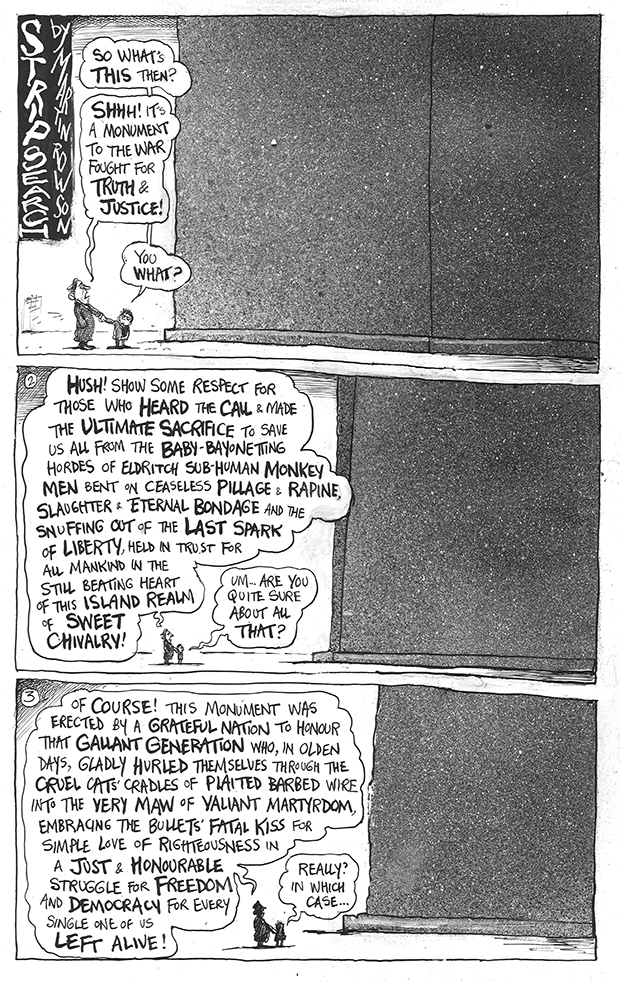
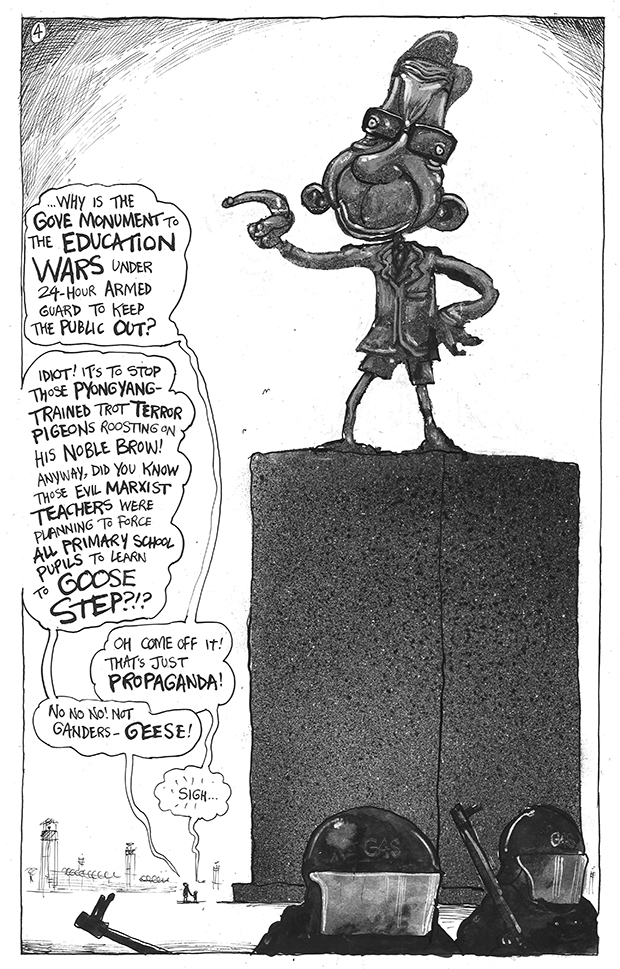
Nonetheless, an unforeseen consequence of this barrage of caricature was that in the end people stopped believing it to be anything more than merely caricature: the truth that should be exposed by the exaggeration got lost. In the 1930s, many people assumed reports of the genuine atrocities of the Nazis were, like the bayoneted babies or harvested corpses blamed on the Kaiser, just propaganda.
Posterity shouldn’t concern cartoonists. We’re just journalists responding to events with a raw immediacy. This is what gives the medium a great deal of its heft.
Some cartoons, however, encapsulate a time or an event and so become part of the more general visual language. Gillray’s The Plum Pudding in Danger is a perfect example, depicting the specific geopolitical struggle between William Pitt and Napoleon in 1805, while also capturing eternal truths about geopolitics itself. But I’m not aware of any political cartoons from World War I that do the same thing.
And yet the medium operates in many ways, and the most effective and popular cartoonist of World War I was undoubtedly Bruce Bainsfather, a serving artillery officer who drew gag cartoons about the slapstick of everyday life in the trenches in his series featuring “Old Bill”. The serving soldiers loved these cartoons, and they are another instance of humour being used to make the harshest imaginable reality simply bearable.
The other truly great cartoon to emerge from the World War I was published after it was all over. In his extraordinarily prophetic drawing Peace and Future Cannon Fodder for the Daily Herald, Will Dyson showed the Allied victors of the war exiting the Versailles peace conference and the French prime minister Georges Clemenceau saying: “Curious! I seem to hear a child weeping.” Behind a pillar a naked infant labelled “1940 class” is crying into its folded arms.
None of the protagonists in the next war doubted the power or importance of cartoons. Again, they were used by all sides to taunt and vilify their foes, perhaps most notoriously in Der Sturmer, the notorious anti-semitic paper edited by Julius Streicher, later hanged at Nuremburg.
Simplicissimus was, once more, taunting the British, this time drawing wartime prime minister, Winston Churchill, as a fat and murderous drunk; in the Soviet Union Stalin’s favourite cartoonist, Boris Yefimov, returned the compliment to the Nazi leadership (Yefimov’s older brother Mikhail first employed him on Pravda before being purged and executed in 1940; Boris survived him by 68 years, dying aged 108 in 2008). No cartoonist in either country would have dared caricature their own totalitarian politicians, but they were given full rein to exercise their skills on their nation’s enemies. In Britain, with its largely legally tolerated history of visual satire going back to 1695, things were slightly different, though also sometimes the same.
The New Zealand-born cartoonist David Low discovered in 1930 from a friend that Hitler, three years away from taking power in Germany, was an admirer of his work. Low did what any other cartoonist would do in similar circumstances and acknowledged his famous fan by sending him a signed piece of original artwork, inscribed “From one artist to another”.
It’s unknown what happened to the cartoon – maybe it was with him right to the end, in the bunker – but it soon became apparent that Hitler had mistaken Low’s attacks on democratic politicians for attacks on democracy itself. He was soon disabused. Low harried the Nazis all the way from the simple slapstick of The Difficulty of Shaking Hands with Gods of November 1933 to the bitterness of his iconic cartoon Rendezvous in September 1939, so much so that in 1936 British Foreign Secretary Lord Halifax, after a weekend’s shooting at Hermann Goering’s Bavarian hunting lodge, told Low’s proprietor at the Evening Standard, Lord Beaverbrook, to get the cartoonist to ease up as his work was seriously damaging good Anglo-German relations. Low responded by producing a composite cartoon dictator called “Muzzler”.
The Nazis had a point that Low entirely understood, and it was why he, along with many other cartoonists – Victor “Vicky” Weisz, Leslie Illingworth and even William Heath Robinson – were all on the Gestapo’s death list. In a debate on British government propaganda in 1943, a Tory MP said Low’s cartoon were worth all the official propaganda put together because Low portrayed the Nazis as “bloody fools”. Low himself later expanded on the point, comparing his work, which undermined the Nazis through mockery, with the work of pre-war Danish cartoonists who unanimously drew them as terrifying monsters. Low’s point was that it’s much easier to imagine you can beat a fool than a monster, and taunting your enemies as being unvanguishably frightening is no taunt at all.
The enduring efficacy of cartoons’ dark and magical voodoo powers were acknowledged in victory, when both Low and Yefimov were official court cartoonists at the Nuremburg war crimes tribunals (Low claimed Goering tried to outstare him from the dock): now the taunting was part of the humiliation served up with the revenge. Likewise, when Mussolini was executed by Italian partisans, the editor of the Evening Standard, Michael Foot, marked the dictator’s demise by giving over all eight pages of the paper to Low’s cartoons of Mussolini’s life and career.
Of course Low, unlike Yefimov, was actively hostile on the Home Front as well, producing cartoons critical of both the military establishment and Churchill. When Low’s famous creation Colonel Blimp, the portly cartoon manifestation of boneheaded reactionary thinking, took on fresh life in the Powell and Pressburger movie The Life and Death of Colonel Blimp, Churchill tried to have the film banned. When the Daily Mirror’s cartoonist Philip Zec responded to stories about wartime profiteering by contrasting them with attacks on merchant shipping in his famous cartoon The Price of Petrol has Been Increased by One Penny – Official, both Churchill and Home Secretary Herbert Morrison seriously considered shutting down the newspaper. (When the Guardian cartoonist Les Gibbard pastiched Zec’s cartoon during the Falklands war 40 years later, the Sun called for him to be tried for treason.)
And yet cartoons, for all their voodoo power, can still spiral off into all sorts of different ambiguities thanks to the way they inhabit different spheres of intent. Are they there to make us laugh, or to destroy them? Or both?
Ronald Searle drew his experiences while he was a prisoner of war of the Japanese, certainly on pain of death had the drawings been discovered, but taking the risk in order to stand witness to his captors’ crimes. Just a few years later, many of his famous St Trinian’s cartoons don’t just deal with the same topics – cruelty and beheadings – but share identical composition with his prisoner of war drawings.
And when Carl Giles, creator of the famous cartoon family that mapped and reflected post-war British suburban life weekly in the Sunday Express, was present as an official war correspondent at the liberation of the Bergen-Belsen concentration camp, the camp’s commandant, Josef Kramer, revealed he was a huge fan of Giles’ work and gave him his pistol, a ceremonial dagger and his Nazi armband in exchange for the promise that Giles would send him a signed original. As Giles explained later, he failed to keep his part of the bargain because by the time he got demobbed Kramer had been hanged for crimes against humanity.
Those twinned qualities of taunting and laughter go some way to explaining the experience of cartoonists in the so-called war on terror, if not the power of their work. In the aftermath of 9/11, in the Babel of journalistic responses to what was without question the most visual event in human history, then visually re-repeated by the media that had initially reported it, the cartoonists were the ones who got it in the neck. While columnists wrote millions of words of comment and speculation, and images captured by machines were broadcast and published almost ceaselessly, the images produced via a human consciousness were, it seems, too much to stomach for many. Cartoonists had their work spiked, or were told to cover another story (there were no other stories). In the US some cartoonists had their copy moved to other parts of the paper, or were laid off. One or two even got a knock on the door in the middle of the night from the Feds under the provisions of the Patriot Act.
Despite a concerted effort by some American strip cartoonists to close ranks on Thanksgiving Day 2001 and show some patriotic backbone, the example of Beetle Bailey flying on the back of an American Eagle didn’t really act as a general unifier. Unlike in previous wars, there was no unanimity of purpose among cartoonists. An editorial in The Daily Telegraph accused me, along with Dave Brown of The Independent and The Guardian’s Steve Bell, of being “useful idiots” aiding the terrorist cause due to our failure to fall in line.
The war on terror and its Iraqi sideshow were anything but consensus wars, and many cartoonists articulated very loudly their misgivings. These included Peter Brookes of the Murdoch-owned Times drawing cartoons in direct opposition to his paper’s editorial line. This has always been one of visual satire’s greatest strengths: sometimes a cartoon can undermine itself.
Moreover, because a majority of cartoons were back in their comfort zone of oppositionism, the taunting had less of the whiff of propaganda about it. Nor was there ever any suggestion in Britain of government censorship of any of this.
That said, the volume of censuring increased exponentially, thanks entirely to the separate but simultaneous growth in digital communication and social media. Whereas, previously, cartoons might elicit an outraged letter to an editor – let alone a death threat from the Gestapo – the internet allowed a global audience to see material to which thousands of people responded, thanks to email, with concerted deluges of hate email and regular death threats. I long since learned to dismiss an email death threat as meaningless – a real one requires the commitment of finding my address, a stamp and possibly a body part of one of my loved ones – but it’s the thought that counts.
More to the point was the second front in the culture-struggle at the heart of the war on terror, in which both sides fought to take greater offence. Amid the bombs, bullets and piles of corpses across Iraq, Afghanistan, Bali, Madrid, London and all the other places, the greatest harm you could suffer, it seemed was that you might be “offended”. People sent me hate emails and threatened to kill me and my children because they were “offended” by my depiction of George Bush, or by a cartoon criticising Israel, or a stupid humourous drawing of anything that might mildly upset them or their beliefs.
It was into this atmosphere that the row over the cartoons of Mohammed published by the Danish newspaper Jyllands Posten erupted, resulting in the deaths of at least 100 people (none of them cartoonists, but most of them Muslims, and many shot dead by Muslim soldiers or policemen). But that, of course, is another story. And – who knows? – may yet prove to be another war.
Martin Rowson’s cartoons appear regularly in The Guardian and Index on Censorship. His books include The Dog Allusion, Giving Offence and Fuck: the Human Odyssey.
© Martin Rowson and Index on Censorship
Join us on 25 October at the Cambridge Festival of Ideas 2015 for Question Everything an unconventional, unwieldy and disruptive day of talks, art and ideas featuring a broad range of speakers drawn from popular culture, the arts and academia. Moderated by Index on Censorship CEO Jodie Ginsberg.
This article is part of the spring 2014 issue of the global quarterly Index on Censorship magazine, with a special report on propaganda and war. Click here to subscribe to the magazine.
15 Sep 2015 | Awards, Campaigns, mobile, Press Releases
- Awards honour journalists, campaigners and artists fighting censorship globally
- Judges will include poet and playwright Wole Soyinka, pianist James Rhodes and human rights lawyer Kirsty Brimelow
- Nominate at indexoncensorship.org/nominations
- Nominations are open from 15 September to 19 October 2015
Beginning today, nominations for the Index on Censorship Freedom of Expression Awards 2016 are open. Now in their 16th year, the awards have honoured some of the world’s most remarkable free expression heroes – from Israeli conductor Daniel Barenboim to Syrian cartoonist Ali Farzat to education activist Malala Yousafzai.
The awards shine a spotlight on individuals fighting to speak out in the most dangerous and difficult of conditions.
Index invites the public, NGOs and media organisations to nominate anyone they believe deserves to be part of this impressive peer group: a hall of fame of some of those at the forefront of tackling censorship worldwide.
There are four categories in Index on Censorship’s Freedom of Expression Awards:
• Arts for artists and arts producers whose work challenges repression and injustice and celebrates artistic free expression.
• Campaigning for activists and campaigners who have had a marked impact in fighting censorship and promoting freedom of expression.
• Digital Activism for innovative uses of technology to circumvent censorship and enable free and independent exchange of information.
• Journalism for courageous, high impact and determined journalism that exposes censorship and threats to free expression.
Winners will be flown to London for the gala ceremony, which will take place at The Unicorn Theatre in London on 13 April 2016. In 2015, the ceremony was hosted by comedian Shappi Khorsandi, with awards presented by judges and special guests including Martha Lane Fox, Mariane Pearl, Elif Shafak and Keir Starmer.
Winners also become awards fellows and receive support to amplify their work for free expression. As fellows, winners become part of a world-class network of campaigners, activists and artists sharing best practice on tackling censorship threats internationally.
Jodie Ginsberg, CEO of Index, said: “The Freedom of Expression Awards turn up the volume on the censored and silenced. I encourage everyone, no matter where they are in the world, to nominate a free expression hero so their voices can be heard.”
The 2016 awards shortlist will be announced in late January 2016.
Judges in 2016 will include Nobel prize-winning Nigerian poet and playwright Wole Soyinka; Kirsty Brimelow QC, a human rights barrister and chair of The Bar Human Rights Committee of England and Wales; and classical pianist James Rhodes, whose memoir Instrumental was published earlier this year after the UK Supreme Court overturned a publication ban.
Rhodes said: “The Russian poet Yevgeny Yevtushenko once wrote: ‘When truth is replaced by silence, the silence is a lie’ – and to honour those who fight to speak out and break that silence is a privilege. Having experienced first hand the terrifying impact of censorship, I’m thrilled to be able to play a small part in acknowledging the bravery of those who continue to express themselves in the face of unimaginable oppression.”
For more information on the awards, please contact [email protected] or call +44 (0)207 260 2660.