19 Jun 2014 | Azerbaijan Statements, Campaigns, Digital Freedom, Digital Freedom Statements
The following is a transcript of a joint oral statement, led by ARTICLE 19 and supported by several IFEX members, that was read aloud today, 19 June 2014, at the 26th UN Human Rights Council session in Geneva:
Thank you Mr. President,
Two years ago this Council affirmed by consensus that “the same rights that people have offline must also be protected online, in particular freedom of expression”.
In 2014, the outcome document of Net-Mundial in Brazil recognised the vital role of the internet to achieve the full realisation of sustainable development goals. 31 UN Special Rapporteurs recently affirmed that guaranteeing the free-flow of information online ensures transparency and participation in decision-making, enhancing accountability and the effectiveness of development outcomes.
Development and social inclusion relies on the internet remaining a global resource, managed in the public interest as a democratic, free and pluralistic platform. States must promote and facilitate universal, equitable, affordable and high-quality Internet access for all people on the basis of human rights and net-neutrality, including during times of unrest.
The blocking of communications, such as the shutdown of social media in Malaysia, Turkey, and Venezuela is a violation of freedom of expression and must be condemned. Dissent online must be protected. We deplore the detention of Sombat Boonngamanong in Thailand, who faces up to 14 years imprisonment for using social media to urge peaceful resistance to the recent military coup in the form of a three-finger salute.
One year after the Snowden revelations, this Council must recognise that trust in the internet is conditional on respect for the rights to freedom of expression and privacy online, regardless of users’ nationality or location. Any mass (or dragnet) surveillance, which comprises collection, processing and interception of all forms of communication, is inherently disproportionate and a violation of fundamental human rights.
The targeted interception and collection of personal data must be conducted in accordance with international human rights law, as set out in the necessary and proportionate principles. Critical and intermediate infrastructure must not be tampered with for this end, nor should any system, protocol or standard be weakened to facilitate interception or decryption of data.
ARTICLE 19 urges the Human Rights Council to take action to comprehensively address these challenges.
Thank you.
Signed,
ActiveWatch – Media Monitoring Agency
Africa Freedom of Information Centre
Albanian Media Institute
Arabic Network for Human Rights Information
ARTICLE 19
Association of Caribbean Media Workers
Bahrain Center for Human Rights
Cairo Institute for Human Rights Studies
Cambodian Center for Human Rights
Canadian Journalists for Free Expression
Center for Independent Journalism – Romania
Center for Media Freedom and Responsibility
Egyptian Organization for Human Rights
Foro de Periodismo Argentino
Foundation for Press Freedom – FLIP
Freedom Forum
Human Rights Watch
Index on Censorship
Institute for the Studies on Free Flow of Information
International Press Institute
Maharat Foundation
Media, Entertainment and Arts Alliance
Media Institute of Southern Africa
Media Rights Agenda
National Union of Somali Journalists
Norwegian PEN
Pacific Islands News Association
Pakistan Press Foundation
PEN Canada
Privacy International
Reporters Without Borders
Southeast Asian Press Alliance
South East European Network for Professionalization of Media
West African Journalists Association
World Association of Community Radio Broadcasters – AMARC
Access
Alternative Informatics
Asian Forum for Human Rights and Development (FORUM-ASIA)
Association for Progressive Communications (APC)
Bangladesh Internet Governance Forum
Bangladesh NGOs Network for Radio and Communications (BNNRC)
Barys Zvozskau Belarusian Human Rights House
Big Brother Watch
Bir Duino (Kyrgyzstan)
Bits of Freedom
Bolo Bhi Pakistan
Bytes For All
Center for e-parliament Research
Centre for Internet & Society
Center for National and International Studies, Azerbaijan
Center for the Development of Democracy and Human Rights, Russia
Chaos Computer Club
CIVICUS: World Alliance for Citizen Participation
Digital Rights Foundation, Pakistan
Electronic Privacy Information Center
English Pen
European Centre for Not-for-Profit Law (ECNL)
Helsinki Citizens’ Assembly – Vanadzor
Human Rights Monitoring Institute, Lithuania
International Centre for Not-for-Profit Law (ICNL)
International Federation for Human Rights (FIDH)
Kazakhstan International Bureau for Human Rights and Rule of Law
Kenya Human Rights Commission
Liberty
OpenMedia.org
Open Net Korea
Open Rights Group
Panos Institute West Africa
Samuelson-Glushko Canadian Internet Policy & Public Interest Clinic (CIPPIC)
Simon Davies, publisher of “Privacy Surgeon”
Thai Netizen Network
Zimbabwe Human Rights Forum
17 Jun 2014 | Volume 43.02 Summer 2014
[vc_row][vc_column][vc_custom_heading text=”In the summer issue of Index on Censorship magazine, we include a special report: Brick by brick, freedom 25 years after the fall of the Berlin Wall.”][vc_row_inner][vc_column_inner width=”1/2″][vc_column_text]
As Europe prepares for the anniversary of the wall’s demolition in November, Index on Censorship looks at how the continent has changed. Author Irena Maryniak explores the idea of a new divide that has formed further east. Polish journalist Konstanty Gebert looks at how Poland’s media came out from the underground and lost its voice.
[/vc_column_text][/vc_column_inner][vc_column_inner width=”1/2″][vc_single_image image=”58030″ img_size=”full”][/vc_column_inner][/vc_row_inner][vc_column_text]
Award-winning German writer Regula Venske shows how Germany has tackled its identity issues through crime fiction; and Helen Womack reports from Moscow on the fears of a new Cold War. We also give voice to “Generation Wall” – the young people who have grown up in a free eastern Europe.
When the wall came down in 1989, there were discussions in the Index office about whether our battles were over. Sadly, we all know there was no universal end to censorship on that day. This issue also shares stories of the continuing fight for free expression worldwide, from a scheme to fund investigative journalism in Tanzania to an ambitious crowdsourcing project in Syria.
Also in this issue:
• Dame Janet Suzman looks at censorship of South African theatre on the 20th anniversary of South African democracy
• Jim Al-Khalili shares his thoughts on threats to science research and debate
• Ex BBC World Service boss Richard Sambrook goes head-to-head with Bruno Torturra, from Brazil’s Mídia Ninja, to debate the future of big media
Plus:
• Two new short stories – exclusive to Index – from Costa first novel winner Christie Watson and Turkish novelist Kaya Genç
[/vc_column_text][/vc_column][/vc_row][vc_row][vc_column][vc_custom_heading text=”SPECIAL REPORT: BRICK BY BRICK” css=”.vc_custom_1483610192923{margin-right: 0px !important;margin-left: 0px !important;border-bottom-width: 1px !important;padding-top: 15px !important;padding-bottom: 15px !important;border-bottom-color: #455560 !important;border-bottom-style: solid !important;}”][vc_column_text]
Freedom 25 years after the fall
[/vc_column_text][/vc_column][/vc_row][vc_row][vc_column][vc_custom_heading text=”IN FOCUS” css=”.vc_custom_1481731813613{margin-right: 0px !important;margin-left: 0px !important;border-bottom-width: 1px !important;padding-top: 15px !important;padding-bottom: 15px !important;border-bottom-color: #455560 !important;border-bottom-style: solid !important;}”][vc_column_text]
[/vc_column_text][/vc_column][/vc_row][vc_row][vc_column][vc_custom_heading text=”CULTURE” css=”.vc_custom_1481731777861{margin-right: 0px !important;margin-left: 0px !important;border-bottom-width: 1px !important;padding-top: 15px !important;padding-bottom: 15px !important;border-bottom-color: #455560 !important;border-bottom-style: solid !important;}”][vc_column_text]
[/vc_column_text][/vc_column][/vc_row][vc_row][vc_column][vc_custom_heading text=”COLUMNS” css=”.vc_custom_1481732124093{margin-right: 0px !important;margin-left: 0px !important;border-bottom-width: 1px !important;padding-top: 15px !important;padding-bottom: 15px !important;border-bottom-color: #455560 !important;border-bottom-style: solid !important;}”][vc_column_text]
[/vc_column_text][/vc_column][/vc_row][vc_row][vc_column][vc_custom_heading text=”END NOTE” css=”.vc_custom_1481880278935{margin-right: 0px !important;margin-left: 0px !important;border-bottom-width: 1px !important;padding-top: 15px !important;padding-bottom: 15px !important;border-bottom-color: #455560 !important;border-bottom-style: solid !important;}”][vc_column_text]
[/vc_column_text][/vc_column][/vc_row][vc_row][vc_column][vc_custom_heading text=”SUBSCRIBE” css=”.vc_custom_1481736449684{margin-right: 0px !important;margin-left: 0px !important;border-bottom-width: 1px !important;padding-bottom: 15px !important;border-bottom-color: #455560 !important;border-bottom-style: solid !important;}”][vc_column_text]Index on Censorship magazine was started in 1972 and remains the only global magazine dedicated to free expression. Past contributors include Samuel Beckett, Gabriel García Marquéz, Nadine Gordimer, Arthur Miller, Salman Rushdie, Margaret Atwood, and many more.[/vc_column_text][vc_row_inner][vc_column_inner width=”1/2″][vc_single_image image=”76572″ img_size=”full”][/vc_column_inner][vc_column_inner width=”1/2″][vc_column_text]In print or online. Order a print edition here or take out a digital subscription via Exact Editions.
Copies are also available at the BFI, the Serpentine Gallery, MagCulture, (London), News from Nowhere (Liverpool), Home (Manchester), Calton Books (Glasgow) and on Amazon. Each magazine sale helps Index on Censorship continue its fight for free expression worldwide.
 SUBSCRIBE NOW[/vc_column_text][/vc_column_inner][/vc_row_inner][/vc_column][/vc_row]
16 Jun 2014 | Brazil, Digital Freedom, Digital Freedom Statements, News
This is the third in a series of articles based on the Index report: Brazil: A new global internet referee?
Key debates are under way at international level on internet governance, with crucial decisions up for grabs that could determine whether the internet remains a broadly free and open space, with a bottom up approach to its operation – as exemplified in part by the multistakeholder approach – or becomes a top-down controlled space as pushed for by China and Russia, supported to some extent by several other countries.
In September 2013, the outrage following the revelations of mass surveillance by the US and UK led President Dilma Rousseff to announce that Brazil would host an international summit – NETmundial – on the future of internet governance in April 2014. This internet governance summit – progressive in appearance – took place just two years after Brazil voted in line with countries that have a tradition of internet control at a major international conference on telecommunications in Dubai.
This section looks at Brazil’s attitude in global internet governance debates and the potential contradictions between its domestic and foreign internet policies. In the aftermath of NETmundial and a year before Brazil is to host the 2015 Internet Governance Forum (IGF), this chapter also looks at Brazil’s ability to impose itself as a world leader in internet governance debates.
Is Brazil a swing state on global internet governance? Contradictions between domestic and international policies
What is at stake during the international discussions that shape the evolution and use of the internet has implications for all. The current multistakeholder approach for internet governance supposedly includes civil society and non-governmental actors in decision-making. It is a more bottom-up and multi-layered process, allowing a range of organisations to determine or contribute towards different parts of internet governance. The consultation process at the origin of the Marco Civil law is a possible example of the multistakeholder approach in action: Civil society, private companies, academics, law enforcement officials and politicians participated in the draft.
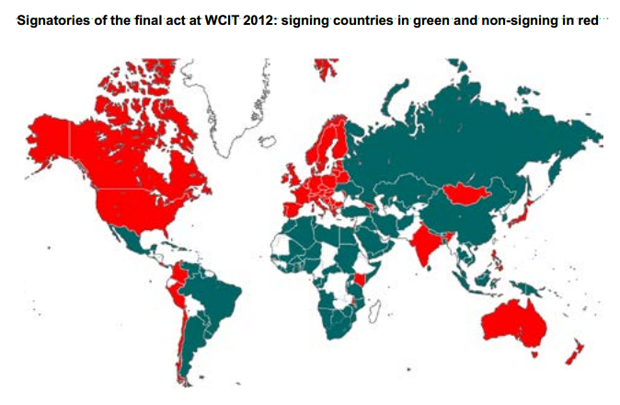
While Brazil has been pushing for stronger internet freedoms lately, especially at the domestic level, it has a history of going in the other direction. In December 2012, Brazil aligned with a top-down approach lobbied by countries that have a tradition of internet control at the Dubai World Conference on International Telecommunications (WCIT) summit. This meeting brought together 193 member states of the International Telecommunication Union (ITU) in part to decide whether or not and how the ITU should regulate the internet. On one side, EU member states and the US argued the internet should remain governed by an open and collaborative multistakeholder approach. On the other side of the divide, Russia, China and Iran lobbied for greater government control of the net. Brazil, along with the most influential emerging democratic powers (India the notable exception), aligned with this top-down approach.
This decision appeared in total contradiction with Brazil’s defence and implementation of the multistakeholder model at home with Marco Civil (see previous section on Marco Civil da Internet). At the time, the rapporteur of Marco Civil, Alessandro Molon, was opposed to the new ITU regulations and regretted that Marco Civil had not been adopted before the vote. While it is not unusual for any government to see a contradiction between domestic and foreign policy, Molon believed that the adoption of Marco Civil would have established without doubt Brazil’s policy and support for a transparent and inclusive approach to internet governance.
The reasons behind Brazil’s vote at the WCIT are obscure. First of all it is worth noting that most Latin American countries voted in favour of the text adopting new International Telecommunications Regulations. An analysis of the region’s vote shows that beyond governments’ intentions and goodwill towards the current multistakeholder governance model, to most Latin American governments, the new regulations were not about the internet but about telecommunications. Most of these governments would have looked at the new ITRs to “reap some of the benefits of the ITRs as a whole”, especially in terms of technical facilities. Second, like India, Brazil has increasingly expressed its desire to take on the US hegemony over the internet and digital technologies. The clash between the two sides revealed at WCIT 2012 led The Economist to call WCIT 2012 a “digital cold war”. Brazil’s position is, however, more complex. Neither a supporter of the US nor Sino-Russian initiatives, Brazil has been seeking greater recognition in multilateral forums and has called for the rebalancing of international institutions. As one of the new global economic powerhouses alongside Russia, India and China, but considered the most democratic of that group with India, aligning with countries supporting tighter government control was more a statement against internet governance by institutions seen as under US control – namely ICANN (Internet Corporation for Assigned Names and Numbers) – and an assertion of Brazil’s sovereignty.
The revelations on mass surveillance activities carried out by the US further fuelled Brazil’s will to break from US-centric internet. Standing against mass surveillance, Brazil distanced itself from the top-down internet governance approach and called for an “open, multilateral and democratic governance, carried out with transparency by stimulating collective creativity and the participation of society, governments and the private sector.”
Shortly after announcing the organisation of an international conference to discuss the future of internet governance in response to the surveillance revelations, President Dilma Rousseff also ordered a series of measures aimed at greater Brazilian online independence and security. But what are the internet governance implications of that opposition to the US spying? By trying to get away from the US dominance of the internet, Roussef’s measures risk taking a regressive stance on the internet. Paradoxically, while asserting internet freedoms, the geopolitics behind Brazil’s response to mass surveillance could align it with countries pushing for top-down internet control both nationally and internationally.
After Snowden: Brazil taking the lead and opposing mass surveillance – but at what cost?
In September 2013, President Dilma Rousseff made a strong political response to Snowden’s revelations on mass surveillance activities carried out by the United States. In a speech delivered to the UN General Assembly, Brazil’s president accused the NSA of violating international law and called on the UN to oversee a new legal system to govern the internet. Rousseff seized the momentum created by Snowden’s revelations to question the current multilateral mechanisms in place – such as ICANN – and announced that Brazil would host an international summit to discuss the future of internet governance in April 2014: NETmundial. ICANN has faced growing criticism in recent years about the influence of the US government on its operations. In this context, the efforts of Brazil in promoting digital freedom at domestic level with Marco Civil have helped the country gain a leading role and visibility in internet rights discussions. While India used to appear as a natural leader of the debate, discussions on Marco Civil and internet legislation have reached an international audience to the extent that Indian politicians now say “India has lost its leadership status to Brazil in the internet governance space”.
Not only is Brazil one of the countries with emerging influence in the multipolar world but it is also a state whose population is increasingly engaging with the internet. The decision to host NETmundial shows both Brazil’s stand against mass surveillance – at least officially – and its ambition to take the lead on internet governance debates.
The opposition to US-led mass surveillance led Brazil to propose a series of ambitious and controversial measures aimed at extricating the internet in Brazil from the influence of the US and its tech giants, in particular protecting Brazilians from the reach of the NSA. These included: constructing submarine cables that do not route through the US, building internet exchange points in Brazil, creating an encrypted email service through the state postal system and having Facebook, Google and other companies store data by Brazilians on servers in Brazil. While the first two were an attempt at developing internet infrastructure in Brazil, forcing tech giants to locate their data centres locally to process local communications would have big implications. Not only would it be very difficult to implement at a practical level, but it would not even protect Brazilians’ data from surveillance. On the contrary, data stored locally would be more vulnerable to domestic surveillance. This proposal – even made with good intent – was sending the wrong message, especially to other countries looking to Brazil as a leader in this space. Engineers and web companies, who have their own agenda and economic interests, argued it would have a negative impact on Brazilian competitiveness, would be damaging for its tech sector and pose a threat of “internet fragmentation”. In terms of internet freedom, the measure set a dangerous precedent. Indeed, forced localisation of data relates more to measures undertaken by countries that have a reputation of internet control and repressive digital environments, such as China, Iran and Bahrain.
At a time when Brazil is gaining international exposure for defending internet freedom, it is important to stick to a progressive internet governance approach, including at the international level. The international summit on the future of internet governance – NETmundial – kicked off with Brazil reiterating its commitment to a “democratic, free and pluralistic” internet. The signing of Marco Civil da Internet into law by the Brazilian president onstage set the tone of the event: “The internet we want is only possible in a scenario where human rights are respected. Particularly the right to privacy and to one’s freedom of expression,” said Dilma Rousseff in her opening speech. She added about Marco Civil: “As such, the law clearly shows the feasibility and success of open multisectoral discussions as well as the innovative use of the internet as part of ongoing discussions as a tool and an interactive discussion platform”.
The drafting process of Marco Civil and the inclusive consultation process that has involved civil society and private sector from beginning to end served as a model for the organisation of NETmundial. The unprecedented gathering brought together 1,229 participants from 97 countries. The meeting included representatives of governments, the private sector, civil society, the technical community and academics. Remote participation hubs were set up in cities around the world and the NETmundial website offered an online livecast of the meetings.
However, despite efforts to include civil society and despite Dilma Rousseff’s speech in favour of freedoms online and net neutrality, the geopolitics around the event and pressure from some governments and private sector led to a weak, disappointing outcome document. The final version of the “Internet governance principles” document did not even mention net neutrality – a fundamental principle of the internet architecture. Disappointed and frustrated, many internet activists launched a campaign asking governments to take concrete actions to end global mass surveillance and protect the free internet. Some even came to question the multistakeholder model of internet governance.
The multistakeholder model in question
Although the process for discussion adopted by NETmundial appeared inclusive, the multistakeholder model was criticised by internet activists and described as “oppressive, determined by political and market interests”. The balance of power and weak outcome document of NETmundial led them to call the principles of NETmundial “empty of content and devoid of real power”. La Quadrature du Net, which defends the rights and freedom of citizens on the web, called NETmundial international governance a “farce” and the multistakeholder approach an “illusion”.
Although Brazil made considerable efforts to offer an event open to civil society, academics, private sector and all governments, in reality the power of non-government actors, especially of civil society, is relatively weak next to the dominance of governments, tech giants and other powerful private corporations. And, as attractive as the rhetoric of liberty and freedom might be, intrusive governance is still regarded as acceptable by governments of all kinds – even those with apparently progressive attitudes towards an open internet. This is reinforced by fears of virtual crimes and cybersecurity, which are vital areas of government policy, as recently claimed by the Brazilian minister of communications Paulo Bernardo. In Brazil, as well as in India and other democracies, the balance between freedom and security can generate contradictory positions between international and domestic policies, and security arguments have often been used to justify claims for greater state control over critical internet resources, at the risk of falling into the game of repressive regimes.
The future of internet governance is still being discussed and Brazil is under the spotlight. It is not clear yet to what extent Marco Civil will lead to a safer and better online and offline environment. Meanwhile, Brazil should not support approaches that lead to top-down control of the net or forced local hosting of data. In the aftermath of NETmundial, Brazil appears more as a leader and influencer in the global debates on the future of internet governance. However, the outcome of NETmundial underlined Brazil’s vulnerability to pressure from the US, the EU and industrial interests. Brazil must continue to build on Marco Civil in the international sphere and use its clout to promote internet freedoms.
The full report is available in PDF: [English] | [Portuguese]
Part 1 Towards an internet “bill of rights” | Part 2 Digital access and inclusion | Part 3 Brazil taking the lead in international debates about internet governance | Part 4 Conclusions and recommendations
This article was posted on 16 June 2014 at indexoncensorship.org


![Read the full report in PDF: [English] | [Portuguese]](https://www.indexoncensorship.org/wp-content/uploads/2014/06/brazil-cover.jpg)