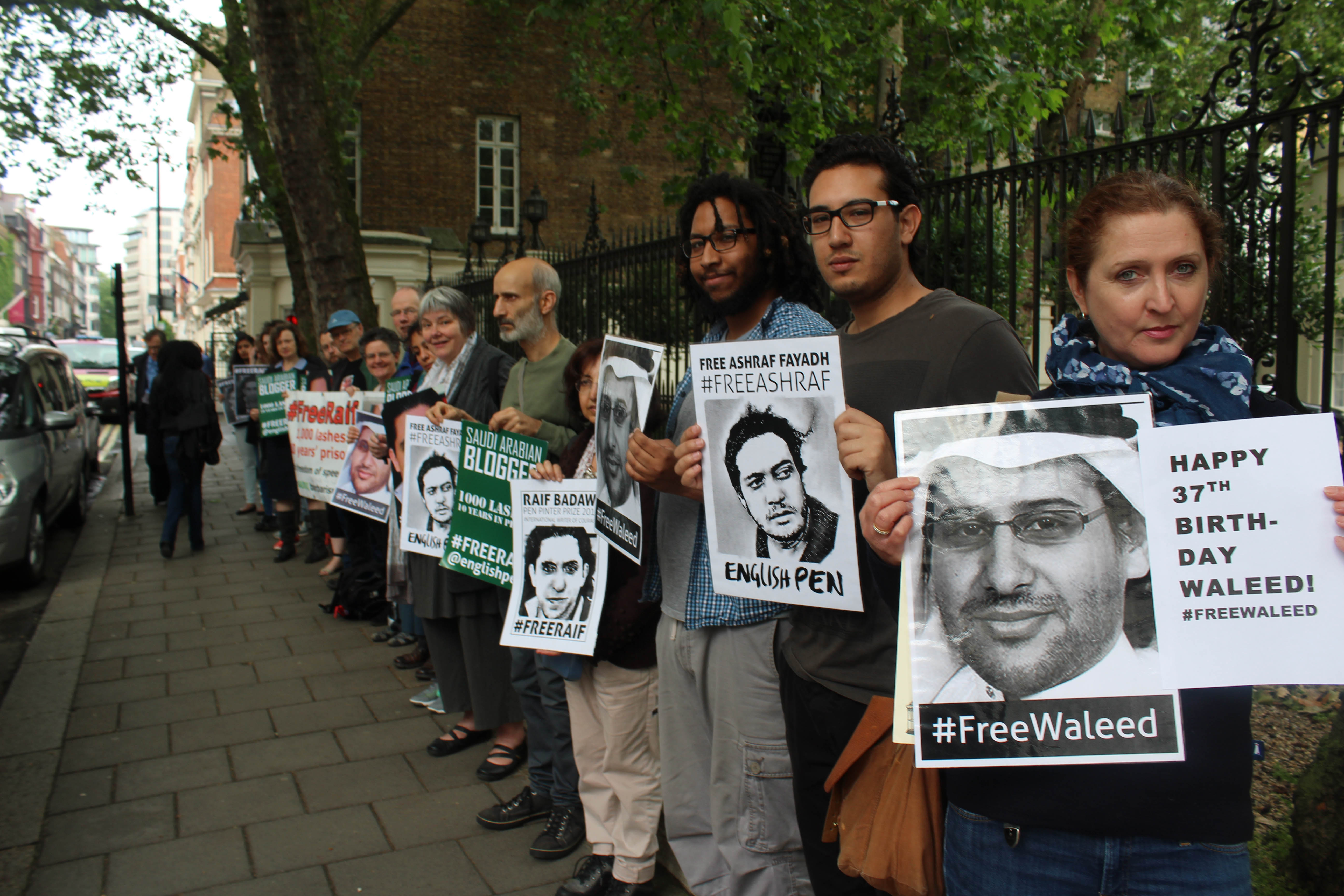
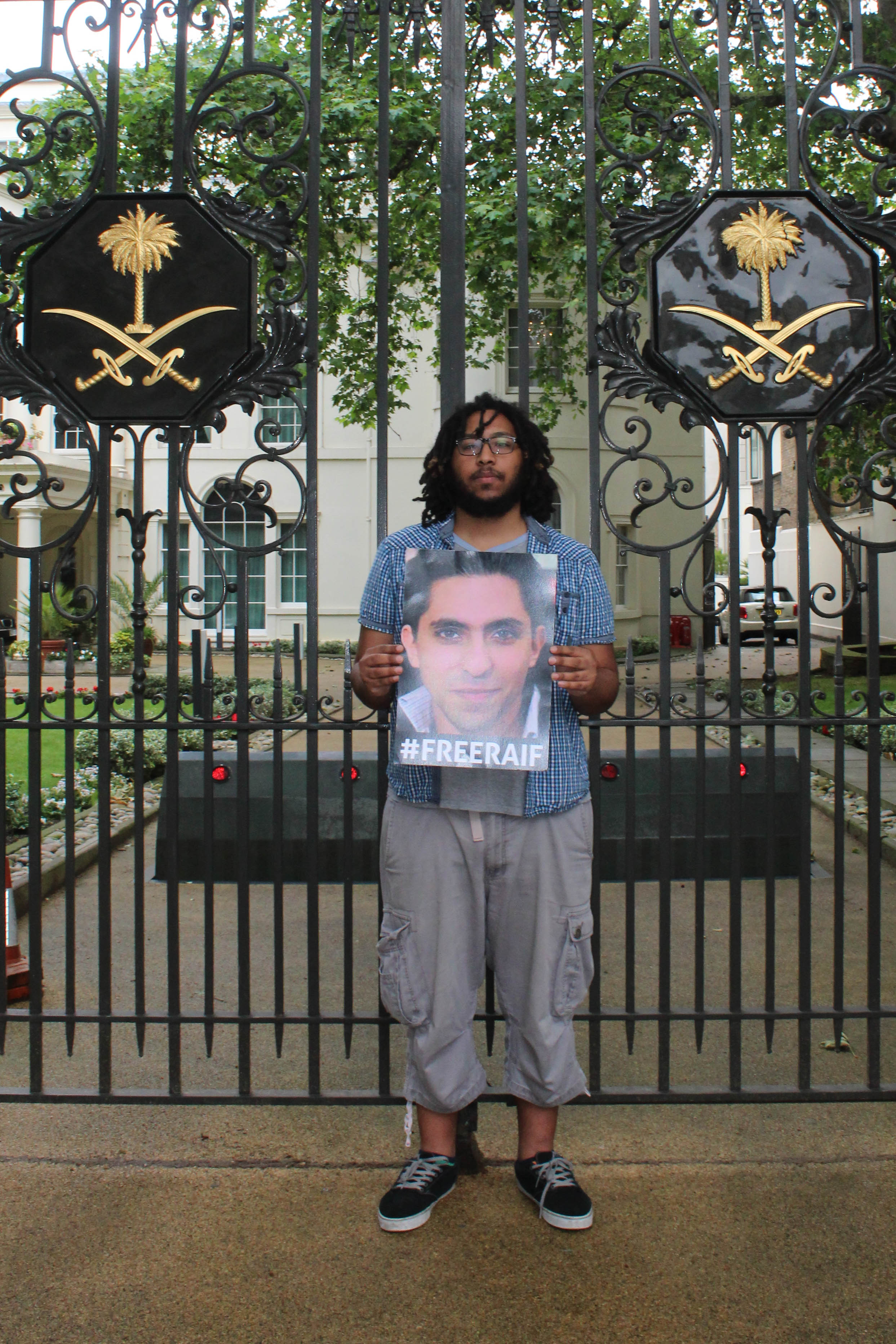
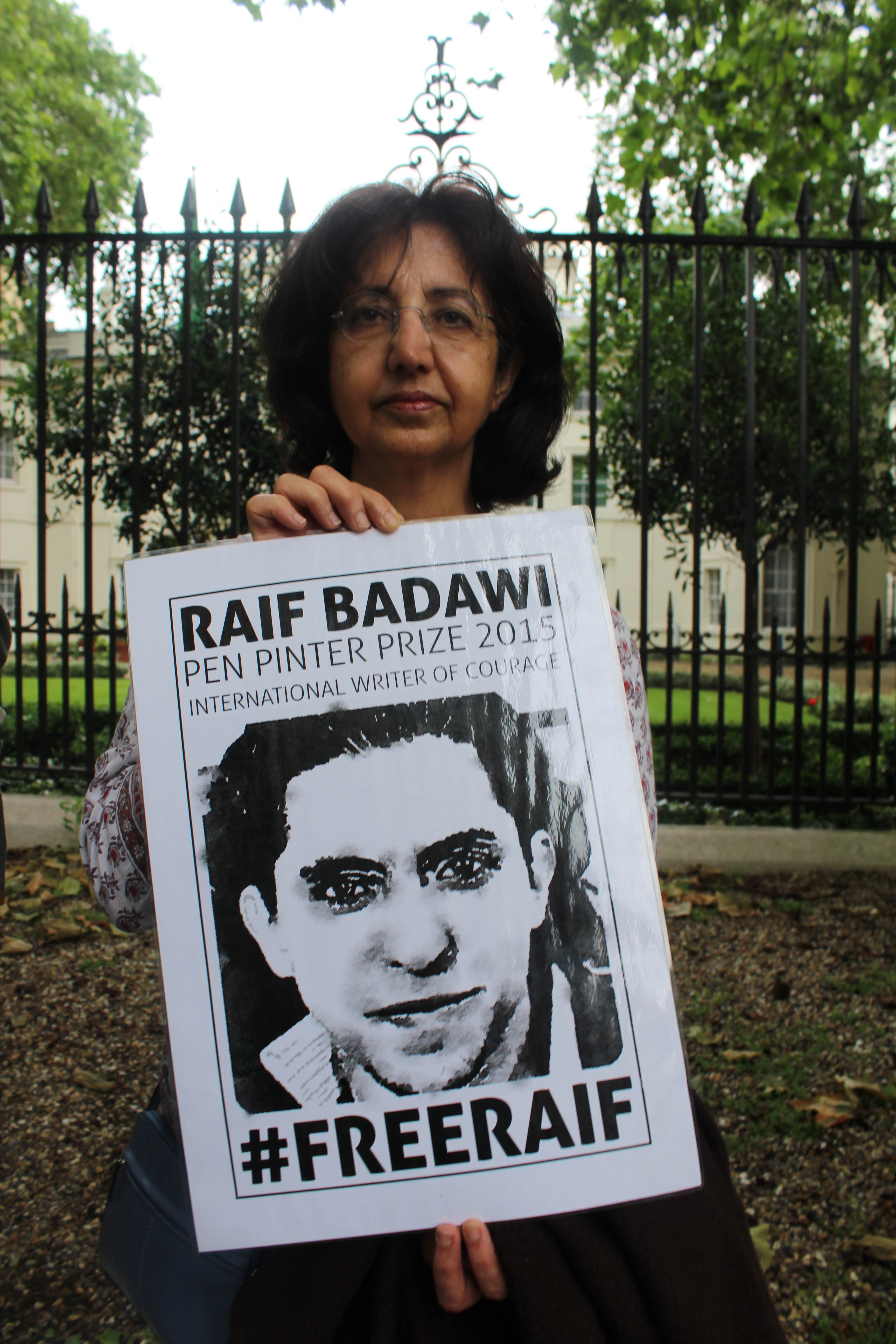
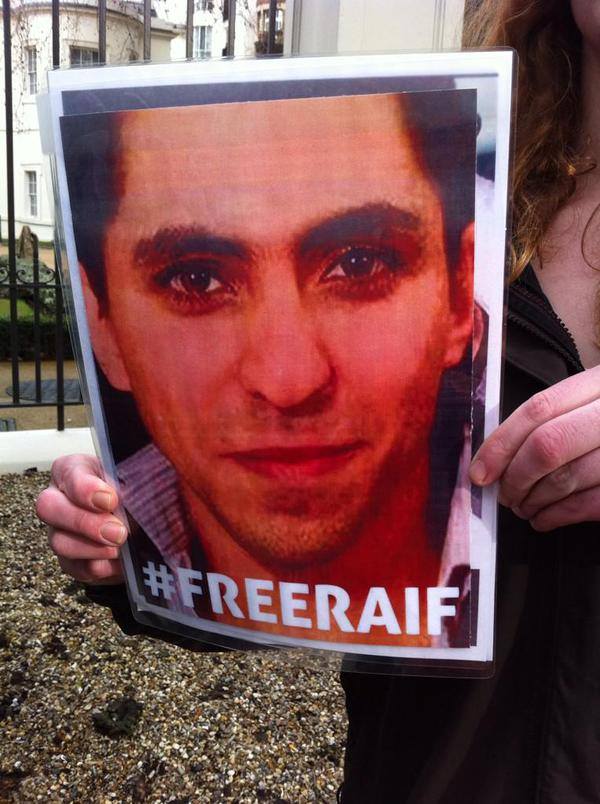
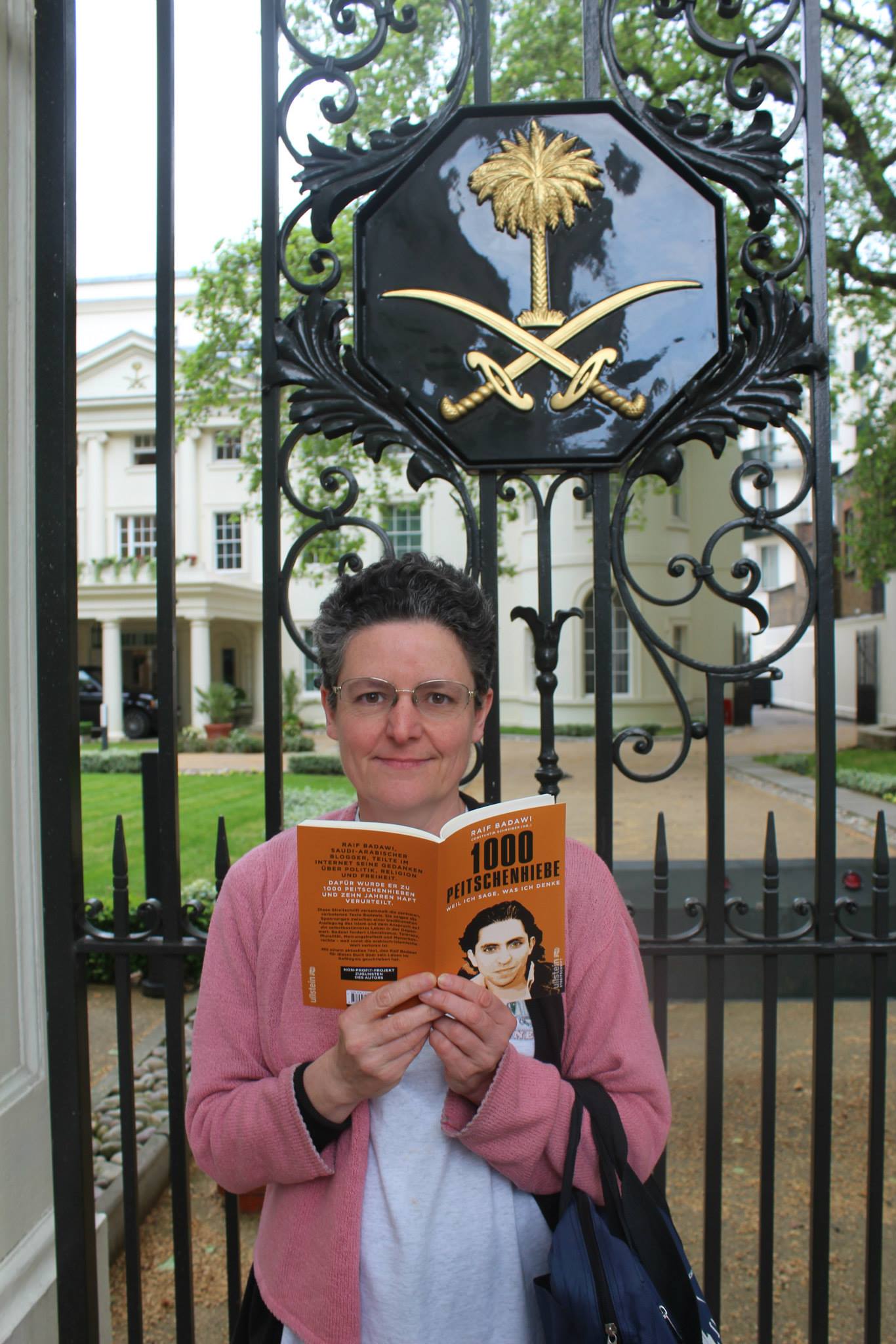
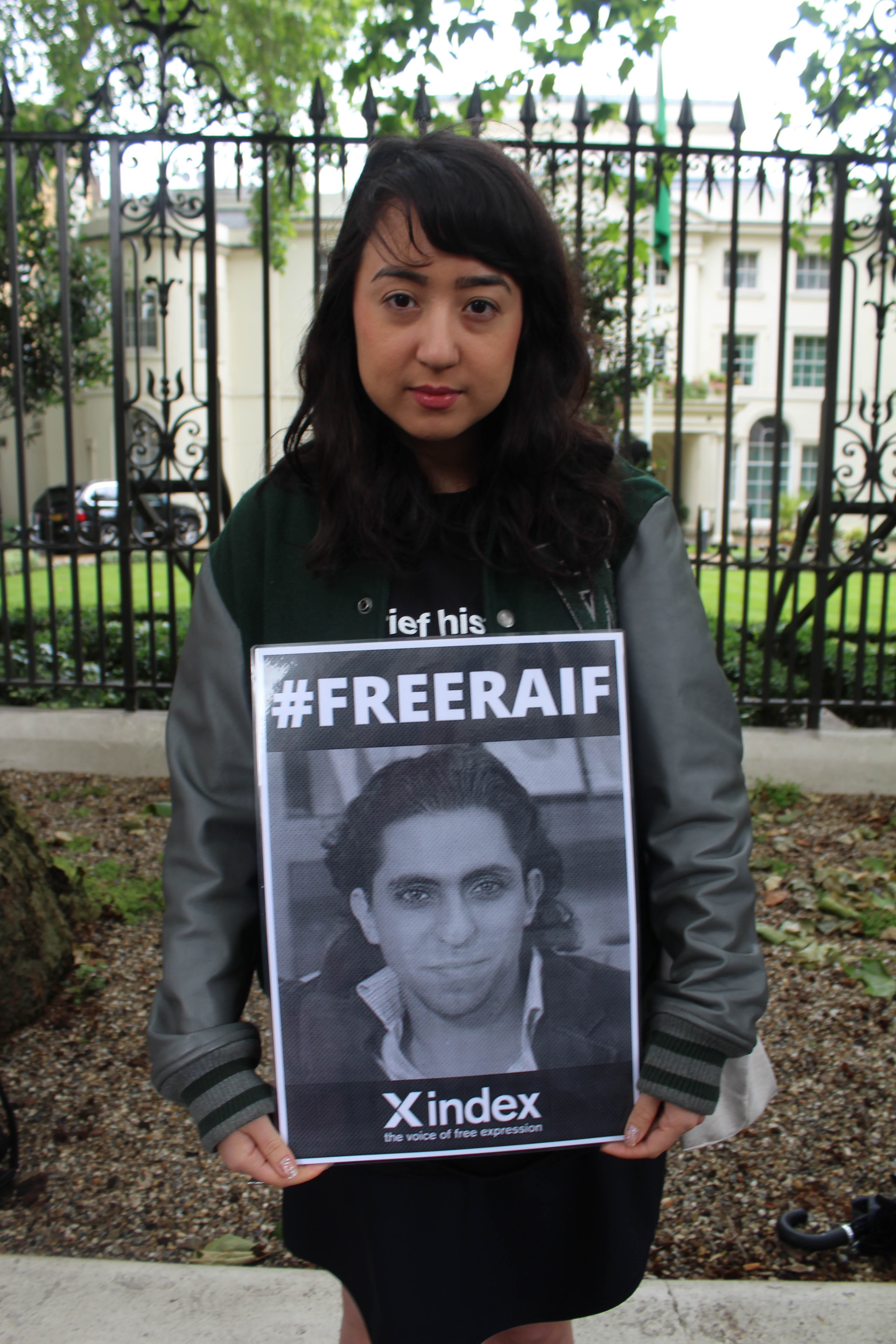
Index on Censorship joined English Pen and several other organisations on Friday outside the Saudi Arabian embassy in London to call for the immediate release of Raif Badawi. The Saudi blogger was arrested four years ago on 17 June 2012. He was subsequently sentenced to 10 years in prison and 1,000 lashes for creating the website Free Saudi Liberals and “insulting Islam through electronic channels”.
Badawi received his first 50 lashes in the port city of Jeddah on Friday 9 January, after which the world took notice. The attention has been invaluable in delaying the remainder of his lashing, which his wife Ensaf Haidar says he won’t be able to survive.
It is crucial that we continue to take a stand against the Saudi government’s treatment of Raif Badawi. Index spoke with several of the protesters in London.
Credit: Cat Lucas, English Pen
Imad Iddine Habib, spokesperson of the Council of Ex-Muslims of Britain
“I come from Western Sahara and I’m here today because I knew Raif Badawi through his writings, have been to his websites and I know his family. This campaign is very close to my heart. Raif is in prison for writing and offering a space for a lot of Saudis that don’t fall in line with the thinking of the regime and the conservatives. I would hope to see more and more people stepping up to call out Saudi Arabia and the oppressive and anti-human rights laws they are implementing. Increasingly these laws are used against atheists and free thinkers, who are being judged as terrorists.”
Credit: Cat Lucas, English Pen
Ravinder Randhawa, novelist
“As a writer, I feel that freedom of expression is the most important freedom that humanity has. In all societies, dialogue and discourse are the manners in which we examine ourselves and move forward. Raif was doing precisely that. He was encouraging dialogue and debate which was peaceful and non-harmful, and his punishment is unjustified and barbaric. Raif is a great person for speaking out regardless of the consequences. I’m here to support his cause and the cause of many other writers who are imprisoned. I’m here as a writer in solidarity with another writer.”
Credit: Cat Lucas, English Pen
Cat Lucas, English Pen
“Unfortunately, here we are outside the Saudi embassy – again. We’ve been coming here for 18 months in support of imprisoned blogger Raif Badawi, firstly with 20 consecutive weekly protests following his lashing, and now we protest here monthly. Today not only marks the fourth anniversary of Raif’s arrest but his lawyer Waleed Abulkhair’s 37th birthday. Waleed is serving a 15-year sentence. We are here to continue to call on the authorities to release them both, which is now more important than ever as we have learned this week that both have been hospitalised following a hunger strike. We know these protests are a really big deal for them.”
Credit: Cat Lucas, English Pen
Susan Dorrell, Activist
“I come here quite frequently — I’m one of the regulars. It’s very important to stand up for freedom of expression and Raif symbolises thousands of people across the world who suffers persecution as a result of expressing a peaceful opinion. He’s a victim of religious-led persecution and anyone who believes in free speech should support him.”
Credit: Cat Lucas, English Pen
Hannah Machlin, Project Officer, Index on Censorship
“We are here in solidarity with Raif. Index on Censorship is particularly concerned with his public lashings, the second set of which has been delayed due to his health problems. If the Saudi government conducts the rest of his lashings in private, as they said they will, there are much more opportunities for abuse. He may not survive and this is why we must not turn a blind eye.”
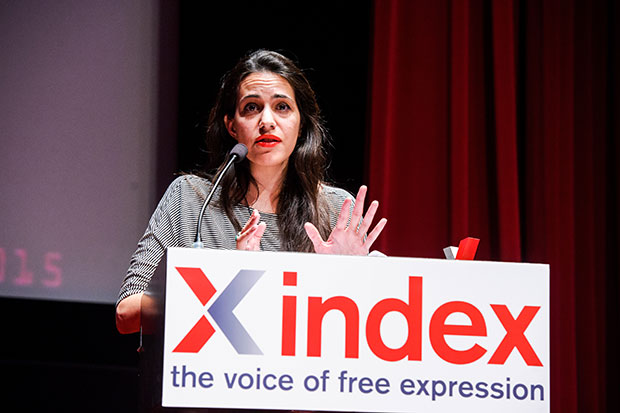
Safa Al Ahmad has spent the last three years covertly filming a mass uprising in Saudi Arabia’s Eastern Province that had, until her film, gone largely unreported. She did this in a country where those accused of dissent can face execution and travelling solo as a female is restricted. Al Ahmad’s 30-minute documentary, Saudi’s Secret Uprising, gave a rare glimpse of civil unrest from the region when it was broadcast by the BBC in May 2014. Since her important documentary aired Al Ahmad has faced extensive and violent online threats, and has been advised for her own safety not to return to her country. She is the joint recipient of the 2015 Index on Censorship Freedom of Expression Award for Journalism.
Saudi Arabia is a mystery, even to its own people.
Parts of our history deliberately concealed, the present muddled with rumours and half-truths.
The government-owned and controlled media play a major role in the dissemination of those false realities of ourselves and others.
This makes facts a precious commodity in Saudi Arabia.
The uprising in the east of Saudi Arabia is a perfect example of how well the government has succeeded in controlling the story and the narrative around an unprecedented event in modern Saudi history. And it also exposes the failure of media in not cutting through the government’s narrative.
Since the protests started in Qatif in early 2011 along with the rest of the Arab world, youth were arrested and given death sentences for posting on Facebook, like Mohmed Alnmir. Poets like Adel Al Labad, and human rights activist Fathil Al Manasif were given 15 year sentences for threatening “social stability”. So called anti-terrorism laws were introduced to criminalise most forms of dissent.
For the film I made that tells this story, and shares my opinions, I have been accused of lying and spying, advocating terrorism, aiding and abetting terrorists, and of course I have been called a heretic.
As a journalist in the Middle East people think they have the right to constantly ask what religion or sect you belong to and judge your work accordingly. It has become nearly impossible to do a story without talking about Sunnis and Shia. But sectarianism is used as a tool, as a weapon, to further confuse and tangle an already complicated political landscape. It has become acceptable reductive language in the media, both Arab and western, to explain our world.
In Saudi Arabia, it was used to isolate and crush a fledgling uprising. A clever way to stop the rest of the country from joining those who have the same demands – to stop political oppression, free political prisoners, have transparent and just courts, stop corruption, and have equal rights for all citizens.
But in the end, the uprising became reduced into a story of “Shia” minority protesting the majority Sunni rulers. A true statement at face value, but not the whole complicated, messy truth.
Documentary maker and journalist Safa Al Ahmad (Photo: Alex Brenner for Index on Censorship)
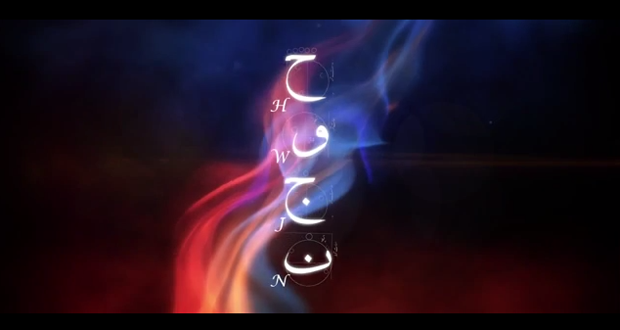
A shot from the YouTube trailer for H W J N (Image: Yatakhayaloon Sci Fi/YouTube)
A top selling Saudi Arabian science fiction novel has been removed from book shops across the country.
Last Tuesday (26 Nov) representatives from the country’s Commission for the Promotion of Virtue and Prevention of Vice — the Haya’a — raided several bookshops selling the novel H W J N by Ibraheem Abbas and Yasser Bahjatt’s, demanding it’d be taken off the shelves. H W J N is a “fantasy, sci-fi and romance” novel about a genie who falls in love with a human, and is a best-seller in Saudi Arabia.
Our source, who wishes to remain anonymous, says the book is charged with “blasphemy and devil-worshiping”. They add that the ban appears to stem from a Facebook post accusing the novel of “referencing jinn [genies] and leading teenage girls to experiment with Ouija boards”.
An official, handwritten letter was delivered to at least one book store from the government body. It stated, among other things that: “We purchased one copy of the book to review and we have counted 73 copies of H W J N by Ibarheem Abbas at your shop. You are requested not to dispose of, sell, or return these books until further notice.” The owners were also asked to “follow up” on this with the Haya’a the following day (27 Nov).
The detention of an Egyptian human rights lawyer shortly after his arrival in Saudi Arabia last week to perform Umrah (or lesser pilgrimage) has evoked outrage and a wave of anti-Saudi protests in Egypt. The case has brought to light the deep resentment harboured by a sizeable portion of Egypt’s population against the oil-rich kingdom for alleged rights violations practiced by the monarchy against Egyptian migrant workers. It has also caused a rift between Egypt and the ultra-conservative Gulf country — one that has culminated in the withdrawal of the Saudi Ambassador to Egypt.
Scores of protesters gathered outside the Saudi Embassy in Dokki on Tuesday demanding the immediate release of activist and lawyer Ahmed El Gizawi who was tried in absentia and sentenced to one year in prison and 20 lashes for insulting the Saudi monarch. El Gizawi had earlier sued Saudi King Abdalla Bin Abdel Aziz for “the unlawful detention of Egyptian workers in Saudi prisons without charge.” He was arrested on arrival in the Saudi kingdom despite having obtained an entry visa to perform the religious rituals of Umrah.
In a show of support for El Gizawi, the protesters chanted “down with the Saudi family”. They vowed to take their revolution to Medina. Some waved their shoes in the air in a sign of disrespect for the Saudi authorities.
“It is unacceptable that Egyptian authorities are turning a blind eye and allowing Egyptians to continue to be stripped of their dignity after our revolution, ” retorted an angry middle-aged protester.
“If Gizawi is not released in the next few days, we will take matters in our own hands,” threatened another.
Protesters’ cries of “one hundred lashes for the Saudi Ambassador” could be heard several blocks away from the Embassy.
The issue is the subject of a lively debate on social media, which is once again being used by the activists to vent their frustration. This time the anger is directed at the Saudi royal family, not the Egyptian authorities. Facebook posts and tweets on the issue teeter between humorous sarcasm and offensive insults.
“You have recalled the Saudi Ambassador. We are hoping that the next step will be for the Saudis to stop the sweeping tide of Wahhabism exported to us from Saudi Arabia,” noted cyber-activist Yasmin Amin.
“When a Danish cartoon insulted Prophet Mohamed, Saudi officials did not react but when King Abdalla was insulted by an Egyptian lawyer, the Saudi Ambassador in Cairo was recalled to his country,” read another Facebook post.
Many of the activists are sceptical about Saudi accusations that El Gizawi was trying to smuggle narcotic tablets into the country — a serious charge punishable by death in Saudi Arabia. Egyptian Foreign Ministry officials have tried to appease the public, saying they are “in constant contact with Saudi counterparts to diffuse the crisis.”
Since the oil boom in the seventies, millions of Egyptian migrant workers have traveled to the oil- rich country seeking jobs and better lives for themselves and their families. But earning higher incomes has not come without a price. Graphic stories of their maltreatment by Saudi nationals and authorities have for years been reported by the Egyptian press fuelling anger and deepening the divide between the peoples of the two countries (staunch allies under ousted President Hosni Mubarak).
Before last year’s mass uprising in Tahrir Square, Egypt was a popular holiday destination for many Saudis because “Egypt is a freer, more open society and because of its affordable holiday rates,” according to a Gulf tourist who did not want to be named. Many wealthy Gulf holiday-makers frequent Egypt’s nightclubs, gambling casinos and brothels, lavishly spending petro-dollars on alcohol and prostitution because of restrictions on both in their own countries.
In a country where tourism is the number one foreign currency earner and a source of livelihood for millions of Egyptians, Egyptian authorities have for years encouraged tourism from the Gulf turning a blind eye to some of the negative aspects this type of tourism brings, such as the seasonal marriages that are commonplace in Egypt and which are considered a form of human trafficking: Deprived Egyptian families “sell” their daughters in marriage to wealthy Gulf visitors seeking brides who are often a lot younger than their ageing grooms. Many of these elderly husbands abandon their young Egyptian wives after a few brief months (sometimes weeks) returning home to their countries never to be heard of again. In many cases, the brides become pregnant and are left to fend for their children on their own after the disappearance of their “husbands”. Worse still, these child brides are exposed to an increased risk of HIV/AIDs because their husbands practice polygamy.
Liberal Egyptians are also concerned about the growing tide of Wahhabism, a rigid type of Islam exported to Egypt in recent decades from Saudi Arabia. Ultra-conservative Salafi principles like the face veil or nikab for women are a manifestation of this trend, rejected by Egyptian secularists. Many intellectuals and liberals complain that Egypt has been “Saudised” thanks to numerous Saudi-funded satellite channels infiltrating Egypt’s airspace during the Mubarak era. There are increasing suspicions that Saudi Arabia is pouring millions of petro-dollars into Egypt to fund Islamists who want Islamic Sharia law to be the source of all legislation in the country. “The Saudis are ready to do whatever they can to stop our revolution from reaching their shores,” explained Ibrahim el Toukhy, who owns a Red Sea tourist resort.
“We had our revolution to claim Egypt back from the grip of the Saudis, ” said political analyst Emad Gad from AlAhram Center for Political Studies. “Egypt has always been moderate and must remain so.”
In the meantime, the fate of one Egyptian rights activist hangs in the balance.
Journalist Shahira Amin resigned from her post as deputy head of state-run Nile TV in February 2011. Read why she resigned from the “propaganda machine” here.