3 Feb 2016 | Europe and Central Asia, Index Reports, News, Turkey Reports
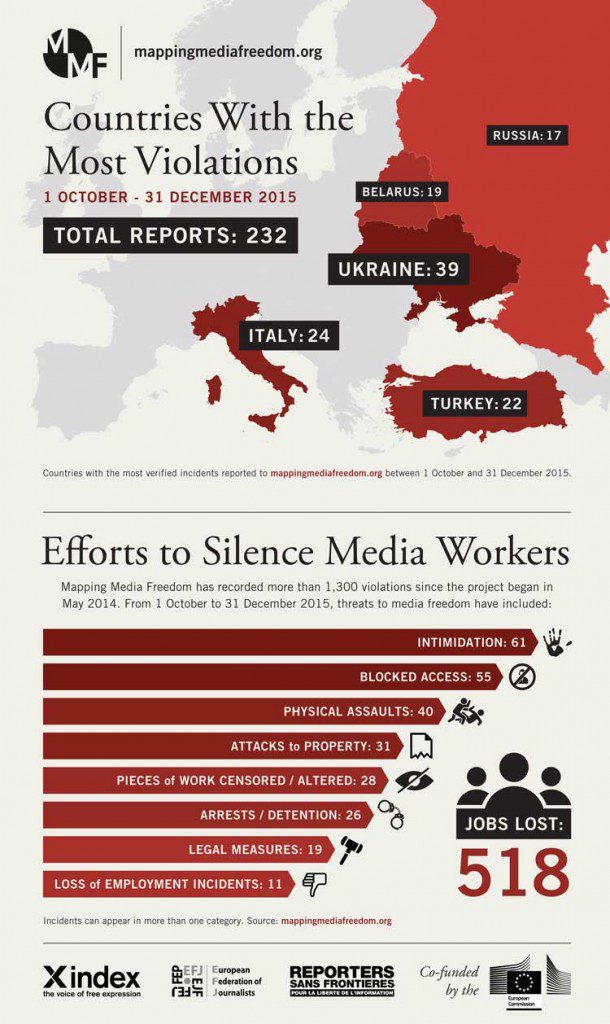
Pressure on Europe’s journalists as they do their jobs saw no let up during the fourth quarter of 2015, according to a survey of verified incidents of violations reported to Index on Censorship’s project Mapping Media Freedom.
Between 1 October and 31 December 2015, Mapping Media Freedom‘s network of 19 correspondents verified 232 reports that were submitted to the database. Each report is reviewed for factual accuracy and confirmed with local sources before an incident is publicly available on the map. The platform — a joint undertaking with the European Federation of Journalists and Reporters Without Borders and partially funded by the European Commission — covers 40 countries, including all EU member states, Albania, Belarus, Bosnia, Iceland, Kosovo, Macedonia, Montenegro, Norway, Russia, Serbia, Turkey and Ukraine. Since it was launched in May 2014, the map has recorded over 1,300 violations of media freedom.
During the fourth quarter of 2015: 518 media jobs were lost; two media workers reporting on the Syrian conflict were killed in Turkey; 40 reports of physical assaults on media professionals were confirmed; media workers were detained in 26 cases with criminal charges filed in 11 cases; media professionals were blocked from covering a story in 55 verified incidents; and journalists were subject to public denigration in 22 of the verified reports.
The full report is available at Mapping Media Freedom and in PDF.
19 Jan 2016 | Bahrain, Bahrain Statements, Campaigns, Statements
NGOs from the around the world call for the immediate release of prisoner of conscience Dr. Abduljalil al-Singace on his 300th day of hunger strike. Dr. al-Singace began his hunger strike in March 2015 as a response to police subjecting inmates at the Central Jau Prison to collective punishment, humiliation and torture.
Since 21 March 2015, Dr. al-Singace has foregone food and subsisted on water and IV fluid injections for sustenance. Days later, Jau prison authorities transferred him to the Qalaa hospital, where he is still being kept in a form of solitary confinement.
Dr. al-Singace’s family, who visited him on 7 January, state that the prison administration is controlling his treatment at Qalaa hospital, and has for five months continuously, denied his need for a physical checkup by his hematologist at Salmaniya Medical Complex.
According to Dr. al-Singace’s family, he is not allowed to walk outside. He remains isolated in the Qalaa hospital, and is provided only irregular contact with his family. He is frequently denied basic hygienic items including soap, and is not allowed to interact with other patients in the hospital.
Dr. al-Singace is a member of the Bahrain 13, a group of thirteen peaceful political activists and human rights defenders, including Ebrahim Sharif and Abdulhadi al-Khawaja, sentenced to prison terms for their peaceful role in Bahrain’s Arab Spring protests in 2011.
Dr. al-Singace was first arrested in August 2010 at Bahrain airport. He had just returned from a conference at the British House of Lords regarding human rights in Bahrain. Security forces detained Dr. al-Singace for six months, during which he was tortured, and released him in February 2011 during the height of protests. However, Dr. al-Singace was rearrested on 17 March 2011, after his participation in peaceful pro-democracy protests. In detention, officers blindfolded, handcuffed, and beat Dr. al-Singace in the head with their fists and batons. Officers threatened him and his family with reprisals.
On 22 June 2011, a military court sentenced Dr. al-Singace to life for attempted overthrow of the regime. Since then, he has been imprisoned in the Central Jau Prison, and has only recently received treatment for a nose injury sustained during torture. He has been denied treatment for a similar ear injury also sustained during torture since his incarceration.
In 2015, Dr. al-Singace was awarded the Liu Xiaobo Courage to Write Award by the Independent Chinese PEN Centre, and was named one of Index on Censorship’s 100 “free expression heroes” in 2016. He has long campaigned for an end to torture and political reform, writing on these and other subjects on his blog, Al-Faseela, which remains banned by Bahraini Internet Service Providers. Bahrain has become a dangerous place for those who speak out, with peaceful dissidents at risk of arbitrary arrests, systematic torture and unfair trial.
We, the undersigned NGOs, call on the government of Bahrain to immediately secure the release of Dr. al-Singace and all prisoners of conscience, and to provide all appropriate and necessary medical treatment for Dr. al-Singace.
Signatories:
Americans for Democracy and Human Rights in Bahrain (ADHRB)
ARTICLE 19
Bahrain Center for Human Rights (BCHR)
Bahrain Institute for Rights and Democracy (BIRD)
Committee to Protect Journalists (CPJ)
Croatian PEN
Danish PEN
English PEN
European Center for Democracy and Human Rights (ECDHR)
FIDH, within the framework of the Observatory for the Protection of Human Rights Defenders
Ghanaian PEN
Gulf Centre for Human Rights (GCHR)
Icelandic PEN
Index on Censorship
Italian PEN
Norwegian PEN
PEN America
PEN Bangladesh
PEN Bolivia
PEN Canada
PEN Català
PEN Center Argentina
PEN Center USA
PEN Centre of German Speaking Writers Abroad
PEN Eritrea in Exile
PEN Flander
PEN Germany
PEN International
PEN Netherlands
PEN New Zealand
PEN Québéc
PEN Romania
PEN South Africa
PEN Suisse Romand
Peruvian PEN
Reporters Sans Frontiers (RSF)
San Miguel PEN
Scholars at Risk
Scottish PEN
Serbian PEN
Trieste PEN
Wales PEN Cymru
World Organisation Against Torture (OMCT), within the framework of the Observatory for the Protection of Human Rights Defenders
Zambian PEN
8 Jan 2016 | Belarus, Greece, Hungary, Italy, Lithuania, Macedonia, Mapping Media Freedom, News, Poland, Portugal, Serbia, Turkey
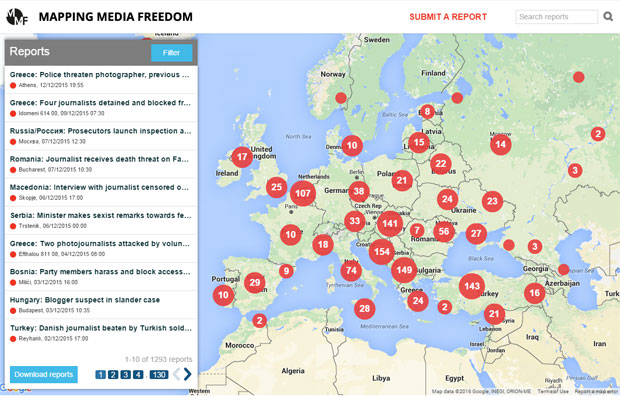
The attacks on the offices of satirical magazine Charlie Hebdo in Paris in January set the tone for conditions for media professionals in 2015. Throughout the year, Index on Censorship’s Mapping Media Freedom correspondents verified a total of 745 violations of media freedom across Europe.
From the murders of journalists in Russia, Poland and Turkey to the growing threat posed by far-right extremists in Germany and government interference in Hungary — right down to the increasingly harsh legal measures imposed on reporters right across the continent — Mapping Media Freedom exposed many difficulties media workers face in simply doing their jobs.
“Last year was a tumultuous one for press freedom; from the attacks at Charlie Hebdo to the refugee crisis-related aggressions, Index observed many threats to the media across Europe,” said Hannah Machlin, Index on Censorship’s project officer for the Mapping Media Freedom project. “To highlight the important cases and trends of the year, we’ve asked our correspondents, who have been carefully monitoring the region, to discuss one violation each that stood out to them.”
Belarus / 19 verified reports between May-Dec 2015
Journalist blocked from shooting entrance to polling station
“It demonstrates the Belarusian authorities’ attitude to media as well as ‘transparency’ of the presidential election – the most important event in the current year.” — Ольга К.-Сехович
Greece / 15 verified reports in 2015
Four journalists detained and blocked from covering refugee operation
“This is important because it is typical ‘attempt to limit press freedom’, as the Union wrote in a statement and it is not very hopeful for the future. The way refugees and migrants are treated is very sensitive and media should not be prevented from covering this issue.” — Christina Vasilaki
Hungary / 57 verified reports in 2015
Serbian camera crew beaten by border police
“These physical attacks, the harsh treatment and detention of journalists are striking because the Hungarian government usually uses ‘soft censorship’ to control media and journalists, they rarely use brute force.” — Zoltan Sipos
Italy / 72 verified reports in 2015
Italian journalists face up to eight years in prison for corruption investigation
“I chose it because this case is really serious: the journalists Emiliano Fittipaldi and Gianluigi Nuzzi are facing up to eight years in prison for publishing books on corruption in the Vatican. This case could have a chilling effect on press freedom. It is really important that journalists investigate and they must be free to do that.” — Rossella Ricchiuti
Lithuania / 9 verified reports in 2015
Journalist repeatedly harassed and pushed out of local area
“I chose it because I found it relevant to my personal experience and the fellow journalist has been the only one to have responded to my hundreds of e-mails — including requests to fellow Lithuanian journalists to share their personal experience on media freedom.” — Linas Jegelevicius
Macedonia / 27 verified reports in 2015
Journalist publicly assaults another journalist
“I have chosen this incident because it best describes the recent trend not only in Macedonia and my other three designated countries, Croatia, Bosnia and Montenegro, but also in the whole region. And that is polarization among journalists, more and more verbal and, like in this unique case, physical assaults among colleagues. It best describes the ongoing trend where journalists are not united in safeguarding public interest but are nothing more than a tool in the hands of political and financial elites. It describes the division between pro-opposition and pro-government journalists. It is a clear example of absolute deviation from the journalistic ethic.” — Ilcho Cvetanoski
Poland / 11 verified reports in 2015
Law on public service broadcasting removes independence guarantees
“The new media law, which was passed through Poland`s two-chamber parliament in the last week of December, constitutes a severe threat to pluralism of opinions in Poland, as it is aimed at streamlining public media along the lines of the PiS party that holds the overall majority. The law is currently only awaiting president Duda’s signature, who is a close PiS ally.” — Martha Otwinowski
Portugal / 9 verified reports in 2015
Two-thirds of newspaper employees will be laid off
“It’s a clear picture of the media in Portugal, which depends on investors who show no interest in a healthy, well-informed democracy, but rather in how owning a newspaper can help them achieve their goals — and when these are not met they don’t hesitate to jump boat, leaving hundreds unemployed.” — João de Almeida Dias
Russia / 37 verified reports between May-Dec 2015
Media freedom NGO recognised as foreign agent, faces closure
“The most important trend of the 2015 in Russia is the continuing pressure over the civil society. More than 100 Russian civil rights advocacy NGOs were recognized as organisations acting as foreign agents which leads to double control and reporting, to intimidation and insulting of activists, e.g., by the state-owned media. Many of them faced large fines and were forced to closure.” — Andrey Kalikh
Russia / 37 verified reports between May-Dec 2015
TV2 loses counter claim to renew broadcasting license Roskomnadzor
“It illustrates the crackdown on independent local media, which can not fight against the state officials even if they have support from the audience and professional community.” — Ekaterina Buchneva
Serbia / 41 verified reports in 2015
Investigative journalist severely beaten with metal bars
“It’s a disgrace and a flash-back to Serbia’s dark past that a journalist, who’s well known for investigating high-level corruption, get’s beaten up with metal bars late at night by ‘unknown men’.” — Mitra Nazar
Turkey / 97 verified reports in 2015
Police storm offices of Koza İpek, interrupting broadcast
“The raid on Bugün and Kanaltürk’s offices just days ahead of parliamentary elections was a drastic example — broadcasts were cut by police and around 100 journalists ended up losing their jobs over the next month — of how the current Turkish government tries to strong-arm media organisations.” — Catherine Stupp
Mapping Media Freedom
Click on the bubbles to view reports or double-click to zoom in on specific regions. The full site can be accessed at https://mappingmediafreedom.org/
|
11 Dec 2015 | Azerbaijan, Azerbaijan Statements, Campaigns, Europe and Central Asia, mobile
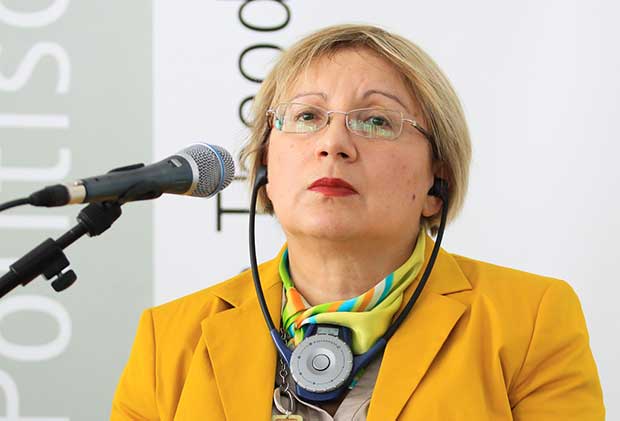
Leyla Yunus (Photo: Human Rights Watch)
We — members of the Civic Solidarity Platform and the Sports For Rights Campaign — were relieved to learn that one of Azerbaijan’s most well-known political prisoners, Leyla Yunus, was released from detention yesterday and that that the Baku City Court of Appeal changed her sentence and that of her husband Arif into suspended sentences of 5 years, on probation. However, most of the charges against the couple have not been dropped and, while on probation, Leyla and Arif Yunus will not be able to leave the country. We remain seriously concerned about the state of health of Leyla Yunus, who has been diagnosed with diabetes and hepatitis C, and that of Arif Yunus, who suffers from high blood pressure. There are doubts that adequate medical assistance can be provided to Leyla Yunus in Azerbaijan.
As part of the ongoing civil society crackdown in Azerbaijan, Leyla and her husband Arif were arrested in late July and early August 2014, respectively. On 13 August 2015, they were convicted on charges of large‑scale fraud and tax evasion. Leyla was sentenced to 8.5 years in prison and Arif to 7 years. While in detention, they were humiliated by police officers, put in overcrowded cells, beaten several times and deprived of much needed medical treatment. On 13 November 2015, Arif Yunus was released under house arrest on health grounds. When ruling to change the sentences, the court of appeal dropped the charges of forgery, but retained others. The court also lifted the order to seize the house owned by the couple.
We, members of the Civic Solidarity Platform and the Sports for Rights Campaign, consider the new developments in the case of Arif and Leyla Yunus to be positive and a first step in the right direction. However, we continue to call for all charges against the couple to be dropped. Leyla Yunus requires an urgent medical examination and she should be granted the right to receive medical treatment abroad if necessary. Arif Yunus must also be provided with swift and adequate medical assistance.
Leyla and Arif Yunus are not the only political prisoners in Azerbaijan. Dozens of other civil society activists, human rights lawyers and journalists remain in detention or prison in Azerbaijan solely due to their professional activities and the peaceful and legitimate exercise of their fundamental rights and freedoms. They should be immediately and unconditionally released. The Azerbaijani government must respect its commitments before its own people, as well as its obligations under international human rights law.
Signed by:
Analytical Center for Interethnic Cooperation and Consultations
Article 19
Association UMDPL
Bulgarian Helsinki Committee
Baris Zvozkau Belarusian Human Rights House
Center for Civil liberties
Center for the Development of Democracy and Human Rights
Crude Accountability
Freedom Files
Helsinki Committee for Human Rights in Serbia
Helsinki Foundation for Human Rights
Human Rights House Foundation
Human Rights Monitoring Institute
Human Rights Movement “Bir Duino-Kyrgyzstan”
Index on Censorship
International Federation for Human Rights (FIDH)
International Partnership for Human Rights
Kazakhstan International Bureau for Human Rights and Rule of Law
Kosova Rehabilitation Centre for Torture Victims
KRF Public Alternative
Legal Transformation Center
Moscow Helsinki Group
Netherlands Helsinki Committee
Norwegian Helsinki Committee
Nota Bene
Promo LEX
Public Verdict Foundation
SOVA Center for Information and Analyses
Sports For Rights
Swiss Helsinki Committee
World Organization against Torture (OMCT)
