19 Dec 2025 | Africa, Features, Middle East and North Africa, Morocco, Volume 54.04 Winter 2025
As the Africa Cup of Nations kicks off on Sunday and tens of thousands of football fans descend on Morocco, we should remember the thousands of Gen Z protesters who were arrested and beaten when they took to the streets following the death of eight women in a maternity hospital in Agadir. They are now being prosecuted and some – including minors under 12 – have already been sentenced to hundreds of years in prison. It was partly football that sparked the anger. Young people saw beautiful stadiums being built, but hospitals so crumbling they couldn’t even keep mothers safe. Read the full story by Omar Radi, whose piece appears in the Winter 2025 issue of Index on Censorship, Gen Z is revolting: Why the world’s youth will not be silenced, published on 18 December 2025.
Saturday, 27 September. At Casablanca’s Arab League Park, riot police and plainclothes agents gather in uneasy groups. Their presence is heavy and full of expectation, a show of state power preparing for a confrontation it doesn’t fully understand. By late afternoon the reason for the confusion is clear. For the first time, the authorities are facing a youth protest movement without leaders, without clear origins, formed not in political party offices or student unions, but on Discord – a platform that feels almost like science fiction to old-style security forces. The youth are anonymous, impossible to track, and everywhere.
At first, they were gamers and football supporters – voices echoing through Discord chat rooms, more familiar with memes than with political public life. Politics had been something happening elsewhere. But then there was a shift. The country’s quiet crisis found its way into their feeds. The trigger? Eight women admitted into a maternity ward at a public hospital in Agadir, in southern Morocco. None came out alive – a shortage of staff, a lack of resources, and a system too broken to respond until it was too late.
Football’s soft power
Following Morocco’s unexpected fourth-place finish at the 2022 FIFA World Cup in Qatar, football has become the cornerstone of the country’s soft power strategy. The momentum carried into 2023, when Morocco was awarded co-hosting rights for the 2030 World Cup alongside Spain and Portugal – a diplomatic victory dressed in sport. Since then, public policy has tilted toward a single, obsessive goal: turning parts of the country’s major cities into acceptable playgrounds for the global guests who will descend upon Morocco for one month in 2030. Billions of dollars are being poured into infrastructure, stadiums and urban makeovers.
The contradiction, however, is hard to ignore. In a country where hospitals resemble warzones and schools are crumbling, the dazzling promise of football has become, for many, a bitter spectacle. Morocco is a nation in love with the game – few would deny that. But among its citizens, the joy of hosting the World Cup is tinged with disillusion. The tragic deaths of eight women during childbirth was a tipping point. For the country’s youth, the women’s fate was no longer just about bad governance. It was personal.
“We don’t want to do politics,” one young activist who uses Discord, told Index. “We’re not asking for a new constitution or a regime change. We just want our hospitals to be as good as our football stadiums.”
At 6.00pm, as the protest was set to begin, the government issued a blanket ban on all public gatherings across Morocco. In Casablanca, police blocked access to public squares, surrounded potential meeting points, and deployed familiar intimidation tactics – threats, beatings, arrests. Undeterred, young protesters splintered into smaller groups, reappearing in alleyways and side streets, improvising a kind of urban guerrilla choreography. The same scene played out across the country: cat-and-mouse chases, baton charges, and standoffs stretching late into the night.
One thing became immediately clear to Morocco’s notoriously powerful political police. This was a new kind of activism – more agile, more defiant, and far more determined than anything they had seen before.
Minors charged over protests
Figures released on 29 October by Morocco’s judicial authorities surpassed even the bleakest estimates shared by rights groups such as the Moroccan Association for Human Rights (AMDH). Of the 2,480 people swept up during the protests, 1,473 were still behind bars awaiting trial. The others, while free, have been ordered to appear before judges in due course.
The charges are familiar, hallmarks of the state’s playbook against public dissent: armed rebellion, incitement to commit felonies, participation in armed gatherings.
Hundreds of detainees are being pushed into the criminal justice system by way of more severe accusations: violent assembly, insulting law-enforcement officers, possession of offensive weapons.
The first rounds of sentencing, swift and unyielding, have already handed down hundreds of years of prison time to several dozen people, including a significant number of minors under the age of 12, with sentences ranging from 5 to 15 years.
In Lqliâa, a town on the outskirts of Agadir in Morocco’s south, security forces killed three protesters with live ammunition before moving in to arrest others. The authorities insist that the shootings were acts of self-defence. Yet no independent inquiry has been launched, and public opinion remains divided after videos contradicting the official narrative began to circulate on Discord.
What the state is offering
When King Mohammed VI finally addressed the nation on 10 October in a speech read to members of Morocco’s parliament, the country braced itself for some acknowledgment of the turmoil that had shaken Morocco in the preceding weeks. But the King made no mention of the unrest and did not offer even an oblique response to the demands surging through the streets.
The disappointment was palpable. Yet, the movement itself did not harden its stance. Its demands remain well short of any direct criticism of the monarchy. Still, the speech was widely felt as a deliberate slight – an act of indifference toward a generation that has insisted, from the outset, on peaceful protest and loyalty to the Crown.
“The King ghosted us. I feel humiliated,” said an organiser of the GenZ212 Discord server, which has played a key role in the demonstrations and now boasts 200,000 members.
Two weeks later, the King presided over a cabinet meeting that approved increased budgets for healthcare and education, as well as a new fund to support young candidates in upcoming elections.
There was money being offered by one hand, in the other an invitation into institutional politics. But for many, the gesture was not received as good news.
“It’s hard to believe these promises,” a young protester declared during a public meeting in Rabat. “There are no details, no assurances that any of this will be implemented effectively.”
His scepticism, he added, is only strengthened by the way the police and courts have treated protesters.
“Shouldn’t they start by releasing all the detainees?” he asked.
Gen Z: a new source of protest
The demonstrations continue. Persistent, if modest in scale, they rarely attract more than a few dozen people per city. To the movement’s initial demands for better healthcare and education, new calls have been added within GenZ212’s discourse: the release of detainees, the dismissal of all charges, and the end of the hogra – a Moroccan term for the violence and arrogance wielded by authority against the powerless.
For observers, journalists and scholars alike, a paradox sits at the centre of any analysis of this movement. On one hand, it is the smallest in numbers and the most restrained in its demands when compared with earlier, more overtly political movements, like the 20 February 2011 protests of the Arab Spring. On the other hand, the repression has been astonishingly severe – disproportionate both in terms of the movement’s size and its relatively “diplomatic” aspirations.
There is also the question of the mark the GenZ212 will leave behind. For the first time, a protest movement in Morocco did not emerge from the political left, political Islam, or labour unions. Instead, it was born out of activity on online chat groups – out of a kind of virtual street. It was immediately echoed, even if only verbally, by social categories traditionally aligned with the regime: artists, influencers, sports champions.
Raid, a Casablanca-based rapper, became an early casualty of this shift. Arrested, released, then rearrested and placed in police custody before being charged with inciting illegal demonstrations, he has become one of the most emblematic figures of the movement, alongside others who lent their voices to the cause. Songs, art performances, widely followed podcasts: all rallied behind the movement, at least in its early days.
Here is a generation that declared itself apolitical from the outset – yet through just a few missteps by those in power was pushed headlong into politics. A generation now shouting to the world: “No, there is no freedom in Morocco – and we are the proof”.
On the streets, the popular dialect, laced with profanity, usually banished from state media, schools and family spaces, has forced its way into political life. As one protester yelled: “Free freedom, you sons of bitches!”
21 Oct 2014 | Africa, Magazine, News, South Africa
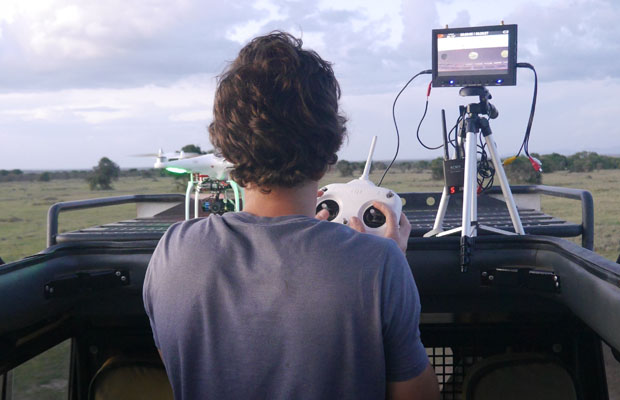
Quadcopters, like this one flown by Ben Kreimer of the University of Nebraska’s Drone Journalism Lab, are being used by AfricanSkyCam to collect images. (Photo: AfricanSkyCAM/University of Nebraska)
In conjunction with the Cambridge Festival of Ideas 2015, we will be publishing a series of articles that complement many of the upcoming debates and discussions. We are offering these articles from Index on Censorship magazine for free (normally they are held within our paid-for archive) as part of our partnership with the festival. Below is and article by Raymond Joseph on n how low-cost technology is helping African newsrooms get hold of information that they couldn’t previously track from the autumn 2014 issue. This article is a great starting point for those planning to attend the Technologies of revolution: how innovations are undermining regimes everywhere session at the festival.
Index on Censorship is a global quarterly magazine with reporters and contributing editors around the world. Founded in 1972, it promotes and defends the right to freedom of expression.
Deep in Mpumalanga province, in the far north-east of South Africa, a poorly resourced newspaper is using a combination of high and low tech solutions to make a difference in the lives of the communities it serves.
It is also pioneering a new and innovative form of journalism that not only places its readers at the centre of its coverage, but also involves them directly in the newsgathering operation.
What this small newspaper does is a lesson for bigger, more established media outlets, which are searching for new non-traditional revenue streams and which, in the age of online and digital journalism, struggle to survive and remain relevant.
The Ziwaphi community-based newspaper is distributed to communities in the Nkomazi district, situated at the epicentre of the South Africa AIDS pandemic, where there is very little access to news reporting. One of the biggest problems in the area is water contaminated with sewage. Women and young girls spend hours every day collecting water from rivers for drinking, cooking and washing, but these same rivers are also often used to dispose of human waste. As a result the E.coli count sometimes spikes, causing diarrhoea. And every few years, there is an outbreak of cholera.
Using a grant, and technology assistance from the African Media Initiative (AMI), which is spearheading the drive to embed data-driven journalism in African newsrooms, Ziwaphi is placing old smartphones submerged in clear plastic bottles in rivers in the area. Functioning as simple electron microscopes, the phones use their cameras to take regular flash-lit pictures. These photographs are then magnified and compared against images from an existing database to detect dangerous levels of E.coli. The results are delivered via SMS to residents, informing them where it’s safe to collect water.
Completing the circle, the newspaper analyses the real-time data to detect trends, and hopefully even triangulates the sources of contamination.
Once a month, Ziwaphi publishes an in-depth story based on the results, which is shared with other community papers and local radio stations in the area. The hope is the information can then empower ordinary people in the region to force the government to deliver clean water and sanitation. Ziwaphi’s readers also help gather information themselves using a mobile-based citizen reporting app which supplements the smartphone data with eyewitness stories about the impacts of the pollution, and possible sources of contamination.
“The total project only cost $20 000, including a modest salary for a year for a full-time health reporter,” says Justin Arenstein, a strategist for AMI. “But the important thing, from a media sustainability perspective, is that Ziwaphi is using the water project to build the digital backbone it will need to survive in the near future.”
Until recently Africa lagged behind the rest of the world where the internet was concerned, because of the high cost of access. But now the deployment of new undersea cables is helping bring down the cost of connectivity, especially in east and southern Africa. This has sparked an exciting new era for journalism, with an explosion of ideas and innovations that are producing “news you can use” tools. Established media is increasingly reaching out to citizens to involve them in their news-gathering and content production processes. The phone-in-a-bottle project is an example of what can be done with limited resources.
In Kenya, the Radio Group, the third largest media house, has set up Star Health, the first in a set of toolkits to help readers do easy background checks on doctors and learn whether they have ever been found guilty of malpractice. In one case a man working as a doctor turned out to be a vet.
The site, which has proved to be a big hit in a country where dodgy doctors are a major problem, also helps users locate medical specialists and their nearest health facility. It can also be used to check whether medicines are covered by the national health scheme. Importantly, the results of queries on Star Health are delivered via a premium SMS service that generates an income stream, crucial in an age when media needs to diversify revenue models away from reliance on advertising and, in some case, copy sales.
“These tools don’t replace traditional journalism, rather they augment journalistic reportage by, for example, helping readers to find out how a national story on dodgy doctors personally affects them,” says Arenstein. News must be personal and actionable and should become an important part of the media’s digital transformation strategies, he stresses.
The reality of journalism today is that, even though outlets may not have the large audiences of conventional media, anyone with a smartphone or basic digital skills has the ability to be a “publisher”.
In Nigeria, for example, the Sahara online community has over a million followers on social media, far more than many media houses. The challenge in the future will be for newsrooms to tap into these grassroots networks, but still keep citizens’ voices at their centre.
A pioneering project in Nigeria’s isolated Delta region has seen the mainstream media working with an existing citizen-reporting network, Naija Voices, to adopt remote-controlled drones fitted with cameras to monitor for environmentally destructive oil spills. The plan is to syndicate the footage to mainstream TV and newspaper partners in Lagos and Abuja. This would allow the newspapers unprecedented reach into parts of the country that had previously been largely inaccessible.
The fixed-wing drones are relatively cheap and simple to fly, but they crash from time to time. “Getting new parts, like the wings or pieces of the fuselage, would be costly and time consuming, so we’re experimenting with 3D printers to create parts onsite and on demand,” says Arenstein.
This citizen-reporting experiment builds on the work of AfricanSkyCam which for the past year has been experimenting with drones in Kenya as part of “Africa’s first newsroom-based eye-in-the-sky”. SkyCam uses drones and camera-equipped balloons to help media that cannot afford news helicopters to cover breaking news in dangerous situations or difficult to reach locations.
In South Africa, Oxpeckers Center for Investigative Environmental Reporting is using “geo journalism” and other mapping techniques to amplify its reporting and to analyse stories such as rhino poaching and canned lion hunting – breeding tame lions for wealthy trophy-hunters to shoot. Investigations help uncover trends or links to criminal syndicates and the Oxpeckers Center’s reportage is credited with promoting a recent ban on canned hunting in Botswana, and helping to shape laws on trade in rhino and other wildlife products in China and in Mozambique.
But the reality is that poorly resourced African newsrooms seldom have the in-house technology or digital skills to build new online tools.
So, AMI’s digital innovation programme and similar initiatives at Google, the Bill & Melinda Gates Foundation, and at smaller donors including the Indigo Trust are all building external support systems to help newsrooms leapfrog into a digital future.
Donors are also focusing on embedding data journalism approaches into mainstream media. They are helping journalists use publicly available digital information from sources such as censuses or government budgets to build decision-making tools to help ordinary citizens make better informed decisions on bread and butter issues affecting their lives.
Helping drive the new-tech approach is Code for Africa, a network of civic technology labs planned for countries across the continent to help drive innovation and to work with media and citizen journalist networks, to help them bridge the digital divide.
Code for South Africa (C4SA) is helping everyone, from the township-based Ziwaphi and its cholera alert project, to national media outlets, such as the Mail & Guardian and City Press.
“The media know they’re in crisis, with their advertising-based business model under threat as audiences shift online, but digital innovation is still a hard sell,” says C4SA director Adi Eyal. “Progress is painstakingly slow because many African media owners are hesitant to invest before they know how these new models will generate revenue. The result is that much of what South African newsrooms are calling home-grown data journalism is just visualisation. They’re creating very little actionable information and virtually no news tools that people can use to make decisions. The investment in a one-off project is high, so it is important that the tools that are built live on, so that newsrooms can use them to report on issues and people can act.”
Progress is painstakingly slow, but nevertheless the building blocks are slowly being put in place as the “root stock” — datasets from across Africa — is collected and collated on the African Open Data portal for both newsroom journalists and civic coders to use. The data means they can create applications and tools which will help them build communities and generate income.
C4SA is also building an “invisible” back-end infrastructure that newsrooms can help build news tools quickly and cheaply. This includes support for initiatives such as OpenAfrica that helps newsrooms digitise and extract data from source documents. C4SA has also built a series of open, machine-readable, data rich application programming interfaces (APIs) that newsrooms can easily plug into their mobile apps or websites. The APIs drive tools like WaziMap, which uses censuses, elections and other data to help journalists to dig into the make up of communities, right down to local ward level. Each of these resources is a tool not only for the media, but also for civic activists and public watchdogs, says Arenstein.
In a recent column on the future of newspapers, Ferial Haffajee, the editor of City Press, a national South African Sunday newspaper that is struggling to reinvent itself in the digital age, wrote: “Nothing is as it was. Nor are most things what they seem. We have a future, and it is tantalising.”
And you just need to look at the smartphones in a bottle and 3D-printed drones to know that this future is slowly, newsroom by newsroom, project by project, becoming a reality.
Read more about the future of journalism in Index on Censorship’s latest magazine. Read more here and find out how to subscribe either in print, digital replica or app.
This article was posted on 21 October at indexoncensorship.org

 SUBSCRIBE[/vc_column_text][/vc_column][/vc_row]