19 Aug 2015 | mobile, Netherlands, News, Youth Board
This is the sixth of a series of posts written by members of Index on Censorship’s youth advisory board.
Members of the board were asked to write a blog discussing one free speech issue in their country. The resulting posts exhibit a range of challenges to freedom of expression globally, from UK crackdowns on speakers in universities, to Indian criminal defamation law, to the South African Film Board’s newly published guidelines.
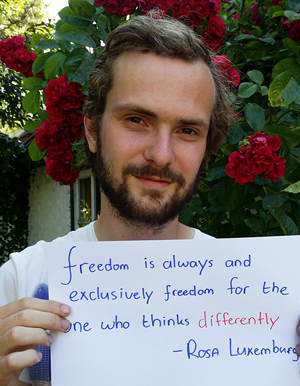
Ravian Ruys is a member of the Index youth advisory board. Learn more
“Haat imam” is a man whose life solely depends on the complete destruction of western values and interests, or so one would think if you were reading or watching the Dutch media.
It is a word used whenever we are talking of an imam whose views are considered either too conservative or too radical. In most cases, when someone is labelled a haat imam, they are subject to protest or no-platforming. In 2015, there have been three known cases of events being cancelled because some of the speakers were labelled haat imams. In these incidences, the individuals involved were investigated by Dutch security services and considered safe, meaning they were found to have no known links to terrorist organisations.
All this has led the Volkspartij voor Vrijheid en Democratie (People’s Party for Freedom and Democracy), a political party currently in power, to advocate a blacklist for radical preachers. The party warns that this blacklist should not only include those Muslim preachers who have known links to terrorist organisations, but also those who spread hate.
This means public pressure leads to the narrowing of freedom of speech for one specific group of people. It has also created a feeling of persecution surrounding young Muslims, made even worse by the deputy prime minister quoting flawed scientific research stating that 80 per cent of young Dutch-Turks support ISIS.
If you are a Muslim in the Netherlands, you are now in an environment where you feel you must be the nicest Muslim anyone has ever met or you can’t be trusted. Perversely, this lack of trust is often quoted as one of the things that drives young Muslim men and women into the arms of extremist organisations. Consequently, a policy trying to protect us against extremist propaganda works in favour of the extremists.
The Netherlands has a great reputation when it comes to freedom of speech and we should keep it that way. This means creating a fair and equal space for Muslims in our country to debate their religion on their terms. We might not always like what we hear, but we cannot intervene directly unless a direct threat is made against innocents. If we do not trust those involved, in other words, if we do not trust our fellow countrymen, how can we expect their trust in return?
Without trust, politics and civil society become a bloody mess.
Ravian Ruys, The Netherlands
Related:
• Muira McCammon: GiTMO’s linguistic isolation
• Jade Jackman: An act against knowledge and thought
• Harsh Ghildiyal: Defamation is not a crime
• Tom Carter: No-platforming Nigel
• Matthew Brown: Spying on NGOs a step too far
• About the Index on Censorship youth advisory board
• Facebook discussion: no-platforming of speakers at universities
21 Jul 2015 | Campaigns, mobile, Statements, United Kingdom
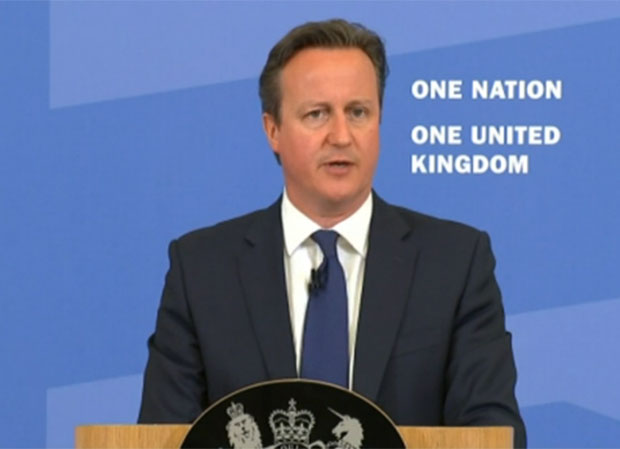
Free speech is a fundamental British value, UK Prime Minister David Cameron insisted on Monday in a widely trailed speech outlining how his government planned to tackle “the struggle of our generation”: Islamic extremism.
Cameron made some of the right noises. He talked of the need for voices countering the extremist narrative to be heard more loudly: to be featured more often in newsprint, or given more airtime in broadcast. More speech is a good thing. One of the reasons why organisations like Index champion free speech as a fundamental good is a belief that more speech is the best counter to speech you dislike or with which you disagree, and that allowing those plethora of voices and ideas to be heard is what allows societies to advance. As author Elif Shafak wrote in a recent article for Index magazine: “The response to a book is another book. The response to a cartoon is another cartoon. Words need to be answered with words.”
Sadly, it became clear throughout the speech – as it has become clear through successive legislation in recent years – that Cameron and his government are not really committed to free speech. No, they are committed to ‘good’ speech, to speech that the government and its supporters decide is palatable. They are committed to funding and advocating the ideas and narratives of which they approve (“If you’re interested in reform; if you want to challenge the extremists in our midst; if you want to build an alternative narrative or if you just want to help protect your kids – we are with you and we will back you – with practical help, with funding, with campaigns, with protection and with political representation”) and banning those they don’t. His speech on Monday was, as ever, short on details in relation to the practicalities, but Cameron once again reiterated the notion that the government wants to introduce further curbs on ‘non-violent’ speech, in other words speech that falls short of inciting violence.
That is not what a commitment to free speech means. Free speech – the kind that allows democracies to flourish – allows people to espouse views that others find offensive, insulting, and even complete anathema to your way of life. And it allows other people to dispute those views. Free speech protections are what allows both the holocaust denier the right to spout nonsense about the Nazis and the wider population to refute them.
But Cameron does not share that commitment to free speech. The kind of free speech protection the Prime Minister envisages permits some as yet undefined version of acceptable speech but seeks to outlaw whatever this government deems beyond the pale. And herein lies the danger. Any attempt to proscribe ideas, or the voicing of ideas, beyond direct incitements to violence undermines the very principle of free speech – and ultimately undermines its benefits for civil society as a whole.
You only have to look at how widely drawn Cameron has to make the net to capture the ‘non-violent extremist’ narrative to understand how easily any group who challenges the government, or the prevailing majority view, might be drawn into his net. This is not the society we want to live in, where public speakers might have to register two weeks in advance and be vetted before being allowed on a podium, as was indicated in an earlier version of this speech trailed before the election. As former attorney general Dominic Grieve said recently: “When in doubt you should always go for the free speech option.” Grieve recently told Index: “In a free society people do have a right to be insulting about other people’s beliefs…I think that the free society requires that there should be should be the possibility of doing it.” This belief is at the core of any democracy and is worth fighting for. Something that David Cameron conveniently seems to be willing to relinquish.
Even more worryingly, Cameron goes even further by suggesting that not only may we be punished for this ill-defined non-violent speech, but we might also be required to demonstrate publicly our lack of support for such ideology. “We must demand that people also condemn the wild conspiracy theories, the anti-Semitism, and the sectarianism too,” the Prime Minister declared. Quite how this thought-police style demands will be enforced in practice is difficult to imagine – perhaps Katie Hopkins might be forced to make public apologies in areas of their country known for high levels of immigration for failing to show the correct British levels of ‘tolerance’ when she wrote about gunships and migrant boats?
We need to champion free speech
Some people seem to view free speech as a “nice-to-have” add-on, a mere luxury principle tacked on the end of other more basic rights. But respecting free expression is a fundamental tenet of democracy. It is qualified by other rights, but assessing those balances is something that should be done by a court of law not by an ever-creeping extension of government power to proscribe people and views it does not like. Cameron laid this blatant disregard for democracy bare last month when he said: “For too long, we have been a passively tolerant society, saying to our citizens: as long as you obey the law, we will leave you alone.”
As soon as you have to fear not just breaking the law, but state interference for ‘non-crimes’ as well, you no longer have a democracy. And with no test for what words might put you in the category of law-abiding undesirables, how do we know when the ‘offence-hunters’ – sniffing out anyone who seems not to defend sufficiently ‘British values’ – might come for any one of us?
David Cameron raises the fearful spectre of an intolerant, violent Islamist state that wants to bring an end to the freedoms we cherish. If we are to succeed in protecting those freedoms, then we cannot let the government undermine the very values he says he is defending. If we let that happen, we will have already lost. Instead we need to defend the rights of everyone – including the extremists – to voice opinions we find abhorrent, or risk finding our ability to say we disagree with those views is lost too.
This article was posted on 21 July 2015 at indexoncensorship.org
26 Jun 2015 | European Union, mobile, News, United Kingdom
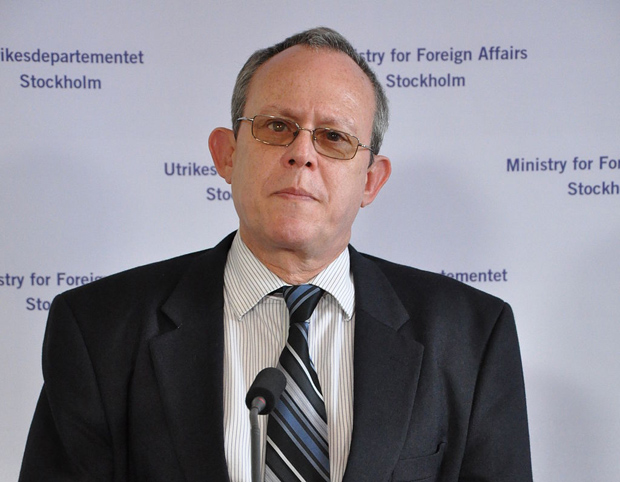
Frank La Rue (above). Credit: Janwikifoto/Wikimedia Commons/Creative Commons)
Freedom of expression is more in danger today than in 2008 because of “the right to be forgotten”, the United Nation’s former free expression rapporteur Frank La Rue told an internet conference.
At the event La Rue told Index: “The emphasis on the ‘right to be forgotten’ in a way is a reduction of freedom of expression, which I think is a mistake. People get excited because they can correct the record on many things but the trend is towards limiting people’s access to information which I think is a bad trend in general.”
La Rue, who was the UN’s rapporteur between 2008 and 2014, addressed lawyers, academics and researchers at the Institute of Advanced Legal Studies in London, in particular covering the May 2014 “right to be forgotten” ruling from the Court of Justice of the European Union, and its impact on free speech following a Spanish case involving Mario Costeja Gonzalez.
The Google Spain vs. Mario Costeja Gonzalez case involved the Spanish citizen challenging Google and a Spanish newspaper in the courts to remove articles that appeared on the search engine relating to a foreclosure notice on his house. Gonzalez won the case against Google, but not the newspaper, which has now set a precedent for users to challenge search engines to de-list information.
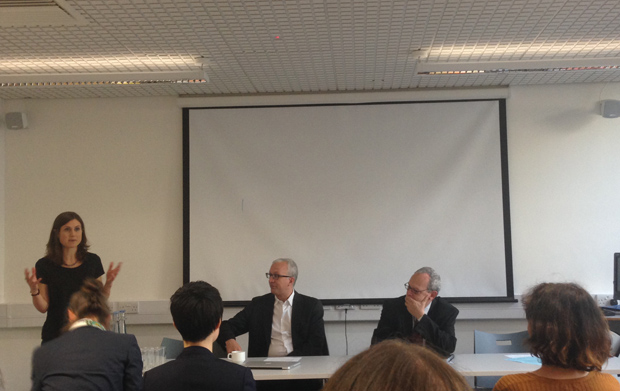
Frank La Rue (right) spoke at the Institute of Advanced Legal Studies in London (Photo: Max Goldbart for Index on Censorship)
On the ruling, La Rue said: “I would want to know the past. It is very relevant information. Everyone should be on the record and we have to question who is making these decisions anyway?” LaRue’s main issue with the “right to be forgotten” is the fact that a private company can have such a say on information being accessed by the public. “The state is accountable to the people of a nation so should be accountable here. Not private companies and especially not those with commercial interests,” he added.
While in London for the conference, he also told Index on Censorship there were “many reasons” for this reduction in freedom of expression: “One is because a breach of privacy has a chilling effect so people are more worried about that, but also there are more and more regulations being enacted in many countries which worry me. Politicians are getting scared of the power of the internet because the internet has made the world more knowledgeable so there is an increase in the way the authorities are trying to reduce criticisms.”
La Rue, now executive director of the charity Robert F. Kennedy Human Rights Europe, felt that commercial organisations such as Google have been given too much power.
Ray Corrigan, senior lecturer in maths and computing at the Open University, said: “We carry the greatest tracking device around with us absolutely willingly, our phones. We don’t think about the costs.”
This article was posted on June 26 2015 at indexoncensorship.org
17 Jun 2015 | Events, Magazine, mobile
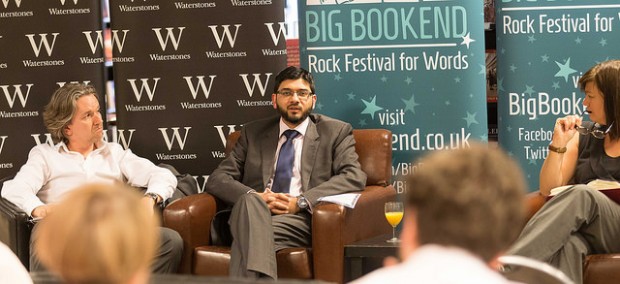
Index hosted a debate at the Leeds Big Bookend festival (Photo: Steve Evans)
Does freedom of religion and freedom of speech come as a package or can you pick and choose? Do those suggesting freedom of expression should be “civilised” and that we should be wary of causing offence to people’s religious sensibilities have a point? Or are there too many people who are easily offended? Are our attempts to be polite actually significant obstructions to the discussion of important issues? These were just some of the questions tackled at “The new civility: are religious freedom and freedom of speech intertwined?” the 10 June event organised as part of the Leeds Big Bookend festival.
Chaired by Index on Censorship magazine editor Rachael Jolley, the panel was made up of assistant features editor at the Yorkshire Evening post Chris Bond, local imam Qari Muhammad Asim MBE and author Anthony Clavane.
In the past, people who have argued for greater religious freedom have also fought for greater freedom of speech, but the debate looked to address the idea that this connection has become somewhat lost. It sprang from the Spring 2015 issue of Index on Censorship, where writers from across the world, including Elif Safak and Ariel Dorfman, provided thoughtful analysis of the aftermath of Charlie Hebdo killings.
The debate threw up some fascinating themes and the panel were observed and questioned by an enthusiastic audience at Waterstones, Leeds. A full recording of the event in the form of a podcast can be listened to below.
The new civility: are religious freedom and freedom of speech intertwined? by Tttdebates on Mixcloud
