
#IndexAwards2019: Here’s what you need to know
[vc_row][vc_column][vc_column_text]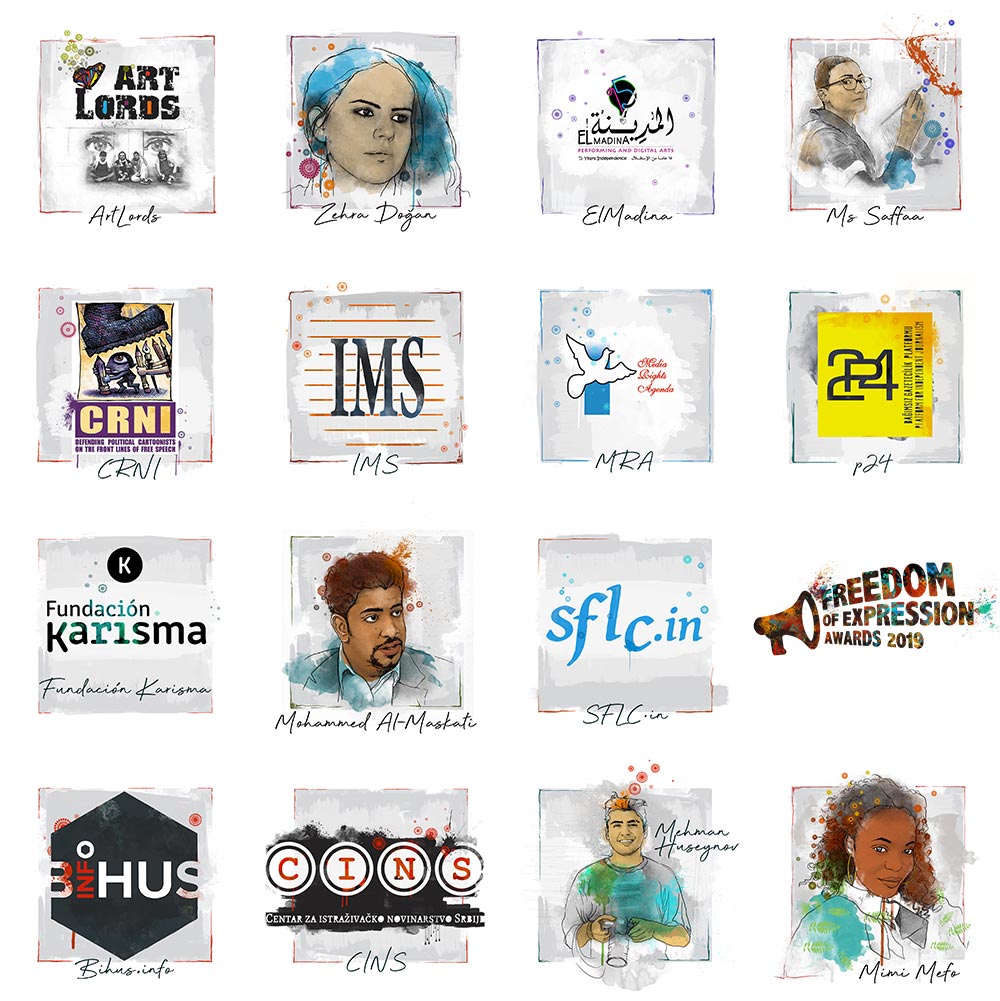
Each year, the Index on Censorship Freedom of Expression Awards gala honours courageous champions who fight for free speech around the world.
Drawn from more than 400 crowdsourced nominations, this year’s nominees include artists, journalists, campaigners and digital activists tackling censorship and fighting for freedom of expression. Many of the 15 shortlisted are regularly targeted by authorities or by criminal and extremist groups for their work: some face regular death threats, others criminal prosecution.
The gala takes place on Thursday 4 April in London and will be hosted by comedian Nish Kumar.
We will be live tweeting throughout the evening on @IndexCensorship. Get involved in the conversation using the hashtag #IndexAwards2019.
Index on Censorship Freedom of Expression Awards nominees 2019
Arts
for artists and arts producers whose work challenges repression and injustice and celebrates artistic free expression
ArtLords | Afghanistan
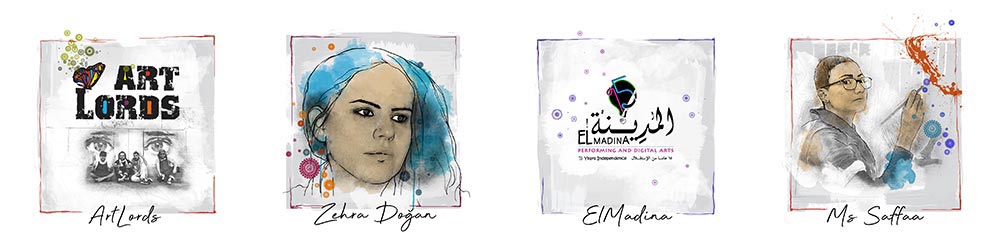
ArtLords is a grassroots movement of artists and volunteers in Afghanistan who encourage ordinary citizens, especially women and children, to paint the issues that concern them on so-called blast walls: walls the country’s rich and the powerful have built around themselves to protect them from violence while the poor fend for themselves. Their work has turned a symbol of fear, tension and separation into a platform where social issues can be expressed visually and discussed in the street. ArtLords has completed over 400 murals in 16 provinces of Afghanistan. In March 2018, for International Women’s Day, ArtLords painted a tribute to Professor Hamida Barmaki, a human rights defender killed in a terrorist attack six years ago.
Zehra Doğan | Turkey
Released from prison on 24 February 2019, Zehra Doğan is a Kurdish painter and journalist who, during her imprisonment, was denied access to materials for her work. She painted with dyes made from crushed fruit and herbs, even blood, and used newspapers and milk cartons as canvases. When she realised her reports from Turkey’s Kurdish region were being ignored by mainstream media, Doğan began painting the destruction in the town of Nusaybin and sharing it on social media. For this she was arrested and imprisoned. During her imprisonment she refused to be silenced and continued to produce journalism and art. She collected and wrote stories about female political prisoners, reported on human rights abuses in prison, and painted despite the prison administration’s refusal to supply her with art materials.
ElMadina for Performing and Digital Arts | Egypt
ElMadina is a group of artists and arts managers who combine art and protest by encouraging Egyptians to get involved in performances in public spaces, defying the country’s restrictive laws. ElMadina’s work encourages participation — through storytelling, dance and theatre — to transform public spaces and marginalised areas in Alexandria and beyond into thriving environments where people can freely express themselves. Their work encourages free expression in a country in which public space is shrinking under the weight of government distrust of the artistic sector. ElMadina also carry out advocacy and research work and provide a physical space for training programmes, residencies and performances.
Ms Saffaa | Saudi Arabia / Australia
Ms Saffaa is a self-exiled Saudi street artist living in Australia who uses murals to highlight women’s rights and human rights violations in Saudi Arabia. Collaborating with artists from around the world, she challenges Saudi authorities’ linear and limited narrative of women’s position in Saudi society and offers a counter-narrative through her art. Part of a new generation of Saudi activists who take to social media to spread ideas, Ms Saffaa’s work has acquired international reach. In November 2018, she collaborated with renowned American artist and writer Molly Crabapple on a mural celebrating murdered Saudi journalist Jamal Khashoggi that read, “We Saudis deserve better.”
Campaigning
for activists and campaigners who have had a marked impact in fighting censorship and promoting freedom of expression
Cartoonists Rights Network International | United States / International
Cartoonists Rights Network International (CRNI) is a small organisation with a big impact: monitoring threats and abuses against editorial cartoonists worldwide. Marshalling an impressive worldwide network, CRNI helps to focus international attention on cases in which cartoonists are persecuted and put pressure on the persecutors. CRNI tracks censorship, fines, penalties and physical intimidation – including of family members, assault, imprisonment and even assassinations. Once a threat is detected, CRNI often partners with other human rights organisations to maximise the pressure and impact of a campaign to protect the cartoonist and confront those who seek to censor political cartoonists.
Institute for Media and Society | Nigeria
The Institute for Media and Society (IMS) is a Nigerian NGO that aims to improve the country’s media landscape by challenging government regulation and fostering the creation of community radio stations in rural areas at a time when local journalism globally is under threat. Three-quarters of television and radio stations in Nigeria are owned by politicians, and as a result they are divided along political lines, while rural communities are increasingly marginalised. IMS’s approach combines research and advocacy to challenge legal restrictions on the media as well as practical action to encourage Nigerians to use their voices, particularly via local radio. IMS also tracks violations of the rights of journalists in Nigeria.
Media Rights Agenda | Nigeria
Media Rights Agenda (MRA) is a non-profit organisation that has spent the last two decades working to improve media freedom and freedom of expression in Nigeria by challenging the government in courts. While the constitution guarantees the right to freedom of expression, other laws – including the sections of the Criminal Code, the Cybercrimes Act and the Official Secrets Act – limit and even criminalise expression. Through its active legal team, MRA has initiated strategic litigation targeting dozens of institutions, politicians and officials to improve the country’s legal framework around media freedom. Its persistent campaigning and lawsuits on freedom of information have helped improve access to government-held data.
P24 | Turkey
P24 (Platform for Independent Journalism) is a civil society organisation that aims to neutralise censorship in Turkey — a country in which speaking freely courts fines, arrest and lengthy jail sentences. P24’s pro bono legal team defends journalists and academics who are on trial for exercising their right to free expression. It also undertakes coordinated social media and public advocacy work that includes live-tweeting from courtrooms and campaigning through an array of websites, newsletters and exhibition spaces. Its latest effort aims to provide spaces for collaboration and free expression in the form of a literature house and a project connecting lawyers and artists.
Digital Activism
for innovative uses of technology to circumvent censorship and enable free and independent exchange of information
Fundación Karisma | Colombia
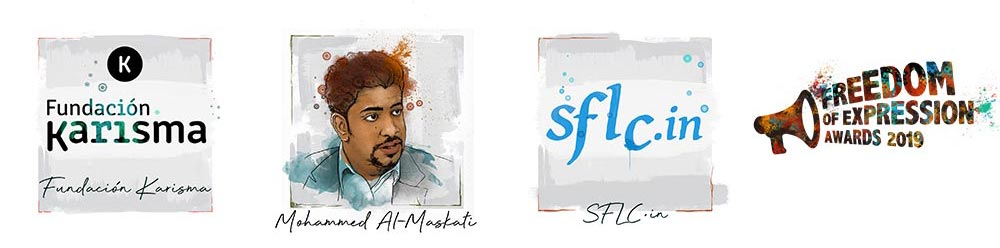
Fundación Karisma is a civil society organisation that challenges online trolls by using witty online ‘stamps’ that flag up internet abuse. It is an initiative that uses humour to draw attention to a serious problem: the growing online harassment of women in Colombia and its chilling effect. The organisation offers a rare space to discuss many issues at the intersection of human rights and technology in the country and then tackles them through a mix of research, advocacy and digital tools. Karisma’s “Sharing is not a crime” campaign supports open access to knowledge against the backdrop of Colombia’s restrictive copyright legislation.
Mohammed Al-Maskati | Middle East
Mohammed al-Maskati is a digital security consultant who provides training to activists in the Middle East and in North Africa. Working as Frontline Defenders’ Digital Protection Consultant for the MENA Region, Mohammed teaches activists – ranging from vulnerable minorities to renowned campaigners taking on whole governments – to communicate despite government attempts to shut them down. He educates them on the use of virtual private networks and how to avoid falling into phishing or malware traps, create safe passwords and keep accounts anonymous. As governments become more and more sophisticated in their attempts to track and crush dissent, the work of people like Al-Maskati is increasingly vital.
SFLC.in | India
SFLC.in (Software Freedom Law Centre) tracks internet shutdowns in India, a crucial service in a country with the most online blackouts of any country in the world. The tracker was the first initiative of its kind in India and has quickly become the top source for journalists reporting on the issue. As well as charting the sharp increase in the number and frequency of shutdowns in the country, the organisation has a productive legal arm and brings together lawyers, policy analysts and technologists to fight for digital rights in the world’s second most populous country. It also provides training and pro-bono services to journalists, activists and comedians whose rights have been curtailed.
Journalism
for courageous, high-impact and determined journalism that exposes censorship and threats to free expression
Bihus.info | Ukraine
Bihus.info is a group of independent investigative journalists in Ukraine who – despite threats and assaults – are fearlessly exposing the corruption of many Ukrainian officials. In the last two years alone, Bihus.info’s coverage has contributed to the opening of more than 100 legal cases against corrupt officials. Chasing money trails, murky real estate ownership and Russian passports, Bihus.info produces hard-hitting, in-depth TV reports for popular television programme, Nashi Hroshi (Our Money), which illuminates discrepancies between officials’ real wealth and their official income. One of the key objectives of the project is not just to inform, but to involve people in the fight against corruption by demonstrating how it affects their own well-being.
Center for Investigative Journalism of Serbia (CINS) | Serbia
Investigating corruption is one of the most dangerous jobs in journalism: three investigative reporters have been murdered in the European Union in the past year alone. In Serbia, journalists face death threats and smear campaigns portray investigative journalists as foreign-backed propagandists. Against this backdrop, Center for Investigative Journalism of Serbia (CINS) stands out as one of the last independent outlets left amid an increasingly partisan media. Using freedom of information requests, the CINS has created databases based on thousands of pages of documents to underpin its hard-hitting investigations. These include stories on loans provided to pro-government tabloids and TV channels. CINS also provides hands-on investigative journalism training for journalists and editors.
Mehman Huseynov | Azerbaijan
Mehman Huseynov is a journalist and human rights defender who documents corruption and human rights violations in Azerbaijan, consistently ranked among the world’s worst countries for press freedom. Sentenced to two years in prison in March 2017 after describing abuses he had suffered at a police station, Huseynov has put his life in danger to document sensitive issues. His work circulated widely on the internet, informing citizens about the real estate and business empires of the country’s government officials, and scrutinising the decisions of president Ilham Aliyev. Before his release from prison in March 2019, Huseynov remained defiant, saying: “I am not here only for myself; I am here so that your children are not in my place tomorrow. If you uphold the judgement against me, you have no guarantees that you and your children will not be in my place tomorrow.”
Mimi Mefo | Cameroon
Mimi Mefo is one of less than a handful of journalists working without fear or favour in Cameroon’s climate of repression and self-censorship. An award-winning broadcast journalist at private media house Equinoxe TV and Radio, Mefo was arrested in November 2018 after she published reports that the military was behind the death of an American missionary in the country. Mefo reports on the escalating violence in the country’s western regions, a conflict that has become known as the “Anglophone Crisis” and is a leading voice in exposing the harassment of other Cameroonian journalists, calling publicly for the release of those jailed.
Full profile[/vc_column_text][/vc_column][/vc_row][vc_row][vc_column][vc_basic_grid post_type=”post” max_items=”12″ style=”load-more” items_per_page=”4″ element_width=”6″ grid_id=”vc_gid:1553869689126-03eaf550-1416-3″ taxonomies=”8935″][/vc_column][/vc_row]

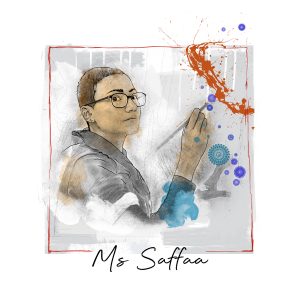 Ms Saffaa is a self-exiled Saudi street artist living in Australia who uses murals to highlight women’s rights and human rights violations in Saudi Arabia.