3 May 2019 | Media Freedom, media freedom featured, News
[vc_row][vc_column][vc_single_image image=”103553″ img_size=”full”][vc_column_text]The investigation into the July 2016 murder of Belarusian journalist Pavel Sheremet in Kyiv, Ukraine continues to be shrouded in mystery. Ukrainian authorities have remained silent, releasing no new information since July 2017.
“The authorities in Ukraine must ensure that there is a fully transparent investigation and they must do their utmost to make real progress,” Joy Hyvarinen, head of advocacy at Index on Censorship said. “There are now too many unanswered questions related to the murder of Pavel Sheremet. The murder cannot be allowed to go unpunished.”
Journalists from the Organized Crime and Corruption Reporting Project, in partnership with Slistvo.info studied a number of leads on the case and analysed footage from more than 50 different surveillance cameras. They used their findings to create an investigative documentary called “Killing Pavel” which later won the IRE Medal, the highest honour that can be received for investigative journalism. One of the most significant findings detailed in the documentary, which was released in May 2017, was the revelation that a former Ukrainian secret service agent and two unidentified individuals were present outside Sheremet’s apartment when the explosives were planted under his car.
Petro Poroshenko, the former president of Ukraine, said in July 2016 that justice for Sheremet’s murder was a “matter of honour” and that the case would be treated with utmost priority. However, he has failed to follow through on this bold statement. Ambassadors from the USA, Canada, the UK, France, Germany, Italy and Japan have emphasised “the importance of continuing the investigation” in order to bring those responsible to justice. Pressures from other countries, human rights organisations and journalists rights groups, have had little effect on the overall progress of the investigation.
Sheremet, who primarily covered political figures, received considerable recognition for his work exposing corruption in Belarus, Russia and Ukraine. According to a letter from Olena Prytula, his partner and the owner of the Ukrainska Pravda news site, to the prosecutor general Yury Lutsenko, Sheremet “was stripped of his Belarusian citizenship due to his criticism of the Belarusian government”. In addition to spending three months in prison for speaking out against the government of Belarusian President Alexander Lukashenko, Sheremet’s Belarusian cameraman, Dzmitry Zavandski was also kidnapped and killed in 2000 after returning to Belarus from a reporting trip in Russia.
The presidents of Ukraine and Belarus met on 20 June 2017 to solely discuss “economic co-operation” between the two countries. However, this meeting was highly criticised by journalists for being held on the first anniversary of Sheremet’s murder and the honours with which Lukashenko was received by Poroshenko.
Poroshenko’s support of Lukashenko and his desire to establish closer relations with Belarus conflicted with the promises he made to attack corruption, and bring resolve to Sheremet’s case. Mustafa Nayyem, a Ukrainian journalist and the co-founder of the Hromadske Network, criticised Poroshenko for praising Lukashenko, whose acts of corruption and crimes against human rights directly tie him to Sheremet’s case. In a Facebook post that later received substantial support from the public, Nayyem wrote that Lukashenko “destroyed freedom of speech in his country, under whom hundreds of journalists have disappeared or been jailed” and emphasised the fact that it was “the very same Lukashenko under whom Pavel was sent to pretrial detention and his friend and cameraman was brutally murdered”.
Volodymyr Zelenskiy, a Ukrainian comedian who defeated Poroshenko in the Ukraine presidential election on 21 April 2019 by a landslide winning 73% of vote, has repeatedly denounced corruption and has promised to expel it from the Ukrainian government; however he has not yet addressed the future development of Sheremet’s case or any other unsolved cases. Although Sheremet’s case has been ignored for almost three years, it has not been forgotten.
On the second anniversary of Sheremet’s murder, Marie Yovanovitch, the US ambassador to Ukraine, said in an interview for Radio Liberty that Sheremet “played an immensely important role here in Ukraine, in terms of finding out what was happening and presenting it to the Ukrainian people so that they could make their own decisions about the situation in the Ukraine”. Furthermore, she emphasised the importance behind the renewal of the investigation, and stated that the “Ukrainian people deserve to know the truth about what happened”. However, the truth continues to be sidestepped regardless of continual demands from country ambassadors, human rights organisations, journalists and the Ukrainian community for justice.[/vc_column_text][/vc_column][/vc_row][vc_row][vc_column][vc_basic_grid post_type=”post” max_items=”4″ element_width=”6″ grid_id=”vc_gid:1556881896863-0ee92b86-a4fa-7″ taxonomies=”8568″][/vc_column][/vc_row]
13 Feb 2019 | Magazine, News, Student Reading Lists
[vc_row][vc_column][vc_column_text]
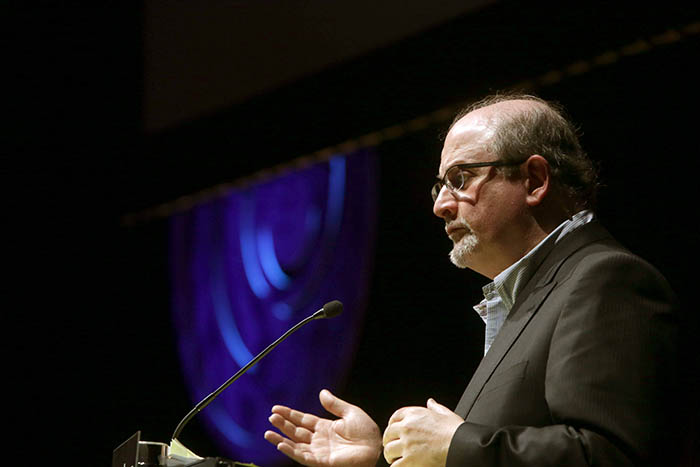
Salman Rushdie. Credit: Fronteiras do Pensamento
On 14 February 1989 Iran’s Ayatollah Khomeini issued a fatwa ordering Muslims to execute author Salman Rushdie over the publication of The Satanic Verses, along with anyone else involved with the novel.
Published in the UK in 1988 by Viking Penguin, the book was met with widespread protest by those who accused Rushdie of blasphemy and unbelief. Death threats and a $6 million bounty on the author’s head saw him take on a 24-hour armed guard under the British government’s protection programme.
The book was soon banned in a number of countries, from Bangladesh to Venezuela, and many died in protests against its publication, including on 24 February when 12 people lost their lives in a riot in Bombay, India. Explosions went off across the UK, including at Liberty’s department store, which had a Penguin bookshop inside, and the Penguin store in York.
Book store chains including Barnes and Noble stopped selling the book, and copies were burned across the UK, first in Bolton where 7,000 Muslims gathered on 2 December 1988, then in Bradford in January 1989. In May 1989 between 15,000 to 20,000 people gathered in Parliament Square in London to burn Rushdie in effigy.
In October 1993, William Nygaard, the novel’s Norwegian publisher, was shot three times outside his home in Oslo and seriously injured.
Rushdie came out of hiding after nine years, but as recently as February 2016, money has been raised to add to the fatwa, reminding the author that for many the Ayatollah’s ruling still stands.
Here, 30 years on, Index on Censorship magazine highlights key articles from its archives from before, during and after the issue of the fatwa, including two from Rushdie himself.
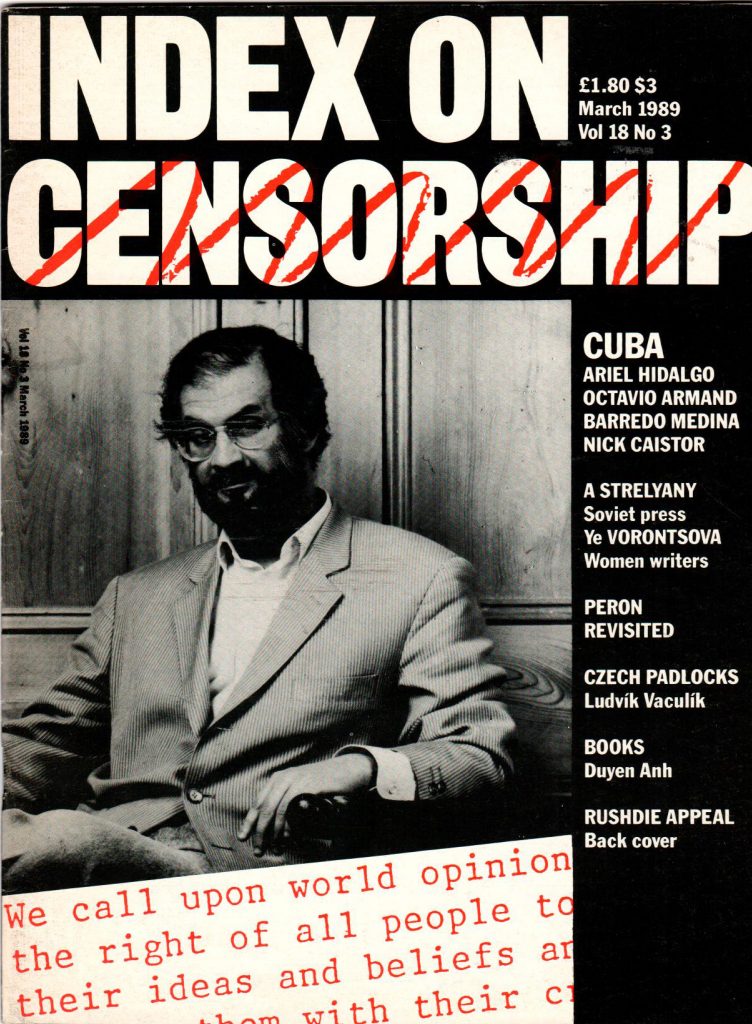
Cuba today, the March 1989 issue of Index on Censorship magazine.
World statement by the international committee for the defence of Salman Rushdie and his publishers
March 1989, vol. 18, issue 3
On 14 February the Ayatollah Khomeini called on all Muslims to seek out and execute Salman Rushdie, the author of The Satanic Verses, and all those involved in its publication. We, the undersigned, insofar as we defend the right to freedom of opinion and expression as embodied in the Universal Declaration of Human Rights, declare that we also are involved in the publication. We are involved whether we approve the contents of the book or not. Nonetheless, we appreciate the distress the book has aroused and deeply regret the loss of life associated with the ensuing conflict.
Read the full article

Islam & human rights, the May 1989 issue of Index on Censorship magazine.
Pandora’s box forced open
Amir Taheri
May 1989, vol. 18, issue 5
‘What Rushdie has done, as far as Muslim intellectuals are concerned, is to put their backs to the wall and force them to make the choice they have tried to avoid for so long’. Last year, when poor old Mr Manavi filled in his Penguin order form for 10 copies of Salman Rushdie’s third novel, The Satanic Verses, he could not have imagined that the book, described by its publishers as a reflection on the agonies of exile, would provoke one of the most bizarre diplomatic incidents in recent times. Mr Manavi had been selling Penguin books in Tehran for years. He had learned which authors to regard as safe and which ones to avoid at all costs.
Read the full article
Islam & human rights, the May 1989 issue of Index on Censorship magazine.
Jihad for freedom
Wole Soyinka
May 1989, vol. 18, issue 5
This statement is not, of course, addressed to the Ayatollah Khomeini who, except for a handful of fanatics, is easily diagnosed as a sick and dangerous man who has long forgotten the fundamental tenets of Islam. It is useful to address oneself, at this point, only to the real Islamic faithful who, in their hearts, recognise the awful truth about their erratic Imam and the threat he poses not only to the continuing acceptance of Islam among people of all religions and faiths but to the universal brotherhood of man, no matter the differing colorations of their piety. Will Salman Rushdie die? He shall not. But if he does, let the fanatic defenders of Khomeini’s brand of Islam understand this: The work for which he is now threatened will become a household icon within even the remnant lifetime of the Ayatollah. Writers, cineastes, dramatists will disseminate its contents in every known medium and in some new ones as yet unthought of.
Read the full article
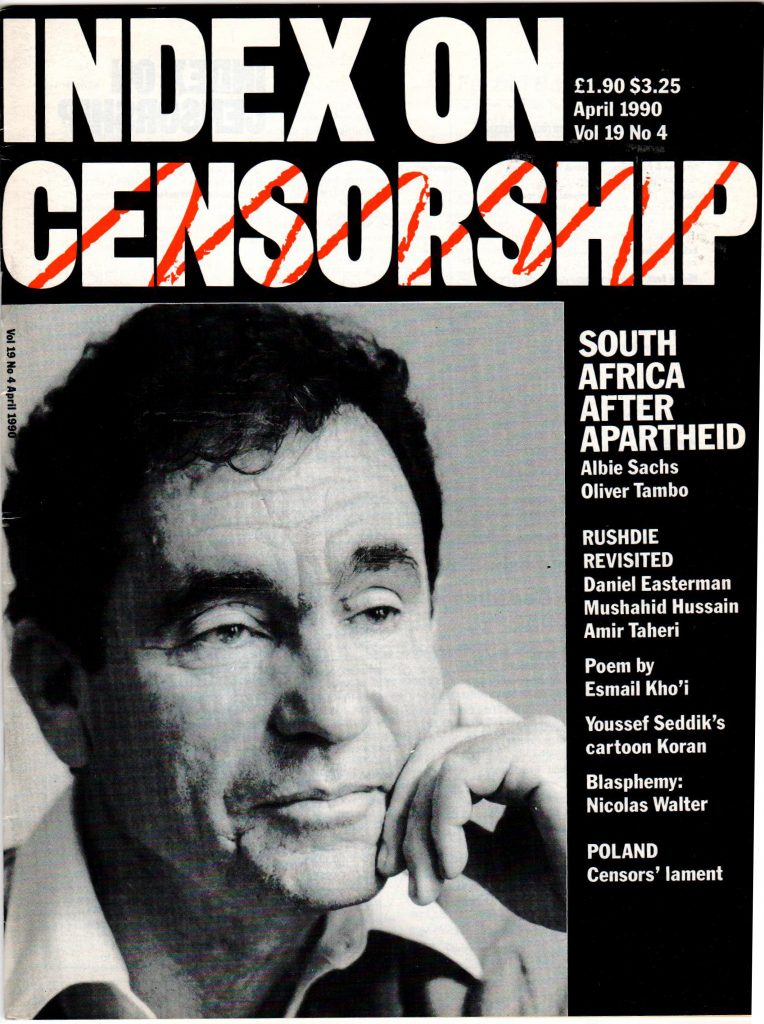
South Africa after Apartheid, the April 1990 issue of Index on Censorship magazine.
Reflections on an invalid fatwah
Amir Taheri
April 1990, vol. 19, issue 4
Broadly speaking, three predictions were made. The first was that Khomeini’s attempt at exporting terror might goad world public opinion into a keener understanding of Iran’s tragedy since the Islamic Revolution of 1979. The fact that the Ayatollah had executed thousands of people, including many writers and poets since his seizure of power in Tehran had provoked only mild rebuke from Western governments and public opinion. With the fatwa against Rushdie, we thought the whole world would mobilise against the ayatollah, turning his regime into an international pariah. Nothing of the kind happened, of course, and only one country, Britain, closed its embassy in Tehran – and that because the mullahs decided to sever.diplomatic ties. In the past twelve months Federal Germany and France have increased their trade with the Islamic Republic to the tune of II and 19 per cent respectively. The EEC countries and Japan have, in the meantime, provided the Islamic Republic with loans exceeding £2,000 million. The stream of European and Japanese businessmen and diplomats visiting Tehran turned into a mini-flood after Khomeini’s death last June.
Read the full article
South Africa after Apartheid, the April 1990 issue of Index on Censorship magazine.
Salman Rushdie and political expediency
Adel Darwish
April 1990, vol. 19, issue 4
When I reviewed Salman Rushdie’s Satanic Verses in September 1988, it never crossed my mind to make any reference to possible offence to Muslim readers, let alone to anticipate the unprecedented international crisis generated in the months that followed. I do not think I was naive – as an LBC radio reporter suggested when she interviewed me at the first public reading from The Satanic Verses in June 1989. On the contrary, I can claim more than many that I am able to understand what Mr Rushdie was trying to say in his book, and the way the crisis has developed. Like Mr Rushdie, I am a British writer, born to a Muslim family. Born in Egypt, I was educated and am employed in Britain, and have been preoccupied and engaged, mainly in the 1960s and 1970s, with the issues that Mr Rushdie has fought for and with which he seemed to be very much concerned in his book.
Read the full article
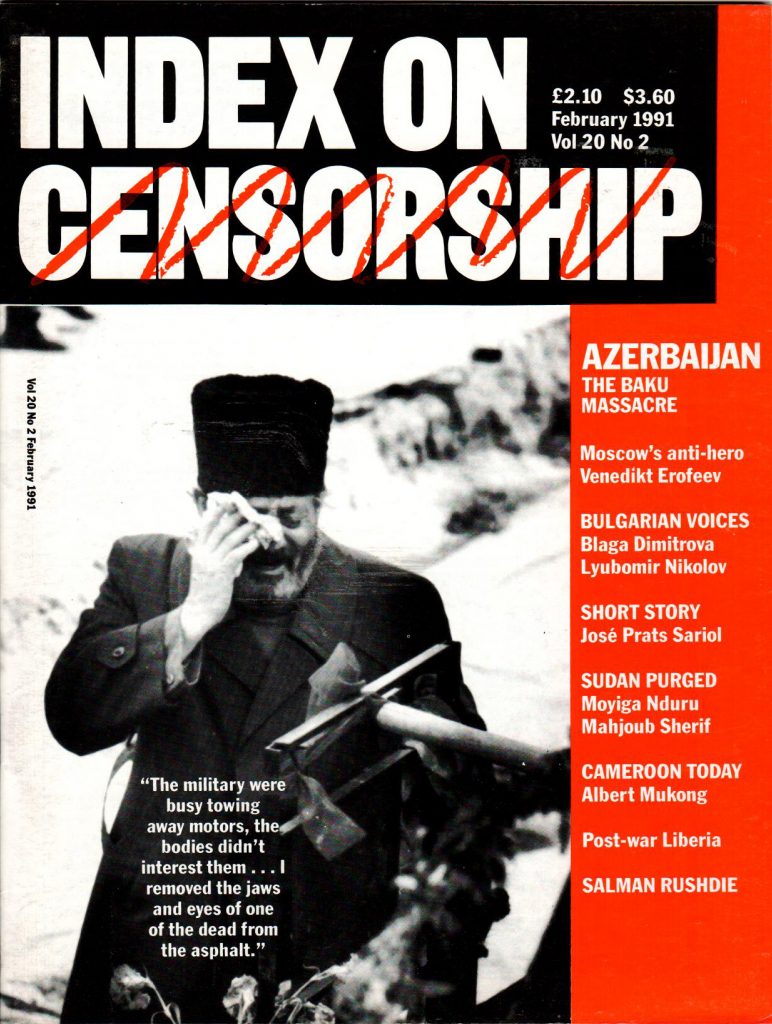
Azerbaijan, the February 1991 issue of Index on Censorship magazine.
My decision
Salman Rushdie
February 1991, vol. 20, issue 2
A man’s spiritual choices are a matter of conscience, arrived at after deep. reflection and in the privacy of his heart. They are not easy matters to speak of publicly. I should like, however, to say something about my decision to affirm the two central tenets of Islam — the oneness of God and the genuineness of the prophecy of the Prophet Muhammad —and thus to enter into the body of Islam after a lifetime spent outside it. Although I come from a Muslim family background, I was never brought up as a believer, and was raised in an atmosphere of what is broadly known as secular humanism. I still have the deepest respect for these principles. However, as I think anyone who studies my work will accept, I have been engaging more and more with religious belief, its importance and power, ever since my first novel used the Sufi poem Conference of the Birds by Farid ud-din Attar as a model. The Satanic Verses itself, with its portrait of the conflicts between the material and spiritual worlds, is a mirror of the conflict within myself.
Read the full article
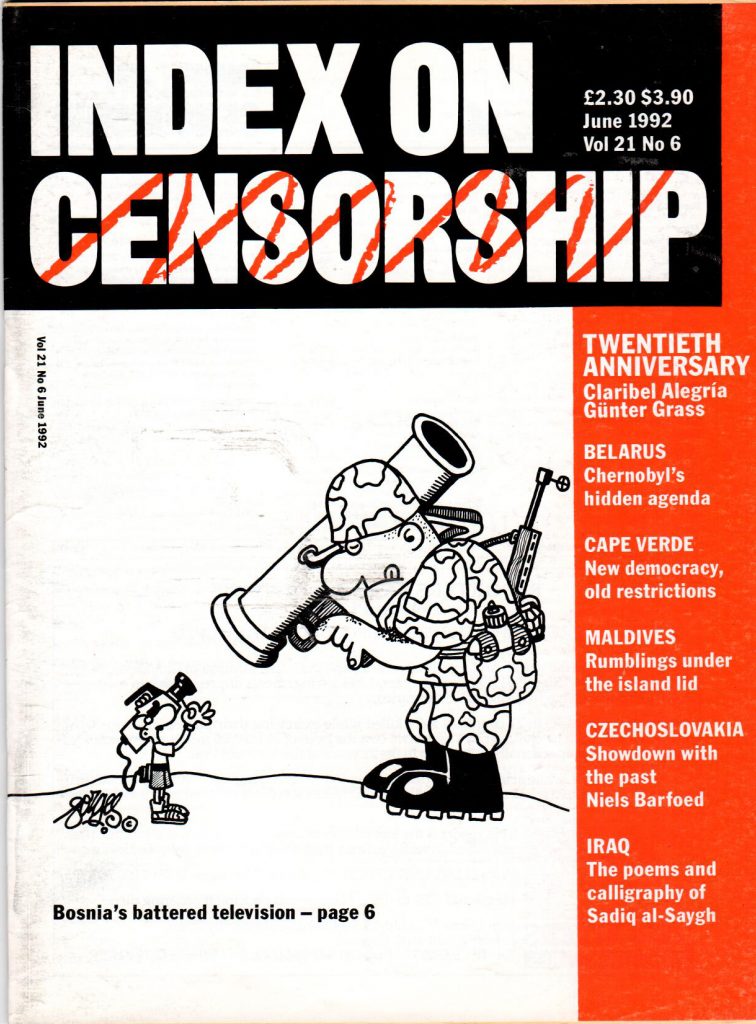
20th Anniversary: Reign of terror, the June 1992 issue of the Index on Censorship magazine.
Offending the high priests
Gunter Grass
June 1992, vol. 21, issue 6
When George Orwell returned from Spain in 1937, he brought with him the manuscript of Homage to Catalonia. It reflected the experiences he had gathered during the Civil War. At first, he was unable to find a publisher because a multitude of influential, left-wing intellectuals had no wish to acknowledge its shocking observations. They did not want to accept the Stalinist terror, the systematic liquidation of anarchists, Trotskyists and left-wing socialists. Orwell himself only narrowly escaped this terror. His stark accusations contradicted a world image of a flawless Soviet Union fighting against Fascism. Orwell’s report, this onslaught of terrible reality, tarnished the picture-book dream of Good and Evil. A year later, a bourgeois Western publisher brought out Homage to Catalonia; in the areas of Communist rule, Orwell’s works – among them the bitter Spanish truth – were banned for half a century. The minister responsible for state security= in the German Democratic Republic, right to its end, was Erich Mielke. During the Spanish Civil War, he was a member of the Communist cadre to whom purge through liquidation became commonplace. A fighter for Spain with an extraordinary capacity for survival.
Read the full article
[/vc_column_text][/vc_column][/vc_row][vc_row][vc_column][vc_column_text]

Russia’s choice, the November-December 1993 issue of Index on Censorship magazine.
The Rushdie affair: Outrage in Oslo
Hakon Harket
November 1993, vol. 22, issue 10
The terrorist state of Iran must face the consequences of refusing to lift the fatwa that condemns Salman Rushdie, and those associated with his work, to death. When someone, in accordance with the express order of the fatwa, attempts to murder one of the damned, the obvious consequence is that Iran must be held responsible for the crime it has called for, at least until there is conclusive proof that no connection exists. The shooting of William Nygaard has reminded the Norwegian public of what the Rushdie affair is really about: life and death; the abuse of religion; the fiction of a free mind. This war of terror against freedom of speech is not one we can afford to lose. Since the nightmare clearly will not disappear of its own accord, it must be engaged head-on.
Read the full article

New censors, the March 1996 issue of Index on Censorship magazine.
From Salman Rushdie
March 1996, vol. 25, issue 2
This statement is not, of course, addressed to the Ayatollah Khomeini who, except for a handful of fanatics, is easily diagnosed as a sick and dangerous man who has long forgotten the fundamental tenets of Islam. It is useful to address oneself, at this point, only to the real Islamic faithful who, in their hearts, recognise the awful truth about their erratic Imam and the threat he poses not only to the continuing acceptance of Islam among people of all religions and faiths but to the universal brotherhood of man, no matter the differing colorations of their piety. Will Salman Rushdie die? He shall not. But if he does, let the fanatic defenders of Khomeini’s brand of Islam understand this: The work for which he is now threatened will become a household icon within even the remnant lifetime of the Ayatollah. Writers, cineastes, dramatists will disseminate its contents in every known medium and in some new ones as yet unthought of.
Read the full article

Shadow of the Fatwa
Kenan Malik
December 2008, vol. 37, issue 4
The Satanic Verses was, Salman Rushdie said in an interview before publication, a novel about ‘migration, metamorphosis, divided selves, love, death’. It was also a satire on Islam, ‘a serious attempt’, in his words, ‘to write about religion and revelation from the point of view of a secular person’. For some that was unacceptable, turning the novel into ‘an inferior piece of hate literature’ as the British-Muslim philosopher Shabbir Akhtar put it. Within a month, The Satanic Verses had been banned in Rushdie’s native India, after protests from Islamic radicals. By the end of the year, protesters had burnt a copy of the novel on the streets of Bolton, in northern England. And then, on 14 February 1989, came the event that transformed the Rushdie affair – Ayatollah Khomeini issued his fatwa.’I inform all zealous Muslims of the world,’ proclaimed Iran’s spiritual leader, ‘that the author of the book entitled The Satanic Verses – which has been compiled, printed and published in opposition to Islam, the prophet and the Quran – and all those involved in its publication who were aware of its contents are sentenced to death.’
Read the full article
The right to publish
Peter Mayer
December 2008, vol. 37, issue 4
As publisher of The Satanic Verses, Peter Mayer was on the front line. He writes here for the first time about an unprecedented crisis:
Penguin published Salman Rushdie’s The Satanic Verses six months before Ayatollah Khomeini issues his fatwa. When we decided to continue publishing the novel in the aftermath, extraordinary pressures were focused on our company, based on fears for the author’s life and for the lives of everyone at Penguin around the world. This extended from Penguin’s management to editorial, warehouse, transport, administrative staff, the personnel in our bookshops and many others. The long-term political implications of that early signal regarding free speech in culturally diverse societies were not yet apparent to many when the Ayatollah, speaking not only for Iran but, seemingly, for all of Islam, issued his religious proclaimation.
Read the full article
Emblem of darkness
Bernard-Henri Lévy
December 2008, vol. 37, issue 4
As publisher of The Satanic Verses, Peter Mayer was on the front line. He writes here for the first time about an unprecedented crisis:
Salman Rushdie was not yet the great man of letters that he has since become. He and I are, though, pretty much the same age. We share a passion for India and Pakistan, as well as the uncommon privilege of having known and written about Zulfikar Ali Bhutto (Rushdie in Shame; I in Les Indes Rouges), the father of Benazir, former prime minister of Pakistan, executed ten years earlier in 1979 by General Zia. I had been watching from a distance, with infinite curiosity, the trajectory of this almost exact contemporary. One day, in February 1989, at the end of the afternoon, as I sat in a cafe in the South of France, in Saint Paul de Vence, with the French actor Yves Montand, sipping an orangeade, I heard the news: Ayatollah Khomeini, himself with only a few months to live, had just issued a fatwa, in which he condemned as an apostate the author of The Satanic Verses and invited all Muslims the world over to carry out the sentence, without delay.
Read the full article[/vc_column_text][/vc_column][/vc_row][vc_row][vc_column][vc_basic_grid post_type=”post” max_items=”4″ element_width=”6″ grid_id=”vc_gid:1623240200822-8c1bcd36-9835-10″ taxonomies=”8890″][/vc_column][/vc_row]
29 Aug 2018 | Bahrain, Bahrain Statements, Campaigns -- Featured, Statements
[vc_row][vc_column][vc_single_image image=”95198″ img_size=”full” add_caption=”yes”][vc_column_text]For the second time since 2013, the United Nations (UN) Working Group on Arbitrary Detention (WGAD) has issued an Opinion regarding the legality of the detention of Mr. Nabeel Rajab under international human rights law.
In its second opinion, the WGAD held that the detention was not only arbitrary but also discriminatory. The 127 signatory human rights groups welcome this landmark opinion, made public on 13 August 2018, recognising the role played by human rights defenders in society and the need to protect them. We call upon the Bahraini Government to immediately release Nabeel Rajab in accordance with this latest request.
In its Opinion (A/HRC/WGAD/2018/13), the WGAD considered that the detention of Mr. Nabeel Rajabcontravenes Articles 2, 3, 7, 9, 10, 11, 18 and 19 of the Universal Declaration on Human Rights and Articles 2, 9, 10, 14, 18, 19 and 26 of the International Covenant on Civil and Political Rights, ratified by Bahrain in 2006. The WGAD requested the Government of Bahrain to “release Mr. Rajab immediately and accord him an enforceable right to compensation and other reparations, in accordance with international law.”
This constitutes a landmark opinion as it recognises that the detention of Mr. Nabeel Rajab – President of the Bahrain Center for Human Rights (BCHR), Founding Director of the Gulf Centre for Human Rights (GCHR), Deputy Secretary General of FIDH and a member of the Human Rights Watch Middle East and North Africa Advisory Committee – is arbitrary and in violation of international law, as it results from his exercise of the right to freedom of opinion and expression as well as freedom of thought and conscience, and furthermore constitutes “discrimination based on political or other opinion, as well as on his status as a human rights defender.” Mr. Nabeel Rajab’s detention has therefore been found arbitrary under both categories II and V as defined by the WGAD.
Mr. Nabeel Rajab was arrested on 13 June 2016 and has been detained since then by the Bahraini authorities on several freedom of expression-related charges that inherently violate his basic human rights. On 15 January 2018, the Court of Cassation upheld his two-year prison sentence, convicting him of “spreading false news and rumors about the internal situation in the Kingdom, which undermines state prestige and status” – in reference to television interviews he gave in 2015 and 2016. Most recently on 5 June 2018, the Manama Appeals Court upheld his five years’ imprisonment sentence for “disseminating false rumors in time of war”; “offending a foreign country” – in this case Saudi Arabia; and for “insulting a statutory body”, in reference to comments made on Twitter in March 2015 regarding alleged torture in Jaw prison and criticising the killing of civilians in the Yemen conflict by the Saudi Arabia-led coalition. The Twitter case will next be heard by the Court of Cassation, the final opportunity for the authorities to acquit him.
The WGAD underlined that “the penalisation of a media outlet, publishers or journalists solely for being critical of the government or the political social system espoused by the government can never be considered to be a necessary restriction of freedom of expression,” and emphasised that “no such trial of Mr. Rajab should have taken place or take place in the future.” It added that the WGAD “cannot help but notice that Mr. Rajab’s political views and convictions are clearly at the centre of the present case and that the authorities have displayed an attitude towards him that can only be characterised as discriminatory.” The WGAD added that several cases concerning Bahrain had already been brought before it in the past five years, in which WGAD “has found the Government to be in violation of its human rights obligations.” WGAD added that “under certain circumstances, widespread or systematic imprisonment or other severe deprivation of liberty in violation of the rules of international law may constitute crimes against humanity.”
Indeed, the list of those detained for exercising their right to freedom of expression and opinion in Bahrain is long and includes several prominent human rights defenders, notably Mr. Abdulhadi Al-Khawaja, Dr.Abduljalil Al-Singace and Mr. Naji Fateel – whom the WGAD previously mentioned in communications to the Bahraini authorities.
Our organisations recall that this is the second time the WGAD has issued an Opinion regarding Mr. Nabeel Rajab. In its Opinion A/HRC/WGAD/2013/12adopted in December 2013, the WGAD already classified Mr. Nabeel Rajab’s detention as arbitrary as it resulted from his exercise of his universally recognised human rights and because his right to a fair trial had not been guaranteed (arbitrary detention under categories II and III as defined by the WGAD).The fact that over four years have passed since that opinion was issued, with no remedial action and while Bahrain has continued to open new prosecutions against him and others, punishing expression of critical views, demonstrates the government’s pattern of disdain for international human rights bodies.
To conclude, our organisations urge the Bahrain authorities to follow up on the WGAD’s request to conduct a country visit to Bahrain and to respect the WGAD’s opinion, by immediately and unconditionally releasing Mr. Nabeel Rajab, and dropping all charges against him. In addition, we urge the authorities to release all other human rights defenders arbitrarily detained in Bahrain and to guarantee in all circumstances their physical and psychological health.
This statement is endorsed by the following organisations:
1- ACAT Germany – Action by Christians for the Abolition of Torture
2- ACAT Luxembourg
3- Access Now
4- Acción Ecológica (Ecuador)
5- Americans for Human Rights and Democracy in Bahrain – ADHRB
6- Amman Center for Human Rights Studies – ACHRS (Jordania)
7- Amnesty International
8- Anti-Discrimination Center « Memorial » (Russia)
9- Arabic Network for Human Rights Information – ANHRI (Egypt)
10- Arab Penal Reform Organisation (Egypt)
11- Armanshahr / OPEN Asia (Afghanistan)
12- ARTICLE 19
13- Asociación Pro Derechos Humanos – APRODEH (Peru)
14- Association for Defense of Human Rights – ADHR
15- Association for Freedom of Thought and Expression – AFTE (Egypt)
16- Association marocaine des droits humains – AMDH
17- Bahrain Center for Human Rights
18- Bahrain Forum for Human Rights
19- Bahrain Institute for Rights and Democracy – BIRD
20- Bahrain Interfaith
21- Cairo Institute for Human Rights – CIHRS
22- CARAM Asia (Malaysia)
23- Center for Civil Liberties (Ukraine)
24- Center for Constitutional Rights (USA)
25- Center for Prisoners’ Rights (Japan)
26- Centre libanais pour les droits humains – CLDH
27- Centro de Capacitación Social de Panama
28- Centro de Derechos y Desarrollo – CEDAL (Peru)
29- Centro de Estudios Legales y Sociales – CELS (Argentina)
30- Centro de Políticas Públicas y Derechos Humanos – Perú EQUIDAD
31- Centro Nicaragüense de Derechos Humanos – CENIDH (Nicaragua)
32- Centro para la Acción Legal en Derechos Humanos – CALDH (Guatemala)
33- Citizen Watch (Russia)
34- CIVICUS : World Alliance for Citizen Participation
35- Civil Society Institute – CSI (Armenia)
36- Colectivo de Abogados « José Alvear Restrepo » (Colombia)
37- Collectif des familles de disparu(e)s en Algérie – CFDA
38- Comisión de Derechos Humanos de El Salvador – CDHES
39- Comisión Ecuménica de Derechos Humanos – CEDHU (Ecuador)
40- Comisión Nacional de los Derechos Humanos (Costa Rica)
41- Comité de Acción Jurídica – CAJ (Argentina)
42- Comité Permanente por la Defensa de los Derechos Humanos – CPDH (Colombia)
43- Committee for the Respect of Liberties and Human Rights in Tunisia – CRLDHT
44- Commonwealth Human Rights Initiative – CHRI (India)
45- Corporación de Defensa y Promoción de los Derechos del Pueblo – CODEPU (Chile)
46- Dutch League for Human Rights – LvRM
47- European Center for Democracy and Human Rights – ECDHR (Bahrain)
48- FEMED – Fédération euro-méditerranéenne contre les disparitions forcées
49- FIDH, in the framework of the Observatory for the Protection of Human Rights Defenders
50- Finnish League for Human Rights
51- Foundation for Human Rights Initiative – FHRI (Uganda)
52- Front Line Defenders
53- Fundación Regional de Asesoría en Derechos Humanos – INREDH (Ecuador)
54- Groupe LOTUS (DRC)
55- Gulf Center for Human Rights
56- Human Rights Association – IHD (Turkey)
57- Human Rights Association for the Assistance of Prisoners (Egypt)
58- Human Rights Center – HRIDC (Georgia)
59- Human Rights Center « Memorial » (Russia)
60- Human Rights Center « Viasna » (Belarus)
61- Human Rights Commission of Pakistan
62- Human Rights Foundation of Turkey
63- Human Rights in China
64- Human Rights Mouvement « Bir Duino Kyrgyzstan »
65- Human Rights Sentinel (Ireland)
66- Human Rights Watch
67- I’lam – Arab Center for Media Freedom, Development and Research
68- IFEX
69- IFoX Turkey – Initiative for Freedom of Expression
70- Index on Censorship
71- International Human Rights Organisation « Club des coeurs ardents » (Uzbekistan)
72- International Legal Initiative – ILI (Kazakhstan)
73- Internet Law Reform Dialogue – iLaw (Thaïland)
74- Institut Alternatives et Initiatives Citoyennes pour la Gouvernance Démocratique – I-AICGD (RDC)
75- Instituto Latinoamericano para una Sociedad y Derecho Alternativos – ILSA (Colombia)
76- Internationale Liga für Menschenrechte (Allemagne)
77- International Service for Human Rights – ISHR
78- Iraqi Al-Amal Association
79- Jousor Yemen Foundation for Development and Humanitarian Response
80- Justice for Iran
81- Justiça Global (Brasil)
82- Kazakhstan International Bureau for Human Rights and the Rule of Law
83- Latvian Human Rights Committee
84- Lawyers’ Rights Watch Canada
85- League for the Defense of Human Rights in Iran
86- League for the Defense of Human Rights – LADO Romania
87- Legal Clinic « Adilet » (Kyrgyzstan)
88- Liga lidských práv (Czech Republic)
89- Ligue burundaise des droits de l’Homme – ITEKA (Burundi)
90- Ligue des droits de l’Homme (Belgique)
91- Ligue ivoirienne des droits de l’Homme
92- Ligue sénégalaise des droits humains – LSDH
93- Ligue tchadienne des droits de l’Homme – LTDH
94- Ligue tunisienne des droits de l’Homme – LTDH
95- MADA – Palestinian Center for Development and Media Freedom
96- Maharat Foundation (Lebanon)
97- Maison des droits de l’Homme du Cameroun – MDHC
98- Maldivian Democracy Network
99- MARCH Lebanon
100- Media Association for Peace – MAP (Lebanon)
101- MENA Monitoring Group
102- Metro Center for Defending Journalists’ Rights (Iraqi Kurdistan)
103- Monitoring Committee on Attacks on Lawyers – International Association of People’s Lawyers
104- Movimento Nacional de Direitos Humanos – MNDH (Brasil)
105- Mwatana Organisation for Human Rights (Yemen)
106- Norwegian PEN
107- Odhikar (Bangladesh)
108- Pakistan Press Foundation
109- PEN America
110- PEN Canada
111- PEN International
112- Promo-LEX (Moldova)
113- Public Foundation – Human Rights Center « Kylym Shamy » (Kyrgyzstan)
114- RAFTO Foundation for Human Rights
115- Réseau Doustourna (Tunisia)
116- SALAM for Democracy and Human Rights
117- Scholars at Risk
118- Sisters’ Arab Forum for Human Rights – SAF (Yemen)
119- Suara Rakyat Malaysia – SUARAM
120- Taïwan Association for Human Rights – TAHR
121- Tunisian Forum for Economic and Social Rights – FTDES
122- Vietnam Committee for Human Rights
123- Vigilance for Democracy and the Civic State
124- World Association of Newspapers and News Publishers – WAN-IFRA
125- World Organisation Against Torture – OMCT, in the framework of the Observatory for the Protection of Human Rights Defenders
126- Yemen Organisation for Defending Rights and Democratic Freedoms
127- Zambia Council for Social Development – ZCSD[/vc_column_text][/vc_column][/vc_row][vc_row][vc_column][vc_basic_grid post_type=”post” max_items=”4″ element_width=”6″ grid_id=”vc_gid:1535551119543-359a0849-e6f7-3″ taxonomies=”716″][/vc_column][/vc_row]
19 Apr 2018 | Awards, Cuba, Fellowship, Fellowship 2018
[vc_row][vc_column][vc_video link=”https://youtu.be/-UpVto-2Sf0″][vc_column_text]
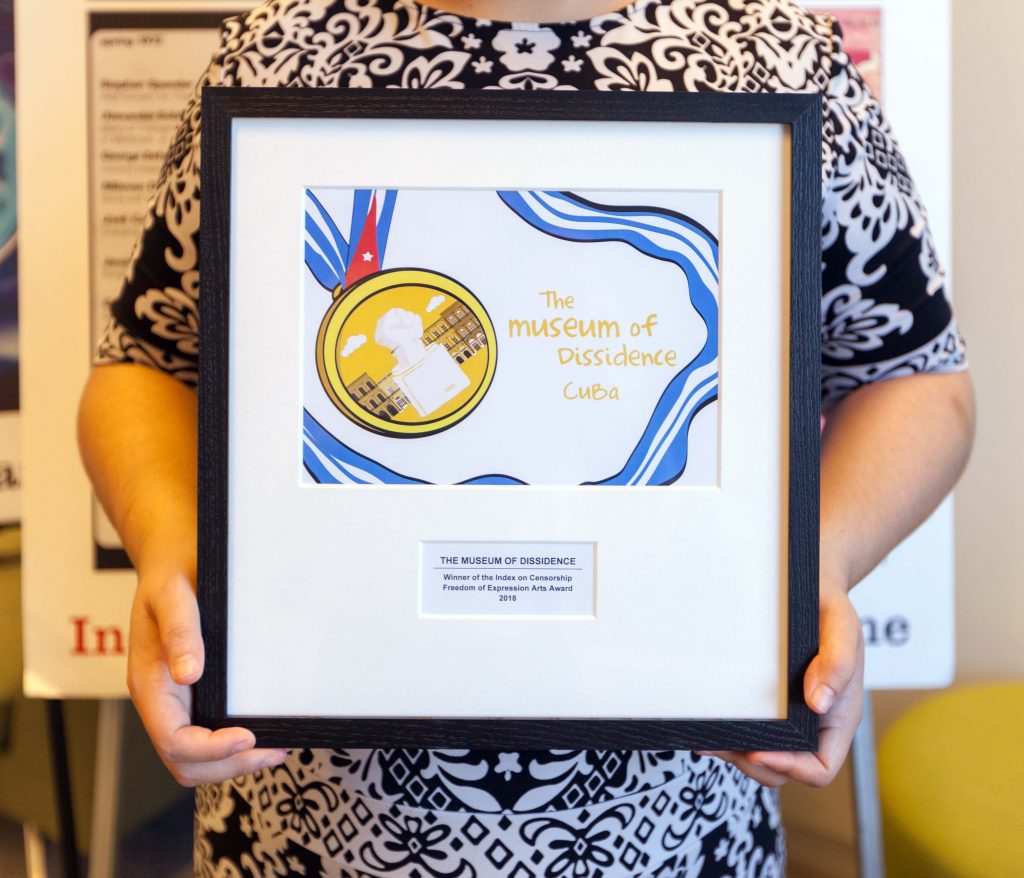
Perla Hinojosa, Fellowship and Advocacy Officer at Index on Censorship, holds the 2018 Freedom of Expression Arts Award for Cuban arts collective Museum of Dissidence, who could not attend the Freedom of Expression Awards. (Photo: Index on Censorship)
Luis Manuel Otero Alcántara: First of all I would like to thank Index and everyone for being here. We had to do this via video because the bureaucracy, the embassies and the powers that be prevented us from being here to accept the award. It’s sad, because we would have liked to share this moment with all of you and the happiness that we feel receiving this award. This award for us means a lot but it also means a lot to all the artists who have preceded us and who are the reason why we have been able to work with a little bit more freedom and a little less fear. Antonia Eiriz, Tania Bruguera, Danilo Maldonado, Angel Delgado and all the artists who have suffered a lack of freedom of expression and creative freedom and who in one way or the other have never given up and have fought for their rights.
Yanelys Nuñez Leyva: On my part, I am happy because this is a boost, where the work of the museum is recognised internationally. This is not the work of just two people, it’s the work of a big collective. There’s a lot of artists but also many activists who are involved in the projects of the Museum of Dissidence. And for us, this is a recognition for them as well.
Luis Manuel: Freedom of expression is an integral part of all societies. It’s what allows us to question all the processes that can happen to an individual. From being able to tell a mother that her way of bringing up her children in a certain way is aggressive or not. To being able to say a political system is corrupt. To being able to express yourself to another person without facing violence or repression.
Yanelys: For me, freedom of expression is like breathing and being able to move every day. It’s something natural that enables us to improve ourselves and grow.
Luis Manuel: Freedom of expression also promotes love towards yourself, towards other people and all the people around you.[/vc_column_text][/vc_column][/vc_row][vc_row disable_element=”yes”][vc_column width=”1/2″][vc_single_image image=”84882″ img_size=”full” alignment=”center”][vc_column_text]
For his one-man protests, Ildar Dadin was sent to prison in December 2015 where he was tortured, before his conviction was quashed in February 2017. Read the full profile.[/vc_column_text][/vc_column][vc_column width=”1/2″][vc_single_image image=”84888″ img_size=”full” alignment=”center”][vc_column_text]
Despite the persecution he faces for his work, Rebel Pepper continues to satirise the Chinese state from a life in exile in Japan. Read the full profile
[/vc_column_text][/vc_column][/vc_row][vc_row disable_element=”yes”][vc_column width=”1/2″][vc_single_image image=”84889″ img_size=”full” alignment=”center”][vc_column_text]
Established in 2015, Turkey Blocks is an independent digital research organisation that monitors internet access restrictions in Turkey. Read the full profile.
[/vc_column_text][/vc_column][vc_column width=”1/2″][vc_single_image image=”84887″ img_size=”full” alignment=”center”][vc_column_text]
Maldives Independent, the Maldives’ premiere English publication and one of the few remaining independent media outlets, was formed in exile in Sri Lanka in 2004. Read the full profile.
[/vc_column_text][/vc_column][/vc_row][vc_row][vc_column][vc_basic_grid post_type=”post” max_items=”12″ style=”load-more” items_per_page=”4″ element_width=”6″ grid_id=”vc_gid:1524235545550-0aab9a14-081b-8″ taxonomies=”8935″][/vc_column][/vc_row]
