1 Mar 2016 | Europe and Central Asia, Mapping Media Freedom, mobile, News, Turkey
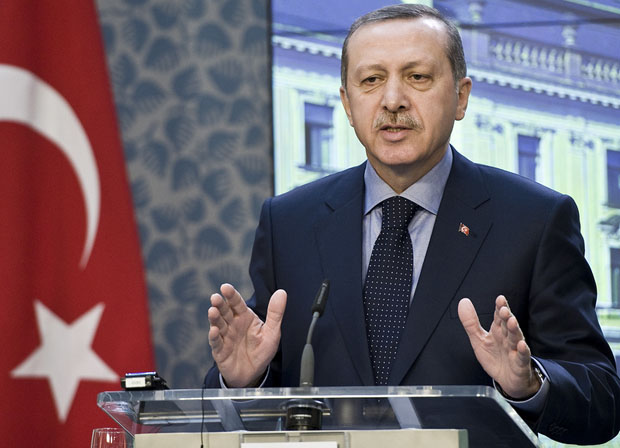
Turkish President Recep Tayyip Erdogan (Photo: Philip Janek / Demotix)
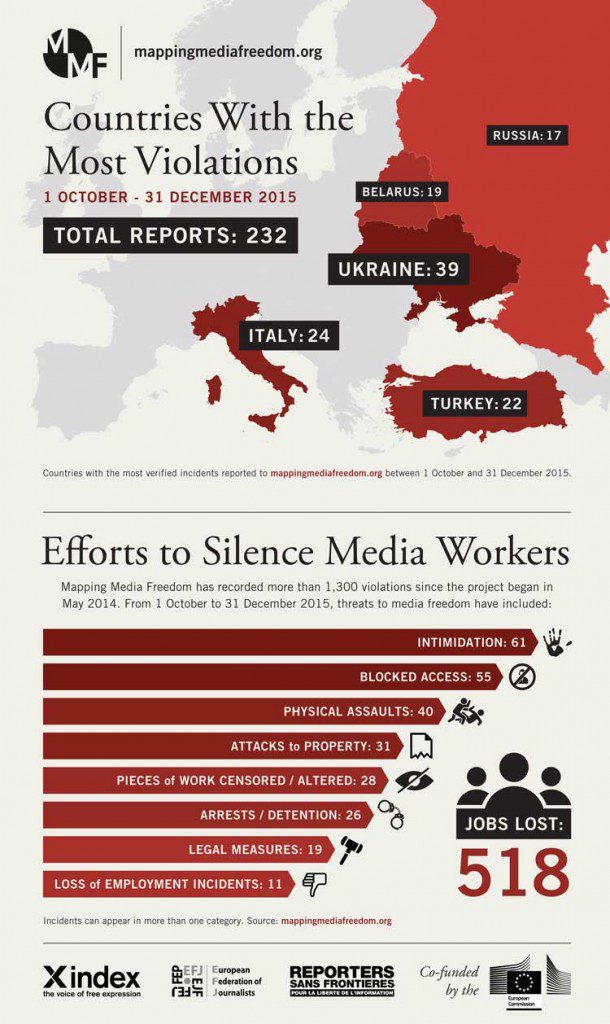
The ongoing deterioration in Turkey’s press freedom has been well documented by Index on Censorship’s Mapping Media Freedom project since its launch in 2014. The crackdown appears to be getting worse, according to a new report by Amnesty International this month. It states that the “human rights situation deteriorated markedly” in Turkey in 2015, as did respect for freedom of expression, including criminal detention though anti-terror laws and the targeting of anyone critical of government policy.
Despite the welcome release of Cumhuriyet journalists Can Dündar and Erdem Gül on 26 February, the situation for media freedom looks uncertain. Here are some of the most worrying reports from February.
Journalists killed
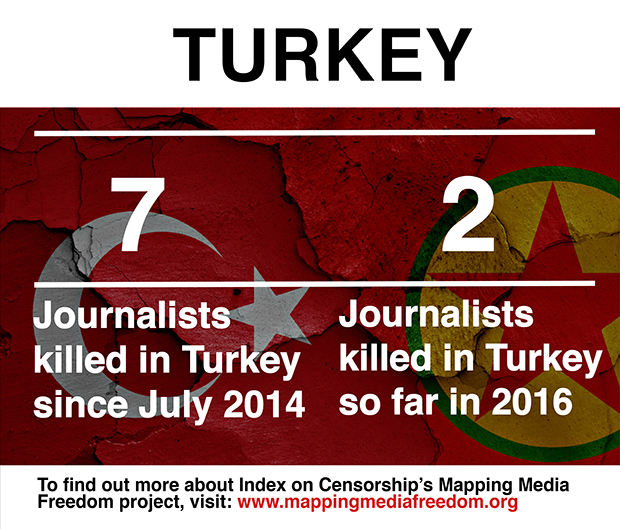
In total, Mapping Media Freedom has recorded the deaths of 15 journalists since July 2014. Seven of these deaths have occurred in Turkey, two of those in this year alone. Gülsen Yıldız, a journalist working in Ankara for Tarim TV, was killed on 18 February. She was among 28 people who died during a terrorist attack on passing military vehicles in the capital.
Later in February, the discovery of a body, later identified as journalist Rohat Aktaş, in the southeastern town of Cizre. Aktaş had been shot in the arm in late January while covering efforts to help those wounded during clashes between Kurdish separatists and Turkish forces.
On 24 February, Dicle-Haber reported that Aktaş’ body was identified by DNA tests carried out by the forensic authority. “Scores” of people are reported to have been killed in Cizre following a raid by security services on buildings they say harboured Kurdish separatist fighters. The exact details of Aktaş’ death are currently unknown.
Journalists detained on anti-terror charges
This year began on a somewhat positive note with the 5 January release of VICE News journalist Mohammed Ismael Rasool. Rasool, an Iraqi Kurdish reporter, had been detained since 27 August 2015 while reporting in the country’s southeast and charged with working for a terrorist organisation.
On 11 February, Nazım Daştan, a journalist for Dicle News Agency (DİHA), which reports in Kurdish, was arrested in Gaziantep on charges of spreading online propaganda for the Kurdistan Workers’ Party (PKK), which the Turkish state lists as a terrorist group. On the next day, he was brought to testify in court and then taken to jail.
On the same date, Feyyaz İmrak, also journalist for Dicle News Agency (DİHA), was arrested along with 16 others on charges of being members of the PKK. Police searched his home and confiscated his reporting equipment and notes.
İmrak appeared before a criminal court 15 February to hear the charges against him, and is currently being held at Antalya Prison, pending trial.
Journalists denied access
For any journalist, access to sources is essential for their ability to carry out their duties. The denial of access is a major problem for journalists in Turkey, something foreign journalists know all too well.
On 9 February, Turkish authorities rejected a permanent press accreditation application filed by Silje Rønning Kampesæter, a correspondent for Norway’s Aftenposten. The press accreditation application also affects her residence permit in Turkey. No reason was given for the rejection.
The authorities also detained Claus Blok Thomsen, a Danish journalist working for Denmark’s daily newspaper Politiken, at the Istanbul airport, barring him from entering the country. The journalist was seeking access to report on refugees at the Turkish-Syrian border.
When Thomsen identified himself as a journalist, police forced him to open his phone and computer, undermining the confidentiality of his sources. He was then detained in a cell overnight and put on a plane to Copenhagen the next day. He was reportedly told to not try re-entering Turkey.
Also see:
Statement: Index condemns seizure of Zaman
Sign Our Petition: End Turkey’s crackdown on press freedom
Letter: Writers and artists condemn seizure of Zaman news group
Reaction: Turkish court orders seizure of Zaman news group
This article was originally published at Index on Censorship.
1 Mar 2016 | Magazine, Statements, Volume 44.04 Winter 2015 Extras
Rachael Jolley, editor of Index on Censorship magazine, in a speech to the §2 – Libraries and Democracy conference in Umea, Sweden.
When I was nine, ten and eleven, my mother, my brother and I had a weekly ritual of driving to the local library, a flat modern building with big glass windows. We’d spend a quiet hour wandering up and down its carpeted corridors, picking out two or three plastic-covered books to take home to read.
All sorts of people found stories, history and biographies within their reach.
I have measured out my life in library books: from weekly visits to Bristol libraries, to school in Pittsburgh – a city which pays tribute to the greatest library supporter of them all Andrew Carnegie – to further study at the great Colindale newspaper archive library, and perhaps the most exciting celebrity library spot, standing next to the poet and librarian Philip Larkin in the neighbourhood butchers in Hull.
US poet laureate Rita Dove believes that libraries provide: “A window into the soul and a door into the world.” There are two types of freedom captured in that thought: The freedom to think, and the freedom to find out about others.
Books, magazines and newspapers are a door into the world and that’s why over centuries governments have tried to stop them being opened.
When that door opens on to the world, who knows what people might think or do? That door is not open to everyone now, or in the past. And when it comes to the freedom to express oneself: to write, draw, paint, act or protest then restrictions have often been levied by governments and other powerful bodies to stop the wider public being allowed those too.
Over the centuries, often, books were only made available to some. Sometimes they were written in a language that only a tiny group of people knew. When paper was expensive, books were for the few, not the many. In times gone by education was also expensive (and it still is in many places); those who were allowed to learn reading and writing were once in the minority.
That’s why public libraries, open to all and funded from the public purse, are so important. Their existence helped the many get access to what the few had held close to their chests; information, literature, inspiration.
US businessman and philanthropist Andrew Carnegie was one of the world’s most enthusiastic endowers of libraries. He helped fund more than 2,000 libraries around the United States plus hundreds more in the UK and beyond, because when he was a poor teenager, a wealthy man, Colonel James Anderson, opened up his private library of 400 books to Andrew and other working boys on Saturday nights, and this, Carnegie believed, made a huge difference to his life chances, and his ability to rise from poor, struggling beginnings to be a successful and wealthy steel magnate.
Carnegie believed in libraries’ power to do good. To open people’s minds. To help build knowledge. To help the ordinary person be introduced to ideas that might never otherwise be seen.
Of course, the history of libraries is much older than Carnegie’s time, stretching back to the Romans, Greeks, Chinese and Islamic libraries, where archives of important documents were kept.
Libraries hold history; documents that tell us what was bought and sold in ancient Greece; or how a Roman senator spoke. They inform us about the reality of other times, and allow us to learn from that past.
That’s why conquering armies have looked to destroy libraries and museums. Part of imposing a new present on a population is sometimes about re-writing the past. From the Library at Alexandria, to the Mosque library at Chinguetti to the Roman library on the Palatine Hill. If documents had not been preserved, we would know far less. We can do more than guess what might have happened, we can actually KNOW details, because records are still available.
In the 21st century libraries are under threat from many directions. As governments and local councils cut public spending, libraries in many western countries, including in the United Kingdom, are being closed down. Does that point to a lack of need or desire for such things? Have libraries become redundant?
In this new age of enlightenment is our thirst for knowledge less desperate than in previous generations or is our thirst quenched by easy access to hundreds of television channels and the internet? Indeed, with electronically accessible information free to anyone with a computer, is the internet the ultimate library, rendering its brick and glass-built equivalents redundant, in the same way the printing press marginalised the illuminated manuscript?
We in Europe are more free than previous generations have ever been to learn, find and understand. With our zillions of instant access points for information and discussion, we can look at Facebook, Twitter and thousands of ideas online in the twitch of mouse click after all. But does that access bring more understanding or deeper knowledge? And what is the future role then of a library?
Librarians are much needed as valuable guides: to help students and other readers to learn techniques to sift information, question its validity and measure its importance. To understand what to trust and what to question; and that all information is not equal. Students need to be able to weigh up different sources of research. The University of California Library System saw a 54% decline in circulation between 1991 to 2001 of 8,377,000 books to 3,832,000. It is shocking that some students are failing themselves by not using a broad range of books, and journals that are free from their university libraries to widen and deepen their understanding.
Both libraries and newspapers in their analogue form gave us the opportunity to stumble over ideas that we might not have otherwise encountered. Over there, on that page opposite the one we are reading in a newspaper, is an article about Chilean architecture that we knew nothing about it, but suddenly find a spark of interest in, and over there on the library shelf next to Agatha Christie, is Henning Mankell, a new author to us, and one that suddenly sounds like one we might like to read. And then off we go on a new winding track towards knowledge; one that we didn’t even know we wanted to explore. But that analogue world of stumbled-upon exploration is closing down. We have to make sure that we still have the equipment to carry on stumbling down new avenues and finding out about new writers, and history that we never knew we would care about.
Technology tends to remove the “stumbling upon”, by taking us down straight lines. Instead it prompts us to read or consume more of the same. Technology learns what we like, but it doesn’t know and cannot anticipate what might fascinate us in a chance, a random, encounter. In a world where we remove the unexpected then we miss out on expanding our knowledge. Something that libraries have always offered. The present is all too easily an echo chamber of social media where we follow only the people we agree with, and where we fail to engage with the arguments of those with whom we disagree. Is the echo chamber being enhanced by the linear nature of the digital library, the digital bookstore and the digital newspaper? AND if we follow only those that we like and agree with, do we lull ourselves into believing that those are the only opinions and beliefs out there. And we are so unused to disagreement that we want to close it down. We are somehow afraid to have it in the same room as us. Somehow we seem to be stumbling on towards a world where disagreement is frowned upon, and not embraced as a way of finding what is out there.
This is just one challenge to freedom of expression and thought. There are others.
Recently at Index on Censorship, we heard from Chilean-American writer Ariel Dorfman, a long-time supporter and writer for us…. that his play, Death and the Maiden, was being banned by a school in New Jersey because some parents didn’t like the language contained in it. In other words it offended or upset somebody. Meanwhile Judy Blume’s books about the realities of teenage life, including swearing and teenage pregnancy, gets her banned from US libraries and schools.
But isn’t fiction, theatre and art about connecting with the real, isn’t it about challenging people to think, and to be provoked?
When a film has been banned from our cinemas or a book banned from distribution has it meant no one is keen to read it? In fact the opposite is usually true, people flock to find out what it is or to watch the film wherever they can. One Flew Over the Cuckoo’s Nest, A Clockwork Orange and DH Lawrence’s novel Sons and Lovers found new audiences because they were banned. Monty Python’s controversial film Life of Brian was once marketed here in Sweden as the film so funny, it was banned in Norway!! (As you can imagine it did very well here in Sweden.)
Increasingly there are loud voices saying that we shouldn’t think about the unpleasant bits in the world, that we should ignore the difficult or traumatic because it is too complicated, or too ugly to have in the room. In a special editorial published at the time of the Charlie Hebdo killings, the South African Mail and Guardian said; “The goals of terrorism, if we are to dignify utter insanity with aims, are fear and polarisation.” If we live in a society where we think we are not allowed to speak about subjects; where they are considered too controversial, where appearing on a platform with someone is somehow seen as a tacit nod to agreeing with them, are giving into those goals?
So what can those living in Europe do to enhance or defend freedom of expression and what are the role of libraries? Firstly, we should never stop learning about our history. Remember periods where freedoms of expression, of thought, of living in a non traditional way, or practising a religion that was not state sanctioned, were not laid out as European rights as they are today. From witch trials, to the Edict of Nantes, to social stigma of unmarried women, to children abused by adults. There are moments in every family’s history, when someone had a desperate need for some secret, some taboo, some injustice to be talked about. To be put under the public spotlight.
Given that historical, but personal, reflection, perhaps each of us can have a clearer understanding of why freedom of expression as a right is something worth defending today.
Freedom of expression has always had a role in challenging injustice and persecution. Some argue that without freedom of expression we would not have other freedoms. Freedom of expression also includes offering groups that have historically been ostracised or sidelined or ignored — a chance to put their views, to be part of the wider debate, to be chosen to join a television chat show. Europe is a diverse society, all those voices should be heard.
Another point about enhancing freedom of expression in Europe, and outside, is that a lively and vigorous and diverse media is extremely important. So we should fight against control of the media by a single corporation, or by increased government influence. We need newspapers, and broadcasters, that cover what is happening, and don’t ignore stories because someone would rather those stories were not covered.
And another role for libraries of the future is as debate houses – a living room – at the centre of communities where people of different backgrounds come together to hear and discuss issues at the heart of our societies. And to meet others in their community. These neutral spaces are increasingly needed.
The value of passionate argument is often valued less than it should be. Where debates or arguments are driven underground, those who are not allowed to speak somehow obtain a glamour, a modern martydom. We must allow dissent and argument. We must let people whose ideas we abhor speak. Freedom of speech for those we like and agree with is no freedom at all.
There are those that dismiss freedom of speech as an indulgence defended by the indulged or the middle class or the left wing or the right wing or some other group that they would like not to hear from. However throughout history, freedom of speech and thought and debate has been used by the less powerful to challenge the powerful. Governments, state institutions, religious institutions. And to argue for change. That is not an indulgence.
And if you believe someone else’s arguments are ill founded, incorrect or malicious, then arguing a different point of view in a public place, a library, or a university hall, is much more powerful, than saying you are not allowed to say those things because we don’t like or disagree with them. To make those arguments, to understand what is happening we need to be able to access knowledge, libraries must continue to be community spaces where people can delve for that research and find out about the world, and themselves.
Libraries and those who support them have often been defenders of the right to knowledge. Because at the heart of any library is the idea of a freedom to think and discover.
We should remember that reading something never killed anyone. Watching a play didn’t either. If you find something that you disagree with, even disagree strongly, it is not the same as a dagger through your heart, as someone told me it was last summer in Italy.
As Turkish writer Elif Shafak said recently the response to a cartoon is another cartoon, the response to a play is another play. We are and can be prepared to listen, read or watch things that we disagree with. Listen to the argument; argue back with your own. Consider the evidence. The point of speech is to arrive at truth, and no one should be offended by that.
9 Feb 2016 | Awards, Fellowship, Fellowship 2015, Index Arts, mobile, News
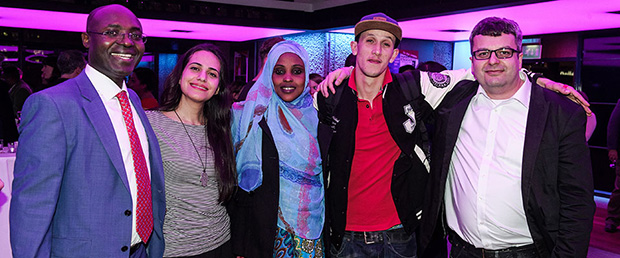
Rafael Marques de Morais, Safa Al Ahmad, Amran Abdundi, Mouad “El Haqed” Belghouat and Tamas Bodokuy (Photo: Alex Brenner for Index on Censorship)
When times get tough, freedom of expression can quickly fall down the list of priorities. But it is exactly in these circumstances when the ability to communicate and express yourself is most important. For this reason, we continue to draw inspiration from last year’s Index on Censorship Freedom of Expression Awards fellows and their struggles to keep freedom of expression alive and well.
As we look forward to the 2016 Index awards, here is our latest reminder of just how important a job our past winners do in the fight for free speech.
Tamas Bodoky, Atlatszo.hu / Digital Activism
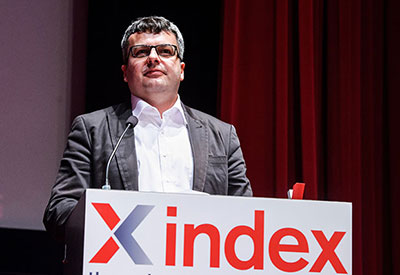
Last year was a positive one for the Hungarian investigative journalism site and NGO Atlatszo. The site’s yearly report reveals that funding was on the up and readership remained high.
The report also outlines the site’s main investigations over the course of 2015, which include exposing state corruption, public budget spending, irregularity within EU funding and land lease and privatisation controversies.
The website’s project for tracking down hate crime gained traction in 2014, and last year expanded to include “violent football hooligan groups and clergymen, who are close to the far-right,” the site’s executive director Tamas Bodoky told Index on Censorship.
“Unfortunately, some people became very hostile to our refugee crisis reporting last year, saying things like ‘go to hell, Atlatszo, for helping them’,” he added.
Atlatszo made 90 freedom of information requests as an organisation — plus hundreds of requests submitted by staff in their own names. Around 50% of Atlatszo’s requests were at least partially granted. Of those that weren’t, the site has initiated court proceedings to obtain the information, with almost half so far being successful, with several others pending.
Going forward, Atlatszo has plans to expand by working with more bloggers and developing a new website allowing Hungarian citizens to “question representatives of Hungary in EU, members of the Hungarian Parliament and — in the long run — representatives of the local governments”. The kepviselom.hu (my representative) project is currently seeking donors through crowdfunding.
“The Index award certainly helped get more international recognition over the last year,” Bodoky said. “As a very small news organisation, we constantly struggle for visibility, and Index on Censorship was instrumental in raising the visibility of our cause.”
Safa Al Ahmad / Journalism
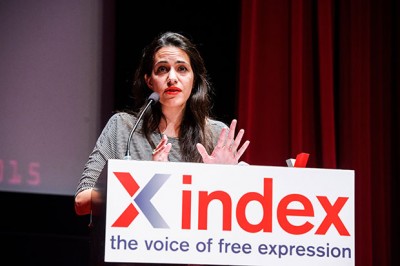 With the political crisis in Yemen steadily getting worse since last year, any plans Safa Al Ahmed had to switch focus were sidelined as she returned to the battle-scarred country.
“I filmed events in Aden and then Taiz, which is currently besieged,” the award-winning journalist told Index on Censorship. “I’m going to be producing two separate films for both cities because north and south have very different dynamics.”
Actually getting into Yemen is a real task in itself. Al Ahmed and her crew took a boat from Djibouti to Aden, which took 34 hours, and then travelled for another day off-road and across mountainous terrain, passing snipers along the way.
With the execution of the prominent Shia cleric Nimr al-Nimr, Al Ahmad’s own country Saudi Arabia was briefly catapulted back into international focus at the start of 2016, but it didn’t last. “There is very little investigative journalism being done on the ground, which makes reporting difficult as there isn’t very much to build on,” Al Ahmed says.
Citing the flogging of blogger Raif Badawi as an example of how brutal the Saudi regime is of critical voices, Al Ahmad describes the state of free speech in Saudi Arabia as “frightening”. “The government have passed really wide rulings and laws so they can stop or arrest anyone for the simplest of reasons, including talking about the war in Yemen, which has been banned,” she explains.
The big difference between now and 2014 is that people are currently receiving death sentences, which is “a whole different level of intimidation”.
Mouad Belghouat aka El Haqed / Arts
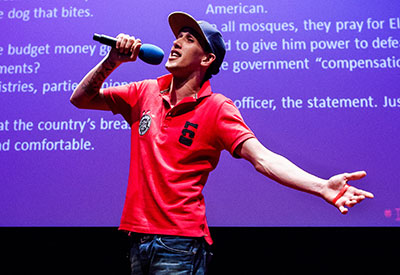 Last time we caught up with Moroccan rapper Mouad Belghouat, aka El Haqed, in October, he was in his home country keeping a low profile, while looking forward to performances in Florence, Italy, and at the 25th anniversary of the Moroccan Association of Human Rights in Brussels. Since November 2015, he has been living in Belgium, having applied for refugee status.
“In Morocco I felt threatened and under constant control,” he told Index this month. “It’s been hard, because already I miss the place where I grew up; I miss my family and my friends.” The situation in Morocco “deteriorates more and more every day, at all levels”, he explains, but vows one day to return.
He has now been cleared to work in Belgium, and has also turned his attention to creating more music. “I’m trying to finish the album I’ve been writing based on my experiences in prison in Morocco, and — as the last set of concerts have gone so well — I will be performing in Belgium in March and am looking to tour Norway come April.”
There are also plans for a biography based on his experiences from 2011, when his music became an anthem for many Moroccans involved in the Arab Spring, right up to his persecution at the hands of the authorities, right up to his eventual self-imposed exile.
As for the Index award, he said: “Through Index, I met many great people from all over the world who share the same principles as me, and word of my case has spanned the breadth of the world.”
Amran Abdundi / Campaigning
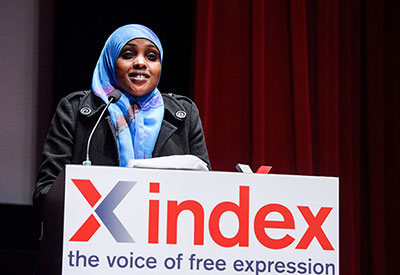 During our last conversation with Amran Abdundi, we discussed the attack in her native Kenya by Al-Shabaab linked terrorists on Garissa University College, in which 148 people were murdered. Abdundi, who knows many students from the college, immediately joined with other women leaders to organise strong community protests against Al-Shabaab.
Last month, Abdundi attended the re-opening ceremony for Garissa University College. “I was happy to meet victims who I offered counselling to after the attack, and see them now back on their feet, ready to study and achieve their dreams,” she told Index.
She has also been busy recently with the upcoming launch of the new Frontier Indigenous Network website and implementing a new social media strategy to foster better connections between Kenyan women and the rest of the world.
As part of this new development plan, 2016 is packed with new projects, including an education programme on non-violence to counter violent extremism and radicalisation. The project will bring together Christians and Muslims together in “preaching peace and reconciliation”.
“All of this wouldn’t have been possible without the Index award and the support I have received from Index on Censorship, which led me to meet key individuals, such as Kenya’s woman minister, Anne Waigiru.”
Rafael Marques de Morais / Journalism
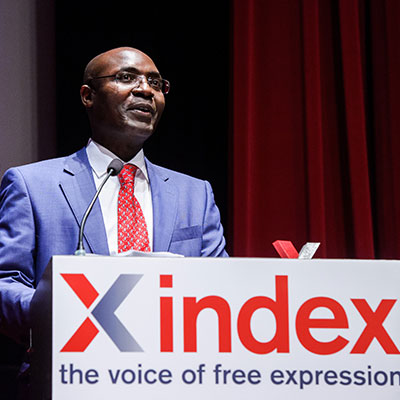 President José Eduardo dos Santos has been in power in Angola for over 35 years and his regime faces criticism on many fronts for, among other things, land grabbing, human rights abuses in Angolan prisons and the divvying up of the country’s resources to his family “like it was their inheritance”. These are just some of the issues Index award winner Rafael Marques de Morais is focusing on his activism and writing.
“This kind of work generates all sorts of troubles, because when you speak out against the president, you become suspect,” de Morais told Index on Censorship.
Being a high-profile activist within the country, there is a misconception that de Morais doesn’t feel the full force of the regime. “I might be ‘free’ but I can’t go anywhere; when I went for a drink recently the person I was with noticed we were being watched,” he explains. When he tried to enter a courtroom in December to observe the case involving the 15 Angolan bloggers now under house arrest, he was denied access. “Immediately the news on television was that I tried to enter the court illegally, because being high profile, the main thing they can attack is your reputation.”
Coupled with the ongoing economic crisis in Angola preventing citizens from taking money out of the bank, times are tough. “How is one supposed to survive and keep going?” he asks.
But go on he does. The attention from home and abroad, including that generated by the Index award, have provided some solace. “It’s always refreshing to know that people are interested,” he explains. “The award provides great encouragement for one to keep going.”
“But that’s it. The next day, you are back to struggling for survival.”
The Index on Censorship 2016 Freedom of Expression Awards shortlist has been announced.
This article was originally posted to Index on Censorship