19 Sep 2016 | Magazine, Volume 45.03 Autumn 2016
[vc_row][vc_column][vc_column_text]
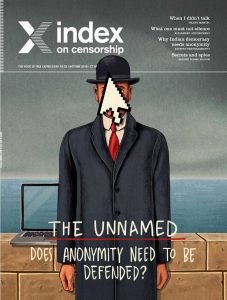
Autumn 2016 magazine cover
Anonymity is out of fashion. There are plenty of critics who want it banned on social media. It’s part of a harmful armoury of abuse, they argue.
Certainly, social media use seems to be doing its best to feed this argument. There are those anonymous trolls who sent vile verbal attacks to writers such as US author Lindy West. She was confronted by someone who actually set up a fake Twitter account under the name of her dead father.
Anonymity has been used in other ways by the unscrupulous. Earlier this year, a free messaging app called Kik was the method two young men used to get in touch with a 13-year-old girl, with whom they made friends online and then invited her to meet. They were later charged with her murder. Participants who use Kik to chat do not have to register their real names or phone numbers, according to a report on the court case in the New York Times, which cited other current cases linked to Kik activity including using it to send child pornography.
So why do we need anonymity? Why does it matter? Why don’t we just ban it or make it illegal if it can be used for all these harmful purposes? Anonymity is an integral part of our freedom of expression. For many people it is a valuable way of allowing them to speak. It protects from danger, and it allows those who wouldn’t be able to speak or write to get the words out.
“If anonymity wasn’t allowed any more, then I wouldn’t use social media,” a 14-year-old told me over the kitchen table a few weeks ago. He uses forums on the website Reddit to have debates about politics and religion, where he wants to express his view “without people underestimating my age”.
Anonymity to this teenager is something that works for him; lets him operate in discussions where he wants to try out his arguments and gain experience in debates. Anonymity means no one judges who he is or his right to join in.
For others, using a fake or pen name adds a different layer of security. Writers for this magazine worry about their personal safety and sometimes ask for their names not to be carried on articles they write. In the current issue, an activist who works helping people find ways around China’s great internet wall is one of our authors who can’t divulge his name because of the work he does.
Throughout history journalists have worked with sources who want to see important information exposed, but do not want their own identity to be made public. Look at the Watergate exposé or the Boston Globe investigation into child sex abuse by priests. Anonymous sources can provide essential evidence that helps keep an investigation on track.
That right, to keep sources private, has been the source of court actions against journalists through the years. And those who choose to work with journalists, often rely on that long held practice.
Pen names, pseudonyms, fake identities have all have been used for admirable and understandable purposes over the centuries: to protect someone’s life; to blow a whistle on a crime; for a woman to get published at a period when only men did so, and on and on. Those who fought for democracy, the right to protest and other rights, often had operate under the wire, out of the searching eyes of those who sought to stop them. Thomas Paine, who wrote the famous pamphlet Common Sense “Addressed to Inhabitants of America”, advocating the independence of the 13 states from Britain, first published his words in 1776 anonymously.
From the early days of Index on Censorship, when writing was being smuggled across borders and out of authoritarian countries, the need for anonymity was paramount.
Over the years it has been argued that anonymity is a vital component in the machinery of freedom of expression. In the USA, the American Civil Liberties Union argues that anonymity is a First Amendment right, given in the Constitution. As far back as 1996, a legal case was taken in Georgia, USA, to restrict users from using pseudonyms on the internet.
Today, in India, the world’s largest democracy, there are discussions about making anonymity unlawful. Our article by lawyer and writer Suhrith Parthasarathy considers why if minister Maneka Gandhi does go ahead with plans to remove anonymity on Twitter it could have ramifications for other forms of writing. As Anja Kovacs of the Internet Democracy Project told Index, “democracy virtually demands anonymity. It’s crucial for both the protection of privacy rights and the right to freedom of expression”.
We must make sure that new systems aimed at tackling crime do not relinquish our right to anonymity. Anonymity matters, let’s remember it has a role to play.
Order your full-colour print copy of our anonymity magazine special here, or take out a digital subscription from anywhere in the world via Exact Editions (just £18* for the year). Each magazine sale helps Index on Censorship fight for free expression worldwide.
*Will be charged at local exchange rate outside the UK.
Copies will be available at the BFI, the Serpentine Gallery, MagCulture, (London), News from Nowhere (Liverpool), Home (Manchester), Carlton Books (Glasgow) and on Amazon. Each magazine sale helps Index on Censorship continue its fight for free expression worldwide.
The full contents of the magazine can be read here.[/vc_column_text][/vc_column][/vc_row][vc_row][vc_column][vc_custom_heading text=”From the Archives”][vc_row_inner][vc_column_inner width=”1/3″][vc_single_image image=”89160″ img_size=”213×289″ alignment=”center” onclick=”custom_link” link=”http://journals.sagepub.com/doi/pdf/10.1177/0306422011400799″][vc_custom_heading text=”Going local” font_container=”tag:p|font_size:24|text_align:left” link=”url:http%3A%2F%2Fjournals.sagepub.com%2Fdoi%2Fpdf%2F10.1177%2F0306422011400799|||”][vc_column_text]March 2011
If the US’s internet freedom agenda is going to be effective, it must start by supporting grassroots activists on their own terms, says Ivan Sigal.[/vc_column_text][/vc_column_inner][vc_column_inner width=”1/3″][vc_single_image image=”89073″ img_size=”213×289″ alignment=”center” onclick=”custom_link” link=”http://journals.sagepub.com/doi/pdf/10.1177/0306422013512242″][vc_custom_heading text=”On the ground” font_container=”tag:p|font_size:24|text_align:left” link=”url:http%3A%2F%2Fjournals.sagepub.com%2Fdoi%2Fpdf%2F10.1177%2F0306422013512242|||”][vc_column_text]December 2013
Attacked by the government and the populist press alike, political bloggers and Twitter users in Greece struggle to make their voices heard.[/vc_column_text][/vc_column_inner][vc_column_inner width=”1/3″][vc_single_image image=”89161″ img_size=”213×289″ alignment=”center” onclick=”custom_link” link=”http://journals.sagepub.com/doi/pdf/10.1177/0306422011409641″][vc_custom_heading text=”Meet the trolls” font_container=”tag:p|font_size:24|text_align:left” link=”url:http%3A%2F%2Fjournals.sagepub.com%2Fdoi%2Fpdf%2F10.1177%2F0306422011409641|||”][vc_column_text]June 2011
Whitney Phillips reports on a loose community of anarchic and anonymous people is testing the limits of free speech on the internet.[/vc_column_text][/vc_column_inner][/vc_row_inner][vc_separator][/vc_column][/vc_row][vc_row][vc_column width=”1/3″][vc_custom_heading text=”The unnamed” font_container=”tag:p|font_size:24|text_align:left” link=”url:%20https%3A%2F%2Fwww.indexoncensorship.org%2F2017%2F09%2Ffree-to-air%2F|||”][vc_column_text]The autumn 2016 Index on Censorship magazine explores topics on anonymity through a range of in-depth features, interviews and illustrations from around the world.
With: Valerie Plame Wilson, Ananya Azad, Hilary Mantel[/vc_column_text][/vc_column][vc_column width=”1/3″][vc_single_image image=”80570″ img_size=”medium” alignment=”center” onclick=”custom_link” link=”https://www.indexoncensorship.org/2016/11/the-unnamed/”][/vc_column][vc_column width=”1/3″][vc_custom_heading text=”Subscribe” font_container=”tag:p|font_size:24|text_align:left” link=”url:https%3A%2F%2Fwww.indexoncensorship.org%2Fsubscribe%2F|||”][vc_column_text]In print, online. In your mailbox, on your iPad.
Subscription options from £18 or just £1.49 in the App Store for a digital issue.
Every subscriber helps support Index on Censorship’s projects around the world.
 SUBSCRIBE NOW[/vc_column_text][/vc_column][/vc_row]
7 Sep 2016 | Awards, Awards year slider
[vc_row full_width=”stretch_row_content_no_spaces” css=”.vc_custom_1478499289940{padding-top: 250px !important;padding-bottom: 250px !important;background-image: url(https://www.indexoncensorship.org/wp-content/uploads/2016/10/2016-logo-1460×490-1.png?id=80259) !important;background-position: center !important;background-repeat: no-repeat !important;background-size: cover !important;}”][vc_column][/vc_column][/vc_row][vc_row css=”.vc_custom_1472525914065{margin-top: -150px !important;}”][vc_column][vc_row_inner equal_height=”yes” content_placement=”middle”][vc_column_inner el_class=”awards-inside-desc” width=”1/2″][vc_custom_heading text=”FREEDOM OF EXPRESSION AWARDS 2016″ use_theme_fonts=”yes”][vc_column_text]Index on Censorship’s Freedom of Expression Awards exist to celebrate individuals or groups who have had a significant impact fighting censorship anywhere in the world.
- Awards were offered in four categories: Arts, Campaigning, Digital Activism and Journalism
- Anyone who has had a demonstrable impact in tackling censorship is eligible
- Winners were honoured at a gala celebration in London at the Unicorn Theatre
- Winners joined Index’s Awards Fellowship programme and received dedicated training and support
[/vc_column_text][/vc_column_inner][vc_column_inner width=”1/2″][vc_video link=”https://www.youtube.com/watch?v=9MUWHhTYVAg”][/vc_column_inner][/vc_row_inner][/vc_column][/vc_row][vc_row equal_height=”yes” el_class=”awards-4grid” css=”.vc_custom_1472549004786{margin-top: 20px !important;margin-bottom: 20px !important;}”][vc_column width=”1/4″ css=”.vc_custom_1472461150656{background-color: #cb3000 !important;}”][vc_custom_heading text=”Arts” use_theme_fonts=”yes”][vc_column_text]for artists and arts producers whose work challenges repression and injustice and celebrates artistic free expression[/vc_column_text][/vc_column][vc_column width=”1/4″ css=”.vc_custom_1472461193991{background-color: #d98c00 !important;}”][vc_custom_heading text=”Campaigning” use_theme_fonts=”yes”][vc_column_text]for activists and campaigners who have had a marked impact in fighting censorship and promoting freedom of expression[/vc_column_text][/vc_column][vc_column width=”1/4″ css=”.vc_custom_1472461232330{background-color: #cb3000 !important;}”][vc_custom_heading text=”Digital Activism” use_theme_fonts=”yes”][vc_column_text]for innovative uses of technology to circumvent censorship and enable free and independent exchange of information[/vc_column_text][/vc_column][vc_column width=”1/4″ css=”.vc_custom_1472461222655{background-color: #d98c00 !important;}”][vc_custom_heading text=”Journalism” use_theme_fonts=”yes”][vc_column_text]for courageous, high-impact and determined journalism that exposes censorship and threats to free expression[/vc_column_text][/vc_column][/vc_row][vc_row el_class=”text_white” css=”.vc_custom_1472549018179{margin-top: 20px !important;margin-bottom: 20px !important;background-color: #cb3000 !important;}”][vc_column][vc_custom_heading text=”The Index Awards Fellowship” use_theme_fonts=”yes”][vc_column_text]In recognising individuals and organisations, often working in dangerous and difficult conditions, Index makes a commitment to them. Through a year-long fellowship we work with our awards winners – both during an intensive week in London, and the rest of the awarding year – to provide longer term, structured assistance to enhance the work they are already doing.[/vc_column_text][/vc_column][/vc_row][vc_row full_width=”stretch_row” css=”.vc_custom_1481803717893{margin-top: 0px !important;margin-bottom: 20px !important;background-color: #f2f2f2 !important;}”][vc_column][vc_custom_heading text=”FELLOWS” font_container=”tag:h1|text_align:center” use_theme_fonts=”yes” css=”.vc_custom_1472608304034{margin-top: 0px !important;}”][vc_column_text el_class=”container680″]
Through the Index Awards Fellowship we work with our winners – both during an intensive week in London and the rest of the awarding year – to provide longer term, structured support.
The goal is to help winners maximise their impact, broaden their support and ensure they can continue to excel at fighting free expression threats on the ground.
[/vc_column_text][awards_fellows years=”2016″][/vc_column][/vc_row][vc_row][vc_column][vc_custom_heading text=”JUDGING” font_container=”tag:h1|text_align:center” use_theme_fonts=”yes”][vc_row_inner el_class=”mw700″][vc_column_inner][vc_column_text]
Criteria – Anyone involved in tackling free expression threats – either through journalism, campaigning, the arts or using digital techniques – is eligible for nomination.
Any individual, group or NGO can nominate or self-nominate. There is no cost to apply.
Judges look for courage, creativity and resilience. We shortlist on the basis of those who are deemed to be making the greatest impact in tackling censorship in their chosen area, with a particular focus on topics that are little covered or tackled by others.
Nominees must have had a recognisable impact in the past 12 months.
Where a judge comes from a nominee’s country, or where there is any other potential conflict of interest, the judge will abstain from voting in that category.
Panel – Each year Index recruits an independent panel of judges – leading world voices with diverse expertise across campaigning, journalism, the arts and human rights.
The judges for 2016, chaired by Index on Censorship’s CEO Jodie Ginsberg are:
[/vc_column_text][/vc_column_inner][/vc_row_inner][vc_row_inner][vc_column_inner width=”1/3″][staff name=”Wole Soyinka” title=”Playwright, poet, novelist and essayist” color=”#28a7cc” profile_image=”80242″]Born and educated in Nigeria, Wole Soyinka is a playwright, poet, novelist and essayist who was Nobel Laureate for Literature in 1986 – the first African to be honoured in that category.
Soyinka has published more than thirty works, and is involved in numerous international artistic and Human Rights organizations.
Soyinka is currently Professor Emeritus in Comparative Literature at Obafemi Awolowo University in Nigeria, Fellow of the Black Mountain Institute at the University of Nevada, and a Hutchins Fellow at Harvard University.[/staff][/vc_column_inner][vc_column_inner width=”1/3″][staff name=”Maria Teresa Ronderos” title=”Journalist and programme director OSF” color=”#28a7cc” profile_image=”80240″]An award-winning Colombian journalist, María Teresa Ronderos is currently Director of the Program on Independent Journalism at the Open Society Foundation.
Before joining OSF in 2014, Ronderos was an editor and investigative reporter for Semana, Colombia’s leading news magazine. She also created and was editor-in-chief of VerdadAbierta.com, a website that has covered armed conflict in Colombia since 2008.
In 2014, Ronderos won Colombia’s Simon Bolivar National Award for her highly acclaimed book Guerras Recicladas, a history of the paramilitary forces in Colombia.[/staff][/vc_column_inner][vc_column_inner width=”1/3″][staff name=”Nabeel Rajab” title=”Human rights campaginer” color=”#28a7cc” profile_image=”80241″]A past winner of Index’s Freedom of Expression Award for Campaigning (2012), Nabeel Rajab is president of the Bahrain Centre for Human Rights.
A prominent international human rights activist and leading campaigner against civil rights abuses in his country, Rajab has been repeatedly arrested and incarcerated. He is currently prohibited from leaving Bahrain.
Rajab is also co-founder and former director of the Gulf Centre for Human Rights, Deputy Secretary General for the International Federation for Human Rights (FIDH), a member of Human Rights Watch’s Middle East and North Africa Advisory Committee and former chairman of CARAM Asia.[/staff][/vc_column_inner][/vc_row_inner][vc_row_inner][vc_column_inner width=”1/3″][staff name=”Kirsty Brimelow QC” title=”Public and criminal international, constitutional and human rights law” color=”#28a7cc” profile_image=”80239″]The first Chairwoman of the Bar Human Rights Committee of England and Wales, Kirsty Brimelow is an expert in public and criminal international, constitutional and human rights law.
Brimelow’s recent work includes an alleged Boko Haram child terrorist case in Nigeria, presenting evidence to the UN of sexual violence against Tamils by Sri Lanka and representing Amnesty against the UK security services.
As a mediator, Brimelow facilitated an apology from President Santos of Colombia to the San José de Apartadó peace community in 2013 that was described as an “historic moment” in the country’s history.[/staff][/vc_column_inner][vc_column_inner width=”1/3″][staff name=”James Rhodes” title=”Pianist” color=”#28a7cc” profile_image=”80238″]Until the age of 14, British concert pianist James Rhodes had no formal academic musical education. Aged 18 he stopped playing the piano entirely for a decade.
Since returning to the piano, Rhodes has released five chart-topping albums, performed in venues around the world and presented numerous TV series and acclaimed documentaries including Notes for The Inside and Don’t Stop The Music.
Rhodes’ memoir Instrumental was recently published – almost banned, the Supreme Court overthrew an injunction against its release in May 2015.[/staff][/vc_column_inner][vc_column_inner width=”1/3″][staff name=”Bindi Karia” title=”Tech entrepreneur” color=”#28a7cc” profile_image=”80237″]Previously vice president at Silicon Valley Bank, “queen of startups” Bindi Karia has worked in and around technology for most of her career.
Raised in Canada, Karia has also been Venture Capital/Emerging Business lead at Microsoft UK, a Tech London advocate and an active mentor and supporter of many of London’s top Incubators including Seedcamp, TechStars, Startupbootcamp, WAYRA and Level39.
Karia is currently setting up a new venture NewCo.[/staff][/vc_column_inner][/vc_row_inner][/vc_column][/vc_row][vc_row full_width=”stretch_row_content_no_spaces” css=”.vc_custom_1473325605190{margin-top: 20px !important;margin-bottom: 20px !important;padding-top: 20px !important;padding-right: 15px !important;padding-bottom: 20px !important;padding-left: 15px !important;background-color: #f2f2f2 !important;}”][vc_column][vc_row_inner content_placement=”middle” el_class=”container container980″][vc_column_inner][awards_news_slider name=”NEWS” years=”2016″][/vc_column_inner][/vc_row_inner][/vc_column][/vc_row][vc_row css=”.vc_custom_1473325552363{margin-top: 0px !important;margin-bottom: 20px !important;padding-top: 0px !important;padding-right: 15px !important;padding-bottom: 0px !important;padding-left: 15px !important;}”][vc_column css=”.vc_custom_1473325567468{margin-top: 0px !important;margin-bottom: 0px !important;padding-top: 0px !important;padding-bottom: 0px !important;}”][awards_gallery_slider name=”GALLERY” images_url=”74912,74870,74858,74854,74850,74849,74848,74847,74846,74845,74844,74843,74842,74841,74839,74838,74836,74835,74834,74833,74832,74831″][/vc_column][/vc_row][vc_row full_width=”stretch_row” css=”.vc_custom_1481798563375{background-color: #f2f2f2 !important;}”][vc_column][vc_custom_heading text=”2016 SHORTLIST” font_container=”tag:h1|text_align:center” use_theme_fonts=”yes”][vc_column_text]
Drawn from more than 400 nominations, the Index awards shortlist celebrates 20 artists, writers, journalists and campaigners tackling censorship and fighting for freedom of expression against incredible obstacles.
[/vc_column_text][/vc_column][/vc_row][vc_row full_width=”stretch_row” css=”.vc_custom_1481798575418{background-color: #f2f2f2 !important;}”][vc_column][vc_custom_heading text=”ARTS” font_container=”tag:h1|text_align:center” use_theme_fonts=”yes”][vc_column_text]
for artists and arts producers whose work challenges repression and injustice and celebrates artistic free expression
[/vc_column_text][vc_row_inner][vc_column_inner width=”1/3″][staff name=”Belarus Free Theatre” title=”Belarus” profile_image=”82684″]Belarus Free Theatre have been using their creative and subversive art to protest the dictatorial rule of Aleksandr Lukashenko for a decade.
Facing pressure from authorities since their inception, the group nonetheless thrived underground, performing in apartments, basements and forests despite continued arrests and brutal interrogations. In 2011, while on tour, they were told they were unable to return home. Refusing to be silenced, the group set up headquarters in London and continued to direct projects in Belarus.
In this anniversary year, the group staged a solidarity concert watched by over half a million people online, mounted a two week retrospective and launched the Ministry of Counterculture, an online platform aiming to widen the understanding of art’s role in affecting social change.
“The very existence of BFT is a challenge to the repression and injustice of the dictatorship in Belarus.” — Natalia Kaliada, co-founder Belarus Free Theatre
Full profile: Belarus Free Theatre battles censorship and oppression by the Belarusian regime[/staff][/vc_column_inner][vc_column_inner width=”1/3″][staff name=”#YoTambienExijo and Tania Bruguera” title=”Cuba” profile_image=”82700″]Tania Bruguera is an American-Cuban artist who was arrested after attempting to stage her performance piece #YoTambienExijo in Havana in late 2014. Mounted soon after the apparent thaw in US-Cuban relations, Bruguera’s piece offered members of the public the chance of one minute of ‘censor-free’ expression in Havana’s Plaza de la Revolución.
The banning of the show, and Bruguera’s subsequent detention, caused an international outcry and sparked a worldwide solidarity movement for free expression in Cuba. Leading venues and artists around the world have been re-staging #YoTambienExijo all year, drawing attention to the ongoing persecution of artists in Cuba. Bruguera estimates that over 20,000 Cubans have been involved in the project to date.
“I truly believe that in totalitarian regimes like Cuba, art has the privilege to open doors. It can serve as an escape from fear and from a life of lies.” — Tania Bruguera, founder #YoTambienExijo
Full profile: Tania Bruguera’s #YoTambienExijo ignites a worldwide movement[/staff][/vc_column_inner][vc_column_inner width=”1/3″][staff name=”Good Chance Theatre” title=”Calais” profile_image=”82688″]Built in 2015, this innovative temporary space in the infamous jungle refugee camp in Calais aims to be more than just a theatre.
Founders Joe Murphy and Joe Robertson, two young British playwrights, came up with the idea after working in the camp as volunteers: “We were struck by everyone’s willingness to tell their story. In many cases this willingness was a need.”
Good Chance offers a safe place where refugees can express themselves, share their stories, and come together as a community. Backed by some of the biggest names in British theatre, Good Chance looks set to continue touching the lives of some of those most in need.
“We are here for 6000 unacknowledged people, each of whom have an individual voice. Our duty is to those voices, as it is those voices that will help deepen and complicate our understanding of this refugee crisis.” — Joe Murphy and Joe Robertson, co-founders Good Chance Theatre
Full profile: Good Chance Theatre gives refugees a place to be heard[/staff][/vc_column_inner][/vc_row_inner][vc_row_inner][vc_column_inner width=”1/3″][staff name=”Sakdiyah Ma’ruf” title=”Indonesia” profile_image=”82699″]Sakdiyah Ma’ruf is a stand-up comedian from Indonesia whose routines challenge Islamic fundamentalism.
Born to a conservative Muslim family in Java, Ma’ruf went against her father’s wishes and started using comedy to speak about religious based violence and extremism, ethnic extremism and xenophobia, as well as fear, terror and violence against women.
One of the very few female stand-up comedians in the country to appear on national TV, she has often been asked to censor her jokes for TV performances, but continues to refuse.
“Good comedy makes you laugh. Great comedy makes you cry.” — Sakdiyah Ma’ruf
Full profile: Indonesian Sakdiyah Ma’ruf carves a name for herself in comedy[/staff][/vc_column_inner][vc_column_inner width=”1/3″][staff name=”Winner: Murad Subay” title=”Yemen” profile_image=”82695″]Artist Murad Subay uses his country’s streets as a canvas to protest Yemen’s war, institutionalised corruption and forced “disappearings”.
Since beginning a street art protest in 2011 Subay has launched five campaigns to promote peace and encourage discussion of sensitive political issues. All his painting is done in public during the day and he encourages fellow Yemenis to get involved. Subay has often been targeted by the authorities, painting over his works or restricting him from painting further.
“I found that the soul of the Yemeni people was broken because of war… I found that the buildings and the streets were full of bullets, full of damage. So I went on Facebook and said I would go on to the streets to paint the next day and I did.” — Murad Subay
Learn more about the 2016 Arts fellow Murad Subay[/staff][awards_fellows][/vc_column_inner][vc_column_inner width=”1/3″][vc_video link=”https://youtu.be/EHVgJHWTT8Y”][/vc_column_inner][/vc_row_inner][/vc_column][/vc_row][vc_row full_width=”stretch_row” css=”.vc_custom_1481798587833{background-color: #f2f2f2 !important;}”][vc_column][vc_custom_heading text=”CAMPAIGNING” font_container=”tag:h1|text_align:center” use_theme_fonts=”yes”][vc_column_text]
For activists and campaigners who have had a marked impact in fighting censorship and promoting freedom of expression.
[/vc_column_text][vc_row_inner][vc_column_inner width=”1/3″][staff name=”Abduljalil Al-Singace” title=”Bahrain” profile_image=”82683″]Dr. Abduljalil Al-Singace is a Bahraini human rights activist, academic and blogger who worked tirelessly to call attention to his country’s human rights practices until, during a crackdown on activists in 2011, authorities imprisoned him and 13 others.
Ever since then, Al-Singace has felt the brunt of the practices against which he has spent his life campaigning. In prison he has not been silenced despite being verbally and physically abused, sexually assaulted and kept in solitary confinement for months on end. He has also been denied access to medication, his family, and even pens and paper. In March last year, Al-Singace began a 313 day hunger strike in protest at the collective punishment and acts of torture that police inflicted upon prisoners. He is still being held.
“Be careful when you use the words ‘change’, ‘dream’ and ‘democracy’. Those things don’t come so easily to us here in Bahrain.” — Dr Abduljalil Al-Singace
Full profile: Dr Abduljalil Al-Singace has not let prison silence him[/staff][/vc_column_inner][vc_column_inner width=”1/3″][staff name=”Vanessa Berhe” title=”Eritrea” profile_image=”82701″]Nineteen-year-old Vanessa Berhe is fighting for the release of her uncle, journalist Seyoum Tsehaye, who has been imprisoned in Eritrea for the last 15 years. She also launched the campaign Free Eritrea to draw the world’s attention to a little-reported country with one of the worst track records for free speech.
Starting when she was 16 and still at school, Berhe has since given a speech in front of the Pope, launched petitions, utilised social media, video and web platforms and orchestrated protests in order to spread her message. Born in Sweden to Eritrean parents and currently studying in the USA, Berhe has taken the plight of this small country to the world stage.
“With one man’s name and story, we aim to dismantle the cover that has been hiding the oppression that has ravaged the Eritrean people for years.” — Vanessa Berhe, founder One Day Seyoum
Full profile: Vanessa Berhe is fighting for freedom of expression in Eritrea[/staff][/vc_column_inner][vc_column_inner width=”1/3″][staff name=”Winner: Bolo Bhi” title=”Pakistan” profile_image=”82685″]Bolo Bhi are a digital campaigning group who have orchestrated an impressive ongoing fight against attempts to censor the internet in Pakistan.
The all-women management team have launched internet freedom programmes, published research papers, tirelessly fought for government transparency and run numerous innovative digital security training programmes.
In 2015 the group turned their attention to the draconian Prevention of Electronic Crimes Bill, organising an extraordinary campaign of events, lobbying, press conferences and online actions. They brought international attention to a landmark bill that would otherwise have been pushed through with little public attention.
“This case alone could change everything for free speech in Pakistan.” — Farieha Aziz, co-director Bolo Bhi
Learn more about the 2016 Campaigning fellow Bolo Bhi[/staff][/vc_column_inner][/vc_row_inner][vc_row_inner][vc_column_inner width=”1/3″][staff name=”Nkosilathi Emmanuel Moyo” title=”Zimbabwe” profile_image=”82696″]Growing up in a small mining town in Zimbabwe, human rights campaigner and writer Nkosilathi Emmanuel Moyo saw first-hand how young people in his community were being manipulated by politicians to perpetuate political violence. To fight this, he set up the Zimbabwe Organization For Youth In Politics and has since trained 80 human rights defenders and now works with over 2,500 youths.
A prolific writer, 28-year-old Moyo has published three bestselling books. All are highly critical of the Mugabe regime, the last written while he was sheltering in the Netherlands for his safety and published immediately on his return. Moyo’s latest stunt was to send President Mugabe a prison uniform present for his 92nd birthday – fearing for his life he is now back in hiding.
“I refuse to allow my dissenting voice to be silenced. Never shall I put my pen down it is the only weapon I have.” — Nkosilathi Emmanuel Moyo, founder Zimbabwe Organization For Youth In Politics
Full profile: Nkosilathi Emmanuel Moyo campaigns against political corruption[/staff][/vc_column_inner][vc_column_inner width=”1/3″][staff name=”Pu Zhiqiang” title=”China” profile_image=”82698″]A student activist who took part in the 1989 pro-democracy protests in Tiananmen Square, Pu Zhiqiang has long fought for China’s human rights, becoming one of the most influential human rights lawyers in his country and fighting famous cases like that of artist Ai Weiwei, who has been targeted by the country’s government.
In 2015, after attending a Tiananmen memorial event, Zhiqiang was arrested on the charge of “creating a disturbance”. The next few months saw him imprisoned while fresh charges were brought against him for comments posted on social media. With his high-profile trial culminating in December last year, all eyes were on China. A three-year suspended sentence has effectively gagged him.
“Given that this is someone with a strong belief in the right to free speech, and a human rights lawyer who has chosen to devote his professional life to free speech cases, it is a great irony that Pu Zhiqiang has been convicted of a crime because of his own speech.” — Professor Hu Yong, Peking University School of Journalism
Full profile: Pu Zhiqiang is unwavering in support of free speech[/staff][/vc_column_inner][vc_column_inner width=”1/3″][vc_video link=”https://youtu.be/fhoOR6Ft1eg”][/vc_column_inner][/vc_row_inner][/vc_column][/vc_row][vc_row full_width=”stretch_row” css=”.vc_custom_1481798600606{background-color: #f2f2f2 !important;}”][vc_column][vc_custom_heading text=”DIGITAL ACTIVISM” font_container=”tag:h1|text_align:center” use_theme_fonts=”yes”][vc_column_text]
For innovative uses of technology to circumvent censorship and enable free and independent exchange of information.
[/vc_column_text][vc_row_inner][vc_column_inner width=”1/3″][staff name=”Dokuz8 Haber and Gökhan Biçici” title=”Turkey” profile_image=”82686″]Gökhan Biçici is a Turkish reporter who faced police brutality during the anti-government Gezi Park protests of 2013 when he was severely beaten and dragged down the street. The footage of his arrest went viral and, after his release, the idea for Dokuz8 Haber was born.
Since the protests, Biçici has been working to build a new kind of news organisation, which combines the dynamism of citizen journalism with the skills of professionals. Dokuz8 Haber’s citizen contributors from around the country are helping prepare for a future where Turkey’s journalists are free to report and citizens can live under a democratic constitution.
“Hundreds of thousands of citizen journalists cannot be censored.” — Gökhan Biçici, founder Dokuz8 Haber
Full profile: Gökhan Biçici launched citizen news agency Dokuz8Haber after Gezi Park protests[/staff][/vc_column_inner][vc_column_inner width=”1/3″][staff name=”Winner: GreatFire” title=”China” profile_image=”82689″]Set up by anonymous individuals, GreatFire is at the forefront of the fight against China’s severe web censorship.
Using a variety of tools, the organisation tracks China’s censorship infrastructure, hosts mirror sites to make censored material available and, in March 2015, launched an app that allows users to browse the officially forbidden web. Previously, the group created FreeWeibo, an uncensored version of the Chinese social platform. Despite ‘the Great Cannon’, a major cyber-attack by Chinese authorities in 2015, GreatFire has continued the fight for online freedom.
“Our goal is to bring transparency to online censorship in China.” — GreatFire
Learn more about the 2016 Digital Activism fellow GreatFire China[/staff][/vc_column_inner][vc_column_inner width=”1/3″][staff name=”Love Matters” title=”International” profile_image=”82692″]International discussion platform Love Matters has dedicated itself to opening up conversation about sexual health in countries where such subjects are censored or taboo.
With autonomous local branches in Egypt, Mexico, India, Africa and China, they’ve now had over 100 million page views since their inception in 2009. Between organising a comedy gig about sexual health in Cairo, music awards for songs about sexuality in Kenya and campaigning against partner violence in India, their impact has been huge. The very act of reading their content can put you in grave danger in some of the countries they call home.
“Access to good information on sexual and reproductive health is a human right – but one which is often thwarted in many countries.” — Vithika Yadav, founder Love Matters India
Full profile: Love Matters opens up conversations about sexual health[/staff][/vc_column_inner][/vc_row_inner][vc_row_inner][vc_column_inner width=”1/3″][staff name=”Méxicoleaks” title=”Mexico” profile_image=”82694″]A whistleblowing website, Méxicoleaks launched last year with the mission to build a more transparent and democratic Mexico.
Days after its launch, Méxicoleaks gained prominence when well-known journalist Carmen Aristegui was fired from her popular talk show after the station axed two of her colleagues because of their involvement in the effort. The international outcry put Méxicoleaks in the spotlight, and the innovative anonymous news-sharing platform has since received a number of tip-offs that allowed its founders – nine independent news outlets in Mexico – to uncover a series of high-profile corruption scandals.
In a country where, between drug cartels and the government, censorship and self-censorship is rife, Méxicoleaks is on the forefront of the fight against corruption.
Full profile: Méxicoleaks seeks to bring more transparency to Mexico[/staff][/vc_column_inner][vc_column_inner width=”1/3″][staff name=”Hebib Muntezir” title=”Azerbaijan” profile_image=”82691″]In a country where social media has been hailed as the last hope for free speech, Azerbaijani activist and blogger Hebib Muntezir has used his huge online presence to call out ingrained corruption.
Müntezir is one of the founders of Meydan TV, one of the few media outlets publishing content critical of Azerbaijan’s government. The Meydan team has faced intense pressure from the authorities: employees have been arrested and detained. Even family members have been harassed. However, Müntezir and Meydan TV have continued to build huge online audiences who thirst for information in a country suffering from an ongoing media crackdown.
“Many people in Azerbaijan are afraid to talk, but citizens still reach out to me to share content and offer support.” — Hebib Muntezir, social media manager, Meydan TV
Full profile: Hebib Muntezir mobilises social media to share uncensored news about Azerbaijan[/staff][/vc_column_inner][vc_column_inner width=”1/3″][vc_video link=”https://youtu.be/E1JvZdjAPvI”][/vc_column_inner][/vc_row_inner][/vc_column][/vc_row][vc_row full_width=”stretch_row” css=”.vc_custom_1481798610425{background-color: #f2f2f2 !important;}”][vc_column][vc_custom_heading text=”JOURNALISM” font_container=”tag:h1|text_align:center” use_theme_fonts=”yes”][vc_column_text]
For courageous, high-impact and determined journalism that exposes censorship and threats to free expression.
[/vc_column_text][vc_row_inner][vc_column_inner width=”1/3″][staff name=”Winner: Zaina Erhaim” title=”Syria” profile_image=”82702″]While journalists and citizens fled, Syrian-native Zaina Erhaim returned to her war-ravaged country and the city of Aleppo in 2013 to ensure those remaining were not forgotten. She is now one of the few female journalists braving the twin threat of violence from both ISIS and the president, Bashar al-Assad.
Erhaim has trained hundreds of journalists, many of them women, and set up independent media outlets to deliver news from one of the world’s most dangerous places. In 2015 Erhaim filmed a groundbreaking documentary, Syria’s Rebellious Women, to tell the stories of women who are helping her country survive its darkest hour.
“In 10 years time, I want a young woman who looks on the internet to find out what happened in Syria to find evidence of the roles women played.” — Zaina Erhaim
Learn more about the 2016 Journalism fellow Zaina Erhaim[/staff][/vc_column_inner][vc_column_inner width=”1/3″][staff name=”Mada Masr” title=”Egypt” profile_image=”82693″]Founded in 2013 by a group of young journalists after newspaper Egypt Independent was censored into bankruptcy, Mada Masr was launched as a media co-operative that aims to hold those in power accountable.
Despite the high-profile arrest of one of its journalists in 2015, Mada Masr continues to grow, recently developing a network of citizen journalists to cover news from Egypt’s governorates. Through innovative fundraising it has managed to remain financially independent.
“I want us, down the line, many many years to come, to be a reference of what happened.” — Lina Attalah, chief editor Mada Masr
Full profile: Mada Masr offers an alternative narrative to Egypt’s official media [/staff][/vc_column_inner][vc_column_inner width=”1/3″][staff name=”Hamid Mir” title=”Pakistan” profile_image=”82690″]Journalist Hamid Mir has worked tirelessly to take on unchallenged powers in Pakistan. With a 30-year-career punctuated by numerous threats, beatings, abductions and assassination attempts, he has become one of the country’s best-known reporters and hosted Pakistan’s popular political Geo TV show Capital Talk for the last 13 years.
The past year has been one of the hardest yet for Mir following an assassination attempt in 2014 in which he was shot six times and left for dead. He returned to work as soon as he left the hospital, but is confined to a life under armed-guard without his family who have been sent abroad for their safety.
“It’s very dangerous and risky to stay in Pakistan, but I am doing it only because majority of common people are with me.” — Hamid Mir
Full profile: Hamid Mir has been targeted for taking on unchallenged power[/staff][/vc_column_inner][/vc_row_inner][vc_row_inner][vc_column_inner width=”1/3″][staff name=”Pravit Rojanaphruk” title=”Thailand” profile_image=”82697″]Pravit Rojanaphruk is a Thai reporter who in 2015 was arrested, interrogated and forced out of his job for a series of tweets criticising Thailand’s military government.
Soon after he was released three days later, he was asked to resign from his job of 23 years. Despite ongoing government pressure, Rojanaphruk continues to write and post messages calling out corruption and censorship, recently taking up a new post at Khaosod English News.
A long-time opponent of his country’s lèse majesté law, which prevents any kind of criticism of the monarchy, Rojanaphruk had tweeted: “Freedom can’t be maintained if we are not willing to defend it.”
“It’s both an honour and a great responsibility to continue to stand for freedom of expression.” — Pravit Rojanaphruk
Full profile: Pravit Rojanaphruk has been targeted for speaking against Thailand’s military rule[/staff][/vc_column_inner][vc_column_inner width=”1/3″][staff name=”Ferit Tunç” title=”Turkey” profile_image=”82687″]A Kurdish journalist who set up an independent newspaper in eastern Turkey, Ferit Tunç has been repeatedly targeted with sanctions and lawsuits for publishing articles critical of local authorities.
Pushed to bankruptcy, Tunç, who also ran for office on an anti-corruption platform this year, fought back by publishing satirical cooking recipes on his front pages – each with a hidden message – an inventive protest against media censorship.
“People talk about how rotten Turkey’s press is at the top, but it’s rotten all the way through… People in this city have lost the right to talk about issues that matter to them.” — Ferit Tunç, founding editor Yӧn Gazetesi
Full profile: Ferit Tunç uses inventive methods to challenge censorship in Turkey[/staff][/vc_column_inner][vc_column_inner width=”1/3″][vc_video link=”https://youtu.be/cAegKHt5h28″][/vc_column_inner][/vc_row_inner][/vc_column][/vc_row]