10 Dec 2015 | mobile, News, United Kingdom
Credit: Flickr/Kristin Wall
Pity poor Tyson Fury.
No, wait, don’t. He’s heavyweight champion of the world and doesn’t seem particularly bothered what you or I think. He was born to box and is now at the top of his game, even if it is a game that has become less and less interesting, compelling and competitive in the last two decades.
Anyone who watched Fury beat Wladimir Klitschko on 28 November will struggle to remember anything about the fight. My word it was dull. Heavyweight boxing can be lumbering at the best of times, but this was beyond pedestrian. “Attritional” suggests a ferocity of combat that was entirely absent.
Nonetheless, Fury won, fairly and squarely. His uncle/trainer Peter Fury laughably compared the underdog victory to Muhammad Ali’s victory over Sonny Liston in 1964, proving, if nothing else, that boxing’s reference points are remarkably limited.
As a British world heavyweight champion, it is only to be expected that Fury should be nominated for the BBC’s Sports Personality of the Year Award. The problem is that Fury’s personality, or more exactly his opinions, ain’t exactly national hero standard. Fury claims that the apparent triumvirate of homosexuality, paedophilia and abortion will lead to the imminent apocalypse. This information, he says, is written in the Bible (where, exactly, remains unclear).
He also says the place of a woman is in the kitchen and on her back. He has offended many by suggesting that genuine national sporting hero, Jessica Ennis Hill, “looks fit in a dress”. This is obviously true in all senses but is the exact kind of objectification that has demeaned women’s sports for years, from Sepp Blatter’s suggestion that women footballers should wear tighter shorts to the annual drooling over women at Wimbledon.
Fury has faced criticism for all these views and come out, well, fighting. He has described the tens of thousands who have signed a petition calling for him to be dropped from Sports Personality of the Year as “wankers” and said his rivals in the competition have no personality to speak of.
This last comment reveals how the BBC is hoist by its own petard. Sports Personality Of The Year is a curious competition: the demands that the British public make of sportspeople make the Vatican’s canonisation processes seem a doddle. For years, Andy Murray, the greatest male tennis player the UK has produced since the 1930s, was criticised for not smiling enough. Sportspeople are simultaneously criticised for being pampered children and for speaking their minds. SPOTY’s name suggests it rewards not only accomplishment but also character. British sport and the BBC still retain the Corinthian ideals of the public school playing fields.
But in spite of the best efforts of Michael Gove while he was education secretary, character and personality mean different things now. Think of everyone you’ve ever met who has been described as a “character” or a “real personality”. Think of every person you’ve met who defends their crass emissions with the phrase “I’m a really honest person”.
Tyson Fury is all those people times one hundred and with fists the size of sledgehammers. He’s Dapper Laughs with a world title. This for him is character and personality.
Peter Fury’s post-fight allusion to Muhammad Ali was entirely deliberate but entirely wrong. When some people see Ali, they see a loudmouth being praised for being a loudmouth. Loudmouths have been part of boxing for a long time, with fight build ups frequently resembling melodramatic soap operas.
Ali was certainly a loudmouth, but he was also a sharp mind and a supremely talented boxer: he could back up the patter. Moreover, his schtick was tied to a new, confident assertion of black identity during the civil rights movement.
This is the small tragedy of Tyson Fury: the self-styled “Gipsy King” is a member of the last minority on these islands who have no one to speak for them. He is the product of a settled Traveller family. In a world where the best this community can expect in mainstream representation is the prurient gawping of Channel 4’s “My Big Fat Gipsy Wedding”, it would be nice for Travellers to have a positive role model. Speaking on Radio 5 Live, Josie O’Driscoll, a volunteer with the Traveller Movement, suggested that if Fury wants to be King of the Travellers then he should “get down off his throne” and talk to LGBT Travellers.
In an ideal world, maybe: but this carries its own problems. In the civil rights era of Ali, this was addressed with reference to Sidney Poitier’s character in Guess Who’s Coming to Dinner, the story of a white middle-class girl bringing her African-American boyfriend to meet her conservative parents. Poitier’s character was perfect: charming, professional, erudite, intelligent… inadvertently, and through no fault of Poitier’s, the message was that if a black man in a white society was in every other sense unobjectionable, then he might be accepted. The rise of the raucous, sexy, gun-toting ghetto heroes of the Blaxploitation era was in part a reaction to the rigidity of the upright, virtuous black characters in well-meaning films of the early 60s, cast as an unapologetic blackness.
So is it entirely fair on anyone to force Fury into the position of role model, whether for the Traveller community or the British people at large? It doesn’t seem to be a position he embraces himself. Far from it, he clearly sees his uglier views as part of his schtick. As with Katie Hopkins, or Donald Trump, there’s only so far the “controversial” routine can take you.
At the time of writing, Fury is being investigated by police for his comments. A prosecution would be ridiculous, and only vindicate Fury’s tweeted assertion that “We only live in a democratic world when it suits everybody else”.
Sports fans play our part in encouraging the drama, the schtick, the anger and the rage, and boxing fans more than most. Only the most ferocious dullard would demand that sports coverage and sports talk should be confined to what happens on the pitch or in the ring. But sports fans are also essentially fickle: we enjoy the controversy until we don’t. And then we take our ball home.
This is the essential dilemma at the heart of our obsession with sport: we imagine sporting endeavour as something sublime, and imagine that the gifted athlete must also be pure in thought and deed. We may need to grow up and stop searching for heroes, but try telling the ancient Greeks that. We’ve had thousands of years to get over that particular need and show no signs of doing so. But we could, at least, learn that we won’t make boxing, Tyson Fury or the lives of LGBT people any better by insisting the heavyweight be silenced.
27 Nov 2015 | Campaigns, Middle East and North Africa, mobile, Palestine, Statements
We, the undersigned organisations, all dedicated to the value of creative freedom, are writing to express our grave concern that Ashraf Fayadh has been sentenced to death for apostasy.
Ashraf Fayadh, a poet, artist, curator, and member of British-Saudi art organisation Edge of Arabia, was first detained in August 2013 in relation to his collection of poems Instructions Within following the submission of a complaint to the Saudi Committee for the Promotion of Virtue. He was released on bail but rearrested in January 2014.
According to court documents, in May 2014 the General Court of Abha found proof that Fayadh had committed apostasy (ridda) but had repented for it. The charge of apostasy was dropped, but he was nevertheless sentenced to four years in prison and 800 lashes in relation to numerous charges related to blasphemy.
At Ashraf Fayadh’s retrial in November 2015 the judge reversed the previous ruling, declaring that repentance was not enough to avoid the death penalty. We believe that all charges against him should have been dropped entirely, and are appalled that Fayadh has instead been sentenced to death for apostasy, simply for exercising his rights to freedom of expression and freedom of belief.
As a member of the UN Human Rights Council (HRC), the pre-eminent intergovernmental body tasked with protecting and promoting human rights, and the Chair of the HRC’s Consultative Group, Saudi Arabia purports to uphold and respect the highest standards of human rights. However, the decision of the court is a clear violation of the internationally recognised rights to freedom of conscience and expression. Article 18 of the Universal Declaration of Human Rights (UDHR) states that, “[e]veryone has the right to freedom of thought, conscience and religion; this right includes freedom to change his religion or belief”. Furthermore, under Article 19 of the Universal Declaration of Human Rights, “everyone has the right to freedom of opinion and expression; this right includes freedom to hold opinions without interference and to seek, receive and impart information and ideas through any media and regardless of frontiers”. Saudi Arabia is therefore in absolute contravention of the rights that as a member of the UN HRC it has committed to protect.
There are also widespread concerns over an apparent lack of due process in the trial: Fayadh was denied legal representation, reportedly as a result of his ID having been confiscated following his arrest in January 2014. It is our understanding that Fayadh has 30 days to appeal this latest ruling, and we urge the authorities to allow him access to the lawyer of his choice.
We call on the Saudi authorities to release Ashraf Fayadh and others detained in Saudi Arabia in violation of their right to freedom of expression immediately and unconditionally.
List of signatories:
AICA (International Association of Art Critics)
Algerian PEN
All-India PEN
Amnesty International UK
Arterial Network
ARTICLE 19
Artists for Palestine UK
Austrian PEN
Banipal
Bangladesh PEN
Bread and Roses TV
British Humanist Association
Bulgarian PEN
Centre for Secular Space
CIMAM (International Committee for Museums and Collections of Modern Art)
Council of Ex-Muslims of Britain
Croatian PEN
Crossway Foundation
Danish PEN
English PEN
Ethiopian PEN-in-Exile
FIDH (International Federation for Human Rights)
Five Leaves Publications
Freemuse
German PEN
Haitian PEN
Human Rights Watch
Index on Censorship
International Humanist and Ethical Union
Iranian PEN in Exile
Jimmy Wales Foundation
Lebanese PEN
Ledbury Poetry Festival
Lithuanian PEN
Modern Poetry in Translation
National Coalition Against Censorship (NCAC)
Norwegian PEN
One Darnley Road
One Law for All
Palestinian PEN
PEN American Center
PEN Canada
PEN International
PEN South Africa
Peruvian PEN
Peter Tatchell Foundation
Portuguese PEN
Québec PEN
Russian PEN
San Miguel PEN
Scottish PEN
Slovene PEN
Society of Authors
South African PEN
Split This Rock
Suisse Romand PEN
School of Literature, Drama and Creative Writing, University of East Anglia
The Voice Project
Trieste PEN
Turkish PEN
Wales PEN Cymru
24 Nov 2015 | News, Press Releases, United Kingdom
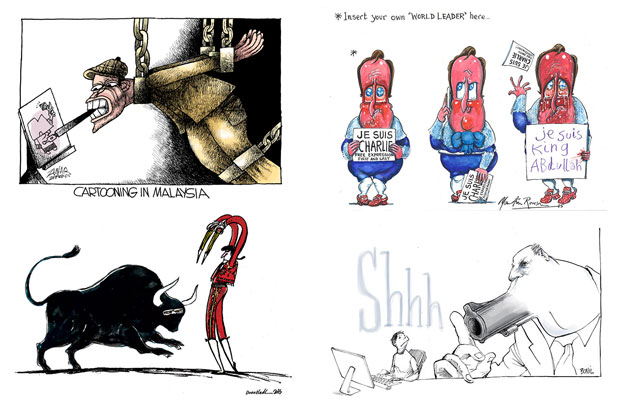
Among the cartoons available in the auction are original artworks by Zulkiflee Anwar Haque (Zunar); Martin Rowson; Xavier Bonilla (Bonil); and Doaa El Adl (clockwise from top left).
Index on Censorship is delighted to announce the auction of an incredible collection of cartoons that celebrate the power of art to challenge suppression. The auction will help fund our work supporting persecuted writers and artists worldwide.
Make a new donation to Index before the end of December to receive a limited-edition postcard set of 10 cartoons created by some of the world’s top political cartoonists
Earlier this year, Index commissioned 10 of the world’s leading cartoonists to pen a work on the theme of free expression. The cartoons are powerful tributes to the role of art, drawn by world-renowned artists from every continent: from a US Pulitzer Prize winner to a Syrian cartoonist beaten in retaliation for his work.
Beginning Tuesday, 24 November 2015, bidders will be able to enter bids for hand-drawn artwork by:
Xavier Bonilla (Bonil) – Ecuador
Regularly denounced, threatened and fined, Ecuador’s Bonil has earned the title “the pursued cartoonist” for his work. For 30 years he has critiqued, lampooned and ruffled the feathers of Ecuador’s political leaders, in the process earning a reputation as one of the wittiest and most fearless cartoonists in South America.
Kevin Kallaugher (Kal) – United States
US artist Kal is the editorial cartoonist for The Economist and The Baltimore Sun and his work has appeared in more than 100 publications worldwide including Le Monde, Der Spiegel, The International Herald Tribune, The New York Times, Time, Newsweek, and The Washington Post. He has won numerous awards, including the 2014 Grand Prix for Cartoon of the Year.
Signe Wilkinson (Signe) – United States
The first woman to win the Pulitzer Prize for Editorial Cartooning, Signe has won several other awards for her work. She comments on topical political issues and is best known for her daily cartoons in The Philadelphia Daily News.
Jean Plantureux (Plantu) – France
Plantu is the chief cartoonist for France’s Le Monde and founder of Cartooning for Peace, a global network of cartoonists. This drawing is a rare, signed copy of the world-famous cartoon Plantu drew for Le Monde the day after the attack on Charlie Hebdo.
Martin Rowson – UK
A former Cartoonist Laureate, political satirist Martin Rowson contributes cartoons to The Guardian and the Daily Mirror as well as Index on Censorship magazine. His work has earned him several awards, including the prize for the Best Humour and Satire Book of the Year at this year’s Political Book Awards.
Ali Farzat – Syria
Ali Farzat, a former Index on Censorship Freedom of Expression Award winner, came to global attention in 2011 when he was pulled from his car and beaten by Syrian security forces who broke both his hands. When Kuwaiti authorities closed the offices of his newspaper, Al-Watan, earlier this year Ferzat was forced to buy new materials and redrew this cartoon for us from scratch.
Doaa El Adl (Doaa) – Egypt
Doaa is a celebrated female artist in the Arab world – well know for her fearless political work. She has often tackled freedom of speech, human rights and women’s rights issues, wining numerous awards as well as controversy and even charges of blasphemy for her work.
Zulkiflee Anwar Haque (Zunar) – Malaysia
Zunar is an award-winning Malaysian political cartoonist who has been repeatedly targeted by authorities. Five of his cartoon books have been banned by the Malaysian government for carrying content “detrimental to public order” and thousands confiscated. He is currently facing up to 43 years in jail for mocking the government.
David Rowe – Australia
A three-time winner of the Stanley Award for Australia’s Cartoonist of the Year, David Rowe has worked for the Australian Financial Review for 22 years. Rowe’s bright and colourful watercolours are famously merciless.
Damien Glez – (Glez) – Burkina Faso
Glez’s cartoons regularly appear across three continents, including his own weekly satirical newspaper in Burkina Faso: Le Journal du Jeudi . He co-created pan-African monthly satirical Le Marabout, writes his own comic strip Divine Comedy and has won numerous awards internationally..
Bids must be placed by noon on Monday, 14 December 2015.
The auction is being hosted by Givergy.