6 Aug 2021 | Afghanistan, Belarus, Burma, China, Hong Kong, India, Opinion, Ruth's blog
[vc_row][vc_column][vc_single_image image=”117177″ img_size=”full” add_caption=”yes”][vc_column_text]There are moments as you’re watching the news when it feels as if the world is becoming an increasingly horrible place, that totalitarianism is winning, and that violence is the acceptable norm. It’s all too easy to feel impotent as the horror becomes normalised and we move on from one devastating news cycle to the next.
This week alone, in the midst of the joy and heartbreak of the Olympics, we have seen the attempted forced removal of the Belarusian sprinter Krystina Timanovskaya from Tokyo by Lukashenko’s regime. Behind the headlines, the impact on her family has been obvious – her husband has fled to Ukraine and will seek asylum with Krystina in Poland and there have been reports that even her grandparents have been visited by KGB agents in Belarus.
This served as a stark reminder, if we needed one, that Lukashenko is an authoritarian dictator who will stop at nothing to retain power. And this is happening today – in Europe. Our own former member of staff Andrei Aliaksandrau and his partner Irina have been detained for 206 days; Andrei faces up to 15 years in prison for treason; his alleged “crime” – to pay the fines of the protestors.
In Afghanistan, reports of Taliban incursions are now a regular feature of every news bulletin, with former translators who supported NATO troops being murdered as soon as they are found and media freedom in Taliban-controlled areas now non-existent. Six journalists have been killed this year, targeted by extremists, and reporters are being forced into hiding to survive. As the Voice of America reported last month: “The day the Taliban entered Balkh district, 20 km west of Mazar e Sharif, the capital of Balkh province last month, local radio station Nawbahar shuttered its doors and most of its journalists went into hiding. Within days the station started broadcasting again, but the programming was different. Rather than the regular line-up, Nawbahar was playing Islamist anthems and shows produced by the Taliban.”
Last Sunday, Myanmar’s military leader, Gen Min Aung Hlaing, declared himself Prime Minister and denounced Aung San Suu Kyi as she faces charges of sedition. Since the military coup in February over 930 have been killed by the regime including 75 children and there seems to be no end in sight as the military continue to clamp down on any democratic activity and journalists and activists are forced to flee.
At the beginning of this week Steve Vines, a veteran journalist who had plied his trade in Hong Kong since 1987, fled after warnings that pro-Beijing forces were coming for him. The following day celebrated artist Kacey Wong left Hong Kong for Taiwan after his name appeared in a state-owned newspaper – which Wong viewed as a ‘wanted list’ by the CCP. Over a year since the introduction of the National Security Law in Hong Kong the ramifications are still being felt as dissent is crushed and people arrested for previously democratic acts, including Anthony Wong, a musician who was arrested this week for singing at an election rally in 2018. Dissent must be punished even if it was three years ago.
And then there is Kashmir… On 5 August 2019, Narendra Modi’s government stripped Jammu and Kashmir of its special status for limited autonomy. Since that time residents inside Kashmir have lived under various levels of restrictions. Over 1,000 people are still believed to be in prison, detained since the initial lockdown began, including children. Reportedly 19 civilians have died so far this year caught in clashes between the Indian Army and militants. And on the ground journalists are struggling to report as access to communications fluctuates.
Violence and silence are the recurring themes.
Belarus, Afghanistan, Myanmar, Hong Kong, Kashmir. These are just five places I have chosen to highlight this week. Appallingly, I could have chosen any of more than a dozen.
It would be easy to try and avoid these acts of violence. To turn off the news, to move onto the next article in the paper and push these awful events to the back of our mind. But we have a responsibility to know. To speak up. To stand with the oppressed.
Behind every story, every statistic, there is a person, a family, a friend, who is scared, who is grieving and in so many cases are inspiring us daily as they stand firm against the regimes that seek to silence them. Index stands with them and as ever we shine a spotlight on their stories – so that we can all bear witness.[/vc_column_text][/vc_column][/vc_row][vc_row][vc_column][three_column_post title=”You may also want to read” category_id=”41669″][/vc_column][/vc_row]
3 Jun 2021 | China, Hong Kong, News
[vc_row][vc_column][vc_single_image image=”116835″ img_size=”full” add_caption=”yes”][vc_column_text]For 30 years in a row after the 4 June bloodshed in Beijing, Hong Kong people had turned out en masse at Victoria Park, the city’s central park, to commemorate the victims of the killings at and around Tiananmen Square in the summer of 1989.
The regular June scenes saw marked changes last year. The imminent enforcement of a national security law scheduled for 1 July 2020 and a government ban on assembly on grounds of the Covid-19 epidemic cast a long shadow over the annual vigil. Still, thousands of people came out, holding candlelights and vowing “not to forget 4 June”.
Citing social distancing rules again this year, the Police rejected the application for a march planned for 30 May and an assembly at the park on 4 June to mark the 32nd anniversary.
The Hong Kong Alliance in Support of Patriotic Democratic Movement in China (Alliance), an umbrella body composed of pro-democracy groups which holds the vigil every year, has announced they will not hold any event at the park in the evening of 4 June.
More than 20 democrats, including leaders of the Alliance, who took part in last year’s candlelight vigil last year, were convicted of participating in unlawful assembly. They were given jail sentences of up to 14 months.
The remaining Alliance leaders will no doubt be arrested and face at least the same charge if they turn up at the park on 4 June. Worse, they may be charged with subversion under the national security law.
Alliance leaders advised people to commemorate the victims in a safe and peaceful manner.
Media reports quoted anonymous sources close to the government warning people not to wear black clothes – a regular form of portest – and not to hold up candles at and near Victoria Park. First, they may breach the social distancing rules. Mort importantly, they may be charged with unlawful assembly if they are deemed to have the same purpose in public places.
As this article goes to press, the city is laden with an air mixed with anger and fear, persistence and helplessness.
Following the harsh sentences of democrats convicted of unlawful assembly and the enactment of the national security law, fear has swept the city. Calls for a democratic China and an end of one-party dictatorship that resonated in earlier 4 June vigils could now be deemed as subversive.
Although the majority of people still believe they are on the right side of the history of the 4 June crackdown and must persist in holding up the candle of hope, they feel helpless in stopping the government crackdown on commemorating the anniversary.
Last Wednesday, the operators of the 4 June Museum run by the Alliance closed its doors, hours after officials from the Food and Environmental Hygiene department accused it of operating as a place of public entertainment without the required licences.
The museum reopened briefly on Sunday to mark the 4 June anniversary; it may never reopen again.
Founded at the heyday of the student-led movement in 1989, the Alliance’s days are seemingly numbered. Pro-Beijing political figures and media have put more pressure on the Government to ban the Alliance on grounds that its call for an end of one-party dictatorship in its manifesto is subversive.
Its disbandment is no longer a question of if, but when.
This is not so much because the Alliance has or will pose any real threat, nor embarrassment, to the ruling Chinese Communist Party. It can be argued that the opposite is true. That it was allowed to exist has provided a real-life case study that showed the world how the policy of “one country, two systems” worked.
Except for the much-smaller scale of commemorations in Taiwan, Hong Kong had been the only place in mainland China where people were allowed to commemorate the Tiananmen massacre.
Tolerance of the communist authorities towards 4 June commemoration, and indeed a free Hong Kong, has now run out.
With hindsight, the authorities feel they were wrong to have given too much freedom to Hong Kong people. As a result of that, many, in particular young people, have kept testing Beijing’s tolerance by crossing the political “red lines”, referring to politically sensitive issues such as independence and self-determination as well as challenging the system of government and their governance.
The protracted territory-wide protests sparked by a bill on extradition in 2019, followed by a landslide victory of the democrats in the district council elections in November that year, have shocked Beijing. They responded by imposing the national security law and overhauling the election system to make sure the city is run by Beijing-trusted patriots.
With democracy scuttled and freedom curtailed, the 4 June candlelights, described by Nancy Pelosi, US House Speaker, as “a beautiful sight to behold”, may now become history, testifying the end of “one country, two systems.”[/vc_column_text][/vc_column][/vc_row][vc_row][vc_column][three_column_post title=”You may also want to read” category_id=”85″][/vc_column][/vc_row]
28 Apr 2021 | Africa, Burma, China, Hong Kong, Magazine, Magazine Contents, Slapps, United States, Volume 50.01 Spring 2021, Volume 50.01 Spring 2021 extras
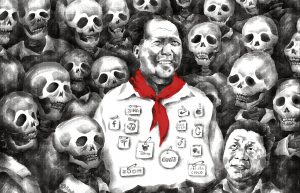
Illustration: Badiucao
Index looks back on 100 years of the Chinese Communist Party and how their censorship laws continue to shape the lives of people around the world and threaten their right to free speech. Inside this edition are articles by exiled writer Ma Jian and an interview with Facebook’s vice-president for global affairs, former UK deputy Prime minister Nick Clegg; as well as an exclusive short story from acclaimed writer Shalom Auslander.
Acting editor Martin Bright said: “I am delighted to introduce the latest edition of Index which marks the 100th anniversary of the Chinese Communist Party.”
“This year also marks the 50th anniversary of the magazine and I am proud that we are continuing the founders’ legacy of opposition to totalitarianism.”
“In this Spring edition of Index we are particularly pleased to publish an exclusive essay by the celebrated Chinese writer Ma Jian, who suggests that an alternative tradition of tolerance and freedom is still possible.”
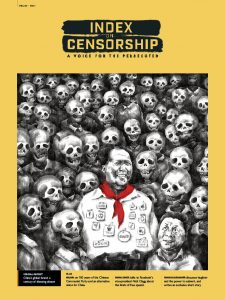 A century of silencing dissent by Martin Bright: We look at 100 years of the Chinese Communist Party and the methods of control that it has adapted to stifle free expression and spread its ideas throughout the world
The Index: Free expression round the world today: the inspiring voices, the people who have been imprisoned and the trends, legislation and technology which are causing concern
Fighting back against the menace of Slapps by Jessica Ní Mhainín: Governments continue to threaten journalists with vexatious law suits to stop critical reporting
Friendless Facebook by Sarah Sands: An interview with Facebook vice-president Nick Clegg about being a British liberal at the heart of the US tech giant
Standing up to a global giant by Steven Donziger: A lawyer who has gone head to head with the oil industry since 1993 at great personal cost tells his story
Fear and loathing in Belarus by Yahuen Merkis and Larysa Shchryakova: The crackdown on journalism has continued with arrests. Read the testimony of two reporters
Killed by the truth by Bilal Ahmad Pandow: Babar Qadri was one of Kashmir’s most strident voices, until he was gunned down in his garden
Cartoon by Ben Jennings: Arguments about the removal of statues cause a stir
The martial art of free speech by Ari Deller and Laura Janner-Klausner: The question of Cancel Culture continues to rage. Is it really a problem?
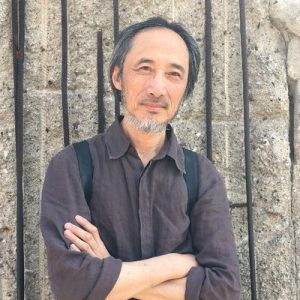
Ma Jian
Burning through censorship: Censorship-busting online organisation GreatFire celebrates its 10th anniversary
The party is your idol by Tianyu M. Fang: China’s propaganda is adapting to target young people
Past imperfect by Rachael Jolley: Four historians explain how the CCP shaped China and ask if globalisation will be its undoing
Turkey changes its tune by Kaya Genç: Uighur refugees living in Turkey find themselves victims of a change in foreign policy
The human face and the boot by Ma Jian: The acclaimed writer-in-exile reflects on 100 years of the CCP and its legacy of bloodshed
A moral hazard by Sally Gimson: Universities around the world and the CCP’s challenges to academic freedom
Director’s cuts by Chris Yeung: Hong Kong broadcaster RTHK has been squeezed by China’s tightening control
Beijing buys Africa’s silence by Issa Sikiti da Silva: Africa’s rich natural resources are being hoovered up by China
A new world order by Natasha Joseph: Journalist Azad Essa found when he wrote about China in Africa, his writing was silenced
A most unlikely ally by Stefan Pozzebon: Paraguay has long been an ally of Taiwan, but it’s paying an economic price
China’s artful dissident: A profile of our cover artist: the exiled cartoonist Badiucao.
Lies, damned lies and fake news by Nick Anstead: Fake news is rife, rampant and harmful. And we can only counter it by making sure that the truth is heard
Censorship? Hardly by Clive Priddle: Even the most controversial book usually finds a publisher after it has been turned down
A voice for the persecuted by Ruth Smeeth: As Index celebrates its 50 year anniversary, we note why free speech is still important
Collective ©ALEXANDER NANAU PRODUCTION
Don’t joke about Jesus by Shalom Auslander: An exclusive short story based on a joke by the acclaimed author of Mother for Dinner
Poet who haunts Ukraine by Steve Komarnyckyj: Vasyl Stus, the writer who remains a Ukrainian hero, 35 years after perishing in a Soviet gulag
The freedom of exile by Khaled Alesmael, Leah Cross: A young refugee Syrian writer on the love between Arab men
Forbidden love songs by Benjamin Lynch: Iran’s underground pop music scene upsets the regime
Reviews: Saudi Arabia’s murder of Jamal Khashoggi, USA Gymnastics and healthcare in Romania: we review three new documentaries
War of the airwaves by Ian Burrell: The Chinese government faces difficulties with its propaganda network CGTN
28 Apr 2021 | China, Magazine, News, Volume 50.01 Spring 2021
[vc_row][vc_column][vc_single_image image=”116639″ img_size=”full” add_caption=”yes”][vc_column_text]
Sometimes, from the most trivial event or seemingly insignificant interaction, you can gauge the health of a society and decide: “This is a place I’d like to live, a place conducive to happiness.”
A few years ago, while in Taiwan for a literary festival, I went to a night market to look for tangyuan – the sticky rice dumplings that are traditionally eaten on the final day of Chinese New Year. As their name is a homophone for the word “union”’, Chinese families eat them on this day to ensure that during the coming year they will remain united. As I’d recently been cast into exile from mainland China, I thought the dumplings could assuage my longing for home.
After a long search, I found a small dumpling stall and asked the elderly owner if she had any. She told me she’d sold out, but that if I bought a bag of frozen ones from the supermarket across the road she would boil them up for me on her stove. I did as she suggested and she served them to me in a big bowl, handed me a spoon and invited me to sit at one of her rickety tables. She fervently refused my offer of payment. As I sat there savouring the hot, translucent dumplings stuffed with sweet black sesame paste, I felt closer to home than I had done in years.
It was not the dumplings themselves or the memories they evoked that made me feel close to home. It was the simple act of kindness from this old woman who didn’t know me. Her kindness struck me as peculiarly Chinese. It was imbued with what we call renqing: a sentiment, a human feeling that inspires one person to perform a favour for another simply because they can, with no thought of recompense.
Traditional Chinese society was glued together by such sentiments. Their roots lie in Confucian values of benevolence, righteousness and propriety. At the heart of them all is the idea that to lead a good life you must treat others with compassion, that each human being has the potential to be good and is worthy of dignity and respect. Almost 500 years before the birth of Christ, Confucius devised his own Golden Rule: “When you leave your front gate, treat each stranger as though receiving an honoured guest … Do not do to others what you do not wish for yourself.”
[/vc_column_text][/vc_column][/vc_row][vc_row][vc_column width=”1/4″][vc_icon icon_fontawesome=”fas fa-quote-left” color=”custom” custom_color=”#dd0d0d”][/vc_column][vc_column width=”3/4″][vc_custom_heading text=”The horror of the current situation in Xinjiang is in a category of its own”][/vc_column][/vc_row][vc_row][vc_column][vc_column_text]
But in China, these ancient values have been bludgeoned by 70 years of Chinese Communist Party rule. Since the days of Mao, the CCP has clung to power through violence, propaganda and lies, viewing its subjects as senseless cogs that it can blind with promises of a future Utopia while confining them to a present hell. How easy it is for humans to be stripped of reason by a tyrant’s deceit and malice. At 13, having survived the Great Famine caused by Mao’s reckless Great Leap Forward campaign, when my siblings and I had had to eat toothpaste and tree bark to stave off starvation, I nevertheless longed to join Mao’s party. When he launched his Great Proletarian Cultural Revolution, I was incensed that the class background of my grandfather, who had perished in a Communist jail, disqualified me from joining Mao’s Red Guards. The deepest hope of my generation was that after purging China of bourgeois elements, we could travel to Britain and the USA to liberate their populations from the yoke of capitalist oppression and welcome them into the CCP’s revolutionary fold.
Slowly, as I witnessed horrific scenes of mob violence, I began to see this march to Utopia for what it was: a dehumanising nightmare that divided people into class categories, pitting one against the other in constant struggle, “rightist” against “leftist”, neighbour against neighbour. Time-honoured values of family loyalty and respect for elders were shattered as sons were encouraged to betray their fathers and daughters their mothers. No thought other than Mao Zedong Thought was allowed. Anyone who, however inadvertently, strayed from party orthodoxy was branded a class enemy and destroyed.
At least 45 million people are estimated to have died in Mao’s Great Famine. Millions more were killed or persecuted in his Cultural Revolution. Mao’s ideas and values caused catastrophic suffering and death, and corroded the hearts of the nation.
In the 40 years since Mao’s death, the Chinese have been forbidden to reflect on their traumatic past or contest any current injustices. Like a cunning and obdurate virus, the CCP has mutated. While other communist regimes around the world have fallen, it lives on, still suppressing free thought, still whitewashing history, but embracing, with increasing vigour, the capitalism Mao strove to eliminate. The party has loosened tethers it itself placed on the economy, and the Chinese have got rich. Although it continues to spout Marxist-Leninist jargon, its overarching obsession is power, and how to cling on to it. It still views the Chinese people as senseless cogs it can manipulate or flatten as it pleases. It still tells them that the material life is all that matters and that happiness is the China Dream of wealth and national glory conceived by the party’s current leader, Xi Jinping. Freedom, democracy, human rights, the desire to become master of one’s own fate: all of these are unnecessary, absurd, dangerous, it says. The Chinese people have no need for them!
In George Orwell’s Nineteen Eighty-Four, Winston is told that if he wants a picture of the future, he must “imagine a boot stamping on a human face – forever”.
This totalitarian nightmare is not some fictional future, though. Published in 1949, the year Mao rose to power, the novel prophetically describes China’s fate under CCP rule.
For moments, sometimes for days or weeks during the dark decades of China’s recent history, a hand has pushed the boot aside and the human face has looked up. It looked up with hope and joy during the Tiananmen Square protests of 1989, when millions gathered across the nation to call for freedom and democracy. In 2008, it looked up when 303 Chinese dissidents signed Charter 08 that argued for an end to one-party rule and asserted that freedom and human rights are universal values that should be shared by all humankind. In Hong Kong, the human face has looked up defiantly as the territory bravely struggles to retain what few freedoms it has left. And last year, back on the mainland, the face looked up for a few short hours when, after Dr Li Wenliang was reprimanded for raising the alarm about Covid-19 and then died of it, Chinese social media became flooded with the courageous hashtag #IWantFreedomOfSpeech.
Every time citizen journalists like Fang Bin upload independent reports on social media, civil rights activists like Xu Zhiyong call openly for political reform, dissidents like Gao Yu shine a light on the secret workings of the oppressive state, the human face looks up and proclaims: “without freedom of speech we are all enslaved”.
But each time, the CCP boot stamps back down again. In 1989, it sent the tanks to Tiananmen Square to crush the unarmed protesters. In 2009, it imprisoned the leading dissident Liu Xiaobo who co-authored Charter 08, banned him from collecting the Nobel Peace Prize he was awarded the following year, and in 2017, humiliated him even in death by stage-managing his funeral, forcing his family to drop his ashes unceremoniously into the sea. Fang Bin has been disappeared, Xu Zhiyong is in prison, Gao Yu and countless other dissidents like Ding Zilin, who courageously persists in dragging the Tiananmen massacre from state-imposed amnesia, are under intense surveillance. In Hong Kong, the party has violated the Sino-British Joint Declaration, beaten protesters and arrested every prominent critic. In Tibet, decades of CCP oppression have driven 156 Tibetans to set fire to themselves in anguish.
“But look how much richer the Chinese have become!” CCP apologists cry out. “Western democracies like the USA and Britain are a sham, corrupt and incompetent – see how they failed to contain the Covid-19 epidemic! Does this not prove the superiority of China’s authoritarian regime?”
They ignore that the CCP’s obsession with secrecy caused the initial outbreak’s catastrophic spread, and that democratic Taiwan far outperformed China, recording only 10 Covid deaths, without the government having to imprison whistleblowers or weld Covid patients into their homes.
It’s true that UK prime minister Boris Johnson and US president Donald Trump failed disastrously to contain the virus. (Is it a coincidence that both leaders share Xi’s disregard for the truth?)
But Trump could be voted out, Johnson can be vilified in the press, and no one loses their freedom of speech. This is the power of democracy – however embattled it may become, it guarantees, more than any other system yet invented, that every citizen can have their say and that political change is always constitutionally possible.
“The Chinese just aren’t suited to democracy, though – it’s not in their culture,” the apologists retort. But Taiwan destroys this argument – it proves that the Chinese can be both prosperous and free.
“It’s different on the mainland,” the apologists insist. “Look at the popular support for the party!” But the apologists fail to understand that when people have been governed by lies and fear, their gratitude to their leaders is little different from the affection some hostages develop for their captors.
The truth is, everyone in China is a hostage. Some may be wealthier than others, some more aware than others of the prison bars that surround them, but everyone is spiritually incarcerated by the CCP. They have all been denied the most fundamental human right: the right to form independent thought. Without freedom of thought, one loses respect for oneself and the ability to respect and feel compassion for others. China may be rich, but 70 years of CCP rule has plunged the country into an ever-deepening moral abyss.
It is impossible to make a hierarchy of misery, to judge the death and persecution of one person or of one people as worse than those suffered by others. But the horror of the current situation in Xinjiang seems to be in a category of its own. The images of Uighur convicts, handcuffed and blindfolded, heads shaven and bowed, being herded onto trains; of hastily-erected internment camps with watchtowers, barbed wire fencing and high perimeter walls; of inmates forced to smile and sing to foreign inspection teams, despair welling in their eyes; the accounts of torture, rape, forced sterilisations and indoctrination from the few Uighurs who have managed to escape. These images and accounts recall the worst atrocities of the 20th century. In the name of “anti-terrorism”, a people and a culture are being annihilated. Determined to eradicate any perceived threat to its rule, the CCP is stamping its boot down on an entire ethnic group, aiming to extinguish the Uighurs “root and branch”.
[/vc_column_text][/vc_column][/vc_row][vc_row][vc_column width=”1/4″][vc_icon icon_fontawesome=”fas fa-quote-left” color=”custom” custom_color=”#dd0d0d”][/vc_column][vc_column width=”3/4″][vc_custom_heading text=”As I witnessed horrific scenes of mob violence, I began to see this march to Utopia for what it was: a dehumanising nightmare”][/vc_column][/vc_row][vc_row][vc_column][vc_column_text]
Ma Jian
When reports first emerged of the Xinjiang camps, I found the images too dreadful to bear. Wanting to convey my grief and solidarity, I sought out a Xinjiang restaurant in London, which has now closed. After I paid for my meal, I asked the owner to join me outside, so that we could speak without being overheard. I asked him about the camps, and whether he still had family in the province. It turned out he was not a Uighur but a Han Chinese who had moved to Xinjiang in the 1990s. “Those Uighurs – they deserve what’s happened to them!” he said with a smirk. “Good thing they’ve been locked up in the camps. My family say the streets are much quieter now.”
His words were abhorrent, but he was expressing views many Han Chinese on the mainland share. These Chinese mainlanders are not evil, of course. The corrupted moral view that some of them may have is the tragic product of an evil regime.
On the hundredth anniversary of its founding, the CCP will reassert that ‘Without the Communist Party, there is no New China!’ Xi wants his model of authoritarian capitalism to be applauded and replicated by the entire world. He wants the UN to move its headquarters to Beijing – the ultimate validation of his ideas and values.
For anyone who cherishes human rights and freedom of speech it is repugnant that, while hundreds of millions of victims of the CCP’s man-made disasters lie rotting in their graves, while Chinese dissidents continue to be jailed and disappeared, while Hong Kong turns from a place that once offered refuge to mainland dissidents into a place from which its own citizens flee, while Tibetans continue to set themselves on fire, and while a genocide is taking place right now in Xinjiang – it should be repugnant to everyone that in the face of such unending injustice, some Western commentators could suggest that the CCP is winning the battle of values and ideas in the world.
But more appalling still is that for the sake of some grubby trade deals with China, the political leaders of Western democracies are doing little more than offering asylum to Hong Kong citizens and expressing “concern” at China’s human rights abuses. As China’s economy grows and CCP values spread across the nation’s borders, freedom of speech, liberal values and renqing – that essential human capacity for kindness and compassion – will become increasingly endangered. Unless Western leaders defend, not with gunboats or empty rhetoric but with unwavering commitment, the enlightenment values of liberty, fraternity and reason that should form the foundation of every civilised country, then there will soon be very few places left in the world that are conducive to human happiness.
[/vc_column_text][/vc_column][/vc_row][vc_row][vc_column][vc_custom_heading text=”Subscribe”][vc_column_text]In print, online. In your mailbox, on your iPad.
Subscription options from £18 or just £1.49 in the App Store for a digital issue.
Every subscriber helps support Index on Censorship’s projects around the world.
 SUBSCRIBE NOW[/vc_column_text][/vc_column][/vc_row]
