17 Mar 2022 | 50 years of Index, Afghanistan, Africa, Americas, Asia and Pacific, Bosnia, Brazil, China, Greece, Hong Kong, India, Iran, Magazine, Magazine Contents, Mexico, Nigeria, Northern Ireland, Philippines, Russia, Rwanda, South Africa, Turkey, Uganda, Ukraine, United Kingdom, United States, Volume 51.01 Spring 2022 Extras
The spring issue of Index magazine is special. We are celebrating 50 years of history and to such a milestone we’ve decided to look back at the thorny path that brought us here.
Editors from our five decades of life have accepted our invitation to think over their time at Index, while we’ve chosen pieces from important moments that truly tell our diverse and abundant trajectory.
Susan McKay has revisited an article about the contentious role of the BBC in Northern Ireland published in our first issue, and compares it to today’s reality.
Martin Bright does a brilliant job and reveals fascinating details on Index origin story, which you shouldn’t miss.
Index at 50, by Jemimah Steinfeld: How Index has lived up to Stephen Spender’s founding manifesto over five decades of the magazine.
The Index: Free expression around the world today: the inspiring voices, the people who have been imprisoned and the trends, legislation and technology which are causing concern.
“Special report: Index on Censorship at 50”][vc_column_text]Dissidents, spies and the lies that came in from the cold, by Martin Bright: The story of Index’s origins is caught up in the Cold War – and as exciting
Sound and fury at BBC ‘bias’, by Susan McKay: The way Northern Ireland is reported continues to divide, 50 years on.
How do you find 50 years of censorship, by Htein Lin: The distinguished artist from Myanmar paints a canvas exclusively for our anniversary.
Humpty Dumpty has maybe had the last word, by Sir Tom Stoppard: Identity politics has thrown up a new phenonemon, an intolerance between individuals.
The article that tore Turkey apart, by Kaya Genç: Elif Shafak and Ece Temulkuran reflect on an Index article that the nation.
Of course it’s not appropriate – it’s satire, by Natasha Joseph: The Dame Edna of South Africa on beating apartheid’s censors.
The staged suicided that haunts Brazil, by Guilherme Osinski: Vladimir Herzog was murdered in 1975. Years on his family await answers – and an apology.
Greece haunted by spectre of the past, by Tony Rigopoulos: Decades after the colonels, Greece’s media is under attack.
Ugandans still wait for life to turn sweet, by Issa Sikiti da Silva: Hopes were high after Idi Amin. Then came Museveni …People in Kampala talk about their
problems with the regime.
How much distance from Mao? By Rana Mitter: The Cultural Revolution ended; censorship did not.
Climate science is still being silenced, by Margaret Atwood: The acclaimed writer on the fiercest free speech battle of the day.
God’s gift to who? By Charlie Smith: A 2006 prediction that the internet would change China for the better has come to pass.
50 tech milestones of the past 50 years, by Mark Frary: Expert voices and a long-view of the innovations that changed the free speech landscape.
Censoring the net is not the answer, but… By Vint Cerf: One of the godfathers of the internet reflects on what went right and what went wrong.[/vc_column_text][vc_custom_heading text=”Five decades in review”][vc_column_text]An arresting start, by Michael Scammell: The first editor of Index recounts being detained in Moscow.
The clockwork show: Under the Greek colonels, being out of jail didn’t mean being free.
Two letters, by Kurt Vonnegut: His books were banned and burned.
Winning friends, making enemies, influencing people, by Philip Spender: Index found its stride in the 1980s. Governments took note.
The nurse and the poet, by Karel Kyncl: An English nurse and the first Czech ‘non-person’.
Tuning in to revolution, by Jane McIntosh: In revolutionary Latin America, radio set the rules.
‘Animal can’t dash me human rights’, by Fela Kuti: Why the king of Afrobeat scared Nigeria’s regime.
Why should music be censorable, by Yehudi Menuhin: The violinist laid down his own rules – about muzak.
The snake sheds its skin, by Judith Vidal-Hall: A post-USSR world order didn’t bring desired freedoms.
Close-up of death, by Slavenka Drakulic: We said ‘never again’ but didn’t live up to it in Bosnia. Instead we just filmed it.
Bosnia on my mind, by Salman Rushdie: Did the world look away because it was Muslims?
Laughing in Rwanda, by François Vinsot: After the genocide, laughter was the tonic.
The fatwa made publishers lose their nerve, by Jo Glanville: Long after the Rushdie aff air, Index’s editor felt the pinch.
Standing alone, by Anna Politkovskaya: Chechnya by the fearless journalist later murdered.
Fortress America, by Rubén Martínez: A report from the Mexican border in a post 9/11 USA.
Stripsearch, by Martin Rowson: The thing about the Human Rights Act …
Conspiracy of silence, by Al Weiwei: Saying the devastation of the Sichuan earthquake was partly manmade was not welcome.
To better days, by Rachael Jolley: The hope that kept the light burning during her editorship.
Plays, protests and the censor’s pencil, by Simon Callow: How Shakespeare fell foul of dictators and monarchs. Plus: Katherine E McClusky.
The enemies of those people, by Nina Khrushcheva: Khrushchev’s greatgranddaughter on growing up in the Soviet Union and her fears for the US press.
We’re not scared of these things, by Miriam Grace A Go: Trouble for Philippine
journalists.
Windows on the world, by Nazanin Zaghari-Ratcliffe and Golrokh Ebrahimi Iraee: Poems from Iran by two political prisoners.
Beijing’s fearless foe with God on his side, by Jimmy Lai: Letters from prison by the Hong Kong publisher and activist.
We should not be put up for sale, by Aishwarya Jagani: Two Muslim women in India on being ‘auctioned’ online.
Cartoon, by Ben Jennings: Liberty for who?
Amin’s awful story is much more than popcorn for the eyes, by Jemimah Steinfeld: Interview with the director of Flee, a film about an Afghan refugee’s flight and exile.
Women defy gunmen in fight for justice, by Témoris Grecko: Relatives of murdered Mexican journalist in brave campaign.
Chaos censorship, by John Sweeney: Putin’s war on truth, from the Ukraine frontline.
In defence of the unreasonable, by Ziyad Marar: The reasons behind the need
to be unreasonable.
We walk a very thin line when we report ‘us and them’, by Emily Couch: Reverting to stereotypes when reporting on non-Western countries merely aids dictators.
It’s time to put down the detached watchdog, by Fréderike Geerdink: Western newsrooms are failing to hold power to account.
A light in the dark, by Trevor Philips: Index’s Chair reflects on some of the magazine’s achievements.
Our work here is far from done, by Ruth Smeeth: Our CEO says Index will carry on fighting for the next 50 years.
In vodka veritas, by Nick Harkaway and Jemimah Steinfeld: The author talks about Anya’s Bible, his new story inspired by early Index and Moscow bars.
A ghost-written tale of love, by Ariel Dorfman and Jemimah Steinfeld: The novelist tells the editor of Index about his new short story, Mumtaz, which we publish.
‘Threats will not silence me’, by Bilal Ahmad Pandow and Madhosh Balhami: A Kashmiri poet talks about his 30 years of resistance.
A classic case of cancel culture, by Marc Nash: Remember Socrates’ downfall.
15 Mar 2022 | News, Russia, Ukraine
Vasyl Symonenko (1935-1963), a Ukrainian dissident poet, died after a brutal attack by the Soviet police in Smila, Cherkasy Oblast, Ukraine. His death was likely connected to his interest in the mass graves at Bykivnia forest outside Kyiv, where the Soviet regime buried tens of thousands of its victims. His poem To A Kurdish Brother can be read as a call to his Ukrainian compatriots to rise against the Soviet regime. The Soviets had committed genocide against Ukrainians during the 1930s, exterminating millions of them during the Holodomor, a forced famine accompanied by mass executions. In the post war period the regime was slowly choking the remains of Ukrainian identity under the guise of “internationalism” by assimilating Ukraine’s people into Russian culture. Putin’s war is the Russian empire’s final effort to destroy Ukrainian identity, but it relates directly to hundreds of years of oppression.
To A Kurdish Brother
by Vasyl Symonenko
Fight… and overcome! Taras Shevchenko
The mountains cry, drenched in blood,
The battered stars fall down:
The fragrant valleys gouged and wounded,
Where chauvinism’s hunger tears in.
Oh, Kurd, conserve your ammo,
But don’t spare the lives of murderers.
Fall as a whirlwind of blood now
On these pillaging lawless bastards.
.
Only talk to them with bullets true:
They did not come just to take all you own,
But for your name and language too
And leave your son an orphan.
The oppressor will “rule” while you haul the cart
So you cannot consent to live with them
Drinking the blood of oppressed peoples they grow fat
For chauvinism is our most savage foe.
He will do anything, so that you submit,
He has betrothed treachery with shame,
Oh, Kurd, conserve each bullet,
For without them you won’t save your kin.
Do not lull to sleep the power of your hate,
Until the last chauvinist on the planet falls,
Into their open grave, only then take
Tenderness as your motto, however it calls.
—
Lina Kostenko was born into a family of teachers on 19 March 1930 in Rzhyshchiv, Ukraine. According to this poem, she wrote her first poem on the walls of a dug-out in World War II. It’s unlikely that this is poetic licence. Kostenko is a poet who is both highly literary, mixing references to Shakespeare and Gogol, but also very honest and accessible. That first poem written as shells fell around her has not survived so what we have instead is a poem about writing a poem. It is a powerful piece that speaks to the plight of children in war. She is currently seeing her country being invaded and shelled by another brutal dictator who, like Hitler and Stalin, wants to destroy the Ukrainian nation. Putin is committing war crimes and has displaced hundreds of thousands of refugees.
My first poem was written in a dug out
On a wall loosened by explosions
When stars were lost in the horoscope:
Though my childhood was not slain by war.
The fire poured its lava,
Stood in the grey craters of orchards,
Our path choked by water
In deranged barrages with flames
The world once bright now dark
That burning night illuminated to its depth
The dug out like a submarine
In a sea of smoke, fear and flame.
There is no longer rabbit or wolf there
Just a world of blood, carbonised star!
I wrote almost in shrapnel
Block capitals from the child’s primer.
I would still play in the dark and in classes
I flew on the wings of book covers in stories
And wrote poems about landmines
Having already seen death so close.
The pain of first unchildish impressions
What trace left on the heart
Verses do not say what I cannot speak
Have they not left mute the spirit?
The spirit in words is the sea in a periscope
And its memory, light refracted from my temple
My first poem, was written in a dug out
Simply imprinted on the soil.
Both poems translated from the Ukrainian by Stephen Komarnyckyj
14 Mar 2022 | China, Hong Kong, News
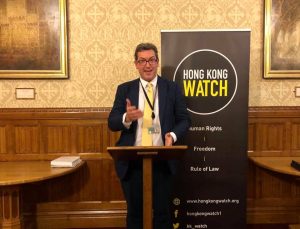
Hong Kong Watch’s Benedict Rogers. Credit: Hong Kong Watch
Benedict Rogers was surprised when he heard that he’d been accused by police in Hong Kong of jeopardising China’s national security and threatened with jail time under the draconian National Security Law. The chief executive of Hong Kong Watch, a charity that campaigns for human rights in the former British colony, told Index that while he knew there was an extra-territorial element to the law, he didn’t believe “they’d go this far”.
Three weeks ago Rogers learnt that the website attached to Hong Kong Watch had been blocked in Hong Kong. After making enquiries about why he received letters back charging him under the law.
“I guess the letters I received were an answer to the inquiry,” he said.
Passed in the summer of 2020, the National Security Law caused global outcry in its implications for freedoms in Hong Kong as it effectively made any form of dissent illegal. But it was not just the punishment for dissent within its borders that caused alarm – even those outside Chinese territory could be charged with breaking it. Index wrote about the law at the time, calling it a “devastating blow to Hong Kong’s autonomy”.
Approaching two years since its passage, scores of arrests and prison sentences have been handed out to protesters and journalists in Hong Kong. This though is the first time the law has been used against an advocacy group outside of Hong Kong.
Rogers is a British human rights activist and journalist based in London. In addition to his work at Hong Kong Watch, he is co-founder and deputy chairman of the Conservative Party’s human rights commission, a member of the advisory group of the Inter-Parliamentary Alliance on China and an advisor to the World Uyghur Congress.
The action is a clear attempt by Beijing to make anyone, anywhere feel vulnerable. They want to reinforce the message that no corner of the globe is beyond their reach, something we have been reporting on recently in our series Banned by Beijing. That it comes on the back of the Hong Kong Watch website being shut down is another worrying sign that Beijing is trying to shape Hong Kong – which does not have a Great Firewall – in its own image.
Rogers says he is not concerned for his own safety and that he has already taken measures to protect those he does communicate with inside Hong Kong, measures that he will take even further now. He sees it as another “sad deterioration in the Hong Kong situation”.
Today our fears lie with all those who want to promote respect for free speech and human rights within China and Hong Kong and might not do so following this message. People in Hong Kong itself already live with the daily fear of repercussions as they see more and more of their friends, relatives and associates being arrested and jailed. We don’t want this fear to infect those outside, to stop them honestly reporting on the situation and communicating with those inside. We need a united front to campaign against Beijing’s actions.
We are also fearful for those in other authoritarian countries around the world. The move comes less than a fortnight after Russia passed its “fake news” law to imprison anyone inside Russia criticising the war in Ukraine. Putin passed this law overnight. We fear he could look to Beijing and decide to extend it to critical voices outside the country, who are playing such a crucial role in revealing the horrors of Ukraine and holding him to account.
Echoing our concerns, Lord Patten of Barnes, the last British Governor of Hong Kong and a patron of Hong Kong Watch, said:
“This is another disgraceful example of Mr Putin’s friends in Beijing and their quislings in Hong Kong trying not only to stamp out freedom of expression and information in Hong Kong but also to internationalise their campaign against evidence, freedom and honesty.”
UK Foreign Secretary Liz Truss has called it “unjustifiable”.
“Attempting to silence voices globally that speak up for freedom and democracy is unacceptable and will never succeed,” she said.
Rogers, who spoke to Index in 2017 about threatening letters he received from Hong Kong to his London home (also sent to his neighbours’), says the last four to five years has seen a succession of threats including letters and emails, with this action being the latest and most extreme. Still, he says he will not let this attack silence him.
“We’re not going to take the website down. We’re needed more than ever,” he told Index.
11 Mar 2022 | News, Russia, Ukraine
As Putin continues his bloody invasion of Ukraine, the rest of the world continues to look for signs of an uprising in Russia that might provide a possible exit strategy without risking World War III.
In a country that has cracked down on protest ever since Index was founded in 1972, it can be hard to tell the real scale of opposition to the war.
What we do know, thanks to human rights group OVD-info, is that some 14,000 people from 140 cities have been detained by the authorities so far for exercising their right to object to the actions in Ukraine. On 6 March alone, 5,000 protesters were detained, including 113 juveniles and 13 journalists. Children as young as seven were detained for laying flowers at Moscow’s Ukrainian Embassy.
Arrests are often violent, with protesters beaten with batons and shot with stun guns. If convicted of breaking the harsh rules on protests, they face fines of up to 300,000 roubles (around £2,000 at the current exchange rate) and detention for up to 30 days.
One of Putin’s most vocal critics – the jailed opposition politician leader Alexey Navalny – has also been publicising the work of his supporters in taking the temperature of public opinion in Russia. Navalny is currently being held in a penal colony for three and a half years after being found guilty of a charge of embezzlement. A new court case started in mid-February in which prosecutors have accused him of stealing more than 350 million roubles in donations from non-governmental organisations.
On 8 March, Navalny (actually his lawyers and supporters outside prison, presumably with his blessing) tweeted a thread sharing the results of four opinion polls taken between 25 February and 3 March in Moscow, each including 700 participants.
Navalny said in his tweets, “Whether Russians actually support the hideous war that Putin has waged against Ukraine is a matter of utmost political importance. The answer to this question will largely define Russia’s place in the history of the 21st century.
“It’s one thing if Putin killed Ukrainian civilians and destroyed life-critical infrastructure with full approval from the Russian citizens. However, it’s a whole different story if Putin’s bloody venture is not supported by the society.”
The polls showed that Muscovites view of the role of Russia in the conflict rapidly shifted, with 53% by the end of the polling saying Russia had taken on the role of aggressor in the conflict against 28% who felt Russia was a liberator and 12% who saw them as a peace-maker.
In the same period, the number of people who felt Russia was the guilty party more than doubled from 14% to 36%,.
By the end of the four polls, 60% of those surveyed felt there would be a catastrophic collapse of the Russian economy as a result of the invasion.
By 3 March, some 79% of those asked said the conflicting parties should immediately cease all military operations and engage in peace talks.
Commenting on the findings, Navalny tweeted: “The nature of these changes is plain and unambiguous: people rapidly begin to realise who is responsible for initiating the conflict, as well as the war’s true objectives and possible outcomes. Undoubtedly, the Kremlin can see these dynamics as well, hence the nervousness, the desperate attempts to end the war campaign as soon as possible.”
He added: “The anti-war momentum will keep growing across the society, so the anti-war protests should not be halted under any circumstances.”
In a thread a few days earlier, Navalny had dubbed Putin an “obviously insane czar” and added: “Putin is not Russia. If there is anything in Russia right now that you can be most proud of, it is those… people who were detained because – without any call – they took to the streets with placards saying ‘No War’”.
“We must, gritting our teeth and overcoming fear, come out and demand an end to the war. Each arrested person must be replaced by two newcomers. If in order to stop the war we have to fill prisons and paddy wagons with ourselves, we will fill prisons and paddy wagons with ourselves.
He concluded: “Everything has a price, and now, in the spring of 2022, we must pay this price. There’s no one to do it for us. Let’s not ‘be against the war’. Let’s fight against the war.”
Others would have you believe that Putin has wide support for his actions. The state-controlled pollster VCIOM said that Putin’s confidence rating among the public had grown from 73% to 7.4% between 4 and 11 March.
A 5 March poll by the organisation found that 71% of Russians support the decision to conduct what they call the “special military operation” in Ukraine with 46% of Russians believing the operation “aims to protect Russia and prevent the deployment of NATO military bases on the territory of Ukraine”.
