4 Apr 2019 | Awards, Fellowship, Fellowship 2019, News
[vc_row][vc_column][vc_column_text]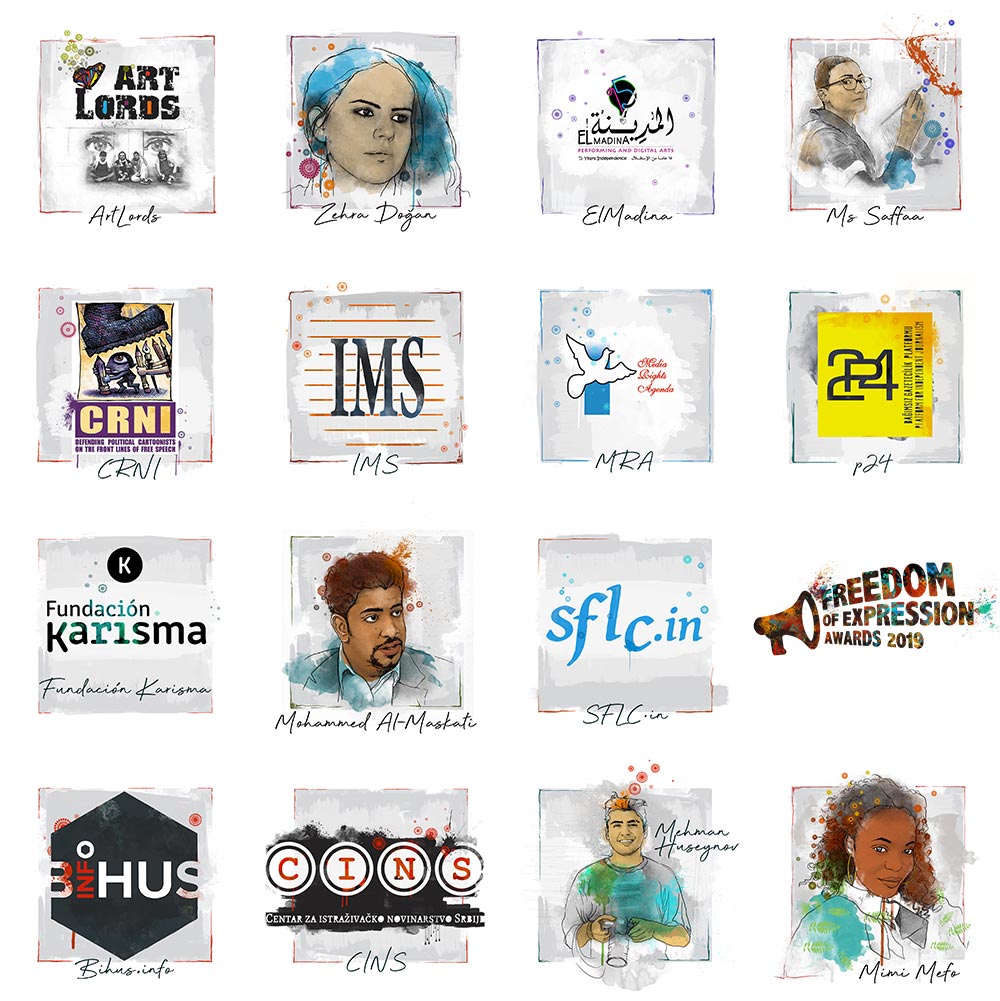
Each year, the Index on Censorship Freedom of Expression Awards gala honours courageous champions who fight for free speech around the world.
Drawn from more than 400 crowdsourced nominations, this year’s nominees include artists, journalists, campaigners and digital activists tackling censorship and fighting for freedom of expression. Many of the 15 shortlisted are regularly targeted by authorities or by criminal and extremist groups for their work: some face regular death threats, others criminal prosecution.
The gala takes place on Thursday 4 April in London and will be hosted by comedian Nish Kumar.
We will be live tweeting throughout the evening on @IndexCensorship. Get involved in the conversation using the hashtag #IndexAwards2019.
Index on Censorship Freedom of Expression Awards nominees 2019
Arts
for artists and arts producers whose work challenges repression and injustice and celebrates artistic free expression
ArtLords | Afghanistan
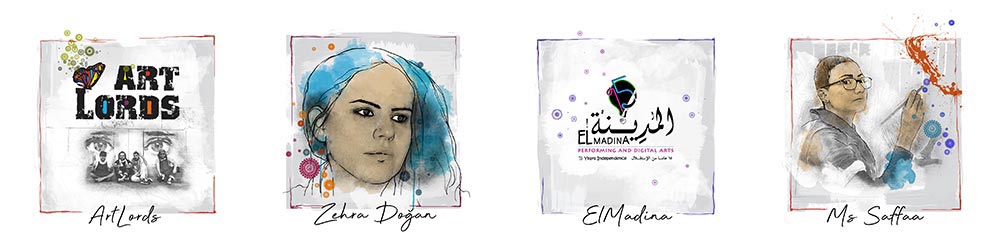
ArtLords is a grassroots movement of artists and volunteers in Afghanistan who encourage ordinary citizens, especially women and children, to paint the issues that concern them on so-called blast walls: walls the country’s rich and the powerful have built around themselves to protect them from violence while the poor fend for themselves. Their work has turned a symbol of fear, tension and separation into a platform where social issues can be expressed visually and discussed in the street. ArtLords has completed over 400 murals in 16 provinces of Afghanistan. In March 2018, for International Women’s Day, ArtLords painted a tribute to Professor Hamida Barmaki, a human rights defender killed in a terrorist attack six years ago.
Full profile
Zehra Doğan | Turkey
Released from prison on 24 February 2019, Zehra Doğan is a Kurdish painter and journalist who, during her imprisonment, was denied access to materials for her work. She painted with dyes made from crushed fruit and herbs, even blood, and used newspapers and milk cartons as canvases. When she realised her reports from Turkey’s Kurdish region were being ignored by mainstream media, Doğan began painting the destruction in the town of Nusaybin and sharing it on social media. For this she was arrested and imprisoned. During her imprisonment she refused to be silenced and continued to produce journalism and art. She collected and wrote stories about female political prisoners, reported on human rights abuses in prison, and painted despite the prison administration’s refusal to supply her with art materials.
Full profile
ElMadina for Performing and Digital Arts | Egypt
ElMadina is a group of artists and arts managers who combine art and protest by encouraging Egyptians to get involved in performances in public spaces, defying the country’s restrictive laws. ElMadina’s work encourages participation — through storytelling, dance and theatre — to transform public spaces and marginalised areas in Alexandria and beyond into thriving environments where people can freely express themselves. Their work encourages free expression in a country in which public space is shrinking under the weight of government distrust of the artistic sector. ElMadina also carry out advocacy and research work and provide a physical space for training programmes, residencies and performances.
Full profile
Ms Saffaa | Saudi Arabia / Australia
Ms Saffaa is a self-exiled Saudi street artist living in Australia who uses murals to highlight women’s rights and human rights violations in Saudi Arabia. Collaborating with artists from around the world, she challenges Saudi authorities’ linear and limited narrative of women’s position in Saudi society and offers a counter-narrative through her art. Part of a new generation of Saudi activists who take to social media to spread ideas, Ms Saffaa’s work has acquired international reach. In November 2018, she collaborated with renowned American artist and writer Molly Crabapple on a mural celebrating murdered Saudi journalist Jamal Khashoggi that read, “We Saudis deserve better.”
Full profile
Campaigning
for activists and campaigners who have had a marked impact in fighting censorship and promoting freedom of expression
Cartoonists Rights Network International | United States / International
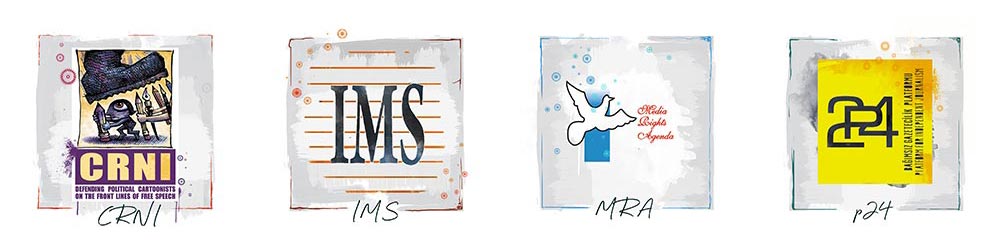
Cartoonists Rights Network International (CRNI) is a small organisation with a big impact: monitoring threats and abuses against editorial cartoonists worldwide. Marshalling an impressive worldwide network, CRNI helps to focus international attention on cases in which cartoonists are persecuted and put pressure on the persecutors. CRNI tracks censorship, fines, penalties and physical intimidation – including of family members, assault, imprisonment and even assassinations. Once a threat is detected, CRNI often partners with other human rights organisations to maximise the pressure and impact of a campaign to protect the cartoonist and confront those who seek to censor political cartoonists.
Full profile
Institute for Media and Society | Nigeria
The Institute for Media and Society (IMS) is a Nigerian NGO that aims to improve the country’s media landscape by challenging government regulation and fostering the creation of community radio stations in rural areas at a time when local journalism globally is under threat. Three-quarters of television and radio stations in Nigeria are owned by politicians, and as a result they are divided along political lines, while rural communities are increasingly marginalised. IMS’s approach combines research and advocacy to challenge legal restrictions on the media as well as practical action to encourage Nigerians to use their voices, particularly via local radio. IMS also tracks violations of the rights of journalists in Nigeria.
Full profile
Media Rights Agenda | Nigeria
Media Rights Agenda (MRA) is a non-profit organisation that has spent the last two decades working to improve media freedom and freedom of expression in Nigeria by challenging the government in courts. While the constitution guarantees the right to freedom of expression, other laws – including the sections of the Criminal Code, the Cybercrimes Act and the Official Secrets Act – limit and even criminalise expression. Through its active legal team, MRA has initiated strategic litigation targeting dozens of institutions, politicians and officials to improve the country’s legal framework around media freedom. Its persistent campaigning and lawsuits on freedom of information have helped improve access to government-held data.
Full profile
P24 | Turkey
P24 (Platform for Independent Journalism) is a civil society organisation that aims to neutralise censorship in Turkey — a country in which speaking freely courts fines, arrest and lengthy jail sentences. P24’s pro bono legal team defends journalists and academics who are on trial for exercising their right to free expression. It also undertakes coordinated social media and public advocacy work that includes live-tweeting from courtrooms and campaigning through an array of websites, newsletters and exhibition spaces. Its latest effort aims to provide spaces for collaboration and free expression in the form of a literature house and a project connecting lawyers and artists.
Full profile
Digital Activism
for innovative uses of technology to circumvent censorship and enable free and independent exchange of information
Fundación Karisma | Colombia
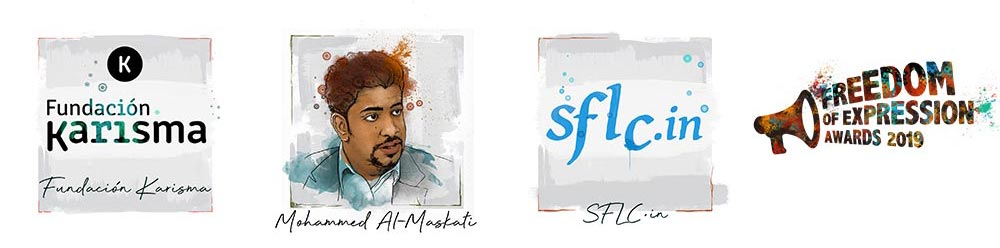
Fundación Karisma is a civil society organisation that challenges online trolls by using witty online ‘stamps’ that flag up internet abuse. It is an initiative that uses humour to draw attention to a serious problem: the growing online harassment of women in Colombia and its chilling effect. The organisation offers a rare space to discuss many issues at the intersection of human rights and technology in the country and then tackles them through a mix of research, advocacy and digital tools. Karisma’s “Sharing is not a crime” campaign supports open access to knowledge against the backdrop of Colombia’s restrictive copyright legislation.
Full profile
Mohammed Al-Maskati | Middle East
Mohammed al-Maskati is a digital security consultant who provides training to activists in the Middle East and in North Africa. Working as Frontline Defenders’ Digital Protection Consultant for the MENA Region, Mohammed teaches activists – ranging from vulnerable minorities to renowned campaigners taking on whole governments – to communicate despite government attempts to shut them down. He educates them on the use of virtual private networks and how to avoid falling into phishing or malware traps, create safe passwords and keep accounts anonymous. As governments become more and more sophisticated in their attempts to track and crush dissent, the work of people like Al-Maskati is increasingly vital.
Full profile
SFLC.in | India
SFLC.in (Software Freedom Law Centre) tracks internet shutdowns in India, a crucial service in a country with the most online blackouts of any country in the world. The tracker was the first initiative of its kind in India and has quickly become the top source for journalists reporting on the issue. As well as charting the sharp increase in the number and frequency of shutdowns in the country, the organisation has a productive legal arm and brings together lawyers, policy analysts and technologists to fight for digital rights in the world’s second most populous country. It also provides training and pro-bono services to journalists, activists and comedians whose rights have been curtailed.
Full profile
Journalism
for courageous, high-impact and determined journalism that exposes censorship and threats to free expression
Bihus.info | Ukraine
Bihus.info is a group of independent investigative journalists in Ukraine who – despite threats and assaults – are fearlessly exposing the corruption of many Ukrainian officials. In the last two years alone, Bihus.info’s coverage has contributed to the opening of more than 100 legal cases against corrupt officials. Chasing money trails, murky real estate ownership and Russian passports, Bihus.info produces hard-hitting, in-depth TV reports for popular television programme, Nashi Hroshi (Our Money), which illuminates discrepancies between officials’ real wealth and their official income. One of the key objectives of the project is not just to inform, but to involve people in the fight against corruption by demonstrating how it affects their own well-being.
Full profile
Center for Investigative Journalism of Serbia (CINS) | Serbia
Investigating corruption is one of the most dangerous jobs in journalism: three investigative reporters have been murdered in the European Union in the past year alone. In Serbia, journalists face death threats and smear campaigns portray investigative journalists as foreign-backed propagandists. Against this backdrop, Center for Investigative Journalism of Serbia (CINS) stands out as one of the last independent outlets left amid an increasingly partisan media. Using freedom of information requests, the CINS has created databases based on thousands of pages of documents to underpin its hard-hitting investigations. These include stories on loans provided to pro-government tabloids and TV channels. CINS also provides hands-on investigative journalism training for journalists and editors.
Full profile
Mehman Huseynov | Azerbaijan
Mehman Huseynov is a journalist and human rights defender who documents corruption and human rights violations in Azerbaijan, consistently ranked among the world’s worst countries for press freedom. Sentenced to two years in prison in March 2017 after describing abuses he had suffered at a police station, Huseynov has put his life in danger to document sensitive issues. His work circulated widely on the internet, informing citizens about the real estate and business empires of the country’s government officials, and scrutinising the decisions of president Ilham Aliyev. Before his release from prison in March 2019, Huseynov remained defiant, saying: “I am not here only for myself; I am here so that your children are not in my place tomorrow. If you uphold the judgement against me, you have no guarantees that you and your children will not be in my place tomorrow.”
Full profile
Mimi Mefo | Cameroon
Mimi Mefo is one of less than a handful of journalists working without fear or favour in Cameroon’s climate of repression and self-censorship. An award-winning broadcast journalist at private media house Equinoxe TV and Radio, Mefo was arrested in November 2018 after she published reports that the military was behind the death of an American missionary in the country. Mefo reports on the escalating violence in the country’s western regions, a conflict that has become known as the “Anglophone Crisis” and is a leading voice in exposing the harassment of other Cameroonian journalists, calling publicly for the release of those jailed.
Full profile[/vc_column_text][/vc_column][/vc_row][vc_row][vc_column][vc_basic_grid post_type=”post” max_items=”12″ style=”load-more” items_per_page=”4″ element_width=”6″ grid_id=”vc_gid:1553869689126-03eaf550-1416-3″ taxonomies=”8935″][/vc_column][/vc_row]
29 Mar 2019 | Europe and Central Asia, News, Ukraine
[vc_row][vc_column][vc_column_text]
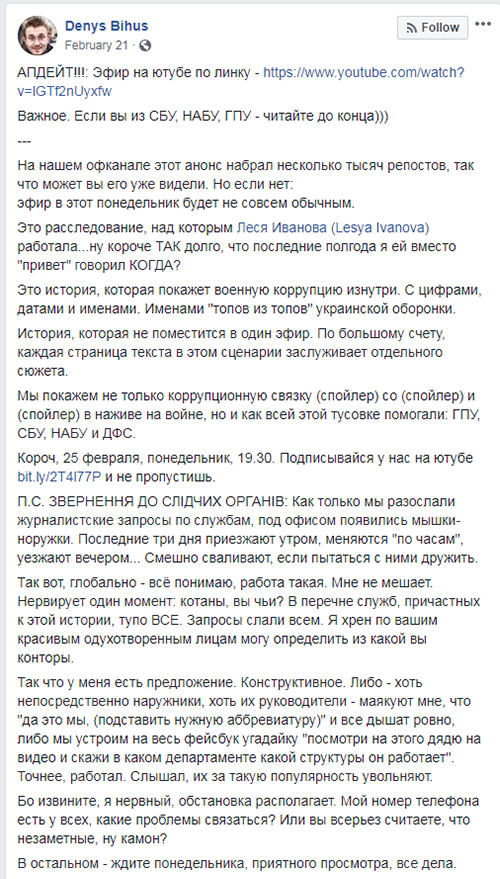
Bihus and members of his reporting team noticed several
unidentified people monitoring their activity from outside their Kiev office starting on February 20. Bihus wrote that the monitoring began after Bihus.Info sent requests for comment to law enforcement bodies in relation to an investigative article alleging corruption within Ukraine’s defense industry.
As Ukrainians head into the first round of a tense presidential election on 31 March, Ukraine’s incumbent president and candidate Petro Poroshenko is at the centre of a corruption scandal involving the military and the country’s press are feeling the heat.
The allegations swirling around the president were uncovered by the 2019 Index on Censorship Freedom of Expression Award-nominated Bihus.info, a group of independent investigative journalists, who undertook a multi-year investigation. The Bihus.info revelations were central to the president’s decision to fire Oleh Hladkovskyy, a top national-security official, who was implicated in corrupt deals involving the armed forces.
Denys Bihus, editor-in-chief of Bihus.info, posted on his Facebook page that unknown persons had been surveilling members of his team ahead of the publication of the investigation. Bihus believes the surveillance was organised by Ukrainian law enforcement and was related to the outlet’s investigations into corruption involving the Prosecutor General’s Office, the Security Service of Ukraine, the National Anti-Corruption Bureau and the State Fiscal Service.
In February, journalists from the TV programme Schemes: Corruption in Details, another leading investigative journalistic project jointly run by public broadcaster UA:Pershyi and Radio Free Europe/Radio Liberty, reported being followed and surveilled. Ukrainian oligarch Rinat Akhmetov has been accused of hiring personnel to spy on journalist Mykhailo Tkach and the camera crew of Schemes. The journalists claimed these activities have been aimed at obstructing their work.
Akhmetov’s security firm has accused Schemes journalists of breaching the oligarch’s privacy and collecting information illegally. The company said that over the past few months unknown persons had secretly filmed the office of SCM, a company owned by Akhmetov, more than 200 times, as well as the private homes of a shareholder. The company claims that those persons had not identified themselves as media workers.
However, Tkach said that Akhmetov’s security firm knew that he and his crew were journalists as they had shown their press cards. Police initially questioned Tkach in late February after he filed a complaint about the firm’s obstruction of journalistic activity. At first, the investigators intended to interrogate him as a witness, but Tkach insisted that he should be defined as an aggrieved party. According to Ukrainian laws, an aggrieved party has more rights in a proceeding: to see material about the case, to file complaints and statements.
In another alarming trend, Ukrainian prosecutors demanded access to the electronic correspondence of the investigative journalist Ivan Verstyuk who collaborated with the Novoye Vremya weekly magazine. On 4 February a court in Kiev allowed law enforcement to gain access to the journalist’s emails.
In 2016 Novoye Vremya published an article by Verstyuk about Olexander Korniyets, a deputy prosecutor of the Kiev region, who paid for his daughter Anastasia’s expensive study in London. According to the UK National Crime Agency report, Korniyets spent about £120,000, while the official annual income of the prosecutor and his wife did not exceed £8,000 per year.
This report, which was the basis of Verstyuk’s article, had been sent exclusively to the Ukrainian Prosecutor General’s Office, but was then leaked. Korniyets was fired in 2015, but Ukrainian prosecutors still haven’t finished investigating his case. They claim that Verstyuk’s story and his source breached the confidentiality of this investigation, despite the leaked report being readily available online.
Verstyuk is preparing a lawsuit for the European Court of Human Rights to protect himself from searches by the prosecutor general’s office.
The prosecutors’ efforts to obtain access to Verstyuk’s emails have drawn international condemnation. Harlem Desir, the representative on the freedom of the media at the Organisation for Security and Cooperation in Europe, urged Ukrainian authorities to respect journalists’ right not to disclose their sources. The Committee to Protect Journalists also condemned the authorities’ efforts to get access to Verstyuk’s emails. Reporters Without Borders said that “it is becoming a habit to trample on the protection of journalistic sources in Ukraine. Head of the National Union of Journalists Serhiy Tomilenko commented that “It’s a shame! It’s an encroachment of media freedom”.
On 6 March journalist Kateryna Kaplyuk and a cameraman Borys Trotsenko from Schemes were assaulted by two deputies of the Chabany village head in the village of Chabany (Kiev region). The pair were filming on the premises of Chabany village council. The assailants were two deputies of the Chabany village head. The journalists called for an ambulance and, after a medical check-up at a hospital, Trotsenko was diagnosed with having a concussion. His camera was broken.
Nataliya Sedletska, editor-in-chief of Schemes, said the journalists had gone to Chabany village council to get information for an investigation on public lands illegal detachment into private possession. A complaint was filed to the police.
On 28 March Schemes reported that unidentified individuals had been trying to access the programme’s accounts in Telegram, WhatsApp and social media sites. On 7 February at 4:07 am, unknown Kyiv residents received access to Telegram account of Maxim Savchuk. In a few minutes at 4:15am, an attempt was made to access the Telegram account of journalist Valeriya Yegoshyna, who suggested that an attempt to break into her account could be connected to her investigation of social media bots acting in the interests of politicians Arseniy Yatsenyuk and Mykola Martynenko, from the ruling People’s Front party. In early March, unidentified persons tried to break the Facebook account of Schemes journalist Katerina Kapluk and accessed the WhatsApp account of editor Daria Martynenko.
Sedletska said the attempts to access the accounts are directly related to the professional activities of journalists.[/vc_column_text][/vc_column][/vc_row][vc_row][vc_column][vc_basic_grid post_type=”post” max_items=”10″ element_width=”6″ grid_id=”vc_gid:1553851892349-06473364-7471-4″ taxonomies=”742, 8996″][/vc_column][/vc_row]
31 Jan 2019 | Bahrain, Bahrain Statements, Campaigns -- Featured, Middle East and North Africa
[vc_row][vc_column][vc_column_text]
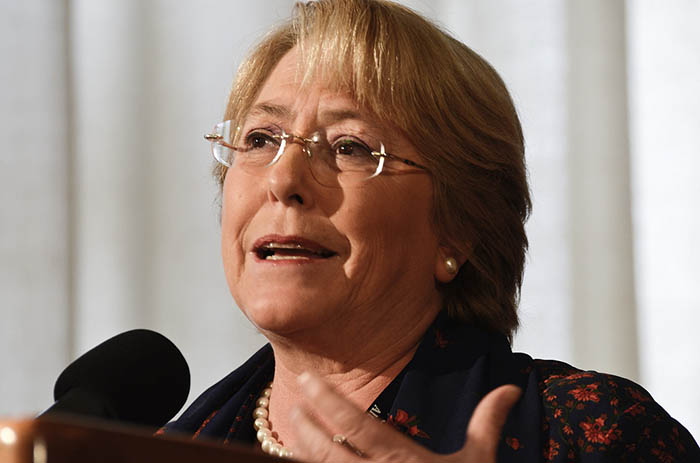
Michelle Bachelet, United Nations High Commissioner for Human Rights. Credit: UN Women / Flickr
H.E. Michelle Bachelet
United Nations High Commissioner for Human Rights
Office of the High Commissioner for Human Rights (OHCHR)
United Nations
52 Rue des Paquis
1201 Geneva, Switzerland
Your Excellency,
We, the undersigned organisations, write to you to express our concern regarding the worsening situation for civil society in Bahrain. We believe co-ordinated international action coupled with public scrutiny are imperative to address the government of Bahrain’s ongoing attacks on civil society and to hold the kingdom accountable to its commitments to international human rights laws and standards. To this end, we call upon your Office to continue to monitor the situation in Bahrain and to continue to raise concerns at the highest level, both publicly and privately, with the government, as was done by your predecessor, Zeid Ra’ad Al Hussein. We believe heightened scrutiny of Bahrain’s human rights record and its ongoing human rights violations is particularly important now that the kingdom is a Member State of the Human Rights Council.
In the past two years, the Bahraini government increased its repression of the kingdom’s remaining civil society organisations, political opposition groups, and human rights defenders. In June 2016, Bahrain’s Administrative Court forcibly dissolved al-Wefaq, Bahrain’s largest political opposition society, a ruling that was upheld in February 2018. In May 2017, a court approved the forcible dissolution of the National Democratic Action Society, also known as Wa’ad. Only a month later, the government indefinitely suspended the kingdom’s last remaining independent newspaper, Al-Wasat, continuing its repression of free expression and press freedom.
While there were hopes that the government might ease repression in the run-up to elections for the lower house of parliament on 24 November 2018, these were dashed with a series of actions and policies that effectively precluded the elections from being free or fair, and that continued the broader assault on civil society. Only weeks ahead of ahead of the elections, the country’s highest appeals court sentenced Sheikh Ali Salman, the Secretary-General of Al-Wefaq, to life in prison on spurious charges of espionage dating from 2011. The government also enacted new legislation banning all individuals who had ever belonged to a dissolved political society from seeking or holding elected office, as well as anyone who has ever served six months or more in prison. This affects a large portion of Bahrain’s population, as the kingdom currently has around 4,000 political prisoners.
Beyond rigging the election process at the expense of political opposition societies and free and fair participation, over this past year Bahrain has continued to target, harass, and imprison activists and human rights defenders for exercising their right to free expression. The government criminalised calls to boycott the elections, and, on 13 November 2018, arrested former Member of Parliament Ali Rasheed al-Asheeri for tweeting about boycotting the November elections. On 31 December 2018, Bahrain’s Court of Cassation – its court of last resort – upheld prominent human rights defender Nabeel Rajab’s five-year prison sentence on spurious charges of tweeting and re-tweeting criticism of torture in Jau Prison and the war in Yemen, drawing criticism from the Office of the High Commissioner for Human Rights. With this decision, Rajab has exhausted all legal remedies to reverse the charges and will remain in prison until 2023. He has already served a two-year prison sentence on charges related to television interviews in which he discussed the human rights situation in the kingdom.
While Bahrain has several institutions tasked with oversight responsibilities and enforcing accountability for human rights abuses, we have grave concerns over their effectiveness, their independence, and their commitment to fulfilling their mandates. Similar concerns have been raised about other Bahraini institutions – the National Institution for Human Rights (NIHR) and the Ministry of Interior Ombudsman – by the UN Human Rights Committee. In the Committee’s first evaluation of Bahrain under the International Covenant on Civil and Political Rights (ICCPR) in July 2018, it found the NIHR largely lacked sufficient independence from the government. The European Parliament has also criticised the NIHR, including in a June 2018 resolution where the body expressed “regret” for the honours it has bestowed upon the NIHR. In the resolution, the European Parliament cited the institution’s lack of independence to fulfil its duties. The Ministry of Interior (MoI) Ombudsman has received sharp criticism, including from the UN Committee Against Torture (CAT). The CAT cited the Ombudsman’s lack of independence, impartiality, and efficacy in addressing complaints submitted to the institution.
Bahrain’s national institutions not only fail to implement human rights reforms, they help perpetuate and whitewash abuses. Both the Ombudsman and NIHR have released reports that sanitise violations like police brutality, while neglecting to address or condemn violent police raids on peaceful protests.
The failure of Bahrain’s human rights institutions to address serious abuses both reflects and promotes a broader culture of impunity in the country, where the government can continue to suppress free expression and civil society.
Despite these abuses and despite concerns from UN bodies, Bahrain has not been the subject of collective action in the United Nations Human Rights Council (HRC) since a joint statement in September 2015 at HRC 30. Since then, the government has taken increased steps to limit fundamental freedoms, including restricting the rights to free expression, free assembly, free association, and free press, dissolving political opposition societies and jailing human rights defenders, religious leaders, and political figures. However, even as Bahrain has embarked on this campaign to suppress opposition and dissent, state action on Bahrain in the HRC has been limited to individual condemnations by various governments under Agenda Items 2 and 4.
Despite this lack of joint action, the Office of the High Commissioner has been consistently vocal about Bahrain’s rights abuses, and we are very appreciative of the Office’s attention over the past several years. Your predecessor raised concerns about Bahrain in his opening statements at the HRC, including at the 36th Council session, where he highlighted restrictions on civil society and the kingdom’s lack of engagement with international human rights mechanisms, and at 38th Council session, in which he reiterated past concerns and sharply criticised Bahrain for its continued refusal to co-operate with the Office of the High Commissioner and the mandates of the Special Procedures.
We believe that this UN scrutiny is now even more necessary as Bahrain assumes a seat on the Council as a Member State.
We strongly urge you to continue to monitor the situation, to publicly express your concerns to Bahraini officials, and to call on the Bahraini government to meet its international obligations, including those concerning protecting and promoting civil society. Without an independent, viable civil society in the country there can be no serious domestic pressure on the government to relax restrictions and ease repression.
We call on you to highlight Bahrain’s restrictions on civil society, targeting of human rights defenders, dissolution of political opposition, and unrelenting attacks on free expression in your opening statement at the 40th Human Rights Council session, the first session of which Bahrain is a member of the Council.
Sincerely,
Americans for Democracy & Human Rights in Bahrain (ADHRB)
Adil Soz – International Foundation for Protection of Freedom of Speech
ARTICLE 19
Bahrain Center for Human Rights
Cairo Institute for Human Rights Studies (CIHRS)
Cartoonists Rights Network International (CRNI)
Center for Media Studies & Peace Building (CEMESP)
Centre for Independent Journalism (CIJ)
Foro de Periodismo Argentino
Freedom Forum
Independent Journalism Center (IJC)
Index on Censorship
Initiative for Freedom of Expression – Turkey
Maharat Foundation
Mediacentar Sarajevo
Media Foundation for West Africa (MFWA)
Norwegian PEN
OpenMedia
Pacific Islands News Association (PINA)
PEN America
Southeast Asian Press Alliance (SEAPA)
South East Europe Media Organisation
Syrian Center for Media and Freedom of Expression (SCM)
Vigilance for Democracy and the Civic State
Asian Human Rights Commission (AHRC)
Association for Human Rights in Ethiopia (AHRE)
Bahrain Institute for Rights and Democracy
Cairo Institute to Human Rights Studies (CIHRS)
CIVICUS
European Centre for Democracy and Human Rights
Odhikar (Bangladesh)
Center for Civil Liberties (Ukraine)
Sudanese Development Initiative (Sudan)
JOINT Liga de ONGs em Mocambique
West African Human Rights Defenders Network
Latin American Network for Democracy (REDLAD)
Ligue Burundaise des Droits de l’homme ITEKA
Organisation Tchadienne Anti-Corruption (OTAC)[/vc_column_text][/vc_column][/vc_row][vc_row][vc_column][vc_basic_grid post_type=”post” max_items=”4″ element_width=”6″ grid_id=”vc_gid:1549278314945-d1d5bcda-455e-2″ taxonomies=”716″][/vc_column][/vc_row]
15 Jan 2019 | Fellowship 2019, News, Press Releases
[vc_row][vc_column][vc_single_image image=”104533″ img_size=”full”][vc_row_inner][vc_column_inner width=”1/4″][vc_single_image image=”104535″ img_size=”full”][/vc_column_inner][vc_column_inner width=”3/4″][vc_column_text]
- Judges include investigative journalist Maria Ressa, one of Time magazine’s people of the Year 2018; actor Khalid Abdalla
- Shortlist celebrates artists, campaigners and activists from Saudi Arabia to Serbia, Colombia to Cameroon
[/vc_column_text][/vc_column_inner][/vc_row_inner][vc_column_text]A self-exiled Saudi street artist who uses murals to challenge her homeland’s repression of women, a Nigerian organisation that fosters community radio, a group of digital activists tackling online trolls in Colombia, and a Serbian collective of investigative journalists exposing government corruption are among the individuals and organisations shortlisted for the 2019 Index on Censorship Freedom of Expression Awards Fellowships.
Drawn from more than 400 crowdsourced nominations, the shortlist celebrates artists, writers, journalists and campaigners fighting for freedom of expression against immense obstacles. Many of the 15 shortlisted nominees face regular death threats, others criminal prosecution or exile. Some are currently in prison for daring to speak out against the status quo.
“Free speech is the cornerstone of a free society – and it’s under increasing threat worldwide. That’s why it’s more important than ever to recognise the groups and individuals willing to stand up for it,” said Jodie Ginsberg, CEO of campaigning nonprofit Index on Censorship.
Awards fellowships are offered in four categories: arts, campaigning, digital activism and journalism.
Nominees include exiled street artist Ms. Saffaa whose murals highlight women’s rights and human rights violations in Saudi Arabia; Nigeria’s Institute for Media and Society, which goes to great lengths to improve the country’s media landscape by challenging government regulation and aiding the creation of community radio stations in rural areas; Colombia’s Fundación Karisma, which fights back against internet trolls and promotes freedom of expression online; and The Center for Investigative Journalism of Serbia (CINS), an independent group of investigative journalists exposing corruption in the country.
Other nominees include ArtLords, a grassroots movement of artists and volunteers in Afghanistan; P24 (Platform for Independent Journalism), a civil society organisation with an ambitious goal of neutralising censorship in Turkey; Mohammed al-Maskati, a Bahraini activist and digital security consultant who provides digital security training to activists in the Middle East and in North Africa; and Mehman Huseynov, an imprisoned journalist and human rights defender who documents corruption and human rights violations in Azerbaijan.
Judges for this year’s awards, now in its 19th year, are award-winning investigative journalist and Rappler.com Editor-in-Chief Maria Ressa, actor and filmmaker Khalid Abdalla, computer scientist and author Dr. Kate Devlin, and writer and social activist Nimco Ali.
Abdalla said: “The abyss we are facing all over the world requires acts of courage and intellect capable of changing the terms of how we think and respond to the challenges ahead. We have to celebrate those who inspire us and lead by example, not just because they have managed to break barriers in their own contexts, but because some part of what they do holds a key for us all.”
Winners, who will be announced at a gala ceremony in London on 4 April, become Index on Censorship Freedom of Expression Awards Fellows and are given year-long support for their work, including training in areas such as advocacy and communications.
“Many of the things that I dreamt of happening one day, in an idealistic way, have become reality, all thanks to Index,” Wendy Funes, 2018 Index on Censorship Freedom of Expression Journalism Fellow, said. “Solidarity, love and friendship are really the things that can move this world, and that is what Index is made of with all of the support they have extended to me.”
This year, the Freedom of Expression Awards are being supported by sponsors including SAGE Publishing, Google, Private Internet Access, Edwardian Hotels, Vodafone, France Médias Mondes and Psiphon. Illustrations of the nominees were created by Sebastián Bravo Guerrero.
Notes for editors:
- Index on Censorship is a UK-based non-profit organisation that publishes work by censored writers and artists and campaigns against censorship worldwide.
- More detail about each of the nominees is included below.
- The winners will be announced at a ceremony in London on 4 April.
For more information, or to arrange interviews with any of those shortlisted, please contact Sean Gallagher on 0207 963 7262 or [email protected]. More biographical information and illustrations of the nominees are available at indexoncensorship.org/indexawards2019.[/vc_column_text][vc_custom_heading text=”Index on Censorship Freedom of Expression Awards nominees 2019″ use_theme_fonts=”yes”][vc_column_text]
Arts
for artists and arts producers whose work challenges repression and injustice and celebrates artistic free expression
[/vc_column_text][vc_single_image image=”104530″ img_size=”full” alignment=”center”][vc_column_text]ArtLords
Afghanistan
ArtLords is a grassroots movement of artists and volunteers in Afghanistan who encourage ordinary citizens, especially women and children, to paint the issues that concern them on so-called blast walls: walls the country’s rich and the powerful have built around themselves to protect them from violence while the poor fend for themselves. Their work has turned a symbol of fear, tension and separation into a platform where social issues can be expressed visually and discussed in the street. ArtLords has completed over 400 murals in 16 provinces of Afghanistan. In March 2018, for International Women’s Day, ArtLords painted a tribute to Professor Hamida Barmaki, a human rights defender killed in a terrorist attack six years ago.
Zehra Doğan
Turkey
Zehra Doğan is an imprisoned Kurdish painter and journalist who — denied access to materials for her work — paints with dyes made from crushed fruit and herbs, even blood, and uses newspapers and milk cartons as canvases. When she realised her reports from Turkey’s Kurdish region were being ignored by mainstream media, Doğan began painting the destruction in town of Nusaybin and sharing it on social media. For this she was arrested and imprisoned. Imprisonment hasn’t stopped her from producing journalism and art. She collects and writes stories about female political prisoners, reports on human rights abuses in prison, and paints despite the prison administration’s refusal to supply her with art materials.
ElMadina for Performing and Digital Arts
Egypt
ElMadina is a group of artists and arts managers who combine art and protest by encouraging Egyptians to get involved in performances in public spaces, defying the country’s restrictive laws. ElMadina’s work encourages participation — through story-telling, dance and theatre — to transform public spaces and marginalised areas in Alexandria and beyond into thriving environments where people can freely express themselves. Their work encourages free expression in a country in which public space is shrinking under the weight of government distrust of the artistic sector. ElMadina also carry out advocacy and research work and provide a physical space for training programmes, residencies and performances.
Ms Saffaa
Saudi Arabia / Australia
Ms Saffaa is a self-exiled Saudi street artist living in Australia who uses murals to highlight women’s rights and human rights violations in Saudi Arabia. Collaborating with artists from around the world, she challenges Saudi authorities’ linear and limited narrative of women’s position in Saudi society, and offers a counter narrative through her art. Part of a new generation of Saudi activists who take to social media to spread ideas, Ms Saffaa’s work has acquired international reach. In November 2018, she collaborated with renowned American artist and writer Molly Crabapple on a mural celebrating murdered Saudi journalist Jamal Khashoggi that read, “We Saudis deserve better.” [/vc_column_text][vc_column_text]
Campaigning
for activists and campaigners who have had a marked impact in fighting censorship and promoting freedom of expression
[/vc_column_text][vc_single_image image=”104531″ img_size=”full” alignment=”center”][vc_column_text]Cartoonists Rights Network International
United States / International
Cartoonists Rights Network International (CRNI) is a small organisation with a big impact: monitoring threats and abuses against editorial cartoonists worldwide. Marshalling an impressive worldwide network, CRNI helps to focus international attention on cases in which cartoonists are persecuted and put pressure on the persecutors. CRNI tracks censorship, fines, penalties and physical intimidation – including of family members, assault, imprisonment, and even assassinations. Once a threat is detected, CRNI often partners with other human rights organisations to maximise the pressure and impact of a campaign to protect the cartoonist and confront those who seek to censor political cartoonists.
Institute for Media and Society
Nigeria
The Institute for Media and Society (IMS) is a Nigerian NGO that aims to improve the country’s media landscape by challenging government regulation and fostering the creation of community radio stations in rural areas at a time when local journalism globally is under threat. Three-quarters of television and radio stations in Nigeria are owned by politicians, and as a result they are divided along political lines, while rural communities are increasingly marginalised. IMS’s approach combines research and advocacy to challenge legal restrictions on the media as well as practical action to encourage Nigerians to use their voices, particularly via local radio. IMS also tracks violations of the rights of journalists in Nigeria.
Media Rights Agenda
Nigeria
Media Rights Agenda (MRA) is a non-profit organisation that has spent the last two decades working to improve media freedom and freedom of expression in Nigeria by challenging the government in courts. While the constitution guarantees the right to freedom of expression, other laws – including the sections of the Criminal Code, the Cybercrimes Act and the Official Secrets Act – limit and even criminalise expression. Through its active legal team, MRA has initiated strategic litigation targeting dozens of institutions, politicians and officials to improve the country’s legal framework around media freedom. Its persistent campaigning and lawsuits on freedom of information have helped improve access to government-held data.
P24 (Platform for Independent Journalism)
Turkey
P24 (Platform for Independent Journalism) is a civil society organisation that aims to neutralise censorship in Turkey — a country in which speaking freely courts fines, arrest and lengthy jail sentences. P24’s pro bono legal team defends journalists and academics who are on trial for exercising their right to free expression. It also undertakes coordinated social media and public advocacy work that includes live-tweeting from courtrooms and campaigning through an array of websites, newsletters and exhibition spaces. Its latest effort aims to provide spaces for collaboration and free expression in the form of a literature house and a project connecting lawyers and artists. [/vc_column_text][vc_column_text]
Digital Activism
for innovative uses of technology to circumvent censorship and enable free and independent exchange of information
[/vc_column_text][vc_single_image image=”104532″ img_size=”full” alignment=”center”][vc_column_text]Fundación Karisma
Colombia
Fundación Karisma is a civil society organisation that takes on online trolls by using witty online ‘stamps’ that flag up internet abuse. It’s an initiative that uses humour to draw attention to a serious problem: the growing online harassment of women in Colombia and its chilling effect. The organisation offers a rare space to discuss many issues at the intersection of human rights and technology in the country and then tackles them through a mix of research, advocacy and digital tools. Karisma’s “Sharing is not a crime” campaign supports open access to knowledge against the backdrop of Colombia’s restrictive copyright legislation.
Mohammed Al-Maskati
Middle East
Mohammed al-Maskati is a digital security consultant who provides training to activists in the Middle East and in North Africa. Working as Frontline Defenders’ Digital Protection Consultant for the MENA Region, Mohammed teaches activists – ranging from vulnerable minorities to renowned campaigners taking on whole governments – to communicate despite government attempt to shut them down. He educates them on the use of virtual private networks and how to avoid falling into phishing or malware traps, create safe passwords and keep accounts anonymous. As governments become more and more sophisticated in their attempts to track and crush dissent, the work of people like Al-Maskati is increasingly vital.
SFLC.in
India
SFLC.in (Software Freedom Law Centre) tracks internet shutdowns in India, a crucial service in a country with the most online blackouts of any country in the world. The tracker was the first initiative of its kind in India and has quickly become the top source for journalists reporting on the issue. As well as charting the sharp increase in the number and frequency of shutdowns in the country, the organisation has a productive legal arm and brings together lawyers, policy analysts and technologists to fight for digital rights in the world’s second most populous country. It also provides training and pro-bono services to journalists, activists and comedians whose rights have been curtailed.[/vc_column_text][vc_column_text]
Journalism
for courageous, high-impact and determined journalism that exposes censorship and threats to free expression
[/vc_column_text][vc_single_image image=”104534″ img_size=”full” alignment=”center”][vc_column_text]Bihus.info
Ukraine
Bihus.info is a group of independent investigative journalists in Ukraine who – despite threats and assaults – are fearlessly exposing the corruption of many Ukrainian officials. In the last two years alone, Bihus.info’s coverage has contributed to the opening of more than 100 legal cases against corrupt officials. Chasing money trails, murky real estate ownership and Russian passports, Bihus.info produces hard-hitting, in-depth TV reports for popular television programme, Nashi Hroshi (Our Money), which illuminates discrepancies between officials’ real wealth and their official income. One of the key objectives of the project is not just to inform, but to involve people in the fight against corruption by demonstrating how it affects their own well-being.
Center for Investigative Journalism of Serbia (CINS)
Serbia
Investigating corruption is one of the most dangerous jobs in journalism: three investigative reporters have been murdered in the European Union in the past year alone. In Serbia, journalists face death threats and smear campaigns portray investigative journalists as foreign-backed propagandists. Against this backdrop, Center for Investigative Journalism of Serbia (CINS) stands out as one of the last independent outlets left amid an increasingly partisan media. Using freedom of information requests, the CINS has created databases based on thousands of pages of documents to underpin its hard-hitting investigations. These include stories on loans provided to pro-government tabloids and TV channels. CINS also provides hands-on investigative journalism training for journalists and editors.
Mehman Huseynov
Azerbaijan
Mehman Huseynov is a journalist and human rights defender who documents corruption and human rights violations in Azerbaijan, consistently ranked among the world’s worst countries for press freedom. Sentenced to two years in prison in March 2017 after describing abuses he had suffered at a police station, Huseynov has put his life in danger to document sensitive issues. His work circulated widely on the internet, informing citizens about the real estate and business empires of the country’s government officials, and scrutinising the decisions of president Ilham Aliyev. Huseynov is still in prison and remains defiant, saying: “I am not here only for myself; I am here so that your children are not in my place tomorrow. If you uphold the judgement against me, you have no guarantees that you and your children will not be in my place tomorrow.”
Mimi Mefo
Cameroon
Mimi Mefo is one of less than a handful journalists working without fear or favour in Cameroon’s climate of repression and self-censorship. An award-winning broadcast journalist and the first-ever woman editor-in-chief of private media house Equinoxe TV and Radio, Mefo was arrested in November 2018 after she published reports that the military was behind the death of an American missionary in the country. Mefo reports on the escalating violence in the country’s western regions, a conflict that has become known as the “Anglophone Crisis” and is a leading voice in exposing the harassment of other Cameroonian journalists, calling publicly for the release of those jailed.[/vc_column_text][/vc_column][/vc_row]
