Free speech in India: Uptick in defamation, attacks on media cause for concern

shutterstock_india_23419381

The state of free speech in India remains a cause for concern judging by the rise in recorded attacks on the media and the increasing use of defamation suits — the most marked trends in 2014.

The figure for attacks on the media rose sharply with better data collection. There were at least 85 attacks this year. For the first time, since January 2014, the National Crime Records Bureau (NCRB) has begun collecting data on attacks on the media as a separate category.

Reported cases of defamation and legal notices alleging defamation totaled 21 in 2014 (till December 15). Of the eleven new cases recorded, seven were filed against media, two against college publications, and 3 against individual politicians. Two were court orders against publishers, a total of 14. Those against the media included the cases filed by Justice Swatanter Kumar and Indian captain M.S. Dhoni; politician Gurudas Kamat, and the Sahara Group.

In addition, one defamation conviction was upheld in a case filed earlier, against Vir Sanghvi when he was at the Hindustan Times.

Seven legal notices were served during the year — five to media houses, one to a marketing federation for the advertisement they ran, and one to journalist-authors. The last was sent by Mukesh Ambani-led Reliance Industries Ltd to Paranjoy Guha Thakurta and other authors of the book Gas Wars: Crony capitalism and the Ambanis. A Rs 100 crore notice was sent by industrialist Sai Rama Krishna Karuturi, Managing Director of Karuturi Global Ltd, to environmental journalist Keya Acharya. Infosys, and a former police commissioner in Pune also served legal notices on the media in the year gone by.

There was a drop in the deaths of journalists from eight in 2013 to two this year. However, a hate crime was recorded in the death of a software engineer in Pune, underlining the spike in hate speech cases. Apart from censorship across media and of books, theatre and film, there were at least 85 cases of attacks on journalists, 62 of which were from Uttar Pradesh alone.

These and other instances form part of the reported cases in the Free Speech Tracker of the Free Speech Hub till December 15, 2014. A project of the media watch site The Hoot the Free Speech Hub has been monitoring freedom of expression in India since 2010 and this is its fifth annual report. The tracker looks at a range of issues, including journalists’ deaths, attacks on journalists and on citizens, threats and arrests arising out of free speech issues, censorship, defamation, privacy, contempt, surveillance, and hate speech.

Seven defamation notices, and six legal notices were against media houses or journalists. In addition police complaints alleging defamation were also filed. The defamation cases also resulted in gag orders against the media, drawing criticism from the Editors Guild of India but to no avail. A defamation case filed by former President of the BJP, Nitin Gadkari also resulted in the arrest of Aam Aadmi Party leader Arvind Kejriwal in May, for calling the former corrupt. Kejriwal refused to furnish a bail bond and was remanded to judicial custody. The latest case, a Delhi police directive to radio stations to stop broadcasting a jingle from the Aam Aadmi Party on the grounds of defamation, only served to illustrate the extreme sensitivity of the powers that be to any criticism.

Clearly, defamation cases act as a pressure and silencing tool. Congress spokesperson and former minister Manish Tiwari faced arrest in a criminal defamation case filed by former BJP President Nitin Gadkari for alleging that the latter held a ‘benami’ flat in the Adarsh housing society. But after a summons was issued for his arrest, Tiwari submitted an unconditional apology and the case was withdrawn.

In another case, the Sahara media group filed a defamation case against Mint editor Tamal Bandopadhyay and the Kolkata High Court stayed the release of his book, Sahara: The Untold Story but a disclaimer and a settlement followed and the case was withdrawn.

Hate speech remains on the fault lines of free speech and, given the unabashed use of hate propaganda during the campaign for the 16th Lok Sabha elections, there was a sharp spike in the number of hate speech cases to 20 this year, double the 2013 figure.

The arrest of people for Facebook posts continued, despite clear guidelines issued on cases related to Section 66 (A) of the Information Technology Act in the wake of the arrest of two students from Palghar in 2012 and a pending case challenging the provisions before the Supreme Court of India. Sedition cases also cropped up; a student was arrested in Kerala for sedition for remaining seated while the national anthem was being played in a cinema.

Apart from the ignominious cave in by book publishers to the demands of Hindutva organisations, as in the case of the Wendy Doniger book The Hindus, other attacks on the media and civil society activists and violence by vigilante groups bent on imposing a regressive moral agenda, added to the potent brew for free speech violations in 2014.

Highlights

Deaths : Two journalists and a victim of a hate crime

There has been a drop in the deaths of journalists from eight in 2013 to two this year. Tarun Acharya in Odisha and M.N.V. Shankar in Andhra Pradesh were brutally killed days after reporting on malpractices by local business people.

The third death, of 24-year old Mohsin Shaikh, a software engineer in Pune, was triggered by a Facebook post allegedly defamatory to 17th century Maratha ruler Shivaji and the late Shiv Sena leader Bal Thackeray. The engineer had no connection with the Facebook post but was targeted because his beard indicated his identity as a Muslim. Police arrested the founder of the Hindu Rashtra Sena, Dhananjay Desai, for a hate crime.

In 2013, eight journalists died, including Sai Reddy who was killed by Maoist groups in Chhattisgarh. In April 2014, these groups admitted that killing Reddy was a mistake. There were five deaths in 2012 and three in 2011.

Defamation cases and legal notices increase to 21

Defamation cases and legal notices threatening defamation had a chilling effect on freedom of expression with 21 instances being recorded through the year, an increase from the two cases in 2012 and seven in 2013. From politicians to business houses, lawyers, former judges and media houses, defamation notices were sent against book publishers, advertisers, other media houses and journalists.

Arrest of 13 persons, including a journalist under NSA, a student for sedition and three persons for Facebook-related content

In Kerala, nine students were arrested for a crossword clue in a college magazine allegedly unfavourable to Prime Minister Narendra Modi. Other arrests included a journalist from Assam, allegedly due to links with insurgency groups and a student from Kerala on charges of sedition for remaining seated while the national anthem was being played in a cinema and three others for Facebook-related content.

Censorship: 85 instances

The number of instances of censorship this year fell to 86 from 99 in 2013 and 74 in 2012. Internet-related censorship fell marginally from 32 in 2013 to 27 this year. Ten of these instances were related to Facebook posts that attracted cases and triggered violence in at least three instances. There were 25 instances of censorship in print and the broadcast media, including five gag orders on media reportage and one on radio broadcasts of an advertisement.

Censorship showed an overall decrease from 99 instances last year to 85 this year. However, censorship in the broadcast media saw an increase to 14 instances, besides five instances of gags on media coverage of sensitive issues being obtained by a range of people, including former judges charged with sexual harassment and sports bodies and educational institutions.

Attacks, threats and harassment: 101 instances

Direct physical attacks on the media and on citizens for freedom of expression issues remained high, with at least 85 cases of attacks recorded by the media alone in 2014. In addition, there were three attacks on other citizens, ten cases of threats and three of harassment.

For the first time, the National Crime Records Bureau has begun collecting data on attacks on the media as a separate category from January this year. In a written reply to a question in the Lok Sabha, the Minister of State for Information and Broadcasting Rajyavardhan Rathore said that, up to June, 62 of these cases occurred in Uttar Pradesh.

According to the Minister’s reply, up to August 8, there were six cases each in Bihar and Madhya Pradesh, with no arrests in Bihar but eight in Madhya Pradesh. Cases of attacks on the media were also registered in Andhra Pradesh, Gujarat, Assam and Meghalaya and seven people were arrested in connection with the cases in Andhra Pradesh, Gujarat, Maharashtra, and Meghalaya.

While more details are awaited on these attacks and on how many were related to professional work, the Hoot’s Free Speech Tracker has details of 18 instances of attacks and 12 instances of threats recorded this year. Of these, 15 attacks and nine threats were directed at the media, including a police assault on journalists covering news events, the sand mafia attacking an environmental journalist, separate instances of a petrol bomb and gunshots fired on the homes of journalists and reports of journalists being used as ‘human shields’ in Kashmir.

Sharp spike in hate speeches

This year saw the sharpest rise in hate speeches from two in 2012 and ten in 2013 to 22, peaking in the run-up to what was billed as the most divisive general election in India’s history. Apart from riots that broke out due to the circulation of videos or inflammatory messages, instances of hate propaganda and riots marked the increase in hate speeches in the country and, given the scheduled elections to various state assemblies, shows no signs of abating till the end of the year — witness the reports of the hate speech made by BJP Minister Sadhvi Niranjan Jyoti in December 2014.

Snapshot of the last three years

Categories 2014 2013 2012
Deaths of journalists
Death due to hate crime
Total
02
01
03
08


05
Attacks on the media
Attacks on citizens
Threats
Harassment
Arrests/detentions
Total
85
03
10
03
04
105
20
04
02
25
39


Censorship :

Gags on all media
Print
Electronic media
Internet
Feature films
Documentary films
Theatre
Art

Music
Literature and educational curriculum

Total

06
06
14
26
10
04
04

05
11

86

15

11
32
21
02
02
03
06

07

99

08

04
41
14

07

74

Privacy & Surveillance 08 13 05
Defamation cases
Legal notices
Court order
Total
12
07
02
21
07 02
Hate speech
Hate propaganda
Court cases on hate speech restrictions
20
02
02
10 02
Policy, regulation 02 07 03
Sedition (including three withdrawals)
Contempt
Legislative privileges
05
03
02
02
01

The year in review

Free speech violations in 2014 included the death of two journalists for their investigative stories on malpractices in local businesses, the killing of a young software engineer in Pune for what police termed a ‘hate crime’, an increase in defamation cases and legal notices to curb reportage of a range of issues, increasing attacks on the media and civil society activists, violence by vigilante groups and a spike in hate speech cases during various election campaigns.

While the number of deaths of journalists for their work may have fallen from the eight of the preceding year to two this year — Tarun Acharya and M.N.V. Shankar – they underline the extreme vulnerability of journalists working in small towns, particularly on unearthing crimes.

Acharya, 29, was a stringer for Kanak TV in Odisha and was killed on May 27 in Khallikote town of Ganjam district. He had done an investigative story on the alleged employment of children in a cashew processing plant owned by one S. Prusty. Shankar, 52, a senior correspondent with Andhra Prabha newspaper, was killed in Chilakaluripet town of Guntur district on May 26, a few days after his newspaper published his report on the kerosene oil mafia. While the police arrested two persons in connection with Acharya’s murder, Shankar’s killers have yet to be found.

Attacks, arrests

This year saw an increase in attacks on the media, as officially recorded by the National Crimes Bureau for the first time, an increase in threats to journalists as well as the arrests of journalists for alleged involvement with insurgency groups and the arrest of citizens for posts on social media.

Of the eight cases linked to Facebook posts, one person was arrested for a post allegedly against West Bengal Chief Minister Mamta Banerjee; an Aam Aadmi Party activist was arrested for forwarding an allegedly anti-Modi text in Karnataka; a student was arrested for allegedly mocking the national anthem in Kumta, Karnataka; and in Kerala, a student was arrested for sedition for allegedly insulting the national anthem by remaining seated while it was being played in a local theatre.

Defamation

The intimidating effect of a possible defamation suit was clearly on the rise as 2014 recorded 21 instances of defamation against individuals and the media. These included 13 cases of defamation and six legal notices, besides one court order.

In May, Aam Aadmi Party leader Arvind Kejriwal was arrested in a defamation case filed by former president of the BJP, Nitin Gadkari, for calling the latter corrupt. He refused to furnish a bail bond and was remanded to judicial custody.

Former Supreme Court judge and National Green Tribunal Chairperson Justice Swatanter Kumar filed a defamation case against two English television channels and a leading English newspaper as well as a law intern who had filed a complaint of sexual harassment against him. He also managed to get a gag order on media reportage of the case.

In another case, India cricket captain M.S. Dhoni filed a Rs 100 crore defamation case in the Madras High Court against media houses Zee Media Corporation and News Nation Network over allegations of his involvement in match-fixing.

Clearly, defamation cases serve to silence people. Congress spokesperson and former minister Manish Tiwari faced arrest in a criminal defamation case filed by former BJP President Nitin Gadkari for alleging that the latter held a ‘benami’ flat in the Adarsh housing society. But after a summons was issued for his arrest, Tiwari submitted an unconditional apology and the case was withdrawn.

In another case, the Sahara media group filed a defamation case against Mint editor Tamal Bandopadhyay and the Kolkata High Court stayed the release of his book, Sahara: The Untold Story, but a disclaimer and a settlement followed and the case was withdrawn. Given that decriminalizing defamation has been a long-standing demand of journalists’ organisations, it is ironical that a media group such as Sahara should resort to defamation notices.

It was not the only one. India TV sent a defamation notice to aggrieved employee Tanu Sharma who had alleged sexual harassment and had attempted suicide outside the company’s office. It also sent a defamation notice to media watch site Newslaundry which carried a report on the incident.

Among the other cases, Infosys sent notices of Rs 2000 crore each to three publications owned by Bennett, Coleman and Co. Ltd and The Indian Express Ltd.  Other multi-crore defamation notices included separate notices sent by Mukesh Ambani’s Reliance Industries Ltd and Anil Ambani-led Reliance Natural Resources Ltd to journalist Paranjoy Guha Thakurta, author of Gas Wars: Crony Capitalism and the Ambanis. The notices were an attempt to remove the self-published book from the website promoting it.

An Inter Press Service story by environmental journalist Keya Acharya on the legal, financial, tax, labour and land problems of the Ramakrishna Karuturi-owned Karuturi Global Limited in Kenya and Ethiopia attracted a Rs 100 crore defamation notice.

Censorship

Censorship showed an overall decrease from 99 instances last year to 86 instances this year. However, censorship in the broadcast media saw an increase to 14 instances, besides five instances of gags on media coverage of sensitive issues being obtained by a range of people, including former judges charged with sexual harassment and sports bodies and educational institutions. A gag on radio jingles by Delhi police was the latest attempt at censorship.

An increase in censorship was also recorded in the arena of literature and non-fiction books, including in academia. In February 2014, Penguin, the publishers of The Hindus: An Alternative Histor, by the well-known Indologist Wendy Doniger, decided to pulp all remaining copies of the book in an out-of-court settlement with Shiksha Bachao Andolan (SBA), which had filed a civil suit against the publishers in 2011.

The organization, headed by Dinanath Batra, targeted other publishers and Orient Blackswan followed suit to withdraw ‘Communalism and Sexual Violence: Ahmedabad since 1969’ by Dr Megha Kumar. The same publisher also put under review Sekhar Bandyopadhyay’s book From Plassey to Partition: A History of Modern India.

In 2008, SBA was instrumental in filing a complaint before the Delhi High Court seeking the withdrawal of A. K. Ramanujam’s essay, Three Hundred Ramayanas: Five Examples and Three Thoughts on Translations, from Delhi University’s history syllabus. In July 2014, following the election victory of the BJP, six of Batra’s books were prescribed as compulsory reading as supplementary literature in the Gujarat state curriculum.

Hate speech

Over the last few years, hate speech and hate propaganda have tested the limits to free speech. The Free Speech Tracker has recorded two instances of hate speech in 2012 and ten in 2013. By 2014, the number of hate speech cases doubled, with an additional complaint of hate campaigning.

The death of an innocent software techie, Mohsin Sadiq Shaikh, 24, at the hands of members of a Hindu fundamentalist group, the Hindu Rashtra Sena in Pune on June 4, was a chilling reminder of the violent consequences of hate propaganda. A Facebook post with allegedly derogatory photographs of 17th century Maratha ruler Shivaji and the late Shiv Sena leader Bal Thackeray had triggered violence in Pune and a mob chanced upon Shaikh and his friend, returning home after offering namaz. Shaikh, who was identified as a Muslim by the skull cap he wore, was beaten to death. Later, seven members of the organization, including its leader, Dhananjay Desai, were arrested and charged with his murder.

Other hate speech cases were recorded throughout the year, beginning with the general election campaign and continuing to the end of the year with a lawyer from Mumbai being charged with posting allegedly inflammatory content on Facebook and BJP MP Sadhvi Niranjan Jyoti making offensive remarks on December 3.

Prominent leaders of political parties, including BJP President Amit Shah, were booked for hate speech. Other political leaders charged with hate speech included Pravin Togadia (VHP), Ramdas Kadam (Shiv Sena), Giriraj Singh, Baba Ramdev, Tapas Pal (Trinamool Congress), Azam Khan (Samajwadi Party), Pramod Mutalik (Sri Ram Sene), Imran Masood and Amaresh Mishra (Congress-I).

Contempt, privacy and surveillance

Contempt cases continued to come up and three instances were recorded, including one case that cited the archaic provision of ‘scandalising the court.

Instances of privacy also continued to figure on the Free Speech Tracker as business people and social activists cited privacy concerns to stall books and films based on their lives. In the latter category, Gulabi Gang founder Sampat Pal sought a stay on a Bollywood feature film based on her life on the grounds of privacy and copyright but settled out of court. And the Bombay High Court directed the makers of a film based on the Khairlanji massacre to apply for a fresh certificate from the Central Board of Film Certification.

Surveillance, a growing issue both globally and nationally, remained a concern as the new government reiterated its plans to go ahead with the UPA’s controversial UID scheme even as it quietly continued the roll out of the surveillance programmes of the previous regime.

For a detailed list of the instances from the Free Speech Tracker, please click here.

This article was originally posted on 16 Dec 2014 at thehoot.org and is posted here with permission.

Under attack: violence and intimidation stalk journalists in Europe, Index map shows

December 2014

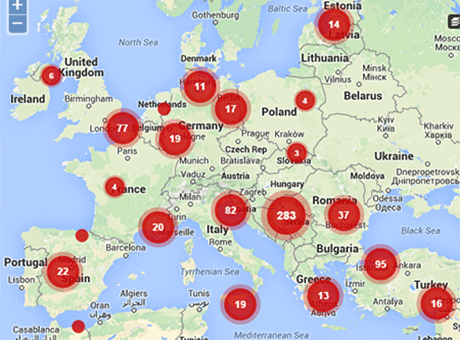
Journalists and media workers are confronting relentless pressure as they do their jobs, a survey of the first six months of incidents reported to Index on Censorship’s Mapping Media Freedom project has found.

In the six months since the mapping project was launched, over 500 reports — including 61 violent attacks on journalists — from across Europe have been verified and published. Reports have come in from as far afield as Finland and Malta, Ireland and Turkey.

Over 150 reports have been mapped to the states of the former Yugoslavia and Italy. However, as the map shows, violations of media freedom and violent incidents against journalists are being committed across Europe, with physical violence and online harassment becoming growing problems.

The map, which was funded by the European Commission, launched on 24 May 2014 in partnership with Osservatorio Balcani e Caucaso and allows anyone — from members of the public to journalist unions — to submit reports for verification by Index’s European Union correspondents.

“Since we launched the platform, we have recorded a number of abuses against media professionals ranging from intimidation and preventing access to information, to murder. What struck me when speaking to some journalists is that too many considered receiving threats as a ‘part of the job’. It shouldn’t be. This map is an essential tool to improve the capacity of journalists, media organisations and others to confront those threats,” Index Senior Advocacy Officer Melody Patry said.

map-121014


NEWMediafreedom

This is the reality of being a journalist in Europe in 2014

Selected incidents reported to mediafreedom.ushahidi.com

jail web size Turkey: Journalist Erol Ozkoray was sentenced to 11 months and 20 days in prison for defaming President Recep Tayyip Erdogan by referring to anti-Erdogan slogans and graffiti in his book about the 2013 Gezi Park protests silenced web size Germany: Blogger Su Yutong was fired by Deutsche Welle’s Chinese service after tweeting about employee meetings, where staff were told to use restraint in their coverage of China
fist web size Hungary: Three journalists were chased with a hydraulic shovel by an employee of a rubbish dump after they tried to verify information regarding a possible leak from the EU-funded dump gavel web size France: Far-right party Front National sued and called for the resignation of journalist Guy Lagache after his TV show aired an undercover documentary about one of their municipal campaigns
bullet Albania: A masked attacker tried to shoot Artur Cani, an investigative journalist for TV News 24, near his home in Tirana fist web size Kosovo: Milot Hasimja, a journalist with the Pristina-based TV Klan, was knifed at his desk by a man apparently unhappy with a feature Hasimja did on him
fist web size Netherlands: Freelance photographer John van Ieperen was beaten by a security guard when covering the aftermath of an explosion in an apartment building that killed two residents screen web size United Kingdom: Blogger Michael Abberton who broadcast “fact checks” about the UK Independence Party said he was advised to delete a tweet about the party’s policies after being visited at home by two police officers
threat web size Serbia: Dusan Dragisic, a local businessman, threatened to cut off the nose and ears of Nenad Tomic, owner and editor-in-chief of the website Ruma fist web size Bosnia: Professor Slavo Kukic, a prominent writer and columnist, was severely beaten with a baseball bat in his office at the University of Mostar
fist web size Italy: Pino Maniaci, head of Sicilian TV station Telejato who is known for reporting on the Sicilian mafia, found his pet dogs hanged from a metal post in a yard near his office flame web size Bulgaria: The company car of bTV political journalist Genka Shikerova was set on fire outside her home in Sofia


Categorisation of violations

There are 51 different labels used to organise the incidents reported to mediafreedom.ushahidi.com

Legal measures

legal-measures
Incidents that involved the threat of or filing of legal actions

Censorship

cases-censorship
Incidents that included partial or complete censorship

Government threat

threat-government
Incidents that originated from a government representative or agency


Co-Funded by
logo_EC

Padraig Reidy: The Soviet Union may be dead, but Soviet disinformation tactics remain

pr-rt-2

(Photo: Padraig Reidy)

There’s a poster near my house in London. It shows a poorly illustrated George W. Bush, aboard the USS Abraham Lincoln early in the Iraq war, with the now infamous “Mission Accomplished” banner behind him. To his side, the tally of dead in the Iraq War (at least according to Iraq Body Count). Underneath is emblazoned the slogan: “This is what happens when there is no second opinion.” It is an advert for Russian propaganda channel RT (formerly Russia Today).

It’s a slightly muddled poster, but the signal is clear: did you feel lied to about the Iraq war? Watch RT.

Curiously, RT, which launched a UK channel on 30 October, seems to believe the poster doesn’t exist. A “report” on the RT website, dated 9 October, claims that the campaign of which this poster is part was “rejected for outdoor displays in London because of their ‘political overtones’”. The story goes on to claim that the “rejected” posters were replaced by ones that simply say “redacted”, before urging readers to download an RT app to view the ads on their phones.

But I have seen the poster. I even took a picture. Yet RT insists it has been banned, saying that outdoor advertising companies cited the Communications Act 2003, which “prohibits political advertising”. This prohibition is indeed to be found in the act, but only applies to broadcast advertisements, not billboard advertisements for broadcasters.

This is a fairly crude illustration of RT’s attitude to the truth. It is simply not an issue. What’s important is something that might sound true, something just about plausible, to suit the agenda (in this case, the agenda is threefold: one, to get people to download the app; two, to sow the belief that “they” are scared of RT; and three, to introduce the notion that political advertising is subject to a blanket ban in the UK).

Fair enough, you might say. But have you seen Fox News? Don’t all sorts of news organisations bend the truth to fit their agenda? There’s a case to be made, but there’s also a crucial difference. RT is funded and controlled by the Kremlin and is on a mission; a mission outlined in a new report by The Interpreter, part of the Institute of Modern Russia (disclosure: Index on Censorship has on occassion crossposted content from The Interpreter).

“The Menace of Unreality: How the Kremlin Weaponizes Information, Culture and Money” elucidates what we had already long suspected: the Soviet Union may be dead, but Soviet tactics remain. And while the west may not want to believe it is in conflict with Russia, the Russians are already acting like it is (witness reports of heightened Russian air force activity in and near Nato airspace).

The report’s authors, Michael Weiss and Peter Pomerantsev, describe disinformation techniques dating back to the Soviet era: straight propaganda, certainly, but also Dezinformatsiya — the planting of false stories to undermine confidence in western governments. These include alleged coup plots, the bizarre theory that AIDS was created by the CIA, even the suggestion that the assassination of Kennedy was an inside job.

The suggestion is that democracy is a sham, and that democratic governments are at best hypocrites and at worst constantly, deliberately acting against the interests of their own populations.

The best false stories always have a ring of truth and a ring of empathy. Many politicians are hypocrites, some politicians act against the interests of those they should represent. If this much is true, is it that much of a leap to imagine that the entire system is a crock? That democracy and human rights are empty terms? We’re just asking legitimate questions, as every conspiracy theorist ever has said at some point.

Conspiracy theorists find a home at RT. Presenter Abby Martin, for example, who briefly won praise for apparently criticising Russia’s actions in Ukraine, says she still has “many questions” (just asking questions!) about the September 2001 attacks on the World Trade Center, and has used her show to expound on “false flag” attacksalleged Israeli eugenics, and every US conspiracy theorists’ favourite, the massacre in Waco, Texas of David Koresh’s Branch Davidian cult in 1993.

All this would mean nothing if RT didn’t have a willing audience in the UK, the US and beyond. But a combination of a large budget, photogenic presenters and a certain way with a YouTube clip makes RT a serious player. It never quite veers into the straight out lunacy of Iran’s Press TV, which is quite open about its conspiracist contributors, and it looks like a serious operation. Furthermore, its positioning as an “alternative news source”, albeit one controlled by an increasingly authoritarian, paranoid and erratic Russian state, finds it fans among people who would rail against their own liberal states and societies (on the two occasions I visited the Occupy St Paul’s encampment in London, Russia Today was playing on a large screen there). All the while, the autocratic Putin is strengthened as democracy in undermined worldwide (witness how easily Putin was able to put the kibosh on effective intervention against Syria’s Assad through the relentless repetition of the line that helping the opposition would mean helping jihadist terrorists).

So what, as Lenin himself once asked, is to be done? After reports of UK broadcast regulator Ofcom’s recent investigations into RT for bias earlier this week, some people saw a chance to get RT taken off the air just weeks after it had begun. But this impulse is too close to political censorship in principle, and in practice, an ineffective sanction against a force that has huge power online, with millions upon millions of YouTube hits.

Decent democrats that they are, Weiss and Pomerantsev suggest eternal vigilance is required: we must be able to combat RT’s half truths and insinuations effectively, with hard facts and hard arguments, in order to stop them spreading. As ever, when arguments for counterspeech as the best defence against poison is suggested, one remembers Yeats’s lines: “The best lack all conviction, while the worst/Are full of passionate intensity.”

But this time 25 years ago, as East and West Germans embraced on top of the Berlin Wall, the world showed that the right argument can win even against the very worst. The Kremlin is playing the same games now as it did in its darkest days. Democrats should be ready to fight back.

This article was posted on 13 November 2014 at indexoncensorship.org

Erdogan cartoons: how artists responded to case against a Turkish colleague

When Turkish political cartoonist Musa Kart faced nine years in prison for “insulting” President Recep Tayyip Erdogan, his colleagues from across the world fought back in the best way they know how — by drawing their own #erdogancaricature.

Image: Martin Rowson

By: Martin Rowson

The online campaign was started on Thursday by Martin Rowson, cartoonist for The Guardian, The Independent and Index on Censorship among others, as Kart was scheduled to appear in court.

Erdogan himself filed the complaint against Kart over a cartoon published in the daily Cumhuriyet on 1 February 2014 showing the then prime minister as a hologram watching over a robbery. This was a reference to his alleged involvement covering up a high-profile graft scandal.

Erdogan claimed Kart was guilty of “insulting through publication and slander,” reports Today Zaman. And while the court initially ruled that there were no legal grounds for action, this decision was revoked following complaints from Erdogan’s lawyer. Kart was also fined in 2005 for drawing Erdogan as a cat.

In court on Thursday, Kart stated: “Yes, I drew it [the cartoon] but I did not mean to insult. I just wanted to show the facts. Indeed, I think that we are inside a cartoon right now. Because I am in the suspect’s seat while charges were dropped against all the suspects [involved in two major graft scandals]. I need to say that this is funny.”

He was finally acquitted, but many of his fellow cartoonists has already shared their artistic interpretations of Erdogan and the case.

Image: Morten Morland

By: Morten Morland

(Image: Ben Jennings)

By: Ben Jennings

“I was alerted to Musa Kart’s plight by the excellent Cartoonists’ Rights Network International (CRNI) and previously, when an Iranian cartoonist was sentenced to 40 lashes, a bunch of us got together to draw the offended politician who’d had him arrested, the sentence was commuted,” Martin Rowson told Index via email.

(Image: Steve Bright)

By: Steve Bright

(Image: Kanika Mishra)

By: Kanika Mishra

“It seems this kind of international bullying by cartoon does have an effect, as even the chippiest despot out there can usually detect a batsqueak of the shamefulness of not being able to take a joke. In Musa Kart’s case, the threat of up to nine years in prison was such an outrageous abuse of power I didn’t wait for anyone else to organise this and simply put out a call via Twitter for cartoons of Erdogan to show solidarity. No idea if it had any effect on the court (I doubt it) though it may put Erdogan off the idea of taking the case to a higher court. I hope so. And I hope it gave Musa Kart a feeling that he wasn’t on his own in there. Basically, this is cartoonists playing the Spartacus card, because if one of us, anywhere, is persecuted for laughing at power, we all are,” said Rowson.

(Image: Harry Burton)

By: Harry Burton

(By: Brian Adcock)

By: Brian Adcock

“Cartoonists are often the last bastion of free speech in repressive regimes and equally valued for telling the truth as it is, in democratic societies too; some consider their work to be of just as much value, if not more, as journalists, and many respected for the courage and ability to often say and report what others cannot, or fear to do, alongside the just as valued use of satire to reveal a truth which otherwise might not see the light of day,” Patricia Bargh from CRNI explained to Index in an email.

By: Mike Roberts

By: Mike Roberts

(Image: Tjeerd Royaards)

By: Tjeerd Royaards

“Thus as societies we should value and protect their right to do what they do, and if they know there is an organisation out there who will take up their case, should they be targeted, we hope that gives them the confidence to continue to on and assists them in their valuable work too,” Bargh added.

This article was originally posted on 20 October at indexoncensorship.org

SUPPORT INDEX'S WORK