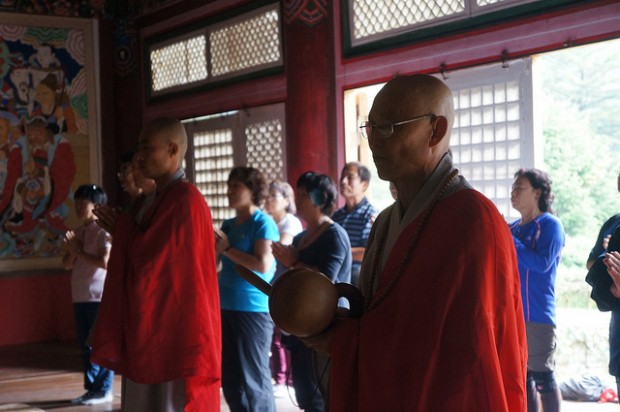
Pohyon Temple in the Myohyang mountains, once a national center for Korean Buddhism. Credit: Uri Tours / Flickr
After the United States Commission on International Religious Freedom, an independent organisation created by the US Congress to evaluate religious freedom conditions around the world, released its 2015 report, it became clear that an insufficient amount of progress had been made since Index on Censorship last reported on the issue.
Here’s a roundup of some the most appalling religious freedom violations from across the globe.
Burma
Bigotry and intolerance continue to scorch the lives of religious and ethnic minorities in Burma, particularly Rohingya Muslims. The Burmese government demonstrated little effort toward intervening or properly investigating claims of abuse, including those carried out by religious figures in the Buddhist community. As internet availability spread throughout the country, social media played a role in promoting a platform of hate and proposed violence against minority populations. Rohingya Muslims in the country face a unique level of discrimination and persecution. The government denies them citizenship and the right to identify as Rohingya. Additionally, four discriminatory race and religion bills could further the prejudices affecting religious minorities.
North Korea
North Korea is a nation where genuine freedom of religion or belief is non-existent; it remains one of the most oppressive regimes and worst violators of human rights. Punishment comes to those who pose difficult questions while the government maintains its control through a constant threat of imprisonment, torture and even death for those who break the law regarding religion. Estimates suggest up to 200,000 North Koreans are currently suffering in labor camps, tens of thousands of whom are there for practicing heir faith. In February 2014, the Commission of Inquiry on Human Rights in the Democratic People’s Republic of Korea released its report documenting the systematic, severe violations of human rights in the country. It found “an almost complete denial of the right to freedom of thought, conscience”.
Saudi Arabia
Officially an Islamic state with eight to ten million expatriate workers of different faiths, Saudi Arabia continues to restrict most forms of public religious expression inconsistent with its interpretation of Sunni Islam. The government continues to use criminal charges of blasphemy to suppress any dialogue between dissenting viewpoints, with a new law helping drive home the goal of silence. The Penal Law for Crimes of Terrorism and its Financing criminalises virtually all forms of peaceful dissent and free expression, including criticising the government’s view of Islam. Lastly, authorities continue to discriminate grossly against dissident clerics and members of the Shia community.
Sudan
The Sudanese government continues to engage in massive violations of freedom of religion, due to president Omar al-Bashir’s policies of Islamisation and restrictive interpretation of sharia law. Despite 97% of the population being Muslim, there is a wide range of other religions practiced. The country’s turmoil from religious persecution rests on the 1991 Criminal Code, the 1991 Personal Status Law of Muslims, and state-level “public order” laws, which have restricted freedom for all Sudanese. The laws – which contradict the country’s constitutional and international commitments to human rights and freedom of religion – allow death sentences for apostasy, stoning for adultery, cross-amputations for theft, prison sentences for blasphemy and floggings for undefined “offences of honor, reputation and public morality”. Since 2011, more than 170 people have been arrested and charged with apostasy.
Article continues below
[/vc_column_text][/vc_column][/vc_row][vc_row][vc_column][vc_custom_heading text=”Join the Index mailing list and get an exclusive gift” font_container=”tag:p|font_size:28|text_align:left” use_theme_fonts=”yes”][vc_separator color=”black”][/vc_column][/vc_row][vc_row][vc_column width=”1/2″][vc_column_text]
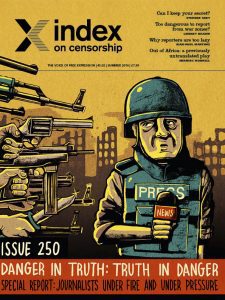
Index on Censorship’s summer magazine 2016
We’ll send you our weekly emails and periodic updates on our events. We won’t share your personal information with anyone outside Index.
You’ll also get access to an exclusive collection of articles from our landmark 250th issue of Index on Censorship magazine exploring journalists under fire and under pressure. Your downloadable PDF will include reports from Lindsey Hilsum, Laura Silvia Battaglia and Hazza Al-Adnan.[/vc_column_text][/vc_column][vc_column width=”1/2″][gravityform id=”20″ title=”false” description=”false” ajax=”false”][/vc_column][/vc_row][vc_row][vc_column][vc_separator color=”black”][/vc_column][/vc_row][vc_row][vc_column][vc_column_text]Uzbekistan
In Uzbekistan, the government imprisons individuals for not conforming to officially prescribed practices or whom it claims are extremist, including as many as 12,000 Muslims. A highly restrictive religion law is imposed, the 1998 Law on Freedom of Consciences and Religious Organisations, which severely limits the rights of all religious groups and facilitates Uzbek government control over religious activity. Many who don’t fit into the framework of officially approved practices are regularly repressed. Additionally, the government has continued a campaign against independent Muslims, targeting those linked to the May 2005 protests in Andijan; 231 are still imprisoned in connection to the events, and ten have died. All the while, Uzbekistan has pressured countries to return Uzbek refugees who fled during the Andijan tragedy.
Turkmenistan
In an environment of nearly inescapable government information control, severe religion freedom breaches persist in Turkmenistan. Continuing police raids and harassment of registered and unregistered religious groups matched with laws and policies that violate international human rights norms has the nation as one of the year’s biggest offenders. With an estimated total population of 5.1 million, the US government projects that the country is 85% Sunni Muslim, 9% Russian Orthodox, and a 2% total that includes Jehovah’s Witnesses, Jews, and evangelical Christians. Despite Turkmenistan’s constitutionally guaranteed religious freedom and separation of religion from the state, the 2003 religion law negates these provisions while setting intrusive registration criteria for individuals. It also requires that the government is informed of all foreign financial support, forbids worship in private homes and places discriminatory restrictions on religious education.
China
While the Chinese constitution guarantees freedom of religion, this idea really only applies to “normal religions”, better known as the five state-sanctioned “patriotic religious associations” associated with Buddhism, Taoism, Islam, Catholicism and Protestantism. Even still, the government monitors religious activities unfairly, and there has been an increased religious persecution of Uighur Muslims in the name of fighting terrorism. All around repression in China worsened in 2014, including the governmental push for controlling Tibet, Xinjiang, and even Hong Kong, as well as controls on the internet, social media, human rights defenders, activists and journalists.
Eritrea
Ongoing religious freedom abuses have continued in Eritrea, including torture or ill-treatment of religious prisoners, random arrests without charges and banning’s on public religious activities. The situation is especially serious for Evangelical and Pentecostal Christians and Jehovah’s Witnesses, and the government suppresses Muslim religious activities and those opposed to the government-appointed head of the community. In 2002, the government increased its control over religion by imposing a registration requirement on all religious groups other than the Coptic Orthodox Church of Eritrea, Sunni Islam, the Roman Catholic Church and the Evangelical Church of Eritrea. The requirements mandated that the non-preferred religious communities provide detailed information about their finances, membership, activities, and benefit to the country. Additionally, released religious prisoners have reported to USCIRF that they were confined in crowded conditions, and subjected to extreme temperature fluctuations. The government continued to arrest and detain followers of unregistered religious communities. Recent estimates suggest 1,200 to 3,000 people are imprisoned on religious grounds in Eritrea, the majority of whom are Evangelical or Pentecostal Christians.
Iran
Poor religious freedom in Iran continued to worsen in 2014, particularly for minority groups like Bahá’ís, Christian converts, and Sunni Muslims. The government is still engaging in systematic violations, including prolonged detention, torture, and executions based on the religion of the accused. Despite Christians, Jews, and Zoroastrians being recognised as protected minorities, the government has consistently discriminated against its citizens on the basis of religion. Killings, arrests, and physical abuse of detainees have increased in recent years, including for religious minorities and Muslims who are perceived as threatening the government’s legitimacy.[/vc_column_text][/vc_column][/vc_row][vc_row][vc_column][vc_basic_grid post_type=”post” max_items=”12″ style=”load-more” items_per_page=”4″ element_width=”6″ grid_id=”vc_gid:1493906845781-a7b9ac80-f77d-2″ taxonomies=”1742″][/vc_column][/vc_row]
Wikipedia founder Jimmy Wales read anonymous collective GreatFire’s acceptance speech.
We are honoured to have been chosen as the winner of Index’s 2016 digital activism award. We’d like to take this opportunity to highlight the incredible and important work being done by the other digital activism nominees who are as, if not more, deserving of this award.
We would not be in this position if it were not for the support of others.
Thank you to those who have provided us with the means to dedicate ourselves to GreatFire. Thank you also to the many individuals within China who have made personal donations. Sadly, many news organisations have their content blocked and censored in China, but we thank those organisations that have chosen to work with us to deliver uncensored information across the great firewall.
A big thank you to our developers, past and present, who have contributed to all of our projects. Without you, none of this would be possible.
And finally, thanks to all Chinese who have supported our efforts from the start. Millions of people have visited our websites, shared our content and downloaded our apps. This incredible support not only gives us the energy to continue our work, it also highlights the great demand that exists in China for unmitigated access to an uncensored internet.
Since the early days of the internet, technology has been used to censor online speech — and to circumvent this censorship.
The Communist Party of China built the Great Firewall, which one-by-one has closed down access to YouTube, Twitter, Facebook, Google, most Chinese-language news sources hosted outside China and, most recently, Wikipedia. In response, VPN services, proxies and other circumvention tools were developed.
On domestic social media websites like Sina Weibo (pronounced “way-bow”), sophisticated keyword and message filtering has been developed by the censors. In response, clever users made use of homophones and images to bypass the filters.
Because there is always a workaround, it may seem as if online censorship is failing. Such an optimistic conclusion, however, would be based on a misunderstanding of the intent of the censors. Their goal is not to completely deny access to certain topics, but rather to prevent these topics from reaching the mainstream. Unfortunately, in this mission they have been successful.
VPNs are only an option for people with knowledge and the means to pay. Free circumvention tools are usually difficult to find, complicated to use or unstable. Homophones on domestic social media are only understood by those who already know the story background.
We believe that to make a real impact we have to reach beyond these users and offer a compelling, uncensored, mainstream service. With these goals in mind, we created FreeBrowser, a free Android browser app with built-in circumvention. On the default start page of the app, we promote uncensored news from a wide range of sources.
To reach more users, we all need your support. Feel free to visit our websites, including freebrowser.org, or reach out to us directly via email or social media. We believe that our impact as well as the impact of all projects combating censorship should be measured by the degree to which we bring censored topics back into the mainstream. Freedom of speech was declared a human right 67 years ago. To make it a reality requires us to raise our ambitions, to collaborate and to demand change. Thank you!
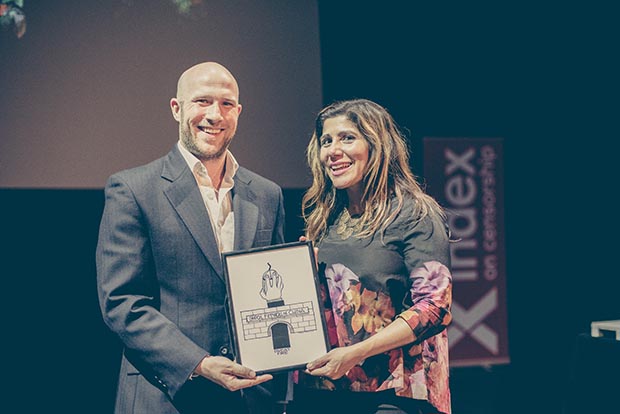
Google’s Anthony House and tech entrepreneur Bindi Karia presented the 2016 Freedom of Expression Digital Activism Award to anonymous tech collective GreatFire (Photo: Elina Kansikas for Index on Censorship)
One of China’s leading human rights lawyers and free speech campaigners, Pu Zhiqiang is known particularly for his way with words. “Whether in court or online, he is adept at mixing classical erudition and street vernacular,” said Chinese scholar and a friend of Pu’s Perry Link. “Twitter was made for him, but Twitter is banned in China.”
Since May 2014 Pu’s voice has been silenced, after he was arrested and charged for a series of blog posts. His trial drew huge international attention with many observers calling it a litmus test for freedom of speech in China. He was released in December 2015 to house arrest, and has made no public comment since.
Index asked three of Pu’s friends to tell his story for him.
“He was born on 11 January 1965 in Luanxian, near Tangshan, Hebei Province,” said Tong Yi, who has been a friend of Pu’s since meeting him in 1988. “His father was categorized as ‘landlord’. Therefore, when he grew up in his village, he was discriminated against because of his father. He experienced the devastating earthquake in Tangshan in July 1976.”
“Despite all the hardship he faced in those years, he grew up with an imposing physical build, as well as a standout student with a keen intellect and a photographic memory.”
As a student Pu became involved in the Tiananmen Students’ Movement. He was at Tiananmen Square in 1989, and witnessed the massacre of many of his friends and fellow campaigners. That was a turning point for him, says Link.
“He felt especially bad about the ordinary workers who protested and then died. They were not famous like some of the students and intellectuals, but were called ‘riffraff’ by the government, then slaughtered and forgotten. That experience has haunted Pu and, I believe, has been the anchor for his devotion to human rights law.”
This devotion saw him become a leading human rights lawyer in China, taking on controversial campaigns that earned him a “Robin Hood” reputation.
“Over the past decade, Pu has defended right to freedom of expression in a number of well-known cases,” Professor Hu Yong, China’s leading academic authority on the history of the Internet in China told Index.
His defendants include earthquake activist and writer Tan Zuoren, dissident writer Wang Tiancheng, fellow human rights lawyer Zheng Enchong, Tibetan environmentalist Karma Samdrop, banned writers such Chen Guidi, Chun Tao and Zhang Yihe, and artist Ai Weiwei.
“He also rescued a dozen of villagers facing harsh criminal charge for disclosing local corruption and criticizing officials, and defended a number of outspoken whistleblowing journalists and liberal media outlets against defamation charges,” said Hu Yong.
This work obviously earned him a place on China’s closely-watched list, but Pu knew the law so well he’d always managed to stay on the right side of it, said Link. That was until last year, when he was arrested after attending a small meeting about Tiananmen Square. Pu was later charged with “creating disturbances” and “inciting ethnic hatred” via seven comments posted on the microblogging platform Weibo between July 2011 and May 2014. The posts criticized the central government’s policies in Xinjiang and Tibet that repress minorities’ religious and ethnic identities.
Pu was detained for 19 months, with many prepared for his trial to result in an 8-year-sentence. On 22 December 2015 Pu was finally released, with an unexpected 3-year suspended sentence.
Xinhua, China’s official news agency, claimed Pu had been given “a light punishment…as he confessed his crime honestly, pleaded guilty and repented his guilt.”
“The government’s goal in persecuting Pu was to to quell freedom of speech on the internet,” said Link. “It was as if the government was saying, ‘Look, if we can take free speech away from the country’s leading advocate of free speech, then what can’t we do? EVERYBODY TAKE NOTE.’ It has worked, to some extent. But the story is not over.”
Hu Yong agrees that Pu’s arrest and sentence, even though less harsh than expected, marks a huge step backwards for freedom of speech in China. “Many people saw Pu’s case as a touchstone that would demonstrate whether the rule of law in China has been moving backward or progressing,” Hu Yong wrote for ChinaFile.
“In terms of levels of the government other than the judiciary, some thought that if Pu were to be convicted, it would serve as a weathervane indicating that China is returning to a ‘second Cultural Revolution.’ In fact, there is no need for a touchstone, and the weathervane has long been pointing in the same direction.”
As for Pu’s own future, Hu Yong believes he could lose his right to practice law. Whether his voice as the Robin Hood of China is lost forever is also still to be decided.
“What happens to Pu will depend mostly on how he decides to play his cards from now on,” said Link. “ If he accepts the government’s muzzle, the authorities will leave him alone. If he chooses to speak out again, they will try to re-imprison him or punish him in other ways.”
[vc_row][vc_column][vc_column_text]This is an extract from an article in the Winter 2015 issue of Index on Censorship magazine. You can read the article in full here.
The streets of Dongguan in southern China have been quiet of late. In the past, China’s city of sin would hum to the sound of late-night karaoke bars offering more than just an innocent sing-along. Now these establishments have been forced underground or driven out of business entirely. Their chances of a future are not looking good. On 1 January 2016, new regulations will come into effect that dictate appropriate behaviour for the Communist Party’s 88 million members. As part of President Xi Jinping’s anti-corruption campaign, the new rules explicitly ban the trading of power for sex, money for sex, and adultery – but these are the foundations of business in Dongguan.
“In Dongguan, whose reputation, if not economy, practically rests on its skin trade, I’m told by several sources that the trade remains mostly out of sight nearly two years after a television report [led to]a sweeping crackdown,” said Robert Foyle Hunwick, a writer who has visited the city many times to research his forthcoming book The Pleasure Garden: China’s Hidden World of Sex, Drugs and the Super-Rich.
Dongguan is not the only city suffering from this campaign against smut – it has been lights out for many brothels across China. Nor is this crackdown limited to China’s Communist party members, as the January 2016 regulations imply. Instead, it forms part of a broader crackdown on China’s sex industry that has been underway since Xi Jinping came to power in 2012.
Enemy number one is internet pornography. In the most recent statistics, from 2014, China accounts for up to 28% of the world’s porn consumption, taking the global lead. It’s a statistic that does not sit well with Xi. Shortly into his term in power, he launched his first anti-pornography crusade, calling for a “benign internet environment”. An attempt was made to clear China’s internet of anything verging on pornography. A similar initiative was launched this summer, following the release of a video featuring a couple having sex in a Uniqlo store. It was the usual drill: sites were blocked or removed and anyone caught facilitating the production or distribution of pornography was arrested.



 [/vc_column_text][/vc_column][/vc_row]