Each week, Index on Censorship’s Mapping Media Freedom project verifies threats, violations and limitations faced by the media throughout the European Union and neighbouring countries. Here are recent reports that give us cause for concern.
Nikolay Andruschenko, an investigative correspondent for weekly newspaper Novyi Petersburg died on 19 April after being subjected to two brutal assaults in March, Open Russia reported. Alevtina Ageyeva, the director of Novyi Peterburg, told Mapping Media Freedom that on 9 March, two unknown individuals approached him near his house and demanded that he hand over documents and materials relating to an ongoing investigation into abuse of power by police officers.
When Andruschenko refused to cooperate, they hit him several times in the head and ran away. The journalist refused to file a complaint to the police.
The second assault took place a few days later. According to Ageyeva, she was called by the Mariinskaya hospital and told that Nikolay Andruschenko was in a critical state and being treated in the intensive care unit. He was found unconscious with a brain injury near his apartment.
Despite undergoing surgery he never recovered.
Although the local police have opened an investigation, Ageyeva doubts it will be conducted properly because of Andruschenko’s history of investigating cases of police corruption.
She is convinced that both assaults are related to Andruschenkov’s work as an investigative reporter.
Two reporters for Buzzfeed News, David Perrotin and Paul Aveline, were physically prevented filming a meeting with French presidential candidate Francois Fillon on 17 April. The journalists were filming two people who had interrupted Fillon’s meeting by shouting “Give the money back!” and were detained by the police when members of the candidate’s security staff physically prevented them from filming. Guards first grabbed David Perrotin, pulling him by the collar, physically threatened him and demanded that he delete his video. A fuard then grabbed Aveline’s phone to prevent him from filming the scene. At this point, according to Buzzfeed, a member of Fillon team said: “Throw them out.” It was only when the two journalists said they would write an article on the incidents that the members of the security team stopped threatening them.
During the same meeting, journalist Hortense Gerard, who works for BFMTV, was spat on. She later tweeteda photo of her sleeve covered in spit.
Independent newspaper Novaya Gazeta has received “direct threats addressed to its journalists” following publications on harassment of gay people in Chechnya according to a statementthey released.
It says: “On 1 April 2017, Novaya Gazeta wrote on mass detainment and torture of Chechen residents who were suspected of being homosexual. We know the names of three persons murdered and we know that the number of those who were killed is much higher.(…)”
The backlash in Chechnya has left the entire staff of the newspaper fearful, the Guardian reported.
According to official data, on 3 April around 15,000 people attended an urgent meeting of representatives from the republic’s Muslim communities in the central mosque in Grozny, the capital of Chechnya.
During the meeting, Adam Shakhidov, an adviser to the head of the Chechen Republic, Ramzan Kadyrov, publicly accused the editorial staff of Novaya Gazeta of defamation and called them “enemies of our religion and our motherland”. This was broadcast live by a local TV channel and led to aggressive comments on social media.
After the meeting, a resolution was accepted. The second paragraph states the following: “The centuries-old traditions of Chechen society, the dignity of Chechen men, and our faith have all been insulted, and we promise that those behind it will face reprisals, whoever they are and wherever they are.”
Novaya Gazeta has called on the Russian authorities to prevent the hate speech directed at journalists for doing their jobs. When Novaya Gazeta’s statement was published online, its website crashed and staff are convinced this was due to a DDoS attack.
The backlash was sparked by an 1 April story from reporter Elena Milashina and her colleague Irina Gordienko. In March, Milashina had discovered evidence that gay men were being detained, tortured and even killed in an anti-homosexual purge in Chechnya.
Milashina spoketo The Washington Post on Friday 14 April from an undisclosed location and said she was thinking of leaving the country because of safety concerns.
Unidentified assailants shot at journalists from investigative program Slidstvo.Info on 14 April. The journalists were filming the estate of oligarch Rinat Akhmetov around Kyiv, the Institute of Mass Information reported.
“Our reporters Maxim Opanasenko and Kirill Shapar were filming a new estate near Kyiv which belongs to Rinat Akhmetov,” Slidstvo.Info reported.
Unidentified individuals shot a meter and a half above the car where Slidstvo.Info journalists were seated, Maxim Opanasenko told IMI. “I didn’t see the gunman. We suspect this was intended to scare us because they saw our drone,” the journalist said.
He added that the journalists are planning to investigate who the shooters were. No journalists were injured according to the IMI report.
Journalist and publisher Kostas Vaxevanis was arrested following a libel lawsuit against him filed by Lina Nikolopoulou, who is married to Bank of Greece Governor Yiannis Stournaras, Naftemporiki newspaper reported.
On 9 April Vaxevanis published an article in the weekly newspaper Documento about Nikolopoulou, who he claimed had received up to €400,000 of state money for medical and pharmaceutical lobbying and conference work and Stournaras presence in these conferences as a lecturer.
Vaxevanis alleges that contracts for these services were awarded to Nikolopoulou without being offered for public tender.
“The Stournaras family is not struggling in a legal battle, as it pretends. Mr and Mrs Stournaras struggle for their survival. They are trying to cover the way they act and operate,” Vaxevanis wrote in a statement asking for support.
The party leading the Greek government, Syriza, issued a statement stressing that the lawsuit “directly challenges journalism and press freedom” and adding that “the report raises some critical questions about the public health area, which require serious and documented answers”.
Vaxevanis was released later the same day. [/vc_column_text][/vc_column][/vc_row][vc_row][vc_column][vc_column_text]
Click on the bubbles to view reports or double-click to zoom in on specific regions. The full site can be accessed at https://mappingmediafreedom.org/[/vc_column_text][/vc_column][/vc_row][vc_row][vc_column][vc_basic_grid post_type=”post” max_items=”4″ element_width=”6″ grid_id=”vc_gid:1493112590515-3ca2c0ad-ff59-8″ taxonomies=”6564″][/vc_column][/vc_row]
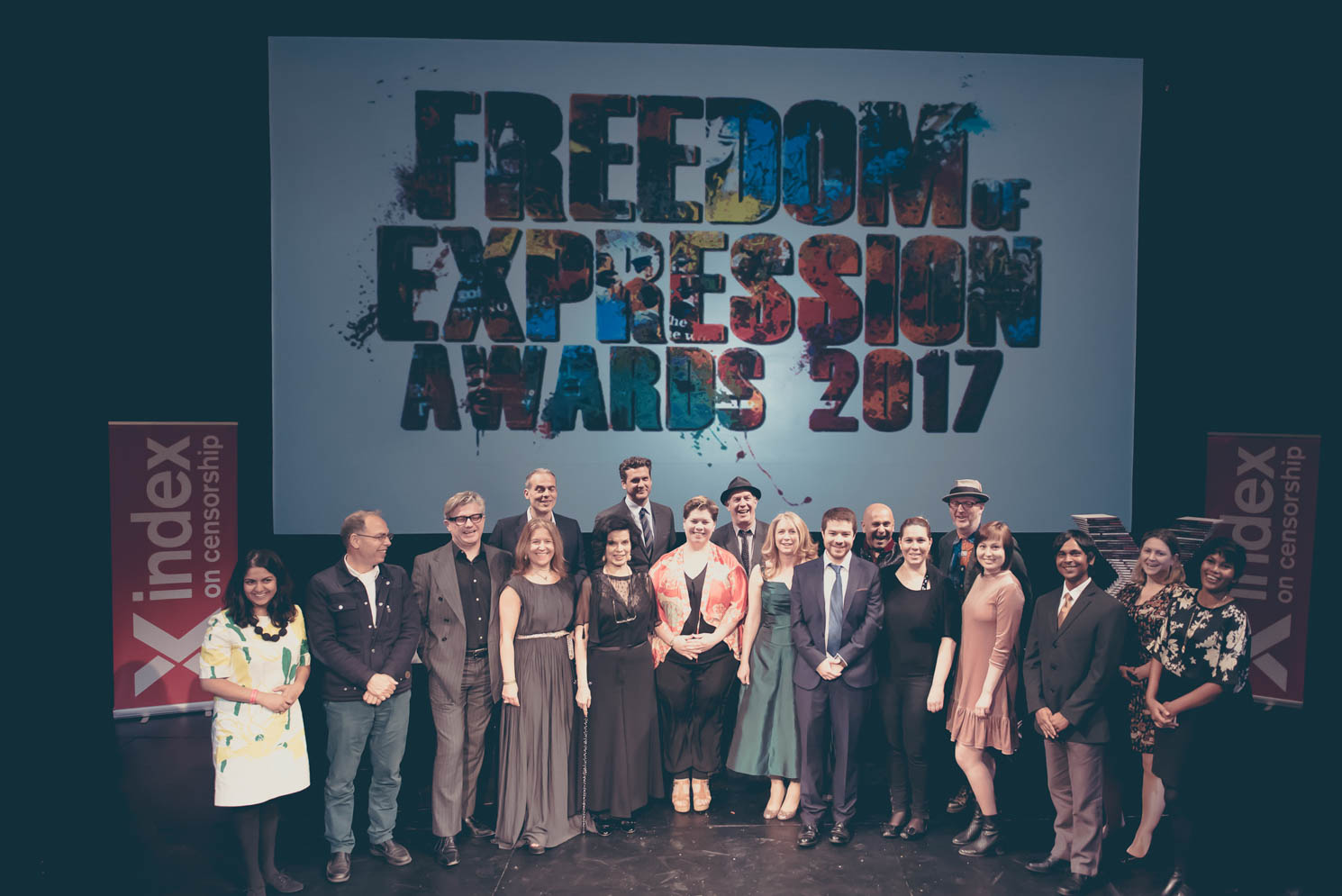
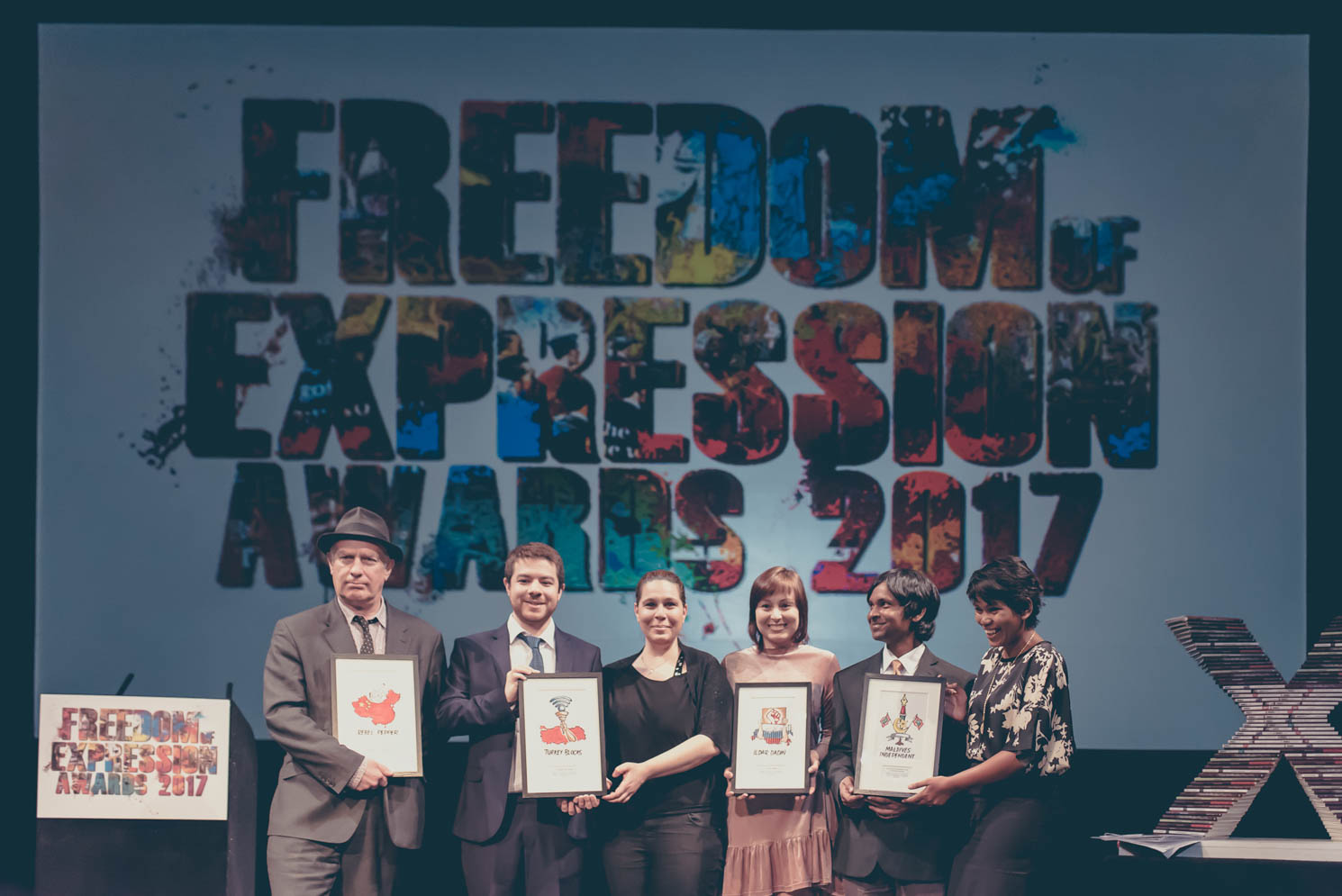
From left: Co-founder Superflux and Freedom of Expression Awards Judge Anab Jain, finalist Maati Monjib, music executive and Freedom of Expression Awards Judge Stephen Budd, tech expert Nicole Yershon, global publishing director Ziyad Marar, president and founder of the Bianca Jagger Human Rights Foundation Bianca Jagger, CNN London Bureau chief Tommy Evans, comedian and actor Katy Brand, cartoonist Martin Rowson, Index CEO Jodie Ginsberg, Turkey Blocks’ Alp Toker, Poet Shane Solanki, Turkey Blocks’ Isik Mater, artist Bob and Roberta Smith, wife and campaigning partner of Ildar Dadin Anastasia Zotova, Maldives Independent’s Ahmed Naish, Freedom of Expression Awards Judge and Barrister Caoilfhionn Gallagher QC, Maldives Independent’s Zaheena Rasheed (Photo: Elina Kansikas for Index on Censorship) High resolution images are available for download on Flickr
A Chinese political cartoonist forced into exile and a Russian prisoners and LGBT rights activist convicted under the country’s draconian anti-protest law were among the winners of the 2017 Index on Censorship Freedom of Expression Awards.
The winners, announced on Wednesday evening at a gala ceremony in London, also included a crusading news organisation battling corruption in the Maldives and a group tracking Turkey’s internet shutdowns.
Awards were presented in four categories: Arts, Campaigning, Digital Activism and Journalism.
“These winners are free speech heroes who deserve global recognition,” said Index on Censorship CEO Jodie Ginsberg. “They, like all of those nominated, face huge personal and political hurdles in their fight so that others can express themselves freely.”
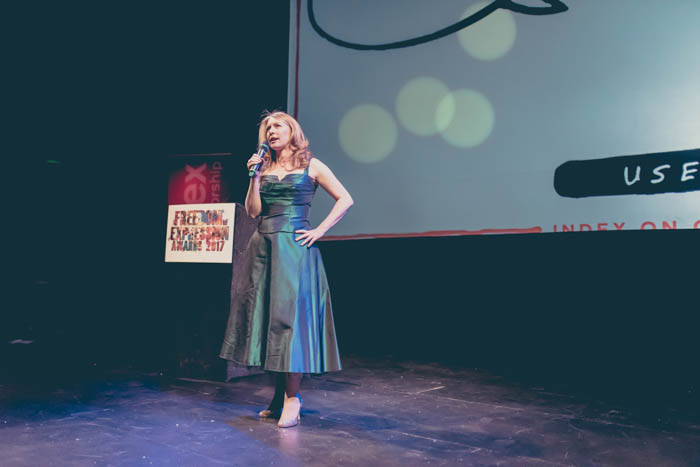
Drawn more than 400 public nominations, the winners were presented with their awards at a ceremony at the Unicorn Theatre, London, hosted by comedian Katy Brand.
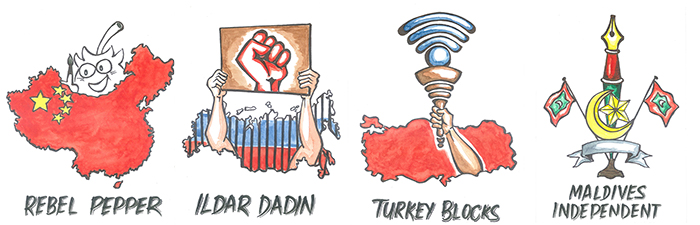
Winners were presented with cartoons created by Aseem Trivedi, an Indian political cartoonist and activist, known for his Cartoons Against Corruption campaign.
Each of the award winners becomes part of the third cohort of Freedom of Expression Awards fellows. They join last year’s winners — Zaina Erhaim (Journalism), Bolo Bhi (Campaigning), GreatFire (Digital Activism), Murad Subay (Arts), Smockey (Music in Exile) — as part of a world-class network of campaigners, activists and artists sharing best practices on tackling censorship threats internationally.
Through the fellowship, Index works with the winners – both during an intensive week in London and the rest of the awarding year – to provide longer term, structured support. The goal is to help winners maximise their impact, broaden their support and ensure they can continue to excel at fighting free expression threats on the ground.
Judges included Harry Potter actor Noma Dumezweni, Hillsborough lawyer Caoilfhionn Gallagher QC, former Vanity Fair editor Tina Brown, as well as Anab Jain, TED fellow and co-founder of Superflux, and Stephen Budd, chairman of the Music Managers Forum.
Awards judge Tina Brown said: “At a time when freedom of expression and press are facing continuous and unprecedented threats around the globe, I am more than ever inspired by the boundless courage and sacrifices of Rebel Pepper, Ildar Dadin, Maldives Independent and Turkey Blocks. Ridiculed, persecuted, imprisoned, tortured, banned or exiled, these writers and activists are putting their lives on the line every day in order to protect basic human rights and fight injustice everywhere.”
This is the 17th year of the Freedom of Expression Awards. Former winners include activist Malala Yousafzai, cartoonist Ali Ferzat, journalists Anna Politkovskaya and Fergal Keane, and Bahrain Center for Human Rights.[/vc_column_text][/vc_column][/vc_row][vc_row full_width=”stretch_row_content_no_spaces” content_placement=”middle”][vc_column][vc_column_text]
From left: Cartoonist Martin Rowson accepting the Arts Award on behalf of Chinese cartoonist Rebel Pepper; Alp Toker of Digital Activism Award-winner Turkey Blocks; Isik Mater of Digital Activism Award-winner Turkey Blocks; Anastasia Zotova, wife and campaign partner of Campaigning Award-winner Ildar Dadin; Ahemd Naish, editor of Journalism Award-winning Maldives Independent; Zaheena Rasheed, former editor of Journalism Award-winning Maldives Independent. (Photo: Elina Kansikas for Index on Censorship) High resolution images are available for download on Flickr
[/vc_column_text][/vc_column][/vc_row][vc_row][vc_column][vc_text_separator title=”2017 Freedom of Expression Journalism Award “][vc_column_text]Maldives Independent and Zaheena Rasheed have been named the winner of the 2017 Freedom of Expression Journalism Award.
Website Maldives Independent, which provides news in English, is one of the few remaining independent media outlets in a country that ranks 112 out of 180 countries on the Reporters Without Borders Press Freedom Index. In August 2016 the Maldives passed a law criminalising defamation and empowering the state to impose heavy fines and shut down media outlets for “defamatory” content. In September, Maldives Independent’s office was violently attacked and later raided by the police, after the release of an Al Jazeera documentary exposing government corruption that contained interviews with editor Zaheena Rasheed, who had to flee for her safety. Despite the pressure, the outlet continues to hold the government to account.
Doughty Street Chambers Barrister and 2017 Freedom of Expression Awards judge Caoilfhionn Gallagher QC said: “Maldives Indpendent under the stewardship of Zaheena Rasheed has faced attacks from all sides in recent years and despite all that they’ve continued to do what they do best: tell stories, expose corruption, expose human rights abuses and attacks on a free press.”
Zaheena Rasheed, former editor, Maldives Independent said: “This award feels like a lifeline. Most of our challenges remain the same, but this recognition and the fellowship has renewed and strengthened our resolve to continue reporting, especially on the bleakest of days. Most importantly, we no longer feel so alone. Tonight I want to honour my colleague, Ahmed Rilwan – who embodies the spirit of speaking truth to power, even in the face of the gravest threats. He’s been missing for nearly 1,000 days now. I want to say tonight, that no matter how long it may take, we will continue the search for him and fight for him.”
Speech | Profile[/vc_column_text][/vc_column][/vc_row][vc_row][vc_column][vc_text_separator title=”2017 Freedom of Expression Digital Activism Award”][vc_column_text]
Turkey Blocks is a digital transparency project documenting internet blackouts in a country marked by increasing authoritarianism, a strident crackdown on press and social media and numerous human rights violations.Turkish-British technologist Alp Toker brought together a small team to investigate internet restrictions and using Raspberry Pi technology they built an open source tool able to reliably monitor and report both internet shut downs and power blackouts in real time. Using their tool, Turkey Blocks have since broken news of 14 mass-censorship incidents during several politically significant events in 2016. The tool has proved so successful that it has been implemented elsewhere globally.
Designer and 2017 Freedom of Expression Awards judge Anab Jain said: “Alp Toker and Turkey Block’s work is important because it is going to have impact not just in Turkey but across the world wherever we start to see internet shutdowns.”
Alp Toker, founder of Turkey Blocks, said: “Turkey Blocks has developed new technology that can pinpoint and validate reports of shutdowns in real time. Through 2016 we uncovered evidence of over a dozen major blackouts during national emergencies, arrests of opposition party members and a devastating attempted military coup. We provided the data that enabled media, local press and international communities to report with confidence and push back to keep the internet on. We encouraged the government to become more transparent and limit use of their telecommunications kill-switch. Today our cause crosses political lines and resounds throughout Turkey’s polarised society.”
Speech | Profile[/vc_column_text][/vc_column][/vc_row][vc_row][vc_column][vc_text_separator title=”2017 Freedom of Expression Campaigning Award”][vc_column_text]
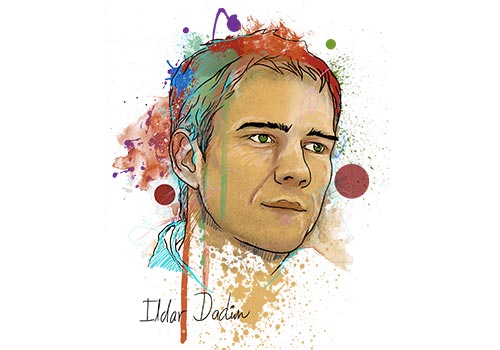
A Russian prisoners and LGBT rights activist, Dadin was the first, and only, person to be convicted under a notorious 2014 public assembly law. Aimed at punishing anyone who breaks strict rules on protest, the law was enacted to silence dissent after a wave of demonstrations following President Vladimir Putin’s last election victory. Dadin’s crime was to stage a series of one-man pickets, often standing silently with a billboard, attempting to duck the cynical law and push for free expression. For his solo enterprise, Dadin was arrested and sentenced to three years imprisonment in December 2015. In November 2016, website Meduza published a letter smuggled from Dadin to his wife, exposing torture he suffered alongside fellow prisoners. In February 2017, a Russian court quashed his conviction and Dadin was released.
Barrister and 2017 Freedom of Expression Awards judge Caoilfhionn Gallagher QC said: “Ildar Dadin has stood up to the Russian authorities in circumstances where we know how risky that can be: It has cost individuals their lives in recent years. It can even lose you a presidential election, as we now know. But Ildar, despite that, has continued to speak out and he continues to speak out even in the worst of circumstances.”
Speaking on behalf of Ildar Dadin, his wife and campaigning partner Anastasia Zotova said: “Tonight I tell you, that in Russia, there are no human rights. It is a society ruled through levels of cruelty and bigotry where Russians are forced to worship the great leader and any and all dissidents are stoned. Maybe I cannot join you in London but I can refuse to be silent. And you, friends, can refuse to be silent too. You can refuse to let these people silence me. Together, we can refuse to look away.”
Speech | Profile[/vc_column_text][/vc_column][/vc_row][vc_row][vc_column][vc_text_separator title=”2017 Freedom of Expression Arts Award”][vc_column_text]
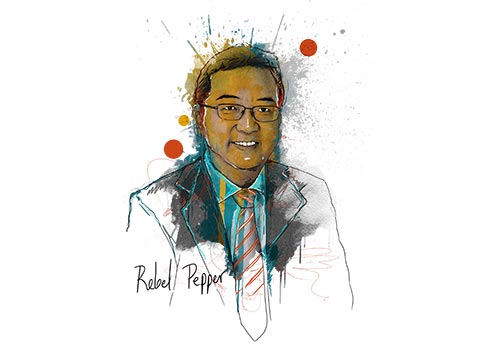
Cartoonist Wang Liming (aka Rebel Pepper) was presented with the Index 2017 Freedom of Expression Award Arts award for satirising Chinese Premier Xi Jinping and lampooning the ruling Communist Party. For his efforts Rebel Pepper has been repeatedly persecuted. In 2014, he took exile in Japan after serious threats against him were posted on Chinese government-sanctioned online forums. The Chinese state has since disconnected him from his fan base by repeatedly deleting his social media accounts, conversations with friends and family are under state surveillance, and exile has made him isolated, bringing significant financial struggles. Nonetheless, Rebel Pepper keeps drawing, ferociously criticising the Chinese regime.
Journalist and 2017 Freedom of Expression Award judge Tina Brown said: “Rebel Pepper was cut off from his family, cut off from all his friends and he wasn’t even able to go back for his mother’s funeral after she died from cancer, which is a very, very cruel fate for someone who simply wanted to tell the truth. At a time when the president of China is going off to Davos and making big statesmen-like speeches about how China is a big open society now, everybody come and trade, the fact is that it’s a really repressive and dark regime.”
In his acceptance speech, delivered by video, Wang Liming said: “Political cartoons are significant as I can use my works to peel away the mask of false perfection put on by the Chinese government. The humour and satire employed in my works can also help lighten the mood and dispel the fear that the Chinese people have towards the administration. I feel that these are the key reasons why political cartoons play such an important role in China. Ever since I came to Japan, I have been able to relish freedom of speech to the fullest. As such, my works are no longer limited by any external restrictions save for the boundaries of my own imagination.”
Speech | Profile[/vc_column_text][/vc_column][/vc_row][vc_row][vc_column][vc_text_separator title=”Jodie Ginsberg: Our ambition is modest: nothing less than an end to censorship”][vc_column_text]
Jodie Ginsberg, chief executive, Index on Censorship (Photo: Elina Kansikas for Index on Censorship)
“I hope you are indeed having an extraordinary evening. It’s extraordinary because of the individuals and groups we have honoured here tonight and it’s extraordinary because you make it so.
“Many of you are old friends of Index. Others are new acquaintances. For those of us who are new to us – and the old friends who may have forgotten – I want to take this opportunity to tell, or remind, you a little bit about us and what we do.
“Index was founded 45 years ago to tell the stories of dissidents behind the Iron Curtain and beyond – from the very first magazine we featured stories from across the world by and about censored writers and artists: from Brazil to Greece to Bangladesh. We were concerned then, as now, not just with the written word but all forms of expression. And we have continued to publish this magazine – the only of its kind in the world – ever since.”
[/vc_column_text][vc_column_text]High-resolution images are available for download on Flickr.[/vc_column_text][/vc_column][/vc_row][vc_row][vc_column][vc_media_grid grid_id=”vc_gid:1494001232704-44285c22-af33-2″ include=”89695,89694,89693,89692,89691,89690,89689,89688,89687,89686,89685,89684,89683,89682,89681,89680,89679,89678,89677,89676,89675,89673,89672,89671,89669,89667,89666,89665,89663,89662,89582,89581,89580,89578,89577,89576,89575,89574,89552,89551,89550,89549,89548,89547,89546,89545,89544,89543,89542,89540,89539,89538,89537,89536,89535,89534,89533,89532,89531,89530,89529,89528,89527,89523,89522,89520,89519,89518,89517,89515,89514,89513,89512,89511,89510,89509,89508,89491,89490,89489,89488,89487,89484,89706″][vc_basic_grid post_type=”post” max_items=”12″ style=”load-more” items_per_page=”4″ element_width=”6″ grid_id=”vc_gid:1494001233011-308855d4-4b96-8″ taxonomies=”8935, 8734″][/vc_column][/vc_row]
Jodie Ginsberg is chief executive of Index on Censorship.
I hope you are indeed having an extraordinary evening. It’s extraordinary because of the individuals and groups we have honoured here tonight and it’s extraordinary because you make it so.
Many of you are old friends of Index. Others are new acquaintances. For those of us who are new to us – and the old friends who may have forgotten – I want to take this opportunity to tell, or remind, you a little bit about us and what we do.
Index was founded 45 years ago to tell the stories of dissidents behind the Iron Curtain and beyond – from the very first magazine we featured stories from across the world by and about censored writers and artists: from Brazil to Greece to Bangladesh. We were concerned then, as now, not just with the written word but all forms of expression. And we have continued to publish this magazine – the only of its kind in the world – ever since.
Our aim is to put ourselves out of business. Our ambition is modest: nothing less than an end to censorship. Sadly, however, the enemies of free speech seem as strong as ever. It is for that reason Index not only publishes its magazine but campaigns against censorship, targeting countries and issues where we believe our specialist knowledge and expertise can have a marked impact. In Europe, we monitor threats to press freedom and next week we publish a groundbreaking report on US media freedom in the Trump era. We also encourage debate about free speech and – through the awards fellowship – support groups and individuals tackling censorship to be even more effective.
Why do we do this? We do it because we believe freedom of expression is the bedrock of all other freedoms – a necessary condition for the flourishing not just of life, but a life with meaning.
But it is a fragile freedom. Across the globe, freedom of expression is under threat. We still live in a world where writers can be killed for voicing their religious or non-religious beliefs and a blind eye turned by authorities, where journalists are detained for criticising their governments even in supposed democracies, and where taking offence has become a sufficient benchmark to enforce silence.
This is not the world I want to see. Nor is it the world I want my children to grow up in. I believe that if we want a more tolerant, inclusive society we need to defend freedom of expression – and that means defending the rights of those with whom you disagree as vigorously – if not more vigorously – than those whose views accord with your own.
Tonight we have heard remarkable stories of people fighting to speak out. But what we have also done is listen. Tonight we have celebrated not just what it means to speak freely but also what it means to be heard. Though Ildar and Rebel Pepper could not join us, the knowledge that there is a witness to their stories provides the strength to continue as it does for friends like former winner Nabeel Rajab, who has now been detained without trial for more than 9 months in a Bahraini jail simply for exercising his peaceful right to expression.
Noma said of tonight’s finalists: “These stories have to be told on behalf of people who cannot speak for themselves”. They also have to be heard. And I want to thank you for hearing them.
Thank you for helping us defend freedom of expression – a freedom that does not make us human but what gives us humanity.
For his one-man protests, Ildar Dadin was sent to prison in December 2015 where he was tortured, before his conviction was quashed in February 2017. Read the full profile.[/vc_column_text][/vc_column][vc_column width=”1/2″][vc_single_image image=”84888″ img_size=”full” alignment=”center”][vc_column_text]
Despite the persecution he faces for his work, Rebel Pepper continues to satirise the Chinese state from a life in exile in Japan. Read the full profile
Established in 2015, Turkey Blocks is an independent digital research organisation that monitors internet access restrictions in Turkey. Read the full profile.
Maldives Independent, the Maldives’ premiere English publication and one of the few remaining independent media outlets, was formed in exile in Sri Lanka in 2004. Read the full profile.
Azerbaijani opposition politician Ilgar Mammadov was jailed in 2013. The European Court of Human Rights (ECHR) ruled in May 2014 that Mammadov’s arrest and continued detention was in retaliation for criticising the country’s government.
Mammadov is a leader of the Republican Alternative Movement (REAL), which he launched in 2009, and is one of Azerbaijan’s rare dissenting political voices. He was sentenced to seven years in prison after participating in an anti-government protest rally in Ismayilli, a town 200 kilometers outside Baku. Authorities arrested him on trumped-up charges of inciting the protest with the use of violence. Mammadov had previously announced his intent to run for president. Mammadov remains in jail, despite the Council of Europe repeatedly calling for his release. Azerbaijan may be expelled from the council as the country repeatedly refuses to comply with the organization’s requests. John Kirby, spokesman of the US Department of State, also called on Azerbaijan to drop all charges against Mammadov. Reports in November 2015 emerged stating that Mammadov had been tortured by prison officials, which resulted in serious injuries including broken teeth. Mammadov has remained very vocal during his time in jail, writing on his blog about political developments in Azerbaijan and refusing to write a letter asking for pardon from President Ilham Aliyev.
The following is a letter written by Ilgar Mammadov:
International investment in fossil fuel extraction is making me and other Azerbaijani political prisoners hostages to the Aliyev regime.
A thirst for freedom.
Azerbaijan has seen a crackdown on any political dissent over the past few years, with dozens of activists and critics of the regime in Baku going behind bars. So far, there’s little sign of improvement.
Though respectful of the memory of Nelson Mandela, the mass media have occasionally shed light on the late South African leader’s warm relationship with scoundrels such as Muammar Qaddafi and Fidel Castro, as well as his refusal to defend Chinese dissidents. These events have been evoked to invite critical thinking about an iconic figure and balance his place in history.
Most readers of these articles judge a figure they previously held as an idol as hypocritical or tainted. They do not ask questions about the roots of a particular contradiction. In the case of Mandela, the dictators above had supported the anti-apartheid struggle of the African National Congress, while several established democracies indulged the inhuman system of apartheid because of the diamond, oil and other industries, and particularly because of the Cold War.
After only four years in prison, even on bogus charges and a politically motivated sentence, I am nowhere near Mandela in terms of symbolising a cause of global significance. Republicanism in my country, Azerbaijan — where the internationally promoted father-to-son succession of absolute power has disillusioned millions — is hardly comparable to the fight against racial segregation. Still, I can, better than many others, explain the flawed international attitudes that help keep democrats locked in the prisons of the “clever autocrats” who are, in turn, courted by retrograde forces within today’s democracies.
I will tell the story of how plans for a giant pipeline that would suck gas from Azerbaijan to Italy, the Southern Gas Corridor (SGC), impacts on Azerbaijan’s political prisoners.
In this letter I will focus only on one tension of the struggle we face here in Azerbaijan — between our democratic aspirations that enjoy only a nominal solidarity abroad, and the attempt to build a de facto monarchy which receives comprehensive support from foreign interest groups.
To be precise, I will tell the story of how plans for a giant pipeline that would suck gas from Azerbaijan to Italy, the Southern Gas Corridor (SGC), impacts on Azerbaijan’s political prisoners.
I will tell the story by discussing my own case. But before I tell it, you need to know what the Southern Gas Corridor is and why my release is crucial for the morale of our democratic forces. Indeed, Council of Europe officials say my freedom is essential for the entire architecture of protection under the European Convention of Human Rights, but there is still no punishment of my jailer.
What is the Southern Gas Corridor?
The Southern Gas Corridor is a multinational piece of gas infrastructure worth $43 billion US dollars. It is designed to extract and pump 16 billion cubic metres of natural gas every year from 2018, sucking hydrocarbons from Azerbaijan’s Shah Deniz gas field to European and Turkish markets. The EU, Turkey, and the US are all eager to connect the pipeline to Turkmenistan so that to an extra 20-30 billion cubic metres of Turkmen gas can be added to the scheme.
Hydrocarbon extraction is the mainstay of the country’s economy. Baku signed the “contract of the century” in 1994, and has attracted western oil and gas giants ever since.
The significance of the SGC is twofold. First, the project could provide up to 8-10% of EU’s gas imports, thus reducing the union’s dependence on Russia. Secondly, it will become another platform for geopolitical access (Russians would use a slightly ominous word “penetration”) of the west to Central Asia.
How did SGC encourage more repression?
Any rational democratic government in Baku would opt for the SGC without much debate and then turn its attention to issues truly important for Azerbaijan’s sustainable economic development. The revenue generated by the project would not be viewed as vital for the country when compared to the country’s economic potential in a less monopolised and more competition-based economy.
However, since the moment when a Russian government plane took Ilham Aliyev’s barely breathing father from a Turkish military hospital to the best clinic in America, in order to smooth the transition of power, the absolute ruler of Azerbaijan has been trained to deal with great powers first and then use such deals to repress domestic political dissent second. He has kept the country’s economy almost exclusively based on selling oil and gas and importing everything else.
Recently, Aliyev has been trying to present the SGC as his generous gift to the west so that governments will not talk about human rights and democracy in Azerbaijan. At one point Aliyev was even considering unilaterally funding the entire project.
In the middle of this tug of war, Azerbaijan suddenly found itself short of money due to falling oil prices. It could not fund its share in the parts of SGC that ran through Turkey (TANAP) and Greece, Albania and Italy (TAP) without backing from four leading international financial institutions — the European Bank for Reconstruction and Development, European Investment Bank, World Bank and Asian Development Bank.
During 2016, these institutions said their backing was subject to Azerbaijan’s compliance with the Extractive Industry Transparency Initiative (EITI). In September, Riccardo Puliti, director on energy and natural resources at the EBRD, cited the resumption of the EITI membership of Azerbaijan as “the main factor” for the prospect of approval of funds for TANAP/TAP.
Together with EIB, EBRD wants to cover US $2.16 billion out of the total US $8.6 billion cost of the TANAP. TAP will cost US $6.2 billion.
What is the Extractive Industry Transparency Initiative?
The EITI is a joint global initiative of governments, extractive industries, and local and international civil society organisations that aims, inter alia, to verify the amount of natural resources extracted by (mostly international) corporations and how much of the latters’ revenue is shared with host states. Its purpose, in that respect, is to safeguard transnational businesses from future claims that they have ransacked a developing nation — for instance, by sponsoring a political regime unfriendly to civil society and principle freedoms.
In April 2015, because of the unprecedented crackdown on civil society during 2013-2014, the EITI Board lowered the status of Azerbaijan in the initiative from “member” to “candidate”. This move, alongside falling oil prices, complicated funding for the Southern Gas Corridor. International backers were reluctant to be associated with the poor ethics of implementing energy projects in a country where already fragmented liberties were degenerating even further.
Hence, during 2016, several governments, especially the US, put strong political pressure on Azerbaijan. This resulted in a minor retreat by the dictatorship. Some interest groups claimed at the EITI board that this was “progress”.
The EITI board assembled on 25 October to review Azerbaijan’s situation. I appealed to the board ahead of its meeting.
Why did my appeal matter?
My appeal was heard primarily because, until I was arrested in March 2013, I was a member of the Advisory Board of what is now the Natural Resource Governance Institute (NRGI), a key international civil society segment of EITI.
In addition to my status within the EITI, the circumstances of my case — which was unusually embarrassing for the authorities — also played a role:
i) The European Court of Human Rights (ECHR) had established that the true reason behind the 12 court decisions (by a total of 19 judges) for my arrest and continued detention was the wish of the authorities “to silence me” for criticising the government;
ii) The US embassy in Azerbaijan had spent an immense amount of man-hours observing all 30 sessions of my trial during five months in a remote town and concluded: “the verdict was not based on evidence, and was politically motivated”;
iii) The European Parliament’s June 2013 resolution, which carried my name in its title, had called for my immediate and unconditional release — a call reiterated in the next two EP resolutions of 2014 and 2015 on human rights situation in Azerbaijan;
iv) Since December 2014, the Committee of Ministers of the Council of Europe had adopted eight (now nine) resolutions and decisions specifically on my case whereby it insisted on urgent release in line with the ECHR judgment.
Due to an onslaught by civil society partners during the 25 October debate, the EITI Board refused to return Azerbaijan its “member” status.
Indecision in America
I am very much obliged to the US embassy for conducting the hard labour of trial observation, but the US government representative’s stance at the EITI board meeting in October was a surprising disappointment.
Mary Warlick, the representative of the US government, insisted that Azerbaijan has made progress worth of being rewarded by EITI membership. Obviously, she was speaking for that part of the US government that wants the SGC pipeline to be built at any cost to our freedom.
Samantha Power’s Facebook posting of my family photo on 10 December, the International day of Human Rights, was also touching. Power is US Permanent Representative at UN. Two years ago, she already mentioned my case in the EITI context at a conference.
Complementing her kindness, around the same time Christopher Smith, Chairman of the Helsinki Commission of the US Congress, in an interview about fresh draconian laws restricting free speech in Azerbaijan, repeated his one year old call for my release.
Yet, on 15 December, Amos Hochstein, US State Department’s Special Envoy on Energy, assured the authorities in Baku that “regardless of any political changes, the US will remain committed to its obligations under the SGC”.
Indecision in Europe
I could set out a similar pattern of European hesitation beginning with my first days in jail.
To be concise, though, let me recall only the fact that on 20 September (the same day that Rodrigo Duterte called the European Parliament “hypocritical” for its criticism of the extra-judicial executions in Philippines), a conciliatory delegation of the EP in Baku not only agreed to hear a lecture from Ilham Aliyev on “[EP] President Martin Schultz and his deputy Lubarek being enemies of the people of Azerbaijan”, but even praised the lecture as a “constructive one”, in the words of Sajjad Karim, the British MEP who had led the delegation.
Political prisoners of Azerbaijan are not worth the amount of money involved in the SGC, but European values probably are.
The aforementioned three resolutions of the European Parliament were thus crossed out as I observed from behind bars.
Two presidents of the Parliamentary Assembly of the Council Of Europe (PACE) have visited me in prison, but this only highlighted the irrelevance of the body to the situation on the ground. They never stopped talking of how constructive or how ongoing their dialogue with the Azerbaijani authorities has been.
New threats
Our narrow win at the EITI Board exposes us to two new threats. (I do not discuss here the extraneous threats, which may originate from, for example, rising oil prices or collapse of the nuclear deal with Iran, i.e. anything adding confidence or bargaining power to the regime in Baku.)
One is that at the next EITI board meeting in March 2017, those driven by pressing commodity and geopolitical interests may outnumber or otherwise outpower the civil society party. If Ilham Aliyev proceeds with his cosmetic, fig leaf “reforms” or releases those political prisoners who have already pleaded for pardon or surrendered in any other way, the probability of my freedom being sacrificed will arise again.
The other threat is that instead of battling at the EITI, those interest groups may ask the international financial institutions to disconnect the SGC loans from Azerbaijan’s compliance with the EITI. These institutions are easier to convince as they are full of short-termist bank executives, rather than civil society activists concerned with the rule of law, transparency and public accountability.
The second scenario may already be in effect as rumours suggest that the World Bank has endorsed a US $800m loan to the TANAP. If so, then the postponed energy consultations between Baku and Brussels at the end of January may put the loans back on the EITI-friendly track. Political prisoners of Azerbaijan are not worth of the amount of money involved in the SGC, but European values probably are.
Deep jail horizon
Of 11 other members of the ruling body of my civic movement, REAL, three had to flee the country after my arrest, two were jailed (for 1.5 years and one month on charges not related to my case), two are not permitted to travel abroad (again on separate cases); one of them cannot even leave Baku.
From time to time, activists spend days under administrative detention designed to scare others. Nonetheless, we live in a world different from the one which tolerated and even fed apartheid.
Mandela’s fight promoted an agenda and international institutions where we can defend the values of freedom from encroachment by dictators and their business partners. This is why we should not consider the means of resisting oppression or seeking solidarity with other international arrangements any less conventional now. The problem is that when others see that our peaceful efforts are not fruitful, they turn to more radical means to end injustice.
*Mary Warlick is married to James Warlick, US co-chair of the OSCE Minsk Group mediating in the conflict between Armenia and Azerbaijan over Nagorno-Karabakh. Therefore, initially I guessed that by being nice to the regime she might have tried to make her husband’s relations with the official Baku easier. But in mid-November, James Warlick announced his resignation from the post, apparently as he had planned, and my guess turned out to be mistaken.[/vc_column_text][/vc_column][/vc_row][vc_row][vc_column][vc_basic_grid post_type=”post” max_items=”4″ element_width=”6″ grid_id=”vc_gid:1485781328870-cb0adaa0-0682-7″ taxonomies=”7145″][/vc_column][/vc_row]

 Maldives Independent and Zaheena Rasheed have been named the winner of the 2017 Freedom of Expression Journalism Award.