13 Sep 2024 | News, Newsletters, United States
Who could have predicted that Donald Trump would unite George Orwell and Taylor Swift in the form of an Index newsletter? But that’s the strange world in which we’re living.
This week I’ve been obsessively telling my Index colleagues about Laura Beers’ excellent book Orwell’s Ghosts, which is full of insights about today’s political climate through the lens of the Animal Farm author’s wisdom. One part that’s really stuck with me is the relationship between free speech and the truth, as Orwell saw it.
“Orwell could never endorse a world in which ‘alternative facts’ were given free rein,” Beers writes, reminding her readers about the famous Nineteen Eighty-Four line where Orwell describes freedom as the right to say that 2 + 2 = 4. As Beers points out, it is very much not the right to say that 2 + 2 = 5. Objective truth matters.
Anyone with even a passing interest in the US election will know that this week has been a goldmine for talking points on truth, lies and misinformation. It is the perfect moment to be reading this book.
When ABC News hosted a debate between Vice President Kamala Harris and former President Donald Trump this week, it was also the first time they’d met in person. After shaking hands, the debate began with gusto, Harris quickly getting under Trump’s skin. What was particularly interesting about this debate though was the on-the-go fact-checking live on air. It’s something we’ve never seen to this degree, and the fact that ABC feel it is needed now is telling.
On the issue of abortion, Trump asserted — not for the first time — that babies in the USA are being executed after being born. Moderators took down the false claim: “There is no state in this country where it is legal to kill a baby after it’s born.”
Commentators on the right were quick to denounce this new era of fact-checking. It was unfairly skewed towards Trump and they were picking him apart more than Harris. There is of course a simple explanation for that, which is that he told more lies. According to CNN, Trump delivered more than 30 false claims while Harris gave one, although additional claims of hers were misleading or lacking in context.
The award for top untruth of the night goes perhaps to Trump’s claim that Haitian migrants in Springfield, Ohio, are eating people’s pet cats and dogs. The internet quickly got to work with memes of The Simpsons’ dog Santa’s Little Helper giving the side eye to cat Snowball II. But ABC moderators were speedier than the meme-makers and set the story straight live on air, confirming that there had been “no credible reports” of this alleged neighbourhood pet buffet.
Of course, the lie didn’t come out of thin air. As The Economist breaks down, the “allegation had been circulating in right-wing circles on social media, boosted by Elon Musk”. Amid anti-immigrant sentiment in some circles, a Facebook post “cited fourth-hand knowledge” about the cat-eating claim. A half-truth is still a lie. And when it comes to a Facebook post based on fourth-hand knowledge being pedalled by a would-be (and former) president, we’re not even close to the realms of a half-truth. Two plus two does not equal four. Two plus two equals Lassie for lunch.
Social media has played a starring role in the misinformation story. Perhaps now is a good time to move on to X owner and tech billionaire Elon Musk’s post directed at pop superstar Taylor Swift.
Following the TV debate, Swift endorsed Harris in an Instagram post to her 284 million followers (to Trump’s 26.5 million and Harris’s 16.9 million, just to demonstrate the sway she has), where she talked about her concern over AI-generated content claiming to show her endorsing Donald Trump. Beneath a picture of the Shake It Off singer holding her ragdoll cat Benjamin Button, she wrote: “The simplest way to combat misinformation is with the truth,” and signed off “Taylor Swift, Childless Cat Lady,” riffing off the sexist trope used by Republican vice presidential nominee JD Vance towards Harris and others.
While not distracted by SpaceX (one of his other companies), which yesterday launched the first ever privately-funded spacewalk, Musk found the time to post: “Fine Taylor … you win … I will give you a child and guard your cats with my life.” If we know anything about Swift it’s that Musk is about to become the villain in an upcoming hit single.
Trump also reacted to Swift endorsing Harris. He said the popstar would “probably pay a price for it in the marketplace”.
Swift might say: “Haters gonna hate”. But when powerful billionaires and presidential candidates are deriding cultural figures for having a political voice, and objective truth becomes optional in a democracy, there is a problem. As this and other elections continue to unfold, it’s everyone’s responsibility to make sure that two plus two continue to equal four.
11 Oct 2022
What is the Index Index? The Index Index is a pilot project that uses innovative machine learning techniques to map the free expression landscape across the globe to gain a clearer country-by-country view of the state of free expression across academic, digital and...
22 Jun 2022 | Afghanistan, Africa, Americas, Asia and Pacific, Belarus, China, Europe and Central Asia, European Union, Hungary, India, Kenya, Magazine, Magazine Contents, Philippines, Poland, Russia, Turkey, Ukraine, United Kingdom, United States, Volume 51.02 Summer 2022 Extras
The summer issue of Index magazine concentrated its efforts on the developing situation between Russia and Ukraine and consequential effects around Europe and the world.
We decided to give voice to journalists, artists and dissidents who chose to respond to this ruthless war. At the same time, we didn’t forget other attacks on freedoms that haven’t been covered around the globe as much as they should.[/vc_column_text][vc_custom_heading text=”Up front”][vc_column_text]Joining Ukraine’s battle for freedom, by Jemimah Steinfeld: We must stand with the bold and brave against Putin.
The Index: A global tour of free expression, departing from the poll booth and arriving at the journalists reporting under Taliban rule.[/vc_column_text][vc_custom_heading text=”Features”][vc_column_text]Fifty years of pride and prejudice, by Peter Tatchell: Following the rise and
corporate fall of London’s march for LGBT rights, will grassroots voices rise again?
India’s meaty issue, by Aishwarya Jagani: When a burger comes with a side of oppression.
Cartoon, by Ben Jennings: Art imitates life, caveman style.
My three years of hell in an Uyghur ‘re-education’ camp, by Gulbahar Hatiwaj and Rahima Mahmut: As the world stays silent, hear the truth from inside China’s brutal concentration camps.
One step ahead of the game, by Chen Dan: Media criticism of the Chinese government is all part of the power play.
Welcome to the kingdom of impunity, by Michael Deibert: The landscape is dangerous for journalists in Haiti. Murders and kidnappings are a daily risk.
Politically corrected? By Issa Sikiti da Silva: The banned words the Kenyan
government doesn’t want to hear in this election year.[/vc_column_text][vc_custom_heading text=”Special report: The battle for Ukraine”][vc_column_text]Losing battle for truth in Russian lecture halls, by Ilya Matveev: The war has put a new strain on academic freedom. A Russian lecturer laments his lost classroom.
Don’t be afraid to say two plus two is four, by Mark Frary and Alla Gutnikova: As a convicted student journalist speaks out for freedom, do Russian dissidents once again face the gulag?
Emotional baggage, by Slavenka Drakulic: How it feels to pack up a life in Ukraine and become a refugee.
Back to the future, by Martin Bright: The world has been turned
upside down for Ukrainian reporters, and this is their new landscape.
On not being shot, by John Sweeney: Amidst the Kremlin-wrought
wreckage, do we need a new era of journalism?
Russia’s trojan horse moves closer to Europe, by Viktória Serdult: In Hungary, Putin’s right-hand man and Europe’s right-wing firebrand wins again.
Turkey’s newfound russophilia, by Kaya Genç: Putinism is seeping into Turkey, and it spells trouble for future freedoms.
Divided by age and a tv screen, by Hanna Komar: How do you make sure your
family see the truth when they’re blinded by Kremlin propaganda? A Belarus activist speaks out.
Culture in the cross hairs, by Andrey Kurkov: Decades after Soviet rule, Ukrainian culture is once again under threat, as are the lives behind the creative expression.
Bordering on media control, by Kseniya Tarasevich: False information about
Ukraine finds fertile breeding ground in Poland.
Treat tragedies of the Ukraine war with dignity, by Olesya Khromeychuk: The grieving hearts left behind when death becomes news fodder.
Worth a gamble, by Jemimah Steinfeld: When telling the truth is a crime, turn to a criminal spam operation.[/vc_column_text][vc_custom_heading text=”Comment”][vc_column_text]
Cancel Putin, not culture, by Maria Sorenson: Banning Russian artists assumes
that they are all collaborators of the Russian state and goes against artistic freedoms.
Beware the ‘civilisation’ battle, by Emily Couch: Why Europe must reject
anti-Asian racism to fully stand with Ukraine.
The silent minority, by Ruth Smeeth: A tribute to those whose work never saw the light of day.[/vc_column_text][vc_custom_heading text=”Culture”][vc_column_text]‘The light is no longer the light it used to be’, by Lyuba Yakimchuk: The poet on children being indoctrinated and the elderly disorientated in Russia-occupied Ukraine.
A cassandra worth heeding, by Dominic Cavendish: Murdered Russian journalist
Anna Politkovskaya, whose dispatches from Chechnya should be put in the spotlight.
Poetic injustice, by Stephen Komarnyckyj: History is repeating itself
on the pages penned by Ukrainian writers.
Banking on Russia’s poetic spirit, by Maria Bloshteyn and Yulia Fridman: A “piggy bank” of Russian poetry is fighting on the right side of Putin’s war.
Metaphors and madness, by Eduardo Halfon: In Guatemala, truth is best expressed through fiction.
Metal shows its mettle, by Guilherme Osinski: A heavy metal band labelled
“satanic” by Iran is free from prison and taking back the microphone.
America’s coming crucible, by Jo-Ann Mort: Women in the USA might soon be in the dark about their own bodies.
13 May 2022 | Israel, Media Freedom, Opinion, Palestine, Ruth's blog
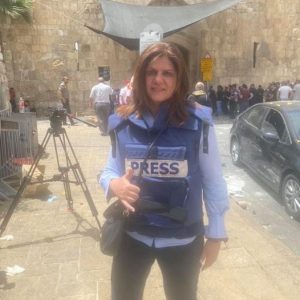
Al Jazeera journalist Shireen Abu Akleh
This week I was planning to write about the Queen’s speech, delivered this week by HRH Prince Charles, as the British Parliament began its new parliamentary session and the Government outlined it parliamentary priorities. There are now six proposed pieces of legislation by the British Government that will impact our collective rights to both freedom of expression and privacy in the United Kingdom. But my views on the ideological incoherence of the Government’s approach to freedom of expression will have to wait until next week.
Because today we mourn the death of another journalist. On Wednesday, Shireen Abu Akleh, a well-known and well regarded Palestinian-American journalist was killed while doing her job in Jenin.
According to Committee for the Protection of Journalists (CPJ) Shireen is the 17th journalist to have been killed in the line of duty in 2022. Index has fought to defend the rights of journalists for over fifty years. Every attack on a journalist is an effort to stop people speaking truth to power. It’s an attempt to quash dissent and to impose a single world view. And every death seeks to silence not just the voice of journalists but through them the voices of all of us. We cannot allow those who seek to repress their populations to win.
Today our thoughts and prayers are with Shireen’s family and loved ones. And as much as we mourn her today, we remember and honour the work and sacrifices made by her, her family and the sixteen other journalists who have lost their lives in 2022.
6 January – John Wesley Amady, Haiti
6 January – Wilguens Louis-Saint, Haiti
9 January – Pu Tuidim, Myanmar
17 January – Alfonso Margarito Martinez Esquivel, Mexico
5 February – Rohit Biswal, India
9 February – Evariste Djailoramdji, Chad
10 February – Heber Lopez Vasquez, Mexico
23 February – Maximilien Lazard, Haiti
1 March – Yevhenii Sakun, Ukraine
13 March – Brent Renaud, Ukraine
13 March-1 April – Maks Levin, Ukraine
14 March – Oleksandra Kuvshynova, Ukraine
14 March – Pierre Zakrzewski, Ukraine
15 March – Armando Linares Lopez, Mexico
23 March – Oksana Baulina, Ukraine
Late March – 2 April – Mantas Kvedaravicius, Ukraine
11 May – Shireen Abu Akleh, Occupied Palestinian Territory
Each of these brave journalists needs to be remembered and celebrated for their work and their sacrifice. And their families need and deserve both the truth and, most importantly, justice.
