Four hundred years after the death of the bard, Shakespeare’s sonnets and plays continue to influence not only the arts and theatre but dissent and defiance around the world. Index on Censorship magazine marks the anniversary with a special issue looking at how his work has been used to combat censorship and kick against the powers that be everywhere from Turkey and Hungary to the USA and China.
Here’s the award-winning cartoonist Ben Jennings discussing his illustrations in the latest issue with editor Rachael Jolley.
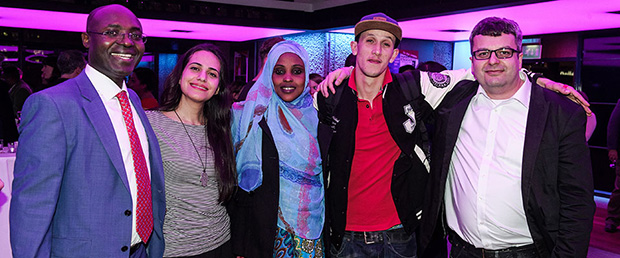
Rafael Marques de Morais, Safa Al Ahmad, Amran Abdundi, Mouad “El Haqed” Belghouat and Tamas Bodokuy (Photo: Alex Brenner for Index on Censorship)
When times get tough, freedom of expression can quickly fall down the list of priorities. But it is exactly in these circumstances when the ability to communicate and express yourself is most important. For this reason, we continue to draw inspiration from last year’s Index on Censorship Freedom of Expression Awards fellows and their struggles to keep freedom of expression alive and well.
As we look forward to the 2016 Index awards, here is our latest reminder of just how important a job our past winners do in the fight for free speech.
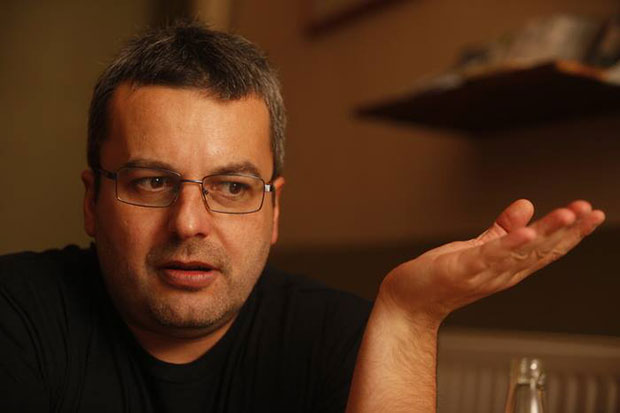
Tamas Bodoky, Atlatszo.hu / Digital Activism
Last year was a positive one for the Hungarian investigative journalism site and NGO Atlatszo. The site’s yearly report reveals that funding was on the up and readership remained high.
The website’s project for tracking down hate crime gained traction in 2014, and last year expanded to include “violent football hooligan groups and clergymen, who are close to the far-right,” the site’s executive director Tamas Bodoky told Index on Censorship.
“Unfortunately, some people became very hostile to our refugee crisis reporting last year, saying things like ‘go to hell, Atlatszo, for helping them’,” he added.
Atlatszo made 90 freedom of information requests as an organisation — plus hundreds of requests submitted by staff in their own names. Around 50% of Atlatszo’s requests were at least partially granted. Of those that weren’t, the site has initiated court proceedings to obtain the information, with almost half so far being successful, with several others pending.
Going forward, Atlatszo has plans to expand by working with more bloggers and developing a new website allowing Hungarian citizens to “question representatives of Hungary in EU, members of the Hungarian Parliament and — in the long run — representatives of the local governments”. The kepviselom.hu (my representative) project is currently seeking donors through crowdfunding.
“The Index award certainly helped get more international recognition over the last year,” Bodoky said. “As a very small news organisation, we constantly struggle for visibility, and Index on Censorship was instrumental in raising the visibility of our cause.”
Safa Al Ahmad / Journalism With the political crisis in Yemen steadily getting worse since last year, any plans Safa Al Ahmed had to switch focus were sidelined as she returned to the battle-scarred country.
“I filmed events in Aden and then Taiz, which is currently besieged,” the award-winning journalist told Index on Censorship. “I’m going to be producing two separate films for both cities because north and south have very different dynamics.”
Actually getting into Yemen is a real task in itself. Al Ahmed and her crew took a boat from Djibouti to Aden, which took 34 hours, and then travelled for another day off-road and across mountainous terrain, passing snipers along the way.
With the execution of the prominent Shia cleric Nimr al-Nimr, Al Ahmad’s own country Saudi Arabia was briefly catapulted back into international focus at the start of 2016, but it didn’t last. “There is very little investigative journalism being done on the ground, which makes reporting difficult as there isn’t very much to build on,” Al Ahmed says.
Citing the flogging of blogger Raif Badawi as an example of how brutal the Saudi regime is of critical voices, Al Ahmad describes the state of free speech in Saudi Arabia as “frightening”. “The government have passed really wide rulings and laws so they can stop or arrest anyone for the simplest of reasons, including talking about the war in Yemen, which has been banned,” she explains.
The big difference between now and 2014 is that people are currently receiving death sentences, which is “a whole different level of intimidation”.
Mouad Belghouat aka El Haqed / Arts
Last time we caught up with Moroccan rapper Mouad Belghouat, aka El Haqed, in October, he was in his home country keeping a low profile, while looking forward to performances in Florence, Italy, and at the 25th anniversary of the Moroccan Association of Human Rights in Brussels. Since November 2015, he has been living in Belgium, having applied for refugee status.
“In Morocco I felt threatened and under constant control,” he told Index this month. “It’s been hard, because already I miss the place where I grew up; I miss my family and my friends.” The situation in Morocco “deteriorates more and more every day, at all levels”, he explains, but vows one day to return.
He has now been cleared to work in Belgium, and has also turned his attention to creating more music. “I’m trying to finish the album I’ve been writing based on my experiences in prison in Morocco, and — as the last set of concerts have gone so well — I will be performing in Belgium in March and am looking to tour Norway come April.”
There are also plans for a biography based on his experiences from 2011, when his music became an anthem for many Moroccans involved in the Arab Spring, right up to his persecution at the hands of the authorities, right up to his eventual self-imposed exile.
As for the Index award, he said: “Through Index, I met many great people from all over the world who share the same principles as me, and word of my case has spanned the breadth of the world.”
Amran Abdundi / Campaigning
During our last conversation with Amran Abdundi, we discussed the attack in her native Kenya by Al-Shabaab linked terrorists on Garissa University College, in which 148 people were murdered. Abdundi, who knows many students from the college, immediately joined with other women leaders to organise strong community protests against Al-Shabaab.
Last month, Abdundi attended the re-opening ceremony for Garissa University College. “I was happy to meet victims who I offered counselling to after the attack, and see them now back on their feet, ready to study and achieve their dreams,” she told Index.
She has also been busy recently with the upcoming launch of the new Frontier Indigenous Network website and implementing a new social media strategy to foster better connections between Kenyan women and the rest of the world.
As part of this new development plan, 2016 is packed with new projects, including an education programme on non-violence to counter violent extremism and radicalisation. The project will bring together Christians and Muslims together in “preaching peace and reconciliation”.
“All of this wouldn’t have been possible without the Index award and the support I have received from Index on Censorship, which led me to meet key individuals, such as Kenya’s woman minister, Anne Waigiru.”
Rafael Marques de Morais / Journalism
President José Eduardo dos Santos has been in power in Angola for over 35 years and his regime faces criticism on many fronts for, among other things, land grabbing, human rights abuses in Angolan prisons and the divvying up of the country’s resources to his family “like it was their inheritance”. These are just some of the issues Index award winner Rafael Marques de Morais is focusing on his activism and writing.
“This kind of work generates all sorts of troubles, because when you speak out against the president, you become suspect,” de Morais told Index on Censorship.
Being a high-profile activist within the country, there is a misconception that de Morais doesn’t feel the full force of the regime. “I might be ‘free’ but I can’t go anywhere; when I went for a drink recently the person I was with noticed we were being watched,” he explains. When he tried to enter a courtroom in December to observe the case involving the 15 Angolan bloggers now under house arrest, he was denied access. “Immediately the news on television was that I tried to enter the court illegally, because being high profile, the main thing they can attack is your reputation.”
Coupled with the ongoing economic crisis in Angola preventing citizens from taking money out of the bank, times are tough. “How is one supposed to survive and keep going?” he asks.
But go on he does. The attention from home and abroad, including that generated by the Index award, have provided some solace. “It’s always refreshing to know that people are interested,” he explains. “The award provides great encouragement for one to keep going.”
“But that’s it. The next day, you are back to struggling for survival.”
The attacks on the offices of satirical magazine Charlie Hebdo in Paris in January set the tone for conditions for media professionals in 2015. Throughout the year, Index on Censorship’s Mapping Media Freedom correspondents verified a total of 745 violations of media freedom across Europe.
From the murders of journalists in Russia, Poland and Turkey to the growing threat posed by far-right extremists in Germany and government interference in Hungary — right down to the increasingly harsh legal measures imposed on reporters right across the continent — Mapping Media Freedom exposed many difficulties media workers face in simply doing their jobs.
“Last year was a tumultuous one for press freedom; from the attacks at Charlie Hebdo to the refugee crisis-related aggressions, Index observed many threats to the media across Europe,” said Hannah Machlin, Index on Censorship’s project officer for the Mapping Media Freedom project. “To highlight the important cases and trends of the year, we’ve asked our correspondents, who have been carefully monitoring the region, to discuss one violation each that stood out to them.”
Belarus / 19 verified reports between May-Dec 2015 Journalist blocked from shooting entrance to polling station
“It demonstrates the Belarusian authorities’ attitude to media as well as ‘transparency’ of the presidential election – the most important event in the current year.” — Ольга К.-Сехович
Greece / 15 verified reports in 2015 Four journalists detained and blocked from covering refugee operation
“This is important because it is typical ‘attempt to limit press freedom’, as the Union wrote in a statement and it is not very hopeful for the future. The way refugees and migrants are treated is very sensitive and media should not be prevented from covering this issue.” — Christina Vasilaki
Hungary / 57 verified reports in 2015 Serbian camera crew beaten by border police
“These physical attacks, the harsh treatment and detention of journalists are striking because the Hungarian government usually uses ‘soft censorship’ to control media and journalists, they rarely use brute force.” — Zoltan Sipos
Italy / 72 verified reports in 2015 Italian journalists face up to eight years in prison for corruption investigation
“I chose it because this case is really serious: the journalists Emiliano Fittipaldi and Gianluigi Nuzzi are facing up to eight years in prison for publishing books on corruption in the Vatican. This case could have a chilling effect on press freedom. It is really important that journalists investigate and they must be free to do that.” — Rossella Ricchiuti
Lithuania / 9 verified reports in 2015 Journalist repeatedly harassed and pushed out of local area
“I chose it because I found it relevant to my personal experience and the fellow journalist has been the only one to have responded to my hundreds of e-mails — including requests to fellow Lithuanian journalists to share their personal experience on media freedom.” — Linas Jegelevicius
Macedonia / 27 verified reports in 2015 Journalist publicly assaults another journalist
“I have chosen this incident because it best describes the recent trend not only in Macedonia and my other three designated countries, Croatia, Bosnia and Montenegro, but also in the whole region. And that is polarization among journalists, more and more verbal and, like in this unique case, physical assaults among colleagues. It best describes the ongoing trend where journalists are not united in safeguarding public interest but are nothing more than a tool in the hands of political and financial elites. It describes the division between pro-opposition and pro-government journalists. It is a clear example of absolute deviation from the journalistic ethic.” — Ilcho Cvetanoski
Poland / 11 verified reports in 2015 Law on public service broadcasting removes independence guarantees
“The new media law, which was passed through Poland`s two-chamber parliament in the last week of December, constitutes a severe threat to pluralism of opinions in Poland, as it is aimed at streamlining public media along the lines of the PiS party that holds the overall majority. The law is currently only awaiting president Duda’s signature, who is a close PiS ally.” — Martha Otwinowski
Portugal / 9 verified reports in 2015 Two-thirds of newspaper employees will be laid off
“It’s a clear picture of the media in Portugal, which depends on investors who show no interest in a healthy, well-informed democracy, but rather in how owning a newspaper can help them achieve their goals — and when these are not met they don’t hesitate to jump boat, leaving hundreds unemployed.” — João de Almeida Dias
Russia / 37 verified reports between May-Dec 2015 Media freedom NGO recognised as foreign agent, faces closure
“The most important trend of the 2015 in Russia is the continuing pressure over the civil society. More than 100 Russian civil rights advocacy NGOs were recognized as organisations acting as foreign agents which leads to double control and reporting, to intimidation and insulting of activists, e.g., by the state-owned media. Many of them faced large fines and were forced to closure.” — Andrey Kalikh
Russia / 37 verified reports between May-Dec 2015 TV2 loses counter claim to renew broadcasting license Roskomnadzor
“It illustrates the crackdown on independent local media, which can not fight against the state officials even if they have support from the audience and professional community.” — Ekaterina Buchneva
Serbia / 41 verified reports in 2015 Investigative journalist severely beaten with metal bars
“It’s a disgrace and a flash-back to Serbia’s dark past that a journalist, who’s well known for investigating high-level corruption, get’s beaten up with metal bars late at night by ‘unknown men’.” — Mitra Nazar
Turkey / 97 verified reports in 2015 Police storm offices of Koza İpek, interrupting broadcast
“The raid on Bugün and Kanaltürk’s offices just days ahead of parliamentary elections was a drastic example — broadcasts were cut by police and around 100 journalists ended up losing their jobs over the next month — of how the current Turkish government tries to strong-arm media organisations.” — Catherine Stupp
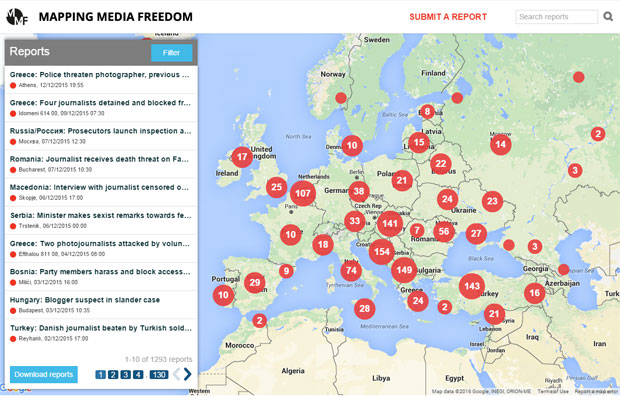
Mapping Media Freedom
Click on the bubbles to view reports or double-click to zoom in on specific regions. The full site can be accessed at https://mappingmediafreedom.org/
Hungarians are polarised on the refugees making the journey to Europe. Hardliners support the government’s tough approach to curbing immigration, as do a large number of ordinary people. But many others are ashamed by what is happening, explains Tamas Bodoky.
The founder of Atlatszo, Index on Censorship’s award winner for digital activism in 2015, Bodoky blames the situation on the government’s campaign of painting migrants as dangerous enemies. “The mainstream and pro-government press is full of scaremongering, claiming refugees are terrorists, that they carry diseases and are taking work away from Hungarian people,” he says.
In a departure for the data-driven investigative journalism and freedom of information organisation, Atlatszo has been covering the human side of the situation by reporting on the experiences and views of asylum seekers since the government began trying to halt the flow of refugees in July. Bodoky and his team have covered conditions at the border and some travelled to Turkey to look at how refugees are crossing the Mediterranean.
“We have interviewed a lot of people at train stations and other ports,” Bodoky explains.
Early last month, Bodoky put together a short documentary capturing the chaotic events of 4 September 2015, when approximately 2,000 refugees attempted to walk from Budapest to Austria. They had been stuck in the Hungarian capital for days, many of them stranded in train stations without help. Late that night, after walking about 30 km, they were finally put on buses and taken to the Austrian border.
Since Index last spoke to Bodoky in June, the Hungarian government has — for the second time since 2010 — changed the law regarding freedom of information requests, which Atlatszo relies heavily on for its investigative work.
“They are charging fees so people won’t file so many requests,” says Bodoky, adding that while Atlatszo isn’t very happy with the situation, it won’t be deterred. “We will pay the small fee and continue to make requests, but citizens and activists who have started to use freedom of information quite a lot may not want or be able to,” he says.
Atlatszo’s readership has been steadily rising and the publication is now over 50% crowdfunded. Around 3,000 donors contribute monthly and the amount of money raised from the 1% of income tax Hungarian citizens can donate to NGOs they sympathise with has tripled for Atlatszo since last year.
Winning the Index Digital Activism Award has helped Atlatszo gain international attention. “We get a lot of press requests for quotes on important issues in Hungary,” says Bodoky. Staffers at Atlatszo have been acting as a source on the refugee crisis for international media outlets such The Guardian and have appeared on Al Jazeera’s Listening Post, a weekly programme examining the world’s media.
In the coming months, Bodoky says Atlatszo will “continue to work on anti-corruption, with articles on state subsidies and budget spending, which is our core business, and of course on the migrant crisis”.

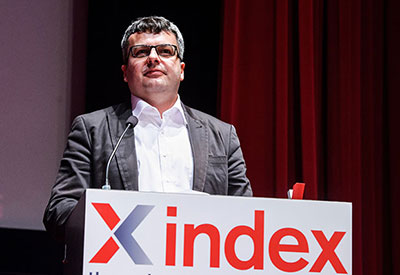
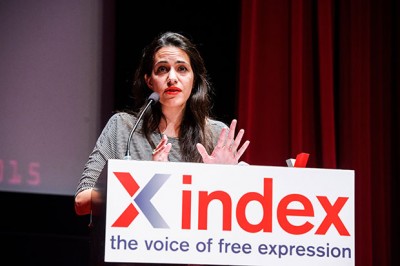 With the political crisis in Yemen steadily getting worse since last year, any plans
 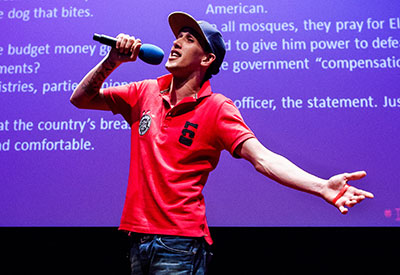 Last time we
 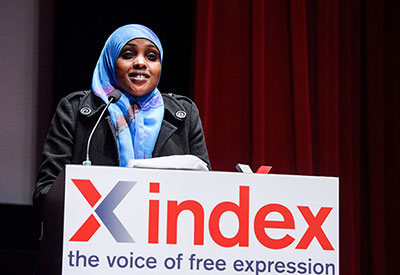 During our
 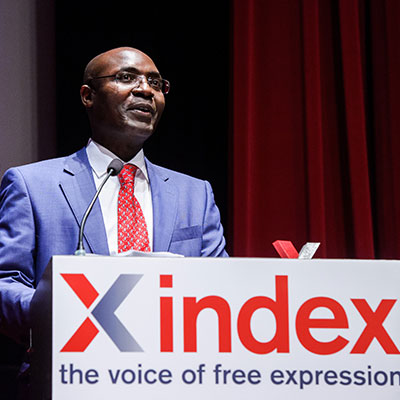 President José Eduardo dos Santos has been in power in Angola for over 35 years and his regime faces criticism on many fronts for, among other things, land grabbing, human rights abuses in Angolan prisons and the divvying up of the country’s resources to his family “like it was their inheritance”. These are just some of the issues Index award winner