29 Apr 2022 | China, Media Freedom, News, Russia, Ukraine
Physical attacks on journalists have increased dramatically over the past year, according to the latest annual report from the Council of Europe Platform on media freedom in Europe.
The platform, of which Index on Censorship is a partner, reports on serious threats to the safety of journalists and media freedom in Europe in order to reinforce the Council of Europe’s response to the threats and member states’ accountability.
The new report, Defending Press Freedom in Times of Tension and Conflict, reveals that the number of cases involving the safety and physical integrity of journalists has jumped by 51% year-on-year, with 82 cases reported to the platform.
Many of the attacks on journalists have taken place during public protests.
“Violence against journalists during street protests is fed by a wave of media bashing and an avalanche of hate speech on social networks – very often prompted by political figures – which directly target journalists, questioning their independence and legitimacy and therefore making them more vulnerable to physical aggression,” the report says.
Overall, the number of alerts in all categories published by the CoE platform has sky-rocketed to 280 in 2021, up from around 200 in 2020 and more than double the level reported in 2016. Of the 280 alerts, 110 related to the harassment and intimidation of journalists.
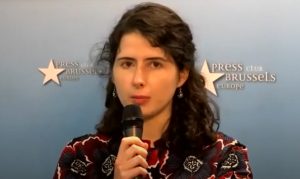
Index’s policy and campaigns manager Jessica Ní Mhainín
Speaking at the launch of the report, Index’s policy and campaigns manager Jessica Ní Mhainín highlighted cases of impunity in CoE’s report.
“Impunity for crimes against journalists refer to failure of states to identify, prosecute and punish anyone including the assailants and masterminds involved in committing a crime against a journalist,” she said. “Cultures of impunity contribute to self-censorship by making journalists more vulnerable to pressures out of fear of reprisals or harm.”
Some 35 cases of impunity have been registered on the platform since 2015 and two new impunity cases – those of Turkish journalist Uğur Mumcu, murdered in 1993, and Turkish-Cypriot journalist Kutlu Adalı, murdered in Cyprus in 1996 – were added to the impunity category during the year.
“In 2021, we welcomed the Slovak Supreme Court’s decision to overturn the not-guilty verdicts of the suspected masterminds of the 2018 murder of journalist Ján Kuciak and his fiancée Martina Kušnírová. The case will be heard in the Specialized Criminal Court later this year,” said Ní Mhainín.
Last year also saw the publication of a 438 page-report from the public inquiry into the assassination of investigative journalist Daphne Caruana Galizia, which concluded that the state of Malta “must bear responsibility for the assassination because it created an atmosphere of impunity”.
“We once again call on the Maltese authorities and the Commission of Experts to implement the recommendations of the Public Inquiry,” said Ní Mhainín.
Russia, Turkey and Ukraine account for 60% of all the cases relating to impunity on the platform. Last October marked the 15th anniversary of Russian journalist Anna Politkovskaya’s murder.
Ní Mhainín said, “The masterminds of her murder are still at large, sending the incredibly dangerous message that killing a journalist is a low-risk crime.”
Yet impunity is not restricted to these countries.
A BBC Spotlight investigation has uncovered serious concerns over the police investigation and the failure to prosecute those behind the murder of Irish journalist Martin O’Hagan, who was killed in September 2001 for his reporting on paramilitary activities in Northern Ireland. The concerns raised in the programme, which aired on 2 March 2022, came in the wake of several Police Ombudsman reports that uncovered collusive behaviour between the police and loyalists in Northern Ireland. According to the BBC’s investigation, police did not act on important information – including individual names – that were handed over to them within 48 hours of the murder. The journalist’s family are now taking legal action against the Police Service of Northern Ireland (PSNI) and the Ministry of Defence.
“Press freedom is the canary in the coal mine – it is a key indicator of the clear and worrying degree of democratic backsliding that is taking place across Europe,” said Ní Mhainín. “That’s why we once again call on Council of Europe member states to ensure that the highest priority is given to conducting thorough and transparent investigations into all crimes against journalists and we remind member states of the 2016 Recommendation of the Committee of Ministers which requires states ‘adopt appropriate criminal law provisions to prevent impunity’”
28 Mar 2022 | News, Russia, Ukraine
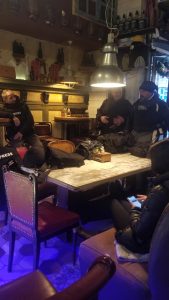
Photo: Reporters inside Kyiv’s Buena Vista Social Bar
There’s always a bar. In Kyiv, in 2022, it’s the Buena Vista Social bar, bang next to a Ukrainian police checkpoint which is both funny ha-ha and funny peculiar because there is a nationwide ban on the sale of alcohol. Sssh. It’s a joyful shebeen, Cuban-themed, run by Maks, and you never quite know what’s available to drink and who’s going to be there. All the women have a past; all the men have no future. You get the vibe.
Early on in the war, a fellow regular was a big bloke with a thick moustache and a mane of bubbly, curly hair, often seen with his fixer, a Ukrainian freelancer. I never spoke to him but I clocked him as someone who had presence, who was an interesting character, who I had probably seen in Sarajevo or somewhere like that. He was Pierre “Zak” Zakrzewski, she Sasha Kuvshynova, and they were both killed on 14 March 2022 when their vehicle came under fire in Bucha – pronounced Butcher – to the northwest of Kyiv. British journalist Ben Hall was wounded in the same attack. They were working for Fox News, something Zak, 55, who had been brought up in Ireland, had mixed feelings about. But he knew the risks of war too well and made a decision that working for a big corporate was better risk-management than being freelance. His co-workers at Fox loved him, giving him an award as “Unsung Hero” after he helped get Afghan freelancers out of Kabul.
Sasha was 24, bold and fiercely smart. After her death, her dad said that she learnt to read at the age of three and picked up English from reading restaurant menus while on family holidays. She was a fanatical photographer with five stills cameras, had founded a music festival for up-and-coming jazz musicians, worked as a DJ and wrote poetry. She wanted to make movies.
If you don’t like free expression in a democracy, you blow up the TV tower. The Kremlin’s first journalist victim was Yevhenii Sakun, 49, a camera operator for Ukraine’s LIVE station, on 1 March. The Russian army sent in four missiles in the evening, killing a worker in the TV tower complex and four civilians. The next morning I saw the people from the morgue take away the bodies of a middle-aged man and a mother and her child with my own eyes.
The most dangerous area of Kyiv is the northwest suburbs, where the Russian army’s offensive, driving down through Chernobyl, has come closest to the capital. Reporters seeking human stories, of refugees fleeing with their dogs on a lead or their cat in a box, went repeatedly to Irpin. Fearing further Russian advance, the Ukrainian army flooded the river plains near the suburb and blew up the most southerly bridge, leaving people to pick their way across the skeleton remains. Once beyond that crossing, there is a second bridge. That’s where US film maker Brent Renaud, 50, originally from Little Rock and formerly of the New York Times, found himself, filming refugees running for their lives. Brent knew what he was doing, having filmed and reported man’s cruelty to man in Iraq, Afghanistan, Libya: all the nice places.
At Irpin, at the second bridge, the Russian army shot him in the neck and he died of his wounds.
Oksana Baulina was one of those intensely brave Russians who were on Team Navalny before their champion was arrested on fake charges and the organisation broken up. Oksana, 43, was declared a “terrorist” by the Kremlin and had to flee Russia. She set up as a reporter and film maker in Poland and reported on the war. When Russian artillery smashed into a shopping centre in Podil, in the northwest of the city, she was killed.
To be honest with you I have done my best to avoid writing this piece for days now because it can only fill one with gloom to think of these brave truth-tellers sent early to their graves by the mobster in the Kremlin. But my pals and I in the Buena Vista are buoyed up the thought that we are in Ukraine exactly because Vladimir Putin does not want us to be here. And on that point, Mr Putin, do fuck off.
And the rum is good.
There is, also, the line from Tom Stoppard’s great play, Night And Day, which I quoted on Twitter while hurrying back from the bar just before – well, actually, just after curfew – had fallen. This, from memory, is how it goes, how the lover of the dead young journalist, played by Diana Rigg, killed on the frontline denounces the false romance of journalism, “it’s not worth the heart-break beauty queen or the crossword and it’s definitely not worth the leader.”
And the old hack, played by John Thaw, replies: “Yes, you’re right. But also the other thing. People do awful things to each other. But it’s worse in places where everybody is kept in the dark. Information is light. Information, in itself, about anything, is light.”
RIP Zak, Sasha, Yevhenii, Brent and Oksana.
18 Mar 2022 | 50 years of Index, China, History, Ireland, Magazine, News, Philippines, United Kingdom, United States, Volume 51.01 Spring 2022 Extras
[vc_row][vc_column][vc_column_text]
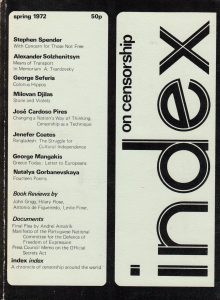
The first issue of Index on Censorship magazine, in March 1972.
You may have heard that the 70s were different. In 1972, when the first issue of Index magazine was launched, no one knew that 20 years later there would be an influential economic bloc called the European Union. The Beatles’ had only just split. The World Trade Center in New York was being built, while Sir Edward Heath was the prime minister of the United Kingdom.
Fifty years on and some things remain. Queen Elizabeth’s reign goes on and celebrates its 70th anniversary in 2022. Dictatorships and censorship, which should be trapped in history books, continue to torment the lives of many. And as a result, Index on Censorship remains vigilant, defending freedom of expression and giving voice to those who are silenced.
As we celebrate our 50th anniversary, we go back in time and remember the remarkable events that happened in 1972.[/vc_column_text][vc_custom_heading text=”1″][vc_column_text]January 30th: British soldiers shoot 26 unarmed civilians during a protest in Derry, Northern Ireland. Fourteen people were killed on this day known as “Bloody Sunday”. [/vc_column_text][vc_custom_heading text=”2″][vc_column_text]February 1st: Paul McCartney and the Wings release “Give Ireland back to the Irish” in the UK. It would be banned by the BBC, nine days later. [/vc_column_text][vc_custom_heading text=”3″][vc_column_text]February 5th: Airlines in the United States begin to inspect passengers and baggage. Tough to imagine that people traveled without any surveillance. [/vc_column_text][vc_custom_heading text=”4″][vc_column_text]February 17th: British Parliament votes to join the European Common Market. In 2020, the United Kingdom would leave the European Union. [/vc_column_text][vc_custom_heading text=”5″][vc_column_text]February 21st: Richard Nixon becomes the first US president to visit China, seeking to establish positive relations in a meeting with Chinese leader Mao Zedong, in Beijing.
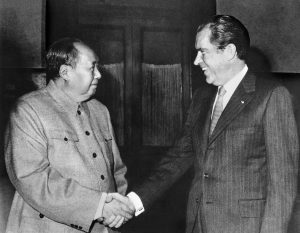
Mao Zedong and Richard Nixon during Nixon’s historical visit to China in 1972. Photo: Ian Dagnall/Alamy
[/vc_column_text][vc_custom_heading text=”6″][vc_column_text]March 15th: The Godfather, starring Marlon Brando and Al Pacino, premieres in New York. It wins Best Picture and Best Actor (Brando) at the 45th Academy Awards.
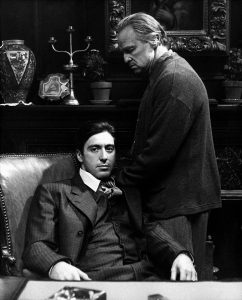
Al Pacino and Marlon Brando in the Godfather. The first film of one the most successful franchises of all time was released in 1972. Photo: All Star Library/Alamy
[/vc_column_text][vc_custom_heading text=”7″][vc_column_text]June 18th: British European Airways Trident crashes after takeoff from Heathrow to Brussels, killing all 118 people on board. [/vc_column_text][vc_custom_heading text=”8″][vc_column_text]July 1st: Feminist magazine Ms, founded by Gloria Steinem, publishes its first issue, with Wonder Woman on the cover.[/vc_column_text][vc_custom_heading text=”9″][vc_column_text]August 4th: Uganda dictator Idi Amin orders the expulsion of 50,000 Asians with British passports.
[/vc_column_text][vc_custom_heading text=”10″][vc_column_text]September 4th and 5th: 11 members of the Israeli Olympic team are murdered by a Palestinian terrorist group in the second week of the 1972 Olympics in Munich.[/vc_column_text][vc_custom_heading text=”11″][vc_column_text]September 21st: Philippines President Ferdinand Marcos declares martial law. In 2022, his son Ferdinand ‘Bongbong’ Marcos is running for president. [/vc_column_text][vc_custom_heading text=”12″][vc_column_text]October 13th: A flight from Uruguay to Chile crashes in the Andes Mountains. Passengers eat the flesh of the deceased to survive. Sixteen people are rescued two months later.[/vc_column_text][vc_custom_heading text=”13″][vc_column_text]November 30th: BBC bans “Hi, Hi, Hi”, by Paul McCartney and The Wings, due to its drug references and suggestive sexual content. [/vc_column_text][vc_custom_heading text=”14″][vc_column_text]December 7th: Apollo 17 is launched and the crew takes the famous “blue marble” photo of the entire Earth.

The earth seen from the Apollo 17 spacecraft. Photo: NASA/Alamy
[/vc_column_text][vc_custom_heading text=”15″][vc_column_text]December 28th: Kim Il-Sung takes over as president of North Korea. He’s the grandfather of the country’s current leader, Kim Jong-un. [/vc_column_text][vc_custom_heading text=”16″][vc_column_text]December 30th: US President Richard Nixon halts bombing of North Vietnam and announces peace talks in Paris, to be held in January 1973. [/vc_column_text][/vc_column][/vc_row]
17 Mar 2022 | 50 years of Index, Afghanistan, Africa, Americas, Asia and Pacific, Bosnia, Brazil, China, Greece, Hong Kong, India, Iran, Magazine, Magazine Contents, Mexico, Nigeria, Northern Ireland, Philippines, Russia, Rwanda, South Africa, Turkey, Uganda, Ukraine, United Kingdom, United States, Volume 51.01 Spring 2022 Extras
The spring issue of Index magazine is special. We are celebrating 50 years of history and to such a milestone we’ve decided to look back at the thorny path that brought us here.
Editors from our five decades of life have accepted our invitation to think over their time at Index, while we’ve chosen pieces from important moments that truly tell our diverse and abundant trajectory.
Susan McKay has revisited an article about the contentious role of the BBC in Northern Ireland published in our first issue, and compares it to today’s reality.
Martin Bright does a brilliant job and reveals fascinating details on Index origin story, which you shouldn’t miss.
Index at 50, by Jemimah Steinfeld: How Index has lived up to Stephen Spender’s founding manifesto over five decades of the magazine.
The Index: Free expression around the world today: the inspiring voices, the people who have been imprisoned and the trends, legislation and technology which are causing concern.
“Special report: Index on Censorship at 50”][vc_column_text]Dissidents, spies and the lies that came in from the cold, by Martin Bright: The story of Index’s origins is caught up in the Cold War – and as exciting
Sound and fury at BBC ‘bias’, by Susan McKay: The way Northern Ireland is reported continues to divide, 50 years on.
How do you find 50 years of censorship, by Htein Lin: The distinguished artist from Myanmar paints a canvas exclusively for our anniversary.
Humpty Dumpty has maybe had the last word, by Sir Tom Stoppard: Identity politics has thrown up a new phenonemon, an intolerance between individuals.
The article that tore Turkey apart, by Kaya Genç: Elif Shafak and Ece Temulkuran reflect on an Index article that the nation.
Of course it’s not appropriate – it’s satire, by Natasha Joseph: The Dame Edna of South Africa on beating apartheid’s censors.
The staged suicided that haunts Brazil, by Guilherme Osinski: Vladimir Herzog was murdered in 1975. Years on his family await answers – and an apology.
Greece haunted by spectre of the past, by Tony Rigopoulos: Decades after the colonels, Greece’s media is under attack.
Ugandans still wait for life to turn sweet, by Issa Sikiti da Silva: Hopes were high after Idi Amin. Then came Museveni …People in Kampala talk about their
problems with the regime.
How much distance from Mao? By Rana Mitter: The Cultural Revolution ended; censorship did not.
Climate science is still being silenced, by Margaret Atwood: The acclaimed writer on the fiercest free speech battle of the day.
God’s gift to who? By Charlie Smith: A 2006 prediction that the internet would change China for the better has come to pass.
50 tech milestones of the past 50 years, by Mark Frary: Expert voices and a long-view of the innovations that changed the free speech landscape.
Censoring the net is not the answer, but… By Vint Cerf: One of the godfathers of the internet reflects on what went right and what went wrong.[/vc_column_text][vc_custom_heading text=”Five decades in review”][vc_column_text]An arresting start, by Michael Scammell: The first editor of Index recounts being detained in Moscow.
The clockwork show: Under the Greek colonels, being out of jail didn’t mean being free.
Two letters, by Kurt Vonnegut: His books were banned and burned.
Winning friends, making enemies, influencing people, by Philip Spender: Index found its stride in the 1980s. Governments took note.
The nurse and the poet, by Karel Kyncl: An English nurse and the first Czech ‘non-person’.
Tuning in to revolution, by Jane McIntosh: In revolutionary Latin America, radio set the rules.
‘Animal can’t dash me human rights’, by Fela Kuti: Why the king of Afrobeat scared Nigeria’s regime.
Why should music be censorable, by Yehudi Menuhin: The violinist laid down his own rules – about muzak.
The snake sheds its skin, by Judith Vidal-Hall: A post-USSR world order didn’t bring desired freedoms.
Close-up of death, by Slavenka Drakulic: We said ‘never again’ but didn’t live up to it in Bosnia. Instead we just filmed it.
Bosnia on my mind, by Salman Rushdie: Did the world look away because it was Muslims?
Laughing in Rwanda, by François Vinsot: After the genocide, laughter was the tonic.
The fatwa made publishers lose their nerve, by Jo Glanville: Long after the Rushdie aff air, Index’s editor felt the pinch.
Standing alone, by Anna Politkovskaya: Chechnya by the fearless journalist later murdered.
Fortress America, by Rubén Martínez: A report from the Mexican border in a post 9/11 USA.
Stripsearch, by Martin Rowson: The thing about the Human Rights Act …
Conspiracy of silence, by Al Weiwei: Saying the devastation of the Sichuan earthquake was partly manmade was not welcome.
To better days, by Rachael Jolley: The hope that kept the light burning during her editorship.
Plays, protests and the censor’s pencil, by Simon Callow: How Shakespeare fell foul of dictators and monarchs. Plus: Katherine E McClusky.
The enemies of those people, by Nina Khrushcheva: Khrushchev’s greatgranddaughter on growing up in the Soviet Union and her fears for the US press.
We’re not scared of these things, by Miriam Grace A Go: Trouble for Philippine
journalists.
Windows on the world, by Nazanin Zaghari-Ratcliffe and Golrokh Ebrahimi Iraee: Poems from Iran by two political prisoners.
Beijing’s fearless foe with God on his side, by Jimmy Lai: Letters from prison by the Hong Kong publisher and activist.
We should not be put up for sale, by Aishwarya Jagani: Two Muslim women in India on being ‘auctioned’ online.
Cartoon, by Ben Jennings: Liberty for who?
Amin’s awful story is much more than popcorn for the eyes, by Jemimah Steinfeld: Interview with the director of Flee, a film about an Afghan refugee’s flight and exile.
Women defy gunmen in fight for justice, by Témoris Grecko: Relatives of murdered Mexican journalist in brave campaign.
Chaos censorship, by John Sweeney: Putin’s war on truth, from the Ukraine frontline.
In defence of the unreasonable, by Ziyad Marar: The reasons behind the need
to be unreasonable.
We walk a very thin line when we report ‘us and them’, by Emily Couch: Reverting to stereotypes when reporting on non-Western countries merely aids dictators.
It’s time to put down the detached watchdog, by Fréderike Geerdink: Western newsrooms are failing to hold power to account.
A light in the dark, by Trevor Philips: Index’s Chair reflects on some of the magazine’s achievements.
Our work here is far from done, by Ruth Smeeth: Our CEO says Index will carry on fighting for the next 50 years.
In vodka veritas, by Nick Harkaway and Jemimah Steinfeld: The author talks about Anya’s Bible, his new story inspired by early Index and Moscow bars.
A ghost-written tale of love, by Ariel Dorfman and Jemimah Steinfeld: The novelist tells the editor of Index about his new short story, Mumtaz, which we publish.
‘Threats will not silence me’, by Bilal Ahmad Pandow and Madhosh Balhami: A Kashmiri poet talks about his 30 years of resistance.
A classic case of cancel culture, by Marc Nash: Remember Socrates’ downfall.
