UPDATE: Following the attacks in Paris on 13 November 2015, including the murder of 89 innocent concertgoers at Le Bataclan theatre, the Eagles of Death Metal have been added to the Music in Exile Fund playlist.
With the release of They Will Have To Kill Us First — Johanna Schwartz’s award-winning new documentary about Malian musicians who stood up to Islamists — comes the launch of the Music In Exile Fund, which will raise money to help musicians facing censorship globally.
Given the treatment of music by governments of all types from the early 20th century until today, it is clear to see it is a medium of real power. It can change minds and spread ideas. Works have been banned and artists imprisoned and sometimes even killed. In some cases, musicians flee their home country or are banned from entering another.
Here is our celebration of music and musicians who have provoked debate, censorship or worked despite society’s disapproval. Listen to our playlist of some of the best songs and artists from this group of determined musicians.
1) Erwin Schulhoff – String Quartet No. 1
Jewish artists suffered under Hitler’s persecution. Dozens of composers were killed. Fortunately, much of Erwin Schulhoff’s work has survived for later generations. Schulhoff briefly studied piano with Debussy, and was awarded the Mendelssohn Prize in 1913 for his piano achievements and again after World War I for his compositions. He was sent to Theresienstadt concentration camp in 1941 and died in the Salzburg concentration camp in 1942.
2) George Formby – WhenI’m Cleaning Windows
Before Elvis sent shockwaves through the music world with a swivel of his hips, George Formby was going head-to-head with censors for his use of innuendo. Compared to the expletive-laden music that tended to come up against censors later in the century, Formby was relatively mild. The ukulele player from Wigan found himself on the BBC banned list for lyrics like: “Pyjamas lyin’ side by side, Ladies nighties I have spied, I’ve often seen what goes inside, When I’m cleanin’ windows.”
3) Victor Jara – El Lazo
Victor Jara is one of the best-known musicians to have paid the ultimate price for being outspoken and critical of a despotic regime. The a folk singer, theatre director and communist party member was taken prisoner during the coup by General Augusto Pinochet. He was tortured, beaten and made to play Russian roulette before being executed on 16 September 1973. Over 40 years after his murder, 10 of the alleged perpetrators were finally brought to justice.
4) Sir Paul McCartney & Wings – Give Ireland Back To The Irish
In January 1972, Paul McCartney was moved by the events of Bloody Sunday in the Bogside area of Derry, Northern Ireland, when British soldiers killed 14 civil rights protesters. His anger turned into Give Ireland back To The Irish, released a month later, and was the first single by Wings. Given the political tensions of the time, the song was banned by BBC, both on the radio and television.
5) Crass – Where Next Columbus?
Anarcho-punk ensemble Crass had a penchant for catchy album titles. Penis Envy, their 1980 release is a fairly typical example. Many record stores in the UK wouldn’t sell the album after one store was prosecuted under the Obscene Publications Act for stocking it.
6) Fela Kuti – Colonial Mentality
Fela Kuti is one of Nigeria’s most influential and outspoken musicians. His political campaigning was so effective that he was arrested 200 times, and once sentenced to five years in prison by a military court for currency smuggling. Amnesty International campaigned for his release, calling him a prisoner of conscience. He served a year and a half of the sentence and always protested his innocence.
7) Stiff Little Fingers – Beirut Moon
Stiff Little Fingers are the band that epitomised punk’s anti-sectarian message in Northern Ireland. But their politics spread much wider than the six counties. The first single from their 1991 Flags and Emblems album was withdrawn from sale on the first day of release because it criticised the British government for not acting to free journalist, writer and broadcaster John McCarthy, who had been held during the in the Lebanon hostage crisis
8) Frankie Goes To Hollywood – Relax
When BBC DJ Mike Read pulled Relax from the airwaves, criticising it for being overtly sexual and “disgusting” he probably didn’t think he would be making history. The song we all know today became the seventh biggest selling single of all time, and the publicity over the controversy couldn’t have hurt. A really good example of how censorship often backfires. Frankie says relax!
9) Body Count – Cop Killer
During the 1990s, American politicians — while divided on many things — seemed united in their distaste of rap. From Democrat Tipper Gore riffing on it in Congress to Republican President H.W. Bush calling it “sick, Ice T’s Cop Killer was public enemy number one. It was subsequently pulled from his metal band Body Count’s debut album.
10) Lavon Volski – Starszynia
Lavon Volski is an icon, not only of rock music in Belarus but of the country’s opposition movement. It is probably of no surprise then that under the current government in Belarus, the guitarist and singer, along with his group Krambambulya are blacklisted.
11) Tyler The Creator – Yonkers
Rapper Tyler, The Creator, was barred from entering the UK in August this year for a period of three to five years due to his controversial lyrics. The Home Office claimed the rapper’s music “fosters hatred with views that seek to provoke others to terrorist acts” and “encourages violence and intolerance of homosexuality.” Tyler will be the first-ever musician to be banned from the UK because of lyrical content — effectively considering an artist on par with a terrorist or hate-preacher.
12) El Haqed – Dawla
Mouad Belghouat is a Moroccan rapper and human rights activist who releases music under the moniker El Haqed. His music has publicised widespread poverty and endemic government corruption in Morocco since he sang Stop the Silence in 2011 and galvanised Moroccans to protest against their government. He has been imprisoned on spurious charges and is banned from performing or releasing music in his home country.
13) Songhoy Blues – Soubour
Songhoy Blues are an energetic band from Mali with inspiring beginnings. They fled their homes as refugee in the north of the country when Islamists took over. All four musicians met each other for the first time when they reached the safety of Bamako and, having decided they couldn’t remain silent, formed a band. Their music and story feature heavily in the film They Will Have To Kill Us First.
14) Ramy Essam – Foul Caviar
Ramy Essam was the voice of the Egyptian revolution which began in 2011. In just under three weeks at Tahrir Square, he found fame. His song Irhal, in which he urged Hosni Mubarak to step down, gained great popularity among the demonstrators. When the army moved in to clear the square, he was arrested and subsequently tortured. In October 2014, Essam was offered safe residence in Sweden for two years.
15) Ikonoklasta – Revolução
Luaty Beirão, aka Ikonoklasta, is a 33-year-old Angolan revolutionary rapper known for his politicised lyrics and criticism of the government. But since June, he has been in prison on charges of plotting to overthrow President Eduardo dos Santos. Beirão is currently on a hunger strike and, according to his family, in critical condition.
16) Eagles of Death Metal – So Easy
On 13 November 2015, the Eagles of Death Metal were playing a sold-out concert at Le Bataclan theatre in Paris when the venue was attacked by terrorists, who killed 89 concertgoers. The attackers shot randomly into the crowd and detonated explosive vests. All band members survived. However, 36-year-old Nick Alexander, who worked the band’s merchandise table, was among those killed.
In conjunction with the Cambridge Festival of Ideas 2015, we will be publishing a series of articles that complement many of the upcoming debates and discussions. We are offering these articles from Index on Censorship magazine for free (normally they are held within our paid-for archive) as part of our partnership with the festival. Below is an article by author Conor Gearty, on politics and extremism, taken from the summer 2008 magazine. It’s a great starting point for those who plan to attend the Can writers and artists ever be terrorists? session at the festival this year.
I object to the ‘age of terror’ title. My anxiety about this is that it is already putting people like me at a disadvantage. I am forced to work within an assumption, which is shared by all normal, sensible people, that we live in ‘an age of terror’. Therefore the point of view that I am about to put – about the total appropriateness of the criminal law; about the relative security in which we live; about the fact of our being pretty secure in comparison with many previous generations – is deemed to be sort of eccentric, if not obstructive. This language has made impossible my victory in the competition for common sense. So I concede we live in a certain age, with misgivings, but I want to call it an age of counter terror. We live in an age during which it has suited certain elements within the culture to talk up, and reflect in law, a concern with a type of criminal violence that warrants legal form in the shape of counter-terrorism laws.
If you are still concerned about the ‘age of terror’, have a look at the FBI’s compendious analysis of terrorism 2000 to 2005 in the United States. You will find references to the occasional environmental activist who has attacked a tractor; you will find detailed analysis of the very occasional intrusion into animal experiment laboratories by this or that criminal tendency committed to the safeguarding of animals; you will find, in other words, a tremendous amount of space devoted to very little. You will find an organisation that is trying to supply an empirical basis for something without very much conviction. That’s why, frankly, the minister of security [Tony McNulty] says [when I asked if there’s empirical evidence for the decision to increase the length of detention without charge to 42 days]: ‘Honestly, no, I won’t provide an empirical basis,’ rather than attempt, in an increasingly embarrassing way, to deliver one.
This ‘age of terror’ depends on a hypothesis about the future, not about the facts of the present, and it is this that makes it so dangerous. The moment you are manoeuvred into a position where you are forced to debate somebody about civil liberties or human rights on certain imprecise assumptions about the future, which have to be taken on trust, then that is the moment when you have lost the debate. So I am extremely anxious about this.
Free Thinking! A unique partnership in 2015, Cambridge Festival of Ideas are working with Index on Censorship to offer in-depth articles and follow-up pieces from leading artists, writers and activists on all of our headline events.
In the latest issue of Index on Censorship magazine Spies, secrets and lies: How yesterday’s and today’s censors compare, we look at nations around the world, from South Korea to Argentina, and discuss if the worst excesses of censorship have passed or whether new techniques and technology make it even more difficult for the public to attain information. Subscribe to the magazine.
Now moving on to the substance, the second of the terms we have here in this conference title: ‘free speech’. Well, it’s clear, and the minister reminded us, though I thought he took a reckless point because he said, ‘It would be quite wrong to shout ‘‘fire’’, here.’ Well, the usual, conventional example is that it would be wrong to shout fire in a crowded cinema, of course. And we have to tell the students this (and very few teachers do) – unless, that is, there is a fire! You have this real concern that a lot of students who studied constitutional law go to cinemas and there is a very small fire breaking out and they’re thinking to themselves, ‘Oh my God, but didn’t my professor say ‘‘don’t shout fire?’’ ‘ So a little knowledge can be a very dangerous thing. So I felt like intervening with the minister, but as he said himself, his answers were nearly as long as my questions – so I couldn’t.
Of course there has been control on speech in democratic society, but we are not that interested in that today; we are interested in a different kind of thing about which there is also an extremely long record – control on political speech in a democracy. Now, it is completely wrong to think of democratic countries as not having control on political speech. It has been ever thus. Most recently, and controversially, there are debates about race hate and religious hate, and those are the most obvious recent examples of controls on speech that emanate out of a democratic culture.
An obvious one, which reminds us that so much of this depends on context, is Holocaust denial. The president of Rwanda, Paul Kagame, spoke at the centre I direct, the Centre for the Study of Human Rights at the London School of Economics. It was a fairly controversial speech, and he got asked about his controls on the press, and in particular about new laws concerning the control of genocide denial. Of course it was asked by an American student for whom this sort of control is often anathema. His answer was: ‘They seem to have it in Switzerland and it does not cause any trouble; in Germany it does not cause any trouble; and it is not going cause any trouble in my country – because we need it.’ In other words, what the president was saying was that democratic cultures make judgments about what is necessary in their own culture and that this drives a great deal of control, not only of speech, simpliciter, but of political speech as well.
Now, in this country, when we talk about controls on extremism, I would say, we are talking about controls on political points of view that are put without any linkage to violence. That too has been a recurring theme in this society, in the entire democratic era. You might say the democratic era starts in 1929 or in 1919. It could even begin, if you had forgotten about the working class, in 1832. But since its inception, we have had control on political speech – and not just during both wars when it was severe. (In the Second World War, parenthetically, Churchill had to order a review of the magistrates’ cases in which anxious judges were throwing people in jail for causing despondency among the public. There was a fantastic debate in the House of Commons, where Churchill, as prime minister, said something along the lines of: ‘We are fighting for freedom, civil liberties and the rule of law, these magistrates have over interpreted the laws we passed, we have to stop them.’) Apart from the wars, in the 1920s, people of the Communist Party here were convicted of sedition. Their conviction was really of membership to the Communist Party, but sedition was the legal form. In 1934, an Act of Parliament was passed called the Incitement to Disaffection Act, which criminalised attempts to persuade the army of the rightness of the socialist cause. In the 1950s and in the 1960s there were political prosecutions under the official secrets legislation that was designed to tackle extremism – which then took the form of radical-left political speech. We have had it in the entire democratic era – so what’s new?
I’ll come to what’s new about the so-called ‘age of terror’, through the so-called terrorism problem – which was of course originally the Irish problem. There have been some references here to this, this afternoon. Memories seem to be extremely short. The legislation was mentioned in the Q&A with the minister. Throughout the problem of political violence in Northern Ireland, there were frequent examples of journalists being at the foreground of efforts by government to attack the peaceful purveyors of political points of view – and in particular to attack the messengers who covered incidents which were of concern to the government. In 1979, for example, Newsnight was compelled by pressure not to broadcast film it had of an IRA action in Carrickmore. In regards the attack on members of the British Army in West Belfast, there were orders that required the media to return its filming of those events, with a view to facilitating prosecution. There was an ABC news crew, which was headed by Pierre Salinger, which was arrested in Northern Ireland. There were frequent controls on the press. There was, it is said, the punishment of Thames TV, through the non- renewal of its franchise – I don’t know if it is the case – for having the temerity to broadcast Death on the Rock, a report that exposed the events in Gibraltar that led to the death of three members of the IRA. There was, above all, the media ban in 1988. A ban not only, as would have been claimed at the time, of IRA members, who were already prevented from appearing on television or radio as a result of proscription introduced in this country in 1974, but of persons who shared the political objectives of the Provisional IRA.
Now this is the point about chill, which is relevant: with the media ban in place, Mr McNulty, or the equivalent of the day, naturally says ‘We do not intend to destroy free speech; we are sending out signals of support for freedom.’ The reality is, however, that news editors, nervous members of the university computer department, radio talk shows and producers are not scrutinising the media ban, they’re not looking at the Internet – they are thinking there is a law that stops me doing ‘this’, but they are vague and anxious about what the ‘this’ is that they refuse to do. It is back to the magistrates during the Second World War. It is the broadcasting of a pop song, by the Pogues for example; it is the refusal to have an interview with persons pushing for the point of view that the Birmingham Six and Guildford Four have not been lawfully imprisoned because their convictions are unsafe and unsatisfactory. The ‘this’ is actually not the violent extremists being prohibited; the ‘this’ are the people on the wider periphery of the same mission, who find that their ability to enter into the public arena for discussion and debate is being undermined by the drive from within government to address so-called extremism.
Now, the United States is very well versed in this – the country with a strong supposed commitment to free speech that has forced out of existence leftist opinion within the country – so it is not all about law. In the United States, it is called the chill factor. And what we learn from the past – moving now to the contemporary, so-called ‘war on terror’ – is the danger of the chill factor, the danger of fear driving a liberal culture onto the defensive and making normal the repression that flows out of that fear. We had the surfacing of an extreme example when, in the immediate aftermath of the 7 July bombings, the government formed the view that it would be important to prevent the celebration of terrorism actions. You may remember in what is now the Terrorism Act 2006, Section 1, there was a brief period when there was a Terrorism Bill which had the plan of having a schedule of things you could celebrate and a schedule of things you couldn’t. So, if you rather fancied celebrating Cromwell for having chopped off the head of a King, that was okay. There was a period where it looked as though you could celebrate the 1916 Easter Rising, but you couldn’t celebrate anything to do with Islam. You couldn’t celebrate the removal of the Shah of Iran, for example, because it is about power – and the powerful are able to determine what they can celebrate and what they cannot. Now, this was removed, because debate exposed it as absurd, but the ‘power’ point remains.
The powerful have erected their current position usually off the backs of violence – not necessarily their own violence, but the violence of their predecessors – and they can celebrate that violence without fear, because they have the power to control the system. But those who have no power in the culture, those who critique the effect of the exercise of power on them, their rival stories of resistance to oppression, of colonial liberation, are condemned as the celebration of terrorism.
Now, finally, what’s different about this current age of terror, the extremism of today? Well, the IRA problem was one that produced in the end a solution; and it was always understood that there was the possibility of a solution. My real concern about this stuff, about the age of terror, is not the word ‘terror’ but the word ‘age’. It is a new situation from which we cannot remove ourselves. It requires no enemy. If you haven’t recently read George Orwell’s 1984, go back to it and read bits of it with this in mind. The unknown enemy who cannot be named, much less found, who never appears to fight back. We know, yes, there are 16 or 17 terrorist plots in the UK or 20 or 22 we are sometimes told, we don’t know whether it is the same number as last year or whether this has changed. Now, I can’t question the Secret Service’s briefings. For all I know these plots do exist. But there is a driven quality to this – a drive for a re- organisation of our culture, away from the commitment of liberal values and in the direction of the commitment of security, which I think is quite important.
One of the reasons why the 42-day detention period matters so much to me, is because opposition to it is a very strong signal that law should not be made on the basis of undisclosed fears about an uncertain future. And it is a blank cheque to the powerful – to push through everything that they desire off the back of that. I wonder what you thought about Mr McNulty’s response about his proposed objections to an extension to 90-days detention in three years, when a Conservative strongman of some sort or other is home secretary and there is a further push for yet more law? How can Labour oppose such a law? The culture will have shifted, with both of our main parties now in favour of extreme legislation on the basis of future threat. We will have lost something important, something liberal, in our political community.
I know that I haven’t dealt with law, which is also in the title, but it is on this point about the culture that I want to end. Do not look to law to dig you out of this hole if you believe in free speech, if you believe in a democratic culture that involves freedom for the powerless as well as for the powerful. Law usually sides with the powerful; law has always done so in this country, apart from one or two occasions, which are then paraded as evidence of the truth. Exceptions do not make rules; exceptions show the existence of the rules. In the 1930s, all the executive and police repression was upheld; in the 1950s, 1960s and 1970s as well; the media ban was upheld in the House of Lords in the late 1980s. The stop and search powers in Section 44 of the Terrorism Act 2000, which the minister acknowledges are being used too broadly, have been upheld by the House of Lords, in a recent case, Gillan v the Metropolitan Police Commissioner. So don’t be misled by avuncular old men being profiled in the liberal press. There are one or two exceptions, but do not rely on law to dig you out of this hole. Rely on political action, rely on generating enough head of steam to preserve our liberal values, so that it becomes common sense – not for Mr McNulty, not for the Mr McNulty of two or three years, when he is trying to rebuild his relationship on the left, but common sense for the McNultys of today, or the Lord Goldsmiths of last year. The culture will be more secure when people, like Churchill during the war, commit to free speech when they are in power and not only when they have left office.
Join us on 25 October at the Cambridge Festival of Ideas 2015 for Question Everything an unconventional, unwieldy and disruptive day of talks, art and ideas featuring a broad range of speakers drawn from popular culture, the arts and academia. Moderated by Index on Censorship CEO Jodie Ginsberg.
This article is part of the summer 2008 issue of the global quarterly Index on Censorship magazine, with a special report on propaganda and war. Click here to subscribe to the magazine.
To tie in with the release of Index on Censorship magazine’s summer 2015 issue on academic freedom, Index put together a reading list of articles looking at the issues surrounding freedom of speech in universities from all over the world. Highlights include Kaya Genc’s examination of the Turkish universities that are restricting professors’ rights to teaching certain portions of history and Duncan Tucker’s look at the academics and students facing death threats in Mexico. There are also testimonies from young women who faced obstacles to getting an education.
All of these articles are taken from the special report of the summer 2015 issue of Index on Censorship magazine.
Students and academics can browse the Index magazine archive in thousands of university libraries via Sage Journals.
Tatyana Malyarenko, June 2015; vol. 44, 2: pp. 14-17
Academic’s jobs are under threat in Ukraine, Tatyana Malarenko discusses how many academics are being hauled in front of special committees and accused of terrorist activity
Government suppression of UK universities is becoming more and more of an issue, reports Thomas Docherty. Includes the students view by the editor of The Cambridge Tab Sarah Ivers.
Journalist Duncan Tucker lays out the battle for academic freedom in Mexico, where death threats, harassment and beatings are commonplace in universities
Jemimah Steinfeld, June 2015; vol. 44, 2: pp. 44-49
Index’s contributing editor in China Jemimah Steinfeld reports from China where a targeted campaign against anyone who criticises the ruling party has recently moved to universities
The reading list for threats to academic freedom can be found here
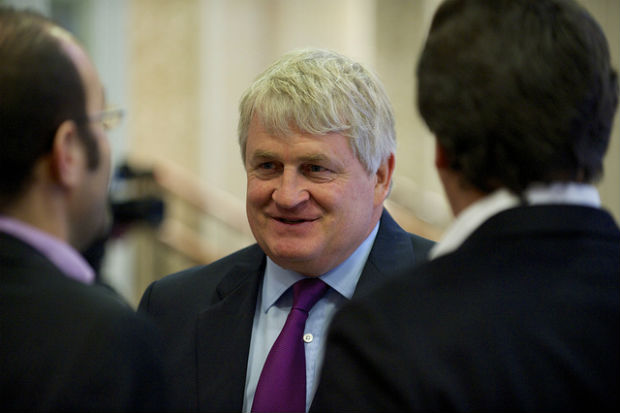
Denis O’Brien, Ireland’s richest media mogul and owner of the country’s largest newspaper group, had a satire malfunction last week when his solicitors, Meaghers, pursued up-and-coming satirical website Waterford Whispers.
The site, known as WWN, had published a fictional story about a parallel universe in which the tycoon had been convicted of white collar crime. The editors soon received a letter stating that “references to a ‘parallel universe’ are a sham”, and that the lawyers had instructions to take “all necessary steps to vindicate their client’s good name and reputation.”
Scary stuff for a fledgling operation. Editor Colm Williamson, faced with the wrath of O’Brien, understandably took the post down.
Then, political site Broadsheet.ie reported the threat to Waterford Whispers, including a screengrab of the original article. So, they, too, got a letter from Meaghers, as did their web hosting company, hostingireland.ie.
For all that, it would be wrong to characterise this as simply a rich and powerful man going after innocent upstart startups. That would be to denigrate O’Brien unfairly. For he is equally at home pursuing the parliament and the national broadcaster as he is pursuing people who write jokes.
As previously reported by this column, O’Brien took umbrage when an independent TD, Catherine Murphy, raised allegations over his business finances in the chamber of the Dáil. O’Brien got an injunction against RTE, the state broadcaster, from reporting the comments, in spite of the fact that, as Murphy enjoyed parliamentary privilege, her comments were available on the Oireachtas (parliament) website.
The Dáil’s Committee on Procedure and Privileges subsequently found that Murphy had not abused her parliamentary privilege, and that it could not rule on the veracity of her comments.
It emerged earlier this month that O’Brien is taking legal action against the committee protesting that decision. He is also taking legal action against the state: He is suing the country over comments made in parliament. Where the hell does satire go from here?
The answer is that satire has never had the most comfortable existence in Ireland, in spite of all our Swifts and Wildes and Becketts and O’Briens.
While we may be a people noted for our sense of humour, we’re deadly serious when it comes to ourselves. O’Brien, a man richer than Oprah, or Donald Trump for that matter, portrays himself throughout these proceedings as the innocent assailed on all sides. He is a citizen making a stand for all that is good and holy in a wicked world.
He, a decent man, a patriot no less, a man who volunteered to pay the wages of the national football team, is assailed by gombeens, ingrates and begrudgers who will do everything in their power to keep a good man down. These forces may take the form of the state or a small website. It doesn’t matter. What matters is there are external forces trying to destroy us. It’s probably a post-colonial thing. We can usually blame that.
But whatever the psychology behind it, O’Brien has engaged a scattergun assault on free speech. It’s fascinating to watch, as he turns one Waterford Whispers spoof story into a near-prophecy.
“Denis O’Brien To Sue Everyone”, read one Waterford Whispers headline in May of this year. “We’re particularly targeting people who have had negative thoughts about Denis in their head but have never uttered them in a public forum,” a fake solicitor was fictitiously quoted as saying in the entirely made up story.
And now? Well we haven’t reached that stage yet, but being honest, one does think twice about writing about Denis O’Brien. And this is only vague trepidation about covering publicly known libel threats. One wonders if editors on struggling titles will really have the stomach for sending a hack out to do some serious muckraking. That is not to suggest that anything will be found — simply that you don’t know until you look. That’s how journalism works.
That O’Brien makes a large part of his money from newspapers, radio and mobile phone communications bears repeating. The free exchange of information is his business. Perhaps he should show a little more respect to the principle and the practice.