7 Jan 2016 | Campaigns, Europe and Central Asia, France, mobile, Statements
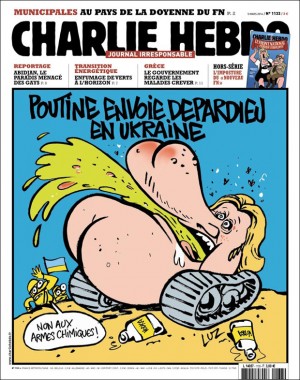
On the anniversary of the brutal attack on the offices of Charlie Hebdo we, the undersigned, reaffirm our commitment to the defence of the right to freedom of expression, even when that right is being used to express views that some may consider offensive.
The Charlie Hebdo attack, which left 11 dead and 12 wounded, was a horrific reminder of the violence to which journalists, artists and other critical voices are subjected in a global atmosphere marked by increasing intolerance of dissent. The killings inaugurated a year that has proved especially challenging for proponents of freedom of opinion.
Non-state actors perpetrated violence against their critics largely with impunity, including the brutal murders of four secular bloggers in Bangladesh by Islamist extremists, and the killing of an academic, M M Kalburgi, who wrote critically against Hindu fundamentalism in India.
Despite the turnout of world leaders on the streets of Paris in an unprecedented display of solidarity with free expression following the Charlie Hebdo murders, artists and writers faced intense repression from governments throughout the year. In Malaysia, cartoonist Zunar is facing a possible 43-year prison sentence for alleged ‘sedition’; in Iran, cartoonist Atena Fardaghani is serving a 12-year sentence for a political cartoon; and in Saudi Arabia, Palestinian poet Ashraf Fayadh was sentenced to death for the views he expressed in his poetry.
Perhaps the most far-reaching threats to freedom of expression in 2015 came from governments ostensibly motivated by security concerns. Following the attack on Charlie Hebdo, 11 interior ministers from European Union countries including France, Britain and Germany issued a statement in which they called on Internet service providers to identify and remove online content ‘that aims to incite hatred and terror.’ In July, the French Senate passed a controversial law giving sweeping new powers to the intelligence agencies to spy on citizens, which the UN Human Rights Committee categorised as “excessively broad”.
This kind of governmental response is chilling because a particularly insidious threat to our right to free expression is self-censorship. In order to fully exercise the right to freedom of expression, individuals must be able to communicate without fear of intrusion by the State. Under international law, the right to freedom of expression also protects speech that some may find shocking, offensive or disturbing. Importantly, the right to freedom of expression means that those who feel offended also have the right to challenge others through free debate and open discussion, or through peaceful protest.
On the anniversary of the Charlie Hebdo attacks, we, the undersigned, call on all Governments to:
- Uphold their international obligations to protect the rights of freedom of expression and information for all, and especially for journalists, writers, artists and human rights defenders to publish, write and speak freely;
- Promote a safe and enabling environment for those who exercise their right to freedom of expression, and ensure that journalists, artists and human rights defenders may perform their work without interference;
- Combat impunity for threats and violations aimed at journalists and others exercising their right to freedom of expression, and ensure impartial, timely and thorough investigations that bring the executors and masterminds behind such crimes to justice. Also ensure victims and their families have expedient access to appropriate remedies;
- Repeal legislation which restricts the right to legitimate freedom of expression, especially vague and overbroad national security, sedition, obscenity, blasphemy and criminal defamation laws, and other legislation used to imprison, harass and silence critical voices, including on social media and online;
- Ensure that respect for human rights is at the heart of communication surveillance policy. Laws and legal standards governing communication surveillance must therefore be updated, strengthened and brought under legislative and judicial control. Any interference can only be justified if it is clearly defined by law, pursues a legitimate aim and is strictly necessary to the aim pursued.
PEN International
ActiveWatch – Media Monitoring Agency
Adil Soz – International Foundation for Protection of Freedom of Speech
Africa Freedom of Information Centre
ARTICLE 19
Bahrain Center for Human Rights
Belarusian Association of Journalists
Brazilian Association for Investigative Journalism
Bytes for All
Cambodian Center for Human Rights
Canadian Journalists for Free Expression
Center for Independent Journalism – Romania
Center for Media Freedom and Responsibility
Comité por la Libre Expresión – C-Libre
Committee to Protect Journalists
Electronic Frontier Foundation
Foundation for Press Freedom – FLIP
Freedom Forum
Fundamedios – Andean Foundation for Media Observation and Study
Globe International Center
Independent Journalism Center – Moldova
Index on Censorship
Initiative for Freedom of Expression – Turkey
Institute for the Studies on Free Flow of Information
Instituto de Prensa y Libertad de Expresión – IPLEX
Instituto Prensa y Sociedad de Venezuela
International Federation of Journalists
International Federation of Library Associations and Institutions
International Press Institute
International Publishers Association
Journaliste en danger
Maharat Foundation
MARCH
Media, Entertainment and Arts Alliance
Media Foundation for West Africa
National Union of Somali Journalists
Observatorio Latinoamericano para la Libertad de Expresión – OLA
Pacific Islands News Association
Palestinian Center for Development and Media Freedoms – MADA
PEN American Center
PEN Canada
Reporters Without Borders
South East European Network for Professionalization of Media
Vigilance pour la Démocratie et l’État Civique
World Association of Community Radio Broadcasters – AMARC
PEN Mali
PEN Kenya
PEN Nigeria
PEN South Africa
PEN Eritrea in Exile
PEN Zambia
PEN Afrikaans
PEN Ethiopia
PEN Lebanon
Palestinian PEN
Turkish PEN
PEN Quebec
PEN Colombia
PEN Peru
PEN Bolivia
PEN San Miguel
PEN USA
English PEN
Icelandic PEN
PEN Norway
Portuguese PEN
PEN Bosnia
PEN Croatia
Danish PEN
PEN Netherlands
German PEN
Finnish PEN
Wales PEN Cymru
Slovenian PEN
PEN Suisse Romand
Flanders PEN
PEN Trieste
Russian PEN
PEN Japan
16 Sep 2015 | Magazine
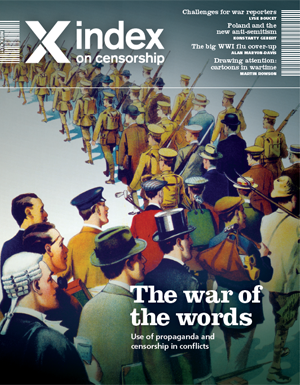
In conjunction with the Cambridge Festival of Ideas 2015, we will be publishing a series of articles that complement many of the upcoming debates and discussions. We are offering these articles from Index on Censorship magazine for free (normally they are held within our paid-for archive) as part of our partnership with the festival. Below is an article by cartoonist and author Martin Rowson, who regularly draws for the magazine, on the power of propaganda in wartime, taken from the spring 2014 issue. It’s a great starting point for those who plan to attend the War, Censorship and Propaganda: Does It Work session at the festival this year.
Index on Censorship is a global quarterly magazine with reporters and contributing editors around the world. Founded in 1972, it promotes and defends the right to freedom of expression.
As a political cartoonist, whenever I’m criticised for my work being unrelentingly negative, I usually point my accusers towards several eternal truths.
One is that cartoons, along with all other jokes, are by their nature knocking copy. It’s the negativity that makes them funny, because, at the heart of things, funny is how we cope with the bad – or negative – stuff.
Whether it’s laughing at shit, death or the misfortunes of others, without this hard-wired evolutionary survival mechanism that allows us to laugh at the awfulness running in parallel with being both alive and human, apes with brains the size of ours would go insane with existential terror as soon as the full implications of existence sink in. Which, for most people, would be when you’re around three years old.
And if that doesn’t persuade them, I usually then try to describe that indescribable but palpable transubstantiation that occurs when you shift from the negative to the positive, and a cartoon sinks from being satire to becoming propaganda.
Though here, of course, I’m not being entirely honest, because in many ways cartoons are propaganda in its purest form. This is because the methodology of the political cartoon has most in common with the practices of sympathetic magic and, likewise, its purposes are invariably malevolent.
Indeed, I’ve often described caricature in particular and political cartooning more generally as a type of voodoo, doing damage at a distance with a sharp object, in this case (usually) a pen.
Certainly the business of caricature is a kind of shamanist shape-shifting, distorting the appearance of the victim in order to bring them under the control of the cartoonist and subjecting them thereafter to ridicule or opprobrium. In short, political cartoons should truly be classified not as comedy but as visual taunts. And taunts, of course, have been an integral ingredient of warfare for millennia.
Within the twisted plaiting of taunts, posturing and brinkmanship that ultimately ended in the hecatombs of the Western Front in World War I you can just about tease out one thread trailing back to a cartoon.
The original sketch for the allegorical 1896 cartoon Nations of Europe: Join in Defence of Your Faith! was by Kaiser Wilhelm II of Germany, though he left the job of the finished artwork to professionals. Its purpose was to stiffen the resolve of European leaders against the “yellow peril” coming from east Asia, and to this end the Kaiser presented a copy of the cartoon to his cousin Tsar Nicholas II of Russia.
It’s generally agreed that the cartoon played a small but significant part in influencing the Tsar’s confrontational policy towards Japan, which ended in Russia’s humiliating defeat in the 1904-05 Russo-Japanese war.
The subsequent revolutions, regional wars and growing European instability erupted nine years later with the general mobilisation of the Great Powers, and the cartoonists were mobilised along with everyone else.
Although a perennial taunt against the Germans is that they have no sense of humour, they had as rich a tradition of visual satire as anyone else. In the pages of both Punch and the German satirical paper Simplicissimus, the enemy was caricatured identically as alternatively preposterous and terrifying. Both sides showed the other in league with skeletal personifications of Death, or transformed into fat clowns, foul or dangerous animals or, in British cartoons about Germans, as sausages.
There were also scores of cartoons showing German soldiers bayoneting Belgian babies in portrayals of “The Beastly Hun” and, later, cartoons showing the Germans harvesting the corpses of slain soldiers for fats to advance their war effort.
All sides taunted each other by attacking their nations’ supposed leaders, using the caricaturist’s typical tools. Thus the Kaiser, mostly thanks to his waxed moustache, acted as a synecdoche for Germany’s defining perfidy. In one cartoon from 1915, when Britain’s George V stripped his cousin, the Kaiser, of his Order of the Garter, his garterless stocking slips down, revealing a black and hairy simian leg. In 1914, meanwhile, the German cartoonist Arthur Johnson (his father was an American) showed the British Royal Family, German by descent, in a camp for enemy aliens.
These taunting cartoons bore little relation to the realities of modern warfare, and most of them would now be dismissed purely as rather ham-fisted propaganda. This shouldn’t downplay their effectiveness, however.
A century earlier Napoleon Bonaparte admitted he feared the damage done by James Gillray’s caricatures of him more than he feared any general, because Gillray always drew him as very short. (To bring this up to date, Le Monde’s cartoonist Plantu told me that every time he drew Nicolas Sarkozy as short, Sarkozy complained personally to his editor; the next cartoon would make him even shorter, and Sarkozy would complain again, until in the end Plantu drew the French president as just a head and feet.)
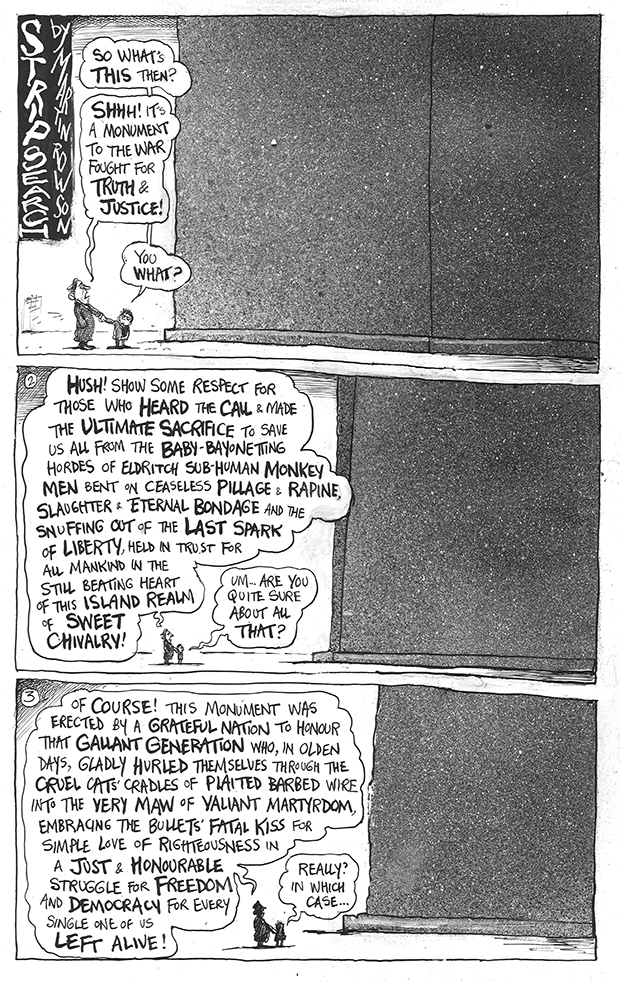
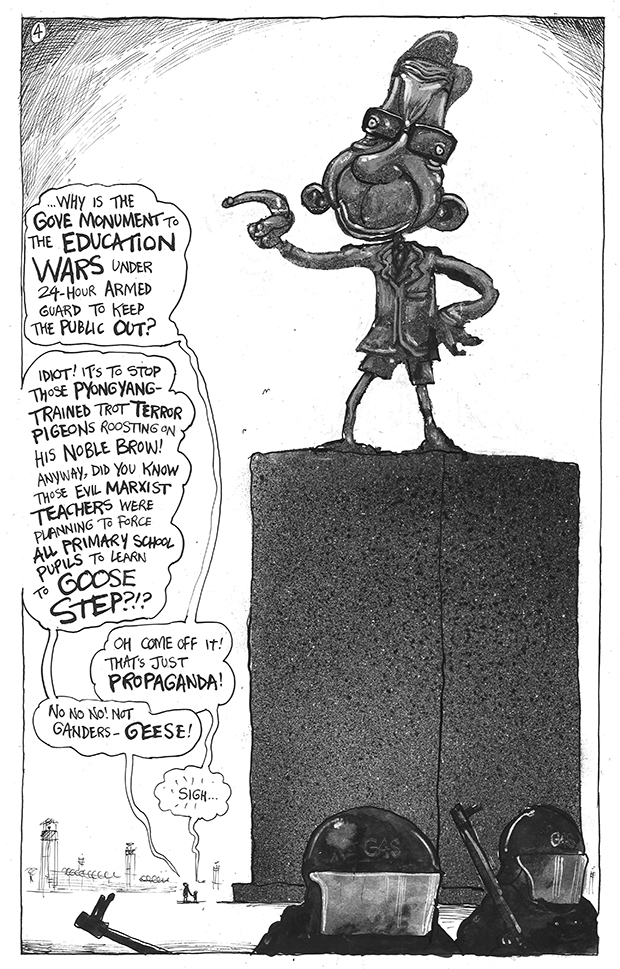
Nonetheless, an unforeseen consequence of this barrage of caricature was that in the end people stopped believing it to be anything more than merely caricature: the truth that should be exposed by the exaggeration got lost. In the 1930s, many people assumed reports of the genuine atrocities of the Nazis were, like the bayoneted babies or harvested corpses blamed on the Kaiser, just propaganda.
Posterity shouldn’t concern cartoonists. We’re just journalists responding to events with a raw immediacy. This is what gives the medium a great deal of its heft.
Some cartoons, however, encapsulate a time or an event and so become part of the more general visual language. Gillray’s The Plum Pudding in Danger is a perfect example, depicting the specific geopolitical struggle between William Pitt and Napoleon in 1805, while also capturing eternal truths about geopolitics itself. But I’m not aware of any political cartoons from World War I that do the same thing.
And yet the medium operates in many ways, and the most effective and popular cartoonist of World War I was undoubtedly Bruce Bainsfather, a serving artillery officer who drew gag cartoons about the slapstick of everyday life in the trenches in his series featuring “Old Bill”. The serving soldiers loved these cartoons, and they are another instance of humour being used to make the harshest imaginable reality simply bearable.
The other truly great cartoon to emerge from the World War I was published after it was all over. In his extraordinarily prophetic drawing Peace and Future Cannon Fodder for the Daily Herald, Will Dyson showed the Allied victors of the war exiting the Versailles peace conference and the French prime minister Georges Clemenceau saying: “Curious! I seem to hear a child weeping.” Behind a pillar a naked infant labelled “1940 class” is crying into its folded arms.
None of the protagonists in the next war doubted the power or importance of cartoons. Again, they were used by all sides to taunt and vilify their foes, perhaps most notoriously in Der Sturmer, the notorious anti-semitic paper edited by Julius Streicher, later hanged at Nuremburg.
Simplicissimus was, once more, taunting the British, this time drawing wartime prime minister, Winston Churchill, as a fat and murderous drunk; in the Soviet Union Stalin’s favourite cartoonist, Boris Yefimov, returned the compliment to the Nazi leadership (Yefimov’s older brother Mikhail first employed him on Pravda before being purged and executed in 1940; Boris survived him by 68 years, dying aged 108 in 2008). No cartoonist in either country would have dared caricature their own totalitarian politicians, but they were given full rein to exercise their skills on their nation’s enemies. In Britain, with its largely legally tolerated history of visual satire going back to 1695, things were slightly different, though also sometimes the same.
The New Zealand-born cartoonist David Low discovered in 1930 from a friend that Hitler, three years away from taking power in Germany, was an admirer of his work. Low did what any other cartoonist would do in similar circumstances and acknowledged his famous fan by sending him a signed piece of original artwork, inscribed “From one artist to another”.
It’s unknown what happened to the cartoon – maybe it was with him right to the end, in the bunker – but it soon became apparent that Hitler had mistaken Low’s attacks on democratic politicians for attacks on democracy itself. He was soon disabused. Low harried the Nazis all the way from the simple slapstick of The Difficulty of Shaking Hands with Gods of November 1933 to the bitterness of his iconic cartoon Rendezvous in September 1939, so much so that in 1936 British Foreign Secretary Lord Halifax, after a weekend’s shooting at Hermann Goering’s Bavarian hunting lodge, told Low’s proprietor at the Evening Standard, Lord Beaverbrook, to get the cartoonist to ease up as his work was seriously damaging good Anglo-German relations. Low responded by producing a composite cartoon dictator called “Muzzler”.
The Nazis had a point that Low entirely understood, and it was why he, along with many other cartoonists – Victor “Vicky” Weisz, Leslie Illingworth and even William Heath Robinson – were all on the Gestapo’s death list. In a debate on British government propaganda in 1943, a Tory MP said Low’s cartoon were worth all the official propaganda put together because Low portrayed the Nazis as “bloody fools”. Low himself later expanded on the point, comparing his work, which undermined the Nazis through mockery, with the work of pre-war Danish cartoonists who unanimously drew them as terrifying monsters. Low’s point was that it’s much easier to imagine you can beat a fool than a monster, and taunting your enemies as being unvanguishably frightening is no taunt at all.
The enduring efficacy of cartoons’ dark and magical voodoo powers were acknowledged in victory, when both Low and Yefimov were official court cartoonists at the Nuremburg war crimes tribunals (Low claimed Goering tried to outstare him from the dock): now the taunting was part of the humiliation served up with the revenge. Likewise, when Mussolini was executed by Italian partisans, the editor of the Evening Standard, Michael Foot, marked the dictator’s demise by giving over all eight pages of the paper to Low’s cartoons of Mussolini’s life and career.
Of course Low, unlike Yefimov, was actively hostile on the Home Front as well, producing cartoons critical of both the military establishment and Churchill. When Low’s famous creation Colonel Blimp, the portly cartoon manifestation of boneheaded reactionary thinking, took on fresh life in the Powell and Pressburger movie The Life and Death of Colonel Blimp, Churchill tried to have the film banned. When the Daily Mirror’s cartoonist Philip Zec responded to stories about wartime profiteering by contrasting them with attacks on merchant shipping in his famous cartoon The Price of Petrol has Been Increased by One Penny – Official, both Churchill and Home Secretary Herbert Morrison seriously considered shutting down the newspaper. (When the Guardian cartoonist Les Gibbard pastiched Zec’s cartoon during the Falklands war 40 years later, the Sun called for him to be tried for treason.)
And yet cartoons, for all their voodoo power, can still spiral off into all sorts of different ambiguities thanks to the way they inhabit different spheres of intent. Are they there to make us laugh, or to destroy them? Or both?
Ronald Searle drew his experiences while he was a prisoner of war of the Japanese, certainly on pain of death had the drawings been discovered, but taking the risk in order to stand witness to his captors’ crimes. Just a few years later, many of his famous St Trinian’s cartoons don’t just deal with the same topics – cruelty and beheadings – but share identical composition with his prisoner of war drawings.
And when Carl Giles, creator of the famous cartoon family that mapped and reflected post-war British suburban life weekly in the Sunday Express, was present as an official war correspondent at the liberation of the Bergen-Belsen concentration camp, the camp’s commandant, Josef Kramer, revealed he was a huge fan of Giles’ work and gave him his pistol, a ceremonial dagger and his Nazi armband in exchange for the promise that Giles would send him a signed original. As Giles explained later, he failed to keep his part of the bargain because by the time he got demobbed Kramer had been hanged for crimes against humanity.
Those twinned qualities of taunting and laughter go some way to explaining the experience of cartoonists in the so-called war on terror, if not the power of their work. In the aftermath of 9/11, in the Babel of journalistic responses to what was without question the most visual event in human history, then visually re-repeated by the media that had initially reported it, the cartoonists were the ones who got it in the neck. While columnists wrote millions of words of comment and speculation, and images captured by machines were broadcast and published almost ceaselessly, the images produced via a human consciousness were, it seems, too much to stomach for many. Cartoonists had their work spiked, or were told to cover another story (there were no other stories). In the US some cartoonists had their copy moved to other parts of the paper, or were laid off. One or two even got a knock on the door in the middle of the night from the Feds under the provisions of the Patriot Act.
Despite a concerted effort by some American strip cartoonists to close ranks on Thanksgiving Day 2001 and show some patriotic backbone, the example of Beetle Bailey flying on the back of an American Eagle didn’t really act as a general unifier. Unlike in previous wars, there was no unanimity of purpose among cartoonists. An editorial in The Daily Telegraph accused me, along with Dave Brown of The Independent and The Guardian’s Steve Bell, of being “useful idiots” aiding the terrorist cause due to our failure to fall in line.
The war on terror and its Iraqi sideshow were anything but consensus wars, and many cartoonists articulated very loudly their misgivings. These included Peter Brookes of the Murdoch-owned Times drawing cartoons in direct opposition to his paper’s editorial line. This has always been one of visual satire’s greatest strengths: sometimes a cartoon can undermine itself.
Moreover, because a majority of cartoons were back in their comfort zone of oppositionism, the taunting had less of the whiff of propaganda about it. Nor was there ever any suggestion in Britain of government censorship of any of this.
That said, the volume of censuring increased exponentially, thanks entirely to the separate but simultaneous growth in digital communication and social media. Whereas, previously, cartoons might elicit an outraged letter to an editor – let alone a death threat from the Gestapo – the internet allowed a global audience to see material to which thousands of people responded, thanks to email, with concerted deluges of hate email and regular death threats. I long since learned to dismiss an email death threat as meaningless – a real one requires the commitment of finding my address, a stamp and possibly a body part of one of my loved ones – but it’s the thought that counts.
More to the point was the second front in the culture-struggle at the heart of the war on terror, in which both sides fought to take greater offence. Amid the bombs, bullets and piles of corpses across Iraq, Afghanistan, Bali, Madrid, London and all the other places, the greatest harm you could suffer, it seemed was that you might be “offended”. People sent me hate emails and threatened to kill me and my children because they were “offended” by my depiction of George Bush, or by a cartoon criticising Israel, or a stupid humourous drawing of anything that might mildly upset them or their beliefs.
It was into this atmosphere that the row over the cartoons of Mohammed published by the Danish newspaper Jyllands Posten erupted, resulting in the deaths of at least 100 people (none of them cartoonists, but most of them Muslims, and many shot dead by Muslim soldiers or policemen). But that, of course, is another story. And – who knows? – may yet prove to be another war.
Martin Rowson’s cartoons appear regularly in The Guardian and Index on Censorship. His books include The Dog Allusion, Giving Offence and Fuck: the Human Odyssey.
© Martin Rowson and Index on Censorship
Join us on 25 October at the Cambridge Festival of Ideas 2015 for Question Everything an unconventional, unwieldy and disruptive day of talks, art and ideas featuring a broad range of speakers drawn from popular culture, the arts and academia. Moderated by Index on Censorship CEO Jodie Ginsberg.
This article is part of the spring 2014 issue of the global quarterly Index on Censorship magazine, with a special report on propaganda and war. Click here to subscribe to the magazine.
28 Jul 2015 | Magazine, mobile
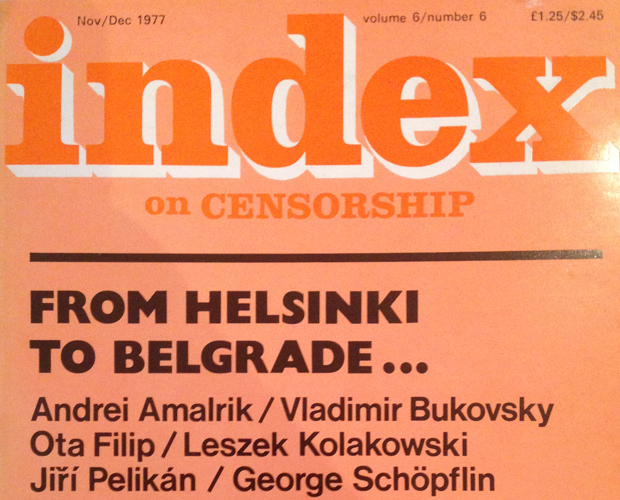
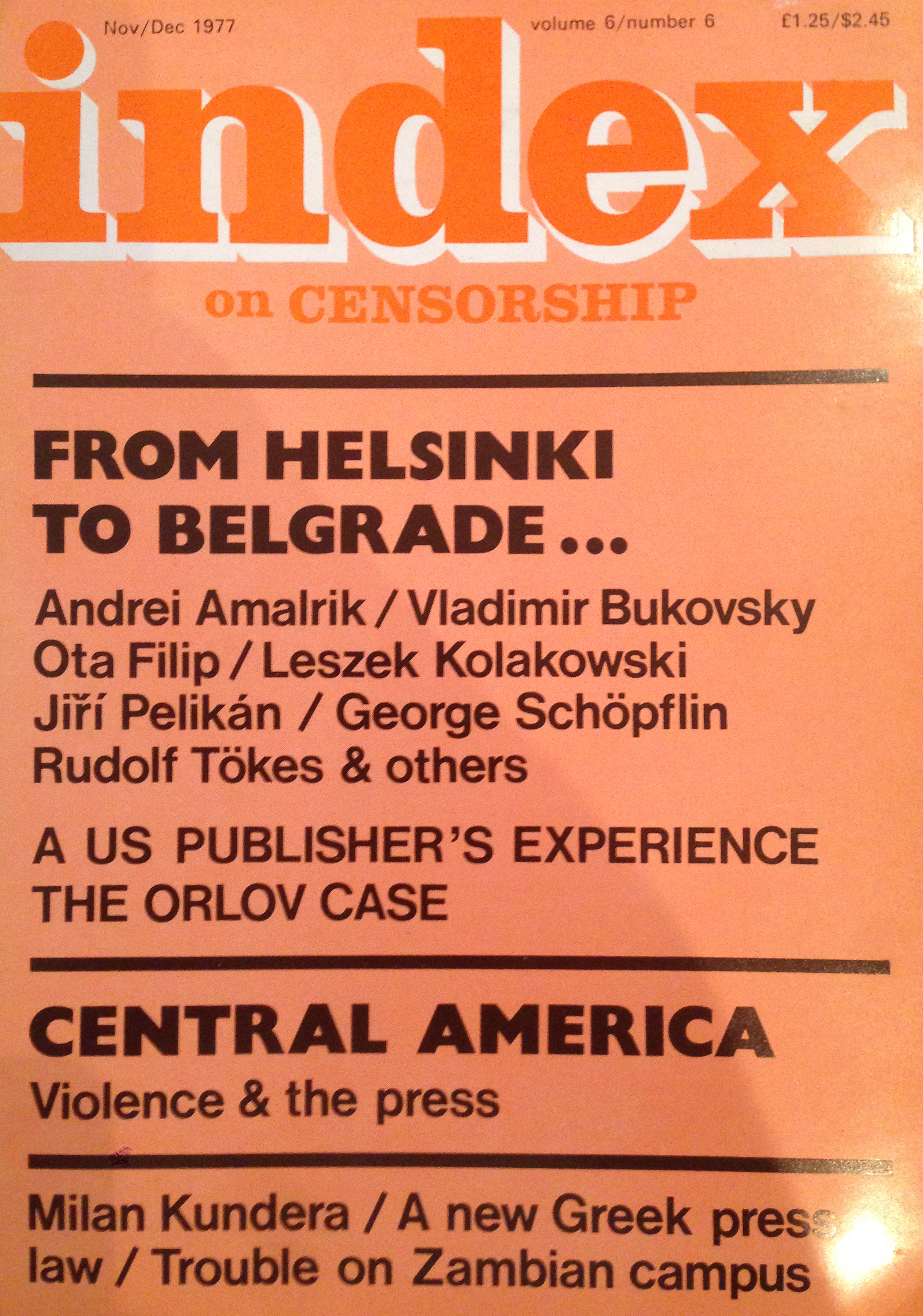
Index on Censorship magazine cover, November/December 1977
Novelist, playwright and short story writer Milan Kundera is one of the many Czech authors who, though they represent the best in their country’s contemporary literature, cannot publish their work in Prague. Acclaimed in France, where in 1973 he won a major literary prize for his last but one novel, and published in English, German, Dutch, Swedish, Finnish, Hebrew, Japanese and many other languages, he remains one of the 400 or more writers who are “on the index” in post-invasion, “normalised” Czechoslovakia.
Born in Brno forty-eight years ago, Kundera was until 1969 a professor at the Prague Film Faculty, his students including all the young film makers who were to bring fame to the Czechoslovak cinema in the sixties with such movies as The Firemen’s Ball, A Blonde in Love and Closely Observed Trains. In 1960 he published a highly influential essay, The Art of the Novel. Two years later the National Theatre put on his first play, The Owners of the Keys. Produced by Otomar Krejca, the play was an immediate success and was awarded the State Prize in 1963.
His first novel, The Joke, came out in 1967, being reprinted twice in a matter of months and reaching a total of 116,000 copies. This book, whose appearance was delayed by a long, determined struggle with the censor, opened the way to publication abroad, where Aragon called it one of the greatest novels of the century.
After the Soviet invasion Kundera was forced to leave the faculty, his work was no longer published in Czechoslovakia, all his books being removed from the public libraries. Since then, his works have only come out in translation. Life Is Elsewhere (see Index 4/1974, ppJ3-62) first appeared in Paris in 1973, where it won the Prix Medicis for the best foreign novel of the year. The French version of his latest novel, The Farewell Party, way published last year.
In 1975 Kundera was offered a professorship by the University of Rennes and obtained permission from the Czechoslovak authorities to go to France, which is now his second home. All his prose works now exist in English translation. (For an appraisal of his work, see Robert C. Porter’s article in Index 4/1975, pp.41-6). Unfortunately, The Joke – published by Macdonald in London and Coward McCann in New York in 1969 – was drastically cut without the author’s consent, forcing Kundera to write an indignant letter to the Times Literary Supplement, disclaiming all responsibility – an interesting case of a non-political, commercial censorship. The irony of the situation was certainly not lost on the author, who is a master of the genre. His collection of short stories, Laughable Loves (with a foreword by Philip Roth) and his other two novels have since been published by Knopf, and The Farewell Party has just been brought out by John Murray in London.
This selection of Kundera’s stimulating and often provocative views on such topics as the writer in exile, committed literature, the death of the novel, the nature of comedy, and so on, has been compiled by George Theiner.
Writing for translator
I am certainly in a rather odd situation. I write my novels in Czech. But since 1970 I have not been allowed to publish in my own country, and so no one reads me in that language. My books are first translated into French and published in France, then in other countries, but the original text remains in the drawer of my desk as a kind of matrix.
In the autumn of 1968 in Vienna I met a fellow-countryman, a writer, who had decided to leave Czechoslovakia for good. He knew that this meant his books would no longer be published there. I thought he was committing a form of suicide, and I asked him if he was reconciled to writing only for translators in future, if the beauty of his mother tongue had ceased to have any meaning for him. When I returned to Prague, I had two surprises in store for me: even though I didn’t emigrate, I too was forced from then on to write for translators only. And, paradoxical as it may seem, I feel it has done my mother tongue a lot of good.
Conciseness and clarity are, for me, what makes a language beautiful. Czech is a vivid, suggestive, sensuous language, sometimes at the expense of a firm order, logical sequence and exactitude. It contains a strong poetic element, but it is difficult to convey all its meanings to a foreign reader. I am very concerned that I should be translated faithfully. Writing my last two novels, I particularly had my French translator in mind. I made myself-at first unknowingly-write sentences that were more sober, more comprehensible. A cleansing of the language. I have a great affection for the eighteenth century. So much the better then if my Czech sentences have to peer carefully into the clear mirror of Diderot’s tongue.
Goethe once said to Eckermann that they were witnessing the end of national literature and the birth of a world literature. I am convinced that a literature aimed solely at a national readership has, since Goethe’s time, been an anachronism and fails to fulfil its basic function. To depict human situations in a way which makes it impossible for them to be understood beyond the frontiers of any single country is a disservice to the readers of that country too. By so doing we prevent them from looking further than their own backyard, we force them into a straitjacket of parochialism. Not to have one’s work published in one’s own country is a cruel lesson, but I think a useful one. In our times we must consider a book that is unable to become part of the world’s literature to be non-existent.
 Index on Censorship has been publishing articles on satire by writers across the globe throughout its 43-year history. Ahead of our event, Stand Up for Satire, we published a series of archival posts from the magazine on satire and its connection with freedom of expression.
14 July: The power of satirical comedy in Zimbabwe by Samm Farai Monro | 17 July: How to Win Friends and Influence an Election by Rowan Atkinson | 21 July: Comfort Zones by Scott Capurro | 24 July: They shoot comedians by Jamie Garzon | 28 July: Comedy is everywhere by Milan Kundera | Student reading lists: Comedy and censorship

Central Europe
As a Czech writer I don’t like being pigeon-holed in the literature of Eastern Europe. Eastern Europe is a purely political term barely thirty years old. As far as cultural tradition is concerned, Eastern Europe is Russia, whereas Prague belongs to Central Europe. Unfortunately, West Europeans don’t know their geography. This ignorance could be fatal, as indeed it has proved to be in the past. Remember Chamberlain in 1938 and his words about “a small country we know little about”.
The nations of Central Europe are small and far too well concealed behind a barrier of languages which no one knows and few study. And yet it is this very part of Europe which, over the past fifty years, has become a kind of crucible in which history has carried out incredible experiments, both with individuals and with nations. And the fact that those living in Western Europe have only very simplified notions, have never taken the trouble properly to study what is going on a few hundred kilometres from their own tranquil homes can, I repeat, be fatal to them.
From this Central Europe have come several major cultural impulses, without which our century would be unthinkable: Freud’s psychoanalysis; Schonberg’s dodecaphony; the novels of Kafka and Hasek, which have discovered a grotesque new literary world and the new poetry of the non-psychological novel; and finally structuralism, born and developed in Prague in the twenties, to become a fashion in West Europe thirty years later. I grew up with these traditions and have little in common with Eastern Europe. Forgive me if I seem to dwell on these ridiculous geographical details.
Small nations
Large nations are obsessed with the idea of unification. They see progress in unity. Even President Carter’s message to the inhabitants of outer space contains a passage expressing regret that the world is as yet divided into nations and the hope that it will soon come together in a single civilisation. As if unity were a cure for all ills. A small nation, in its efforts to maintain its very existence, fights for its right to be different. If unification is progress, then small nations are anti-progressive to the core, in the finest sense of the word. Big nations make history, small ones receive its blessings. Big nations consider themselves the masters of history and thus cannot but take history, and themselves, seriously. A small nation does not see history as its property and has a right not to take it seriously.
Franz Kafka was a Jew, Jaroslav Hasek a Czech – both members of a minority. When the First World War broke out, Europe was seized by a paroxysm of warlike nationalism, which did not spare even Thomas Mann or Apollinaire. In Franz Kafka’s diary we can read: “Germany has declared war on Russia. Went swimming in the afternoon“. And when, in 1914, Hasek’s Schweik learns that Ferdinand has been killed, he asks which one – the barber’s apprentice who once drank some hair oil, or was it the Ferdinand who collects dogshit on the pavement?
They say the greatness of life is to be found only where life transcends itself. But what if all transcendent life is history – which does not belong to us anyway? Is there only Kafka’s absurd
office? Only the daftness of Hasek’s army? Where then is the greatness, the gravity, the meaning of
it all? The genius of the minorities has discovered a world without gravity and greatness. Discovered its grotesqueness. Hegel’s concept of history -wise and ascending, like assiduous schoolgirls, ever higher on the staircase of progress – has been inconspicuously buried by Hasek and Kafka. In this sense we are their heirs.
Our Prague humour is often difficult to understand. The critics took Miloš Forman to task because in one of his films he made the audience laugh where they shouldn’t. Where it was out of place. But isn’t that just what it is all about? Comedy isn’t here simply to stay docilely in the drawer allotted to comedies, farces and entertainments, where “serious spirits” would confine it. Comedy is everywhere, in each one of us, it goes with us like our shadow, it is even in our misfortune, lying in wait for us like a precipice. Joseph K. is comic because of his disciplined obedience, and his story is all the more tragic for it. Hasek laughs in the midst of terrible massacres, and these become all the more un- bearable as a result. You see, there is consolation in tragedy. Tragedy gives us an illusion of greatness and meaning. People who have led tragic lives can speak of this with pride. Those who lack the tragic dimension, who have known only the comedies of life, can have no illusions about themselves.
When I came to France, the thing that astonished me most was the difference in national humour. The French are immensely humorous, witty, gay. But they take themselves and the world seriously. We are far more sad, but we take nothing seriously.
Committed literature
All my life in Czechoslovakia I fought against literature being reduced to a mere instrument
of propaganda. Then I found myself in the West only to discover that here people write about the literature of the so-called East European countries as if it were indeed nothing more than a propaganda instrument, be it pro- or-anti- Communist. I must confess I don’t like the word “dissident”, particularly when applied to art. It is part and parcel of that same politicising, ideological distortion which cripples a work of art. The novels of Tibor Dery, Miloš Forman’s films – are they dissident or aren’t they? They cannot be fitted into such a category. If you cannot view the art that comes to you from Prague or Budapest in any other way than by means of this idiotic political code, you murder it no less brutally than the worst of the Stalinist dogmatists. And you are quite unable to hear its true voice. The importance of this art does not lie in the fact that it accuses this or that political regime, but in the fact that, on the strength of social and human experience of a kind people over here cannot even imagine, it offers new testimony about the human conditions.
If by “committed” you mean literature in the service of a certain political creed, then let me tell you straight that such a literature is mere, conformity of the worst kind.
A writer always envies a boxer or a revolutionary. He longs for action and, wishing to take a direct part in real life, makes his work serve immediate political aims. The nonconformity of the novel, however, does not lie in its identification with a radical, opposition political line, but in presenting a different, independent, unique view of the world. Thus, and only thus, can the novel attack conventional opinions and attitudes.
There are commentators who are obsessed with the demon of simplification. They murder books by reducing them to a mere political interpretation. Such people are only interested in so-called “Eastern” writers as long as their books are banned. As far as they’re concerned, there are official writers and opposition writers – and that is all. They forget that any genuine literature eludes this sort of evaluation, that it eludes the Manichaeism of propaganda.
There are historical situations which open people’s souls the way you open a tin of sardines. Without the key offered to me by my country’s recent history, I would not, for instance, have been able to discover in Jaromil’s soul the incredible coexistence of the Poet and the Informer.
We have got into the habit of putting the blame for everything on “regimes”. This enables us not to see that a regime only sets in motion mechanisms which already exist in ourselves. A novel’s mission is not to pillory evident political realities but to expose anthropological scandals.
The death of the novel
Since the twenties, everyone seems to have been writing the obituary of the novel – the Surrealists, the Russian avant-garde, Malraux, who claims the novel has been dead since the time Malraux stopped writing novels, and so on and so forth. Isn’t it strange? No one talks about the death of poetry. And yet, since the great generation of Surrealists, I know of no truly great and innovatory work of poetry. No one talks about the death of the theatre. No one talks about the death of painting. No one talks about the death of music. Yet, since Schonberg, music has abandoned a thousand-year-old tradition based on tonality and on musical instruments. Varese, Xenakis . . . I am very fond of them, but is this still music? In any case, Varese himself preferred to speak about the organisation of sound rather than music. So, music may have been dead for several decades, yet no one talks about its demise. They talk about the death of the novel, though this is possibly the least dead of all art forms.
To speak of the end of the novel is a local preoccupation of West European writers, notably the French. It’s absurd to talk about it to a writer from my part of Europe, or from Latin America. How can one possibly mumble something about the death of the novel and have on one’s bookshelf A Hundred Years of Solitude by Gabriel Garcia Marquez? As long as there is human experience which cannot be depicted except in a novel, all conjectures about its having expired are mere expressions of snobbery. It is, of course, possibly true to say that the novel in Western Europe no longer provides many new insights and that for those we have to look to the other part of Europe and to Latin America.
I expect that all this talk of the death of the novel is due to the eschatological thinking of the avant-garde. Spurred on by revolutionary illusions, the avant-garde dreamed of installing a completely new art, a new era. If you like, in the spirit of Marx’s well-known saying about the prehistory and the history of mankind. From this point of view, the novel would belong to prehistory, while history would be ruled by poetry, in which all earlier genres would dissolve and vanish. It’s quite remarkable how this eschatological concept, utterly irrational though it is, has gained general acceptance, becoming one of the commonest clichis of the contemporary snob. He despises the novel, preferring to speak of’ a text’. According to him, the novel is a thing of the past (the prehistory of letters), and this in spite of the fact that the greatest strength of literature over the past 50 years has been in that very sphere-just take Robert Musii, Thomas Mann, Faulkner, Celine, Pasternak, Gombrowicz, Giinter Grass, Boll, or my dear friends, Philip Roth and Garcia Marquez.
The novel is a game with invented characters. You see the world through their eyes, and thus you
see it from various angles. The more differentiated the characters, the more the author and the reader have to step outside themselves and try to understand. Ideology wants to convince you that its truth is absolute. A novel shows you that everything is relative. Ideology is a school of intolerance. A novel teaches you tolerance and understanding. The more ideological our century becomes, the more anachronistic is the novel. But the more anachronistic it gets, the more we need it. Today, when politics have become a religion, I see the novel as one of the last forms of atheism.
When I was a boy I used to idealise the people who returned from political imprisonment. Then I discovered that most of the oppressors were former victims. The dialectics of the executioner and his victim is very complicated. To be a victim is often the best training for an executioner. The desire to punish injustice is not only a desire for justice, pure and simple, but also a subconscious desire for new evil…
Jacob knows all this when he thinks about others. He does not know it in relation to himself. So that all it needs is a single unguarded moment, when his reason takes a nap, and his subconscious dislike of people, his suppressed hatred, take over and an innocent girl dies. The more noble a person is, the darker the shadow of suppressed evil within.
A true novel always stands beyond hope and despair. Hope is not a value, merely an unproven supposition that things will get better. A novel gives you something far better than hope. A novel gives you joy. The joy of imagination, of narration, the joy provided by a game. That is how I see a novel – as a game. One of the characters in The Farewell Party occasionally has a halo round his head. The spa gynaecologist cures his patients by injecting his own semen and becomes the father of many children. Am I being serious, or is it just a joke? It is a game . . .
Of course, if the game is to be worthwhile, it must be played and must be about something serious. It must be a game with fire and demons. The game of the novel combines the lightest and the hardest, the most serious with the most light-hearted.
Milan Kundera is a Czech-born writer who has been living in exile in France since 1975.
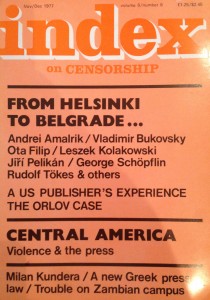 This article is from the November/December 1977 issue of Index on Censorship magazine and is part of a series of articles on satire from the Index on Censorship archives. Subscribe here, or buy a single issue. Every purchase helps fund Index on Censorship’s work around the world. For reproduction rights, please contact Index on Censorship directly, via [email protected]
2 Jun 2015 | Africa, Angola, mobile, News, Statements
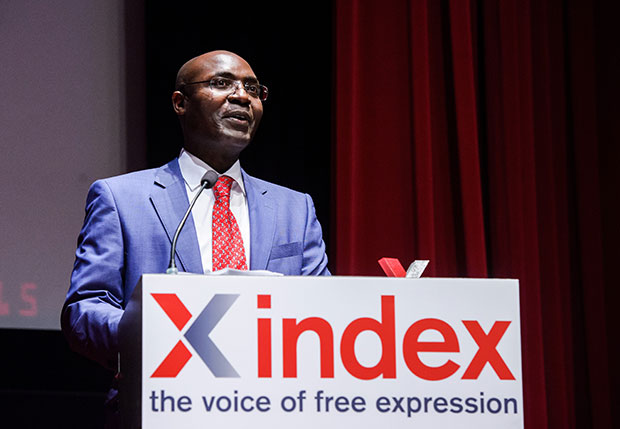
Journalist and human rights activist Rafael Marques de Morais (Photo: Alex Brenner for Index on Censorship)
International signatories from the worlds of technology, journalism, publishing, theatre, film and business, including jewellers Tiffany & Co, called on Angolan president José Eduardo dos Santos on Tuesday to drop the prosecution of award-winning investigative journalist Rafael Marques de Morais.
Marques was last week given a six-month suspended sentence following a trial in which he faced criminal defamation charges over his 2011 book on blood diamonds, which was published for the first time in English on Tuesday.
“Rafael’s trial was a sham. He was told charges would be dropped, only for him to be hit with new charges out of the blue, and he was not allowed to present his evidence or call witnesses,” said Jodie Ginsberg, CEO of freedom of expression group Index on Censorship, which organised the letter.
“Rafael is a courageous journalist, working with little support to expose corruption in Angola. This absurd trial and verdict is meant to stop him from speaking out. We want to make sure that does not happen.”
Marques was awarded an Index on Censorship Freedom of Expression award in March for his work. Signatories to the letter include jewellers Tiffany & Co.; tech entrepreneurs Martha Lane Fox, one of the judges of the awards, and Wikipedia founder Jimmy Wales; authors Philip Pullman, Neil Gaiman and Elif Shafak; actors Janet Suzman, Juliet Stevenson, and Simon Callow; playwrights Howard Brenton and Timberlake Wertenbaker; as well as Steve McQueen, director of Oscar-winning film 12 Years a Slave. Other signatories included journalists Sir Harold Evans and Christina Lamb; and artists and writers with direct experience of censorship, such as Syrian political cartoonist Ali Ferzat and Azerbaijani journalist Idrak Abbasov.
The letter will be delivered by Index on Censorship to the Embassy of Angola in London on Tuesday, June 2.
For more information, contact David Heinemann on 0207 260 2664 or email [email protected].
The letter
We, the undersigned, call on Angolan President José Eduardo dos Santos to drop the prosecution of journalist Rafael Marques de Morais.
Marques’ vital investigations into human rights abuses should not be impeded by the threat of jail, which is set to loom over him for two years under the court’s terms.
His conviction and six-month suspended sentence are a clear violation of the rights to free expression, to a free press and to a fair trial.
Marques’ reporting is fundamental not only to Angola, but to the world at large.
We call on you to ensure standards of international law are applied during the appeal process.
Yours faithfully,
Ali Ferzat, cartoonist
Angela Quintal, editor, Mail & Guardian, South Africa
Dame Ann Leslie, journalist
Anthony Barling, lawyer
Art Kaufman, World Movement for Democracy
Bob Fu, founder and president, ChinaAid
Brilliant Earth Jewellery
Carl Gershman, president, National Endowment for Democracy
Chantal Uwimana, Transparency International
Chie Murakami, director general, Diamonds for Peace, Japan
Christopher Hird, film producer
Christophe Deloire, secretary-general, Reporters Without Borders
Christina Lamb OBE, journalist
David Aaronovitch, columnist
David Harewood MBE, actor
David McCune, publisher
David Schlesinger, founder, Tripod Advisors
Dreda Say Mitchell, author
Edward Fitzgerald CBE QC, lawyer
Elaine Potter, journalist
Elif Shafak, author
Geoffrey Hosking OBE, historian
Grigory Pasko, journalist
Sir Harold Evans, journalist
Howard Brenton, playwright
Idrak Abbasov, journalist
Janet Suzman, actor and director
Jesper Højberg, executive director, International Media Support
Jeffrey Smith, Robert F Kennedy Centre for Justice & Human Rights
Jimmy Wales, founder, Wikipedia
Jodie Ginsberg, chief executive, Index on Censorship
John Witherow, editor, The Times, UK
Juliet Stevenson, actor
Kamila Shamsie, author
Kostas Vaxevanis, journalist
Lara Pawson, author of In the Name of the People: Angola’s Forgotten Massacre
Larry Kilman, secretary-general, World Association of Newspapers and News Publishers
Leber Jeweler Inc
Lee Hirsch, film director
Lindsey Hilsum, journalist
Louise Redvers, journalist
Mariane Pearl, journalist
Mark Stephens CBE, senior member, Howard Kennedy LLP
Martha Lane Fox CBE, House of Lords
Mary Lawlor, executive director, Front Line Defenders
Maya Wolfe-Robinson, journalist
Matthew d’Ancona, journalist
Matthew Parris, journalist
Mohamed Al-Dharadji, film director
Neil Gaiman, author
Paul Webster, film producer
Peter Oborne, journalist
Peter Kellner, president, YouGov
Peter Pomerantsev, author
Peter Tatchell, director, Peter Tatchell Foundation
Philip Pullman, author
Rahim Haciyev, editor, Azadliq, Azerbaijan
Richard Sambrook, director, Centre for Journalism, Cardiff University
Ronald Deibert, academic
Robert McCrum, writer and editor
Sanar Yurdatapan, Initiative for Freedom of Expression, Turkey
Shubhranshu Choudhary, journalist
Simon Callow CBE, actor
Steve McQueen CBE, film director
Sue Woodford-Hollick OBE, businesswoman
Sue Valentine, Committee to Protect Journalists Africa Programme
Suzanne Nossel, executive director, PEN American Centre
Stephen Hull, editor-in-chief, Huffington Post UK
Thomas Hughes, executive director, Article 19
Tiffany & Co.
Timberlake Wertenbaker, playwright
Turi Munthe, founder, Demotix
Yoav Shamir, filmmaker
Ziyad Marar, publisher