24 May 2016 | Azerbaijan, Azerbaijan News, Belarus, Belgium, Bosnia, Croatia, Europe and Central Asia, France, Germany, Greece, Index Reports, Macedonia, Mapping Media Freedom, mobile, News, Poland, Serbia, Spain, Turkey, Ukraine
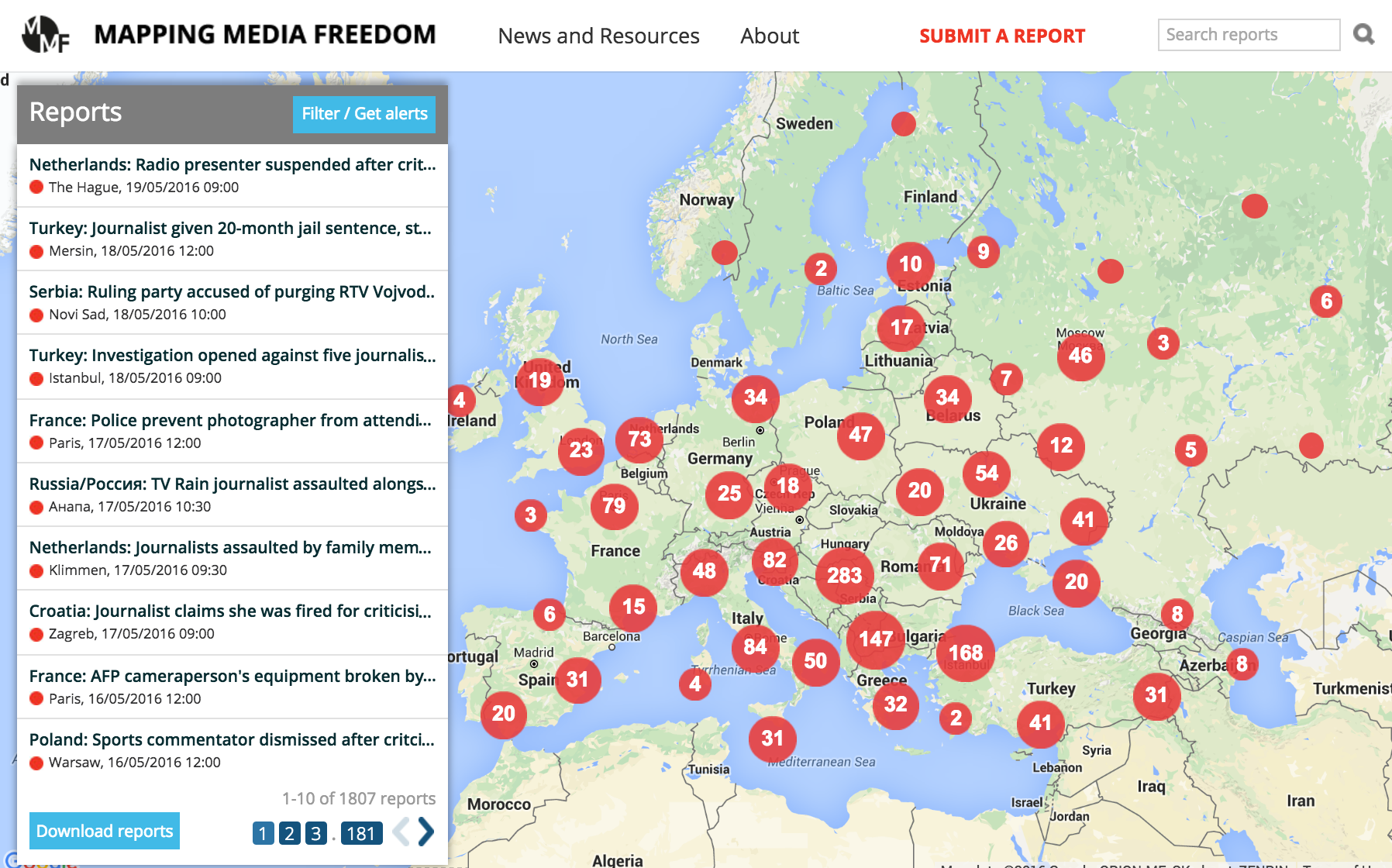
Mapping Media Freedom launched to the public on 24 May 2014 to monitor media censorship and press freedom violations throughout Europe. Two years on, the platform has verified over 1,800 media violations.
“The data the platform has collected over the last two years confirms that the state of press freedom across Europe is deplorable,” said Hannah Machlin, project officer for Mapping Media Freedom. “Media violations are occurring regularly in countries with strong democratic institutions and protective laws for journalists. Legislation limiting the press, violence across the continent and authoritarian governments are also fuelling this rapid and worrying decline. We hope that institutions and leaders take note of this information and take action swiftly.”
To mark the anniversary, we asked our correspondents to pick a key violation that stood out to them as an example of the wider picture in their region.
Russia / 113 verified reports
Several journalists and human rights activists attacked in Ingushetia
“The brutal attack on a minibus carrying six journalists and several human rights activists near the border between Ingushetia and Chechnya on the 9 March 2016 demonstrates the dangers faced by media professionals working in Russia’s North Caucasus. No suspects have been established so far. This case stands out due to its extreme violence but also supports a common trend: the reluctance of the local authorities to ensure that the journalists’ rights are respected.” – Ekaterina Buchneva
Italy / 190 verified reports
97 journalists accused of breaking the law in mafia investigation
“This was a very relevant investigation, with no precedent, that took place in October, a few weeks away from the start of the trial known as Mafia Capitale, which concerns the scandal that involved the government of the city of Rome. It is a collective intimidation because it involved 97 journalists, who were denounced for violating the secret on the ongoing investigations. It is a really serious form of intimidation because it was activated within the field of law and thus is not punishable.” – Rossella Ricchiuti
Turkey / 57 verified reports
Zaman newspaper seized by authorities
“These attacks and actions taken by the government against independent media in Turkey attest to the shrinking space of independent media overall. In addition, it illustrates the shifting power dynamic within the ruling government in Turkey where once upon a time friends, are turned into enemies by the regime. As the paper wrote itself, Turkey is headed through its ‘darkest and gloomiest days in terms of freedom of the press.'” – MMF’s Turkey correspondent
Azerbaijan/ 5 verified reports
Writer banned from leaving country
“Aylisl’s 12-hour interrogation at the airport and later charges of hooliganism were just as absurd as the claim that a 79-year-old man, suffering from a heart condition and other health issues would attack an airport employee to such an extent that it would cause hemorrhage. I chose this example to illustrate the absurdity of charges brought against individuals in Azerbaijan but also the extent to which the regime is ready to go in order to muzzle those voices who different.” – MMF’s Azerbaijan correspondent
Macedonia / 59 verified reports
Deputy Prime Minister attacks journalist
“This incident best demonstrates the division in society as a whole and among journalists as a professional guild. This is a clear example of how politicians and elites look upon and treat the journalist that are critical towards their policies and question their authority.” – Ilcho Cvetanoski
Bosnia / 56 verified reports
Police raid Klix.ba offices
“This was the most serious incident over the last two years in Bosnia regarding the state’s misuse of institutions to gag free media and suppress investigative journalism. In this specific incident, the state used its mechanisms to breach media freedoms and send a chilling message to all other media.” – Ilcho Cvetanoski
Croatia / 64 verified reports
Journalist threatened by disbanded far-right military group
“After the centre-right government in Croatia came to power in late 2015, media freedom in the country rapidly deteriorated. Since then around 70 media workers in the public broadcaster were replaced or removed from their posts. This particular case of the prominent editor-in-chief of the weekly newspaper Novosti receiving a threatening letter from anonymous disbanded military organisation demonstrates the polarisation in the society and its affect on media freedom.” – Ilcho Cvetanoski
Greece / 34 verified reports
Golden Dawn members assault journalists covering demonstration
“This was the second attack against journalists by Golden Dawn members within one month. With more than 50,000 asylum seekers and migrants trapped in Greece, the tension between members of the far-right group and anti-fascist organisations is rising.” – Christina Vasilaki
Poland / 35 verified reports
Over 100 journalists lose jobs at public broadcasters
“This report highlights the extent of the ongoing political cleansing of the public media since the new media law was passed in early January.” – Martha Otwinowski
Germany / 74 verified reports
Journalist stops blogging after threats from right-wing extremists
“The MMF platform lists numerous incidents where German journalists have been threatened or physically assaulted by right-wing extremists over the last two years. This incident stands out as a case of severe intimidation that resulted in silencing the journalist altogether.” – Martha Otwinowski
Belgium / 19 verified reports
Press asked to respect lockdown during anti-terrorism raids
“On 22 November 2015, the Belgian authorities asked the press to refrain from reporting while a big anti-terrorist raid was taking place in Brussels. While understandable, this media lock-down raised questions for press freedom and underlined the difficulties of reporting on terror attacks and anti-terror operations.” – Valeria Costa-Kostritsky
Luxembourg / 2 verified reports
Investigative journalist on trial for revealing Luxleaks scandal
“This Luxleaks-related case is the only violation we have become aware in Luxembourg over the period (which is not to say that no other cases occurred). Along with two whistleblowers, a journalist was prosecuted by PricewaterhouseCoopers and accused of manipulating a whistleblower into leaking documents. This is a good example of the threat the notion of trade secrets can represent to journalism.” – Valeria Costa-Kostritsky
Ukraine / 127 verified reports
Website leaks personal information of more than 4,000 journalists
“This incident shows how fragile the media freedom and personal data of journalists are in armed conflict. Even after a great international scandal, the site continues to break the legislation and publishes new lists. It has been operating for two years already and those involved in its activities go unpunished. It seems that the post-Maidan Ukraine has simply ‘no political will’ for this.” – Tetiana Pechonchyk
Crimea / 18 verified reports
Journalists’ homes searched, criminal case filed
“This report shows the everyday life of independent journalists working on the peninsula. Only a few critical voices are still remaining in Crimea while the majority of independent journalists were forced to leave the profession or to leave Crimea and continue their work on the mainland Ukraine.” – Tetiana Pechonchyk
Spain / 49 verified reports
Journalist fined for publishing photos of arrest
“The latest issue for the Spanish media is the Public Security Law, introduced in June 2015, which among other things limits space for reporters. The law prohibits the publication of photo and video material where police officers may be identified, unless official state permission is obtained. This was the first case of a journalist being fined by the new law.” – Miho Dobrasin
Belarus / 47 verified reports
Journalist beaten by police, detained and fined for filming police attacks
“The story has ended in impunity: a criminal case was not even filed against the police officers who had beaten the journalist.” – Volha Siakhovich
Latvia / 12 verified reports
Latvia and Lithuania ban Russian-language TV channels
“This was the beginning of a disturbing tendency to react with rather futile gestures against Russian television channels. The bans are not so much against the media, as telling the audience that the authorities, not the public, will decide what Latvian viewers may or may not see or hear.” – Juris Kaža
Serbia / 110 verified reports
Investigative journalists victim of smear campaign
“You have to be very brave to launch a new investigative journalism portal in Serbia and expose corruption and organised crime involving government officials. That is why the launch of KRIK in early 2015 has been so important for media freedom, but at the same time so dangerous for its journalists. Smear campaigns like this by pro-government tabloid Informer are a relatively new but common method in the Balkans to scare journalists off.” – Mitra Nazar
8 Jan 2016 | Belarus, Greece, Hungary, Italy, Lithuania, Macedonia, Mapping Media Freedom, News, Poland, Portugal, Serbia, Turkey
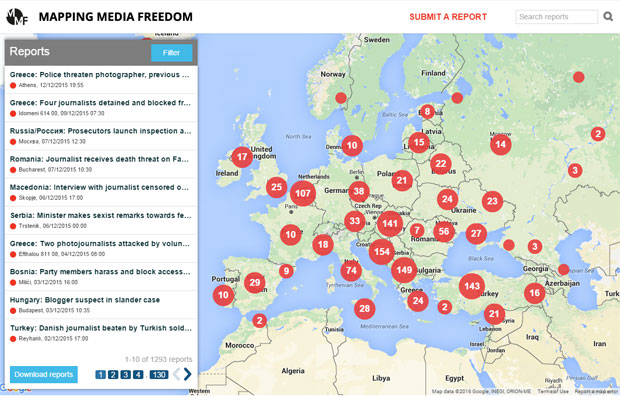
The attacks on the offices of satirical magazine Charlie Hebdo in Paris in January set the tone for conditions for media professionals in 2015. Throughout the year, Index on Censorship’s Mapping Media Freedom correspondents verified a total of 745 violations of media freedom across Europe.
From the murders of journalists in Russia, Poland and Turkey to the growing threat posed by far-right extremists in Germany and government interference in Hungary — right down to the increasingly harsh legal measures imposed on reporters right across the continent — Mapping Media Freedom exposed many difficulties media workers face in simply doing their jobs.
“Last year was a tumultuous one for press freedom; from the attacks at Charlie Hebdo to the refugee crisis-related aggressions, Index observed many threats to the media across Europe,” said Hannah Machlin, Index on Censorship’s project officer for the Mapping Media Freedom project. “To highlight the important cases and trends of the year, we’ve asked our correspondents, who have been carefully monitoring the region, to discuss one violation each that stood out to them.”
Belarus / 19 verified reports between May-Dec 2015
Journalist blocked from shooting entrance to polling station
“It demonstrates the Belarusian authorities’ attitude to media as well as ‘transparency’ of the presidential election – the most important event in the current year.” — Ольга К.-Сехович
Greece / 15 verified reports in 2015
Four journalists detained and blocked from covering refugee operation
“This is important because it is typical ‘attempt to limit press freedom’, as the Union wrote in a statement and it is not very hopeful for the future. The way refugees and migrants are treated is very sensitive and media should not be prevented from covering this issue.” — Christina Vasilaki
Hungary / 57 verified reports in 2015
Serbian camera crew beaten by border police
“These physical attacks, the harsh treatment and detention of journalists are striking because the Hungarian government usually uses ‘soft censorship’ to control media and journalists, they rarely use brute force.” — Zoltan Sipos
Italy / 72 verified reports in 2015
Italian journalists face up to eight years in prison for corruption investigation
“I chose it because this case is really serious: the journalists Emiliano Fittipaldi and Gianluigi Nuzzi are facing up to eight years in prison for publishing books on corruption in the Vatican. This case could have a chilling effect on press freedom. It is really important that journalists investigate and they must be free to do that.” — Rossella Ricchiuti
Lithuania / 9 verified reports in 2015
Journalist repeatedly harassed and pushed out of local area
“I chose it because I found it relevant to my personal experience and the fellow journalist has been the only one to have responded to my hundreds of e-mails — including requests to fellow Lithuanian journalists to share their personal experience on media freedom.” — Linas Jegelevicius
Macedonia / 27 verified reports in 2015
Journalist publicly assaults another journalist
“I have chosen this incident because it best describes the recent trend not only in Macedonia and my other three designated countries, Croatia, Bosnia and Montenegro, but also in the whole region. And that is polarization among journalists, more and more verbal and, like in this unique case, physical assaults among colleagues. It best describes the ongoing trend where journalists are not united in safeguarding public interest but are nothing more than a tool in the hands of political and financial elites. It describes the division between pro-opposition and pro-government journalists. It is a clear example of absolute deviation from the journalistic ethic.” — Ilcho Cvetanoski
Poland / 11 verified reports in 2015
Law on public service broadcasting removes independence guarantees
“The new media law, which was passed through Poland`s two-chamber parliament in the last week of December, constitutes a severe threat to pluralism of opinions in Poland, as it is aimed at streamlining public media along the lines of the PiS party that holds the overall majority. The law is currently only awaiting president Duda’s signature, who is a close PiS ally.” — Martha Otwinowski
Portugal / 9 verified reports in 2015
Two-thirds of newspaper employees will be laid off
“It’s a clear picture of the media in Portugal, which depends on investors who show no interest in a healthy, well-informed democracy, but rather in how owning a newspaper can help them achieve their goals — and when these are not met they don’t hesitate to jump boat, leaving hundreds unemployed.” — João de Almeida Dias
Russia / 37 verified reports between May-Dec 2015
Media freedom NGO recognised as foreign agent, faces closure
“The most important trend of the 2015 in Russia is the continuing pressure over the civil society. More than 100 Russian civil rights advocacy NGOs were recognized as organisations acting as foreign agents which leads to double control and reporting, to intimidation and insulting of activists, e.g., by the state-owned media. Many of them faced large fines and were forced to closure.” — Andrey Kalikh
Russia / 37 verified reports between May-Dec 2015
TV2 loses counter claim to renew broadcasting license Roskomnadzor
“It illustrates the crackdown on independent local media, which can not fight against the state officials even if they have support from the audience and professional community.” — Ekaterina Buchneva
Serbia / 41 verified reports in 2015
Investigative journalist severely beaten with metal bars
“It’s a disgrace and a flash-back to Serbia’s dark past that a journalist, who’s well known for investigating high-level corruption, get’s beaten up with metal bars late at night by ‘unknown men’.” — Mitra Nazar
Turkey / 97 verified reports in 2015
Police storm offices of Koza İpek, interrupting broadcast
“The raid on Bugün and Kanaltürk’s offices just days ahead of parliamentary elections was a drastic example — broadcasts were cut by police and around 100 journalists ended up losing their jobs over the next month — of how the current Turkish government tries to strong-arm media organisations.” — Catherine Stupp
Mapping Media Freedom
Click on the bubbles to view reports or double-click to zoom in on specific regions. The full site can be accessed at https://mappingmediafreedom.org/
|
8 Dec 2015 | Belarus, Mapping Media Freedom, mobile, News
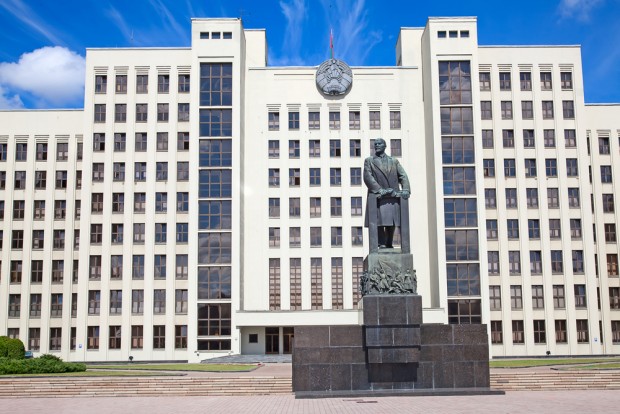
Credit: Shutterstock / Fedor Selivanov
Miklos Haraszti, the UN Special Rapporteur on Human Rights in Belarus, has called for reforms to the country’s laws and practices that for two decades have stifled freedom of expression.
“Critical opinion and fact-finding are curtailed by the criminalisation of content that is deemed ‘harmful for the State’; by criminal defamation and insult laws that protect public officers and the president, in particular, from public scrutiny; and by ‘extremism’ laws that ban reporting on political or societal conflicts,” Haraszti said in a 6 November statement.
Belarus anti-extremism law came into force in 2007. According to Article 14 of the Law On Countering Extremism, it is prohibited to publish and or disseminate extremist materials, even through the media. Information products propagandising extremist activities can be seized by the decision of state security services, law enforcement agencies, prosecutor’s office or courts. If deemed extremist, the court can order the materials be destroyed.
The threat for free speech lies in the broad definitions of “extremist activities” and “extremist materials”. Under Belarusian law, extremist activities include “degrading of national honor and dignity”. Such provisions are contrary to international standards of freedom of expression.
“Unfortunately, this is one of the indicators of the current legislation of Belarus – the absolute vagueness of definitions and the absolute possibility of law enforcement to interpret them as they want,” Andrey Bastunets, chairperson of Belarusian Association of Journalists, said.
Critical materials regarded as extremist can end up banned. In 2011, the Ministry of Information issued a warning to Autoradio for broadcasting a message “containing calls for extremist activities”. The warning concerned a phrase by Andrei Sannikau, candidate for the presidency in 2010, that “the fate of the country is solved in the square, not in the kitchen”. The Supreme Economic Court and the National Commission on Broadcasting upheld the warning and the radio was stripped of its frequency.
The law has led to frequent seizures of imported printed material and videos by Belarusian customs offices. Usually, the seized materials are examined to determine if the items are extremist, but it is unclear how to properly get any property out of impound. Often the rightful owners are forced to repeatedly ask for the return of their material.
One of the most sensational cases related to “countering extremism” was the recognition of Belarus Press Photo 2011 album as extremist materials in 2013. The album contained images that won in 2011 the National Press Photo contest — an open annual contest of press photography. In November 2012, 41 copies of the album were seized for expert examination at the border with Lithuania border from three photojournalists, who were organisers of the contest.
Then the Belarusian KGB’s Hrodna regional department initiated proceedings to categorise the album as extremist material. Ashmiany District Court decided that the publication under consideration was extremist. The court’s decision was based on the KGB’s report that “the choice of the photos for the photo album in the aggregate reflects only negative sides of the life of the Belarusian people, together with the author’s own insinuations and conclusions, which, with the view of the socially accepted norms and morals, insults the national honor and dignity of citizens of the Republic of Belarus, diminishes the authority of the state power organs, undermines the trust of foreign states, foreign and international organisations to them.”
As a result, the seized copies of the album were ordered to be destroyed. Further, the court decision served as grounds to withdraw the license from Lohvinau, the publisher of the album. At least 17 anti-extremism motivated seizures of publications have been carried out by Belarusian customs officers since then.
In 2014, the National Commission of Experts on Assessment of Information Productions Regarding Extremist Contents was established as a permanent body with regional subcommissions set up in the regions. Two-thirds of the National Commission’s members are state officials — including representatives of the KGB and customs — who often initiate proceedings to recognise a material as extremist. In the first six months of its existence, the National Commission considered over 100 different publications, 25 of which have been recognised as extremist.
In November 2015, Belarusian customs officers seized two publications for expert examination.
On 10 November 2015, Oleksandr Doniy and four other Ukrainian TV journalists were interrogated and searched by Belarusian officers at the Ukraine-Belarus border while traveling by car to Vilnius, Lithuania. The journalists, who were working for the cultural programme Last Barricade, were held for five hours. A total of 22 items were seized, including five copies of a documentary about the Ukrainian Revolution (1917-1921) and 11 books, among them Confession From a Condemned Cell, Marshal Zhukov and Ukrainians During World War II. The Ukrainian journalists have been accused of importing “extremist literature and audio productions”.
On 19 November 2015, a number of human rights books were seized by customs officers from Aliaksandr Hanevich who was returning to Belarus from Lithuania. Those were De-facto Implementation of International Human Rights Standards: The Experience of Belarusian ILIA Program Alumni, Enlightened by Belarusianness by Ales Bialiatski, My Fight by Valery Hrytsuk, The Death Penalty in Belarus and Pervasive Violations of Labor Rights and Forced Labor in Belarus.
Besides the anti-extremism law, the grounds for stifling freedom of speech are contained in the Law On Mass Media. In the beginning of 2015, the new Article 51.1 was incorporated that set the procedure for restricting access to online information resources. It can be carried out extrajudicially by the decision of the ministry of information upon the request of any state body if the online resource disseminates information prohibited by law. The law also prohibits propaganda of extremist activities. Blocking websites can follow only one violation of the law, within three months since it occurred. This concerns access to both Belarusian and foreign websites viewed in Belarus.
In 2015, the ministry of information has restricted access to 40 websites, 11 of them have been blocked for disseminating extremist materials.
Mapping Media Freedom
Click on the bubbles to view reports or double-click to zoom in on specific regions. The full site can be accessed at https://mappingmediafreedom.org/
|
27 Nov 2015 | Campaigns, Middle East and North Africa, mobile, Palestine, Statements
We, the undersigned organisations, all dedicated to the value of creative freedom, are writing to express our grave concern that Ashraf Fayadh has been sentenced to death for apostasy.
Ashraf Fayadh, a poet, artist, curator, and member of British-Saudi art organisation Edge of Arabia, was first detained in August 2013 in relation to his collection of poems Instructions Within following the submission of a complaint to the Saudi Committee for the Promotion of Virtue. He was released on bail but rearrested in January 2014.
According to court documents, in May 2014 the General Court of Abha found proof that Fayadh had committed apostasy (ridda) but had repented for it. The charge of apostasy was dropped, but he was nevertheless sentenced to four years in prison and 800 lashes in relation to numerous charges related to blasphemy.
At Ashraf Fayadh’s retrial in November 2015 the judge reversed the previous ruling, declaring that repentance was not enough to avoid the death penalty. We believe that all charges against him should have been dropped entirely, and are appalled that Fayadh has instead been sentenced to death for apostasy, simply for exercising his rights to freedom of expression and freedom of belief.
As a member of the UN Human Rights Council (HRC), the pre-eminent intergovernmental body tasked with protecting and promoting human rights, and the Chair of the HRC’s Consultative Group, Saudi Arabia purports to uphold and respect the highest standards of human rights. However, the decision of the court is a clear violation of the internationally recognised rights to freedom of conscience and expression. Article 18 of the Universal Declaration of Human Rights (UDHR) states that, “[e]veryone has the right to freedom of thought, conscience and religion; this right includes freedom to change his religion or belief”. Furthermore, under Article 19 of the Universal Declaration of Human Rights, “everyone has the right to freedom of opinion and expression; this right includes freedom to hold opinions without interference and to seek, receive and impart information and ideas through any media and regardless of frontiers”. Saudi Arabia is therefore in absolute contravention of the rights that as a member of the UN HRC it has committed to protect.
There are also widespread concerns over an apparent lack of due process in the trial: Fayadh was denied legal representation, reportedly as a result of his ID having been confiscated following his arrest in January 2014. It is our understanding that Fayadh has 30 days to appeal this latest ruling, and we urge the authorities to allow him access to the lawyer of his choice.
We call on the Saudi authorities to release Ashraf Fayadh and others detained in Saudi Arabia in violation of their right to freedom of expression immediately and unconditionally.
List of signatories:
AICA (International Association of Art Critics)
Algerian PEN
All-India PEN
Amnesty International UK
Arterial Network
ARTICLE 19
Artists for Palestine UK
Austrian PEN
Banipal
Bangladesh PEN
Bread and Roses TV
British Humanist Association
Bulgarian PEN
Centre for Secular Space
CIMAM (International Committee for Museums and Collections of Modern Art)
Council of Ex-Muslims of Britain
Croatian PEN
Crossway Foundation
Danish PEN
English PEN
Ethiopian PEN-in-Exile
FIDH (International Federation for Human Rights)
Five Leaves Publications
Freemuse
German PEN
Haitian PEN
Human Rights Watch
Index on Censorship
International Humanist and Ethical Union
Iranian PEN in Exile
Jimmy Wales Foundation
Lebanese PEN
Ledbury Poetry Festival
Lithuanian PEN
Modern Poetry in Translation
National Coalition Against Censorship (NCAC)
Norwegian PEN
One Darnley Road
One Law for All
Palestinian PEN
PEN American Center
PEN Canada
PEN International
PEN South Africa
Peruvian PEN
Peter Tatchell Foundation
Portuguese PEN
Québec PEN
Russian PEN
San Miguel PEN
Scottish PEN
Slovene PEN
Society of Authors
South African PEN
Split This Rock
Suisse Romand PEN
School of Literature, Drama and Creative Writing, University of East Anglia
The Voice Project
Trieste PEN
Turkish PEN
Wales PEN Cymru
