15 Apr 2016 | About Index, Awards, Fellowship, Fellowship 2016, News
Words by Alessio Perrone and Sean Gallagher
Photos: Sean Gallagher
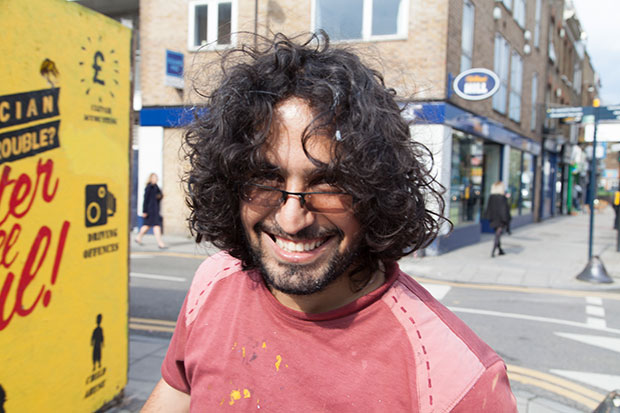
“I invite people like this: I just say – you paint now.” That’s how it works with street artist Murad Subay.
His murals grew from the frustration he felt as his homeland, Yemen, descended into chaos and factionalism. Amid the destruction and anger, Subay picked up his brush. With friends, he went out into the streets and began painting in broad daylight. Days passed, then people from the community joined him. All of them driven by their desire for peace amid Yemen’s civil war.
Since 2011 he’s created campaigns to encourage Yemenis to express their outrage at what their country has become. He and his collaborators have coloured walls, named the disappeared and marked ruins.
He always works during the day. It’s always part performance, part collaboration. Thursday 14 April was no different. Only the location had changed.
For his first mural outside Yemen, Subay took his brushes and paint to the corner of Hackney Road and Cremer Street to send a pointed message about the international community’s lack of humanity, especially toward his homeland. Even dogs are better than some of the global institutions and structures.
In London, to receive the 2016 Freedom of Expression Arts Award for his work, which Subay stressed is for Yemen. His acceptance speech was dedicated to the “unknown people who struggle to survive”.
Invited by Jay, the community curator of Art Under the Hood, Subay set up his equipment — with the help of new friends — and began transforming a hoarding into his vision using stencils he had laboured over since arriving on Saturday.
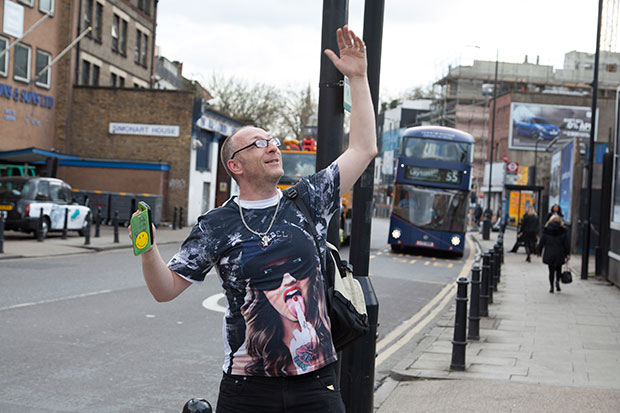
“I’m doing a sun dance.”
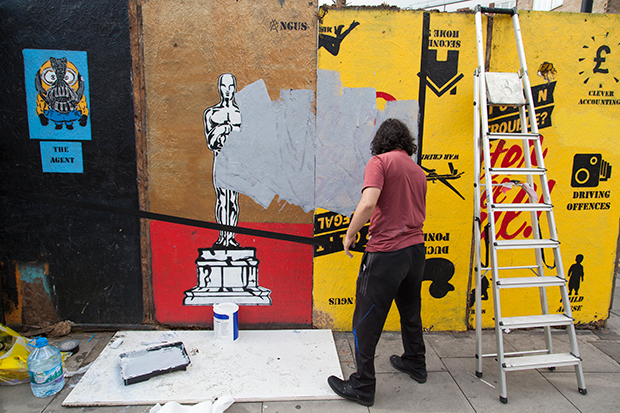
“I’m not the type of artist who zones out and thinks this is precious. It’s an ordinary thing for me”
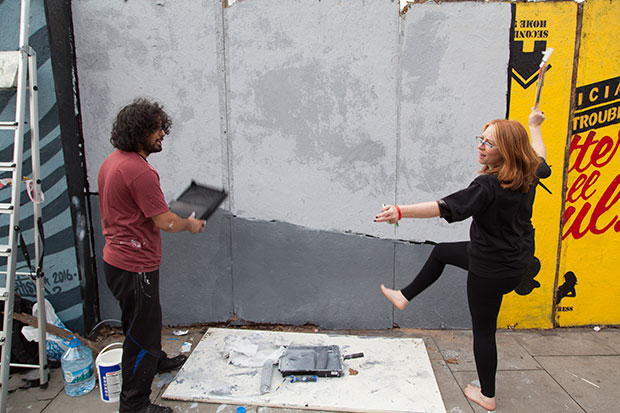
“How long will it take for it to dry?”
“In Sana’a, three minutes!” Then a few seconds later “Here, I don’t know”
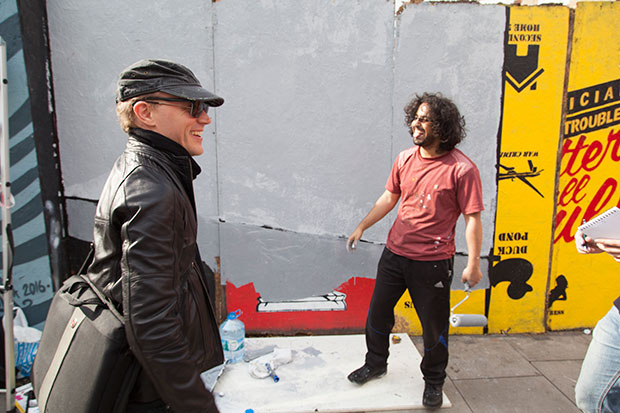
“Do you want me to do anything”
“Yes of course. Come here”
“Welcome to the holy state of Hackney, my friend. This is not a borough, not a city, it’s a state.”
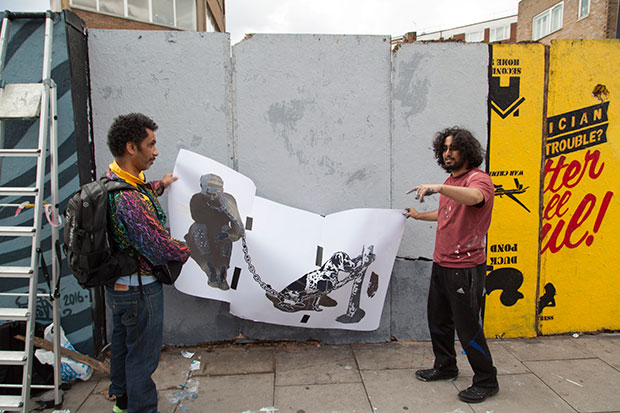
“I’ve worked on these stencils from time to time for four days. It’s hard to say how long it takes. Sometimes it takes three, four hours, other times five … Depends on what I do”
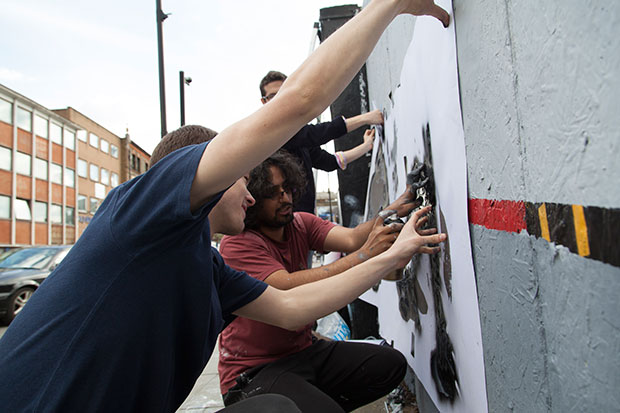
“First, try it on the cardboard to see how strong or light it is. Then press in the shape, light, not strong. Keep it at an angle close to the margins, so you can make sure you don’t spray outside the shape. Then perpendicular in the middle. Keep it light, light!”
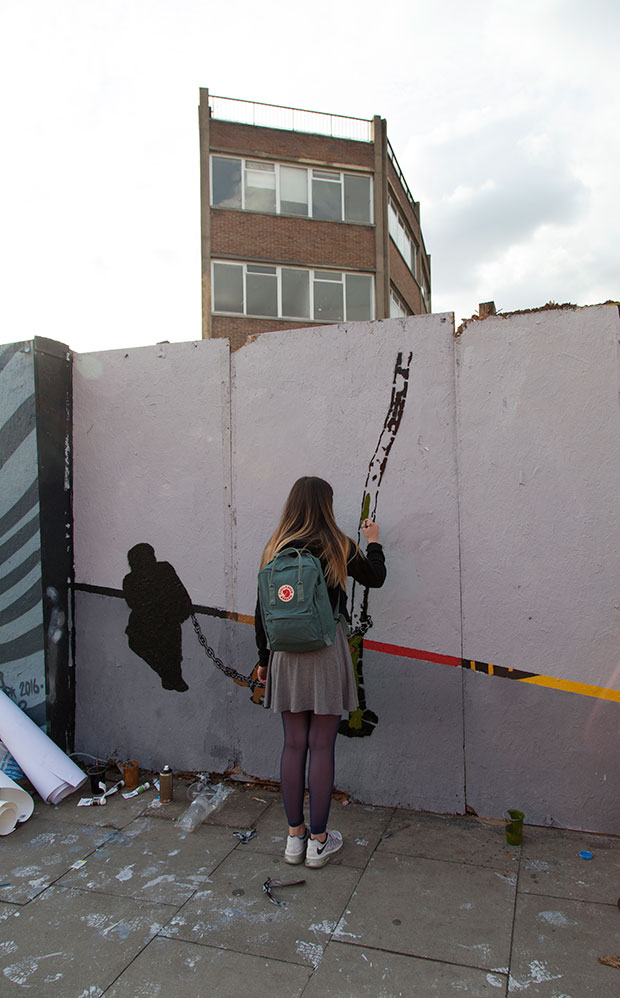
“Can I have a go?” a young woman asks.
“Yes of course!”
She stops for a moment, hesitant. Then she ends up staying until the very end. And in the end, Subay gives her, Éléa, the stencils when he finishes the mural.
“Do you paint?”
“A bit”
“Not a bit, you have to paint a lot! Painting is beautiful.”
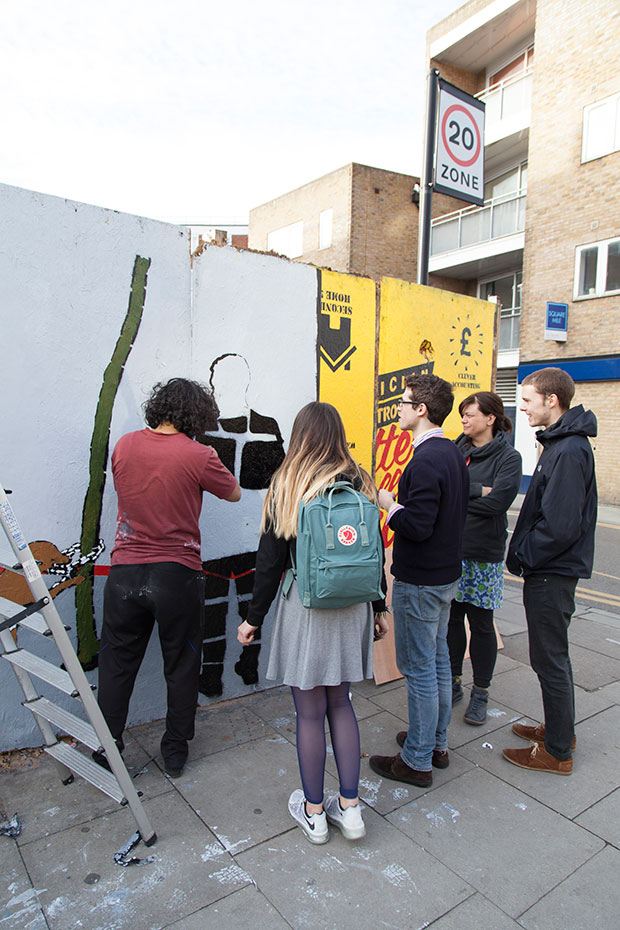
“They have artists in Yemen? First time I hear that!”
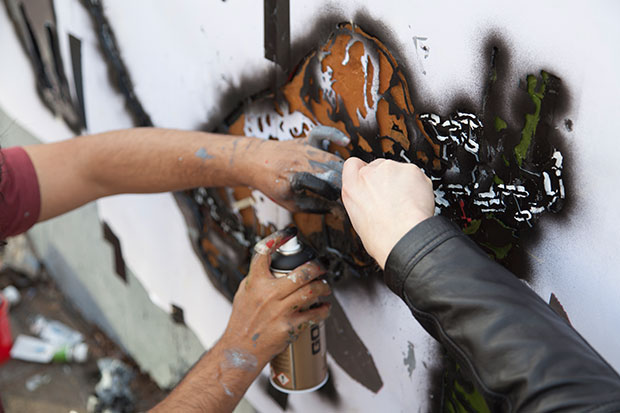
“You know how to spray right? Come and learn a bit!”
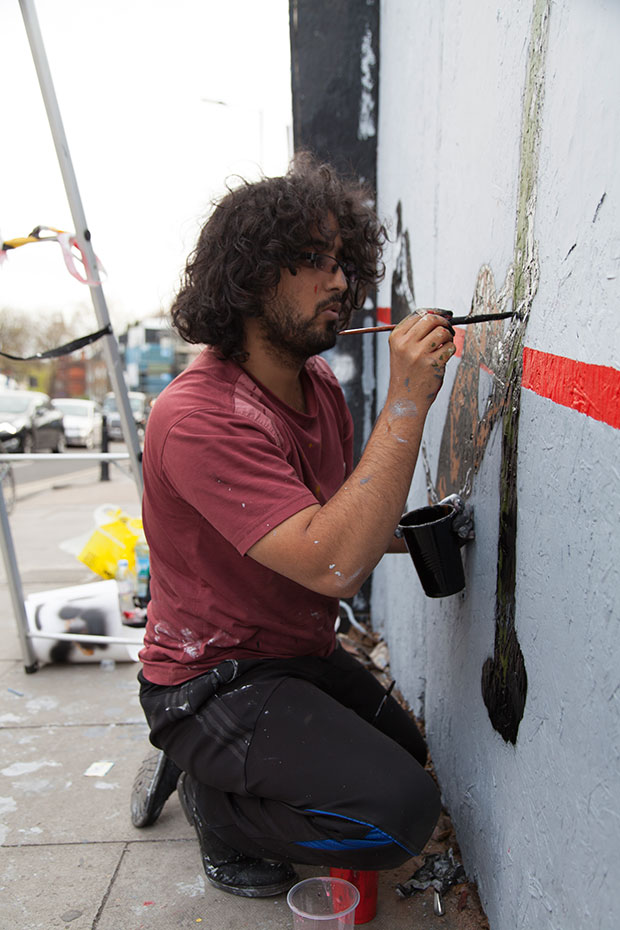
“When I started out, I was alone, and I did it all in one week. I am slow. In the beginning, I never thought people could join. But then they did. They say: ‘Oh look, the artist!’ And they join”
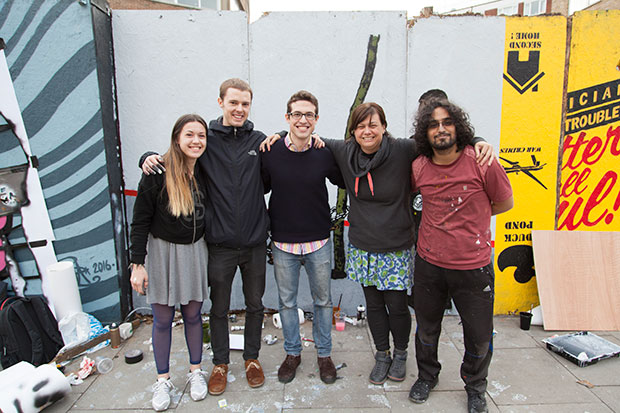
“These stencils, I made in Yemen. I staged a photo, printed it, then cut it out. That chained man is one of my relatives. He’s a very nice person. He jokes a lot and loves painting. I really like him. We work together a lot, on street art of course but also many different things.”
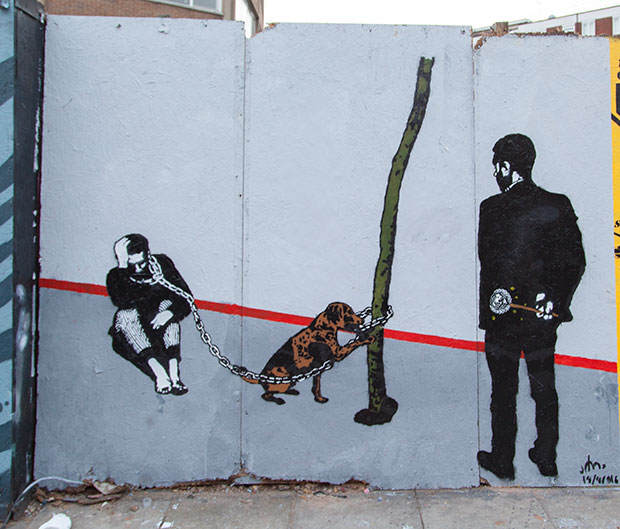
“It’s all about how the man is suffering. He’s not just Yemen or anybody in particular. It could be any man. The dog is trying to help, and is showing more kindness then the other man. The dog shows that it’s possible to help out, but the other man doesn’t want to do anything.”
15 Apr 2016 | Awards, mobile, News
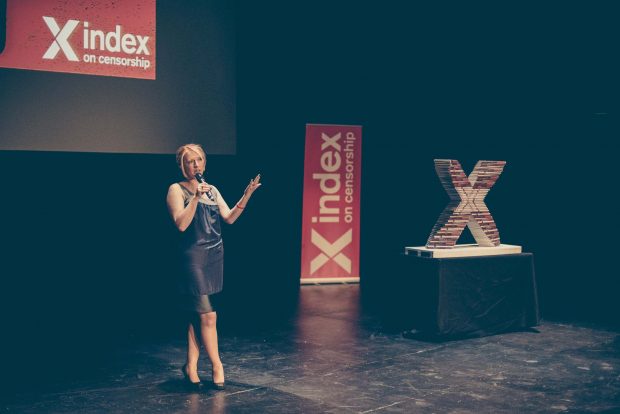
Index on Censorship CEO Jodie Ginsberg (Photo: Elina Kansikas for Index on Censorship)
You can donate to Index on Censorship here.
This is the text of a speech give by Index on Censorship CEO Jodie Ginsberg at the Freedom of Expression Awards on April 13, 2016.
In the very first edition of Index on Censorship magazine – published in 1972 – the then editor Michael Scammell wrote that a definite need existed for such an organisation… only time will tell whether the need is temporary or permanent.
Sadly, 43 years later – as evidenced by tonight’s winners – the need seems permanent. Our aim though, remains to be temporary – our goal is nothing less than an end to all censorship. That’s some target, but if those whom we have honoured here this evening have shown us anything, I hope it’s that is this a target worth aiming for.
Index challenges censorship and celebrates the value of free expression in four ways. The first is through the publication of works by censored writers and artists and about censorship.
We do this through our magazine, a copy of which you all receive this evening, and through our website and social media. If you want a reminder of how censorship remains as live an issue as it was in 1972, in this issue you will find a story from Azeri playwright and poet Akram Aylisi, whose books were burned and his title of “People’s Writer” revoked after he dared to discuss the Armenian genocide. Just this month he was barred from leaving the country.
We challenge censorship through campaigning. This year we will be campaigning along with other like-minded organisations to ensure the government’s planned new extremism bill contains none of its proposed new curbs on free speech.
We challenge by encouraging debate such as one held here at Unicorn Theatre last year following the cancellation of Homegrown — whose director Nadia was one of tonight’s guest presenters, by the National Youth Theatre.
And we challenge censorship by supporting those on the frontlines of its defence. Each of tonight’s winners becomes an Index fellow and we will work with them for the next year to help make sure we can magnify their impact at home and abroad.
We have heard stories tonight of what censorship means in practice. Tonight I want to share with you another slice of Index history: a video made for Index 30 years ago that I think drives home all of those stories.
Free expression needs defenders. It needs defenders to ensure that Zunar does not go to prison for 43 years – another Index lifetime – for drawing cartoons of Malaysia’s Prime Minister. It needs defenders to help ensure that the world in which Zaina’s six-week-old baby, who joined her in London this week, grows up to be a woman who can speak freely, and – if she so chooses – report freely. It needs defenders so that Nabeel Rajab, one of this year’s awards judges, is free to travel and speak freely without fear of jail, harassment or torture.
So what I want you to do this evening is very simple. I want you to reach into your programme and take out the pledge card you’ll find there. Then I want you to take a moment to think what you might otherwise have spent this evening. Then I want you to take a pen and write down that figure – or a higher one – to help ensure that Index can continue to defend free speech. If you can’t do analogue, you can text FEXY16 £10 to give us £10 right now. We might not end censorship immediately but with your help we can make ourselves a little less permanent.
Thank you. To end this evening I am delighted to introduce Martyn Ware, who will present our inaugural Music In Exile Fellowship.
The MIEF is a joint initiative with the producers of the film Music in Exile, which explores the plight of Mali’s musicians after jihadists banned music in the country. Moved by their experiences, producers Johanna Schwartz and Sarah Mosses approached Index to see what we could do to support persecuted artists like those featured in the film. Indeed, one group featured, Songhoy Blues, was shortlisted for an Arts award last year. The MIEF, funded through money from special screenings of the film and other events, will support one musician each year as part of the Index awards fellowship. I’m delighted that MW of Human League and Heaven 17 fame is here to present it.
#IndexAwards2016
Index announces winners of 2016 Freedom of Expression Awards
2016 Freedom of Expression Awards: The acceptance speeches
Bolo Bhi: “What’s important is the process, and that we keep at it”
Zaina Erhaim: “I want to give this award to the Syrians who are being terrorised”
GreatFire: “Technology has been used to censor online speech — and to circumvent this censorship”
Murad Subay: “I dedicate this award today to the unknown people who struggle to survive”
Smockey: “The people in Europe don’t know what the governments in Africa do.”
14 Apr 2016 | Awards, Fellowship, Fellowship 2016, mobile, News
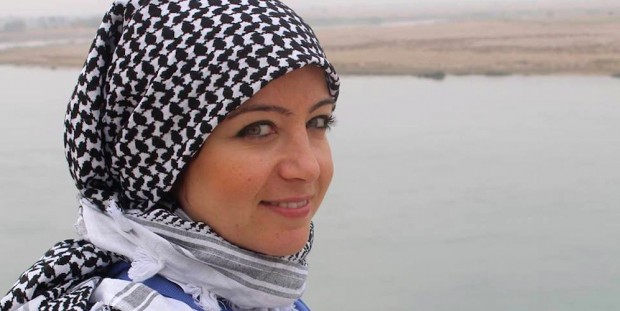
A series of short documentaries directed by 2016 Index on Censorship Freedom of Expression Awards finalist Zaina Erhaim were screened at the Frontline Club in London last night.
Syria’s Rebellious Women was filmed by the Syrian journalist over an 18-month period to offer a rare insight into the difficulties faced by women living and working in rebel-held parts of Syria.
The films, which show a side of Syria rarely seen in the media, tell the individual stories of heroic women who continue to document war, provide medical services and deliver supplies to civilians despite disapproval from their families and the male-dominated society.
Erhaim told the audience that she decided to make the films after failing to find anything about Syrian women throughout history during her own research, and wanting to ensure the work of these women was remembered.
She said: “The main reason I made the films is because I am Syrian, and I’m a woman. I tried to do some research six years ago about Syrian women who participated in Syrian history and I couldn’t find anything.
“So I felt like we had to capture this work that the women are doing because in the future the men are going to be writing the history and these heroines are going to be forgotten.”
As a female journalist Erhaim faced many struggles when making the films, including being forbidden from filming in certain locations, just for being female; meaning she had to teach a male friend to use a camera in order to film scenes for her. Her friend was then hit by a missile after helping her.
She said: “Sometimes you need a hand and there are plenty of people willing to do that, free of charge; even if they are sacrificing their lives for you.”
Erhaim has spent the last two years training hundreds of citizen journalists, many of them women. She is also the Syria project coordinator for the Institute for War and Peace Reporting (IWPR), an international organisation that supports journalists in countries undergoing conflict, crisis, or transition, who co-presented the event with Index and the Frontline Club.
When asked if she was optimistic about Syria’s future she replied: “No, I’m not. I think I’m being realistic; I don’t see any change happening, at least for better. Not for women, not for men, not for Syrians.”
14 Apr 2016 | Asia and Pacific, Burma, China, Eritrea, Europe and Central Asia, Iran, Middle East and North Africa, mobile, News, North Korea, Saudi Arabia, Sudan, Turkmenistan, Uzbekistan
[vc_row][vc_column][vc_column_text]
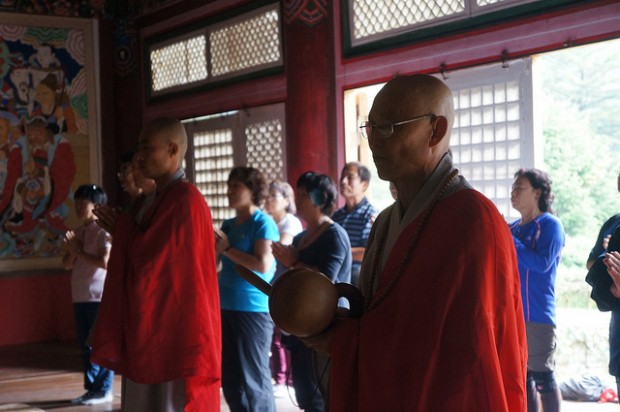
Pohyon Temple in the Myohyang mountains, once a national center for Korean Buddhism. Credit: Uri Tours / Flickr
After the United States Commission on International Religious Freedom, an independent organisation created by the US Congress to evaluate religious freedom conditions around the world, released its 2015 report, it became clear that an insufficient amount of progress had been made since Index on Censorship last reported on the issue.
Here’s a roundup of some the most appalling religious freedom violations from across the globe.
Burma
Bigotry and intolerance continue to scorch the lives of religious and ethnic minorities in Burma, particularly Rohingya Muslims. The Burmese government demonstrated little effort toward intervening or properly investigating claims of abuse, including those carried out by religious figures in the Buddhist community. As internet availability spread throughout the country, social media played a role in promoting a platform of hate and proposed violence against minority populations. Rohingya Muslims in the country face a unique level of discrimination and persecution. The government denies them citizenship and the right to identify as Rohingya. Additionally, four discriminatory race and religion bills could further the prejudices affecting religious minorities.
North Korea
North Korea is a nation where genuine freedom of religion or belief is non-existent; it remains one of the most oppressive regimes and worst violators of human rights. Punishment comes to those who pose difficult questions while the government maintains its control through a constant threat of imprisonment, torture and even death for those who break the law regarding religion. Estimates suggest up to 200,000 North Koreans are currently suffering in labor camps, tens of thousands of whom are there for practicing heir faith. In February 2014, the Commission of Inquiry on Human Rights in the Democratic People’s Republic of Korea released its report documenting the systematic, severe violations of human rights in the country. It found “an almost complete denial of the right to freedom of thought, conscience”.
Saudi Arabia
Officially an Islamic state with eight to ten million expatriate workers of different faiths, Saudi Arabia continues to restrict most forms of public religious expression inconsistent with its interpretation of Sunni Islam. The government continues to use criminal charges of blasphemy to suppress any dialogue between dissenting viewpoints, with a new law helping drive home the goal of silence. The Penal Law for Crimes of Terrorism and its Financing criminalises virtually all forms of peaceful dissent and free expression, including criticising the government’s view of Islam. Lastly, authorities continue to discriminate grossly against dissident clerics and members of the Shia community.
Sudan
The Sudanese government continues to engage in massive violations of freedom of religion, due to president Omar al-Bashir’s policies of Islamisation and restrictive interpretation of sharia law. Despite 97% of the population being Muslim, there is a wide range of other religions practiced. The country’s turmoil from religious persecution rests on the 1991 Criminal Code, the 1991 Personal Status Law of Muslims, and state-level “public order” laws, which have restricted freedom for all Sudanese. The laws – which contradict the country’s constitutional and international commitments to human rights and freedom of religion – allow death sentences for apostasy, stoning for adultery, cross-amputations for theft, prison sentences for blasphemy and floggings for undefined “offences of honor, reputation and public morality”. Since 2011, more than 170 people have been arrested and charged with apostasy.
Article continues below
[/vc_column_text][/vc_column][/vc_row][vc_row][vc_column][vc_custom_heading text=”Join the Index mailing list and get an exclusive gift” font_container=”tag:p|font_size:28|text_align:left” use_theme_fonts=”yes”][vc_separator color=”black”][/vc_column][/vc_row][vc_row][vc_column width=”1/2″][vc_column_text]
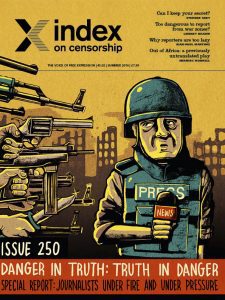
Index on Censorship’s summer magazine 2016
We’ll send you our weekly emails and periodic updates on our events. We won’t share your personal information with anyone outside Index.
You’ll also get access to an exclusive collection of articles from our landmark 250th issue of Index on Censorship magazine exploring journalists under fire and under pressure. Your downloadable PDF will include reports from Lindsey Hilsum, Laura Silvia Battaglia and Hazza Al-Adnan.[/vc_column_text][/vc_column][vc_column width=”1/2″][gravityform id=”20″ title=”false” description=”false” ajax=”false”][/vc_column][/vc_row][vc_row][vc_column][vc_separator color=”black”][/vc_column][/vc_row][vc_row][vc_column][vc_column_text]Uzbekistan
In Uzbekistan, the government imprisons individuals for not conforming to officially prescribed practices or whom it claims are extremist, including as many as 12,000 Muslims. A highly restrictive religion law is imposed, the 1998 Law on Freedom of Consciences and Religious Organisations, which severely limits the rights of all religious groups and facilitates Uzbek government control over religious activity. Many who don’t fit into the framework of officially approved practices are regularly repressed. Additionally, the government has continued a campaign against independent Muslims, targeting those linked to the May 2005 protests in Andijan; 231 are still imprisoned in connection to the events, and ten have died. All the while, Uzbekistan has pressured countries to return Uzbek refugees who fled during the Andijan tragedy.
Turkmenistan
In an environment of nearly inescapable government information control, severe religion freedom breaches persist in Turkmenistan. Continuing police raids and harassment of registered and unregistered religious groups matched with laws and policies that violate international human rights norms has the nation as one of the year’s biggest offenders. With an estimated total population of 5.1 million, the US government projects that the country is 85% Sunni Muslim, 9% Russian Orthodox, and a 2% total that includes Jehovah’s Witnesses, Jews, and evangelical Christians. Despite Turkmenistan’s constitutionally guaranteed religious freedom and separation of religion from the state, the 2003 religion law negates these provisions while setting intrusive registration criteria for individuals. It also requires that the government is informed of all foreign financial support, forbids worship in private homes and places discriminatory restrictions on religious education.
China
While the Chinese constitution guarantees freedom of religion, this idea really only applies to “normal religions”, better known as the five state-sanctioned “patriotic religious associations” associated with Buddhism, Taoism, Islam, Catholicism and Protestantism. Even still, the government monitors religious activities unfairly, and there has been an increased religious persecution of Uighur Muslims in the name of fighting terrorism. All around repression in China worsened in 2014, including the governmental push for controlling Tibet, Xinjiang, and even Hong Kong, as well as controls on the internet, social media, human rights defenders, activists and journalists.
Eritrea
Ongoing religious freedom abuses have continued in Eritrea, including torture or ill-treatment of religious prisoners, random arrests without charges and banning’s on public religious activities. The situation is especially serious for Evangelical and Pentecostal Christians and Jehovah’s Witnesses, and the government suppresses Muslim religious activities and those opposed to the government-appointed head of the community. In 2002, the government increased its control over religion by imposing a registration requirement on all religious groups other than the Coptic Orthodox Church of Eritrea, Sunni Islam, the Roman Catholic Church and the Evangelical Church of Eritrea. The requirements mandated that the non-preferred religious communities provide detailed information about their finances, membership, activities, and benefit to the country. Additionally, released religious prisoners have reported to USCIRF that they were confined in crowded conditions, and subjected to extreme temperature fluctuations. The government continued to arrest and detain followers of unregistered religious communities. Recent estimates suggest 1,200 to 3,000 people are imprisoned on religious grounds in Eritrea, the majority of whom are Evangelical or Pentecostal Christians.
Iran
Poor religious freedom in Iran continued to worsen in 2014, particularly for minority groups like Bahá’ís, Christian converts, and Sunni Muslims. The government is still engaging in systematic violations, including prolonged detention, torture, and executions based on the religion of the accused. Despite Christians, Jews, and Zoroastrians being recognised as protected minorities, the government has consistently discriminated against its citizens on the basis of religion. Killings, arrests, and physical abuse of detainees have increased in recent years, including for religious minorities and Muslims who are perceived as threatening the government’s legitimacy.[/vc_column_text][/vc_column][/vc_row][vc_row][vc_column][vc_basic_grid post_type=”post” max_items=”12″ style=”load-more” items_per_page=”4″ element_width=”6″ grid_id=”vc_gid:1493906845781-a7b9ac80-f77d-2″ taxonomies=”1742″][/vc_column][/vc_row]
