30 Apr 2018 | Statements
[vc_row][vc_column][vc_single_image image=”100082″ img_size=”full” alignment=”center”][vc_column_text]
Понедельник, 30 апреля 2018 г.
Мы, нижеподписавшиеся 26 международных правозащитных организации в сфере медиа и интернет-свобод, решительно осуждаем попытки Российской Федерации заблокировать интернет-мессенджер Telegram, результатом которых стали широкомасштабные нарушения свободы выражения мнения и доступа к информации, и в т.ч. массовая блокировка сторонних вебсайтов.
Мы призываем Россию остановить блокировку Telegram и прекратить беспрестанные нападки на свободу интернета в целом. Мы также призываем Организацию Объединенных Наций, Совет Европы, Организацию по безопасности и сотрудничеству в Европе, Европейский Союз, Соединенные Штаты Америки и другие заинтересованные правительства оспорить действия России и поддержать основополагающие права на свободу выражения мнения и неприкосновенность частной жизни в интернете и вне его. Наконец, мы призываем интернет-компании противостоять необоснованным и неправовым требованиям, нарушающим права их пользователей.
Массовые перебои в работе интернета
13 апреля 2018 г. Таганский районный суд Москвы удовлетворил запрос Роскомнадзора о блокировке доступа к Telegram на основании того, что компания не исполнила датированное 2017 годом распоряжение передать ключи шифрования Федеральной службе безопасности (ФСБ). С того времени действия, предпринятые российскими органами власти с целью ограничить доступ к Telegram, привели к массовым перебоям в работе интернета, в т.ч.:
-
16-18 апреля 2018 года Роскомнадзор отдал указание о блокировке почти 20 миллионов IP-адресов в попытке ограничить доступ к Telegram. Значительная часть заблокированных адресов принадлежит международным интернет-компаниям, в т.ч. Google, Amazon и Microsoft. В настоящее время XX из них остаются заблокированными.
-
Массовая блокировка IP-адресов негативно влияет на большое число сетевых сервисов, которые не имеют никакого отношения к Telegram, в числе прочего интернет-банкинг и сайты бронирования гостиниц, электронная коммерция и покупка авиабилетов.
-
Международная правозащитная группа Агора, представляющая Telegram в России, сообщила, что были получены запросы о помощи в связи с массовыми блокировками от около 60 компаний, включая интернет-магазины, службы доставки и разработчиков программного обеспечения.
-
По меньшей мере шесть интернет-СМИ (Петербургский дневник, Coda Story, FlashNord, FlashSiberia, Тайга.инфо, и 7×7) пострадали от временного ограничения доступа к их вебсайтам.
-
17 апреля 2018 года Роскомнадзор потребовал от Google и Apple удалить приложение Telegram из магазинов приложений, несмотря на отсутствие в российском законодательстве оснований для такого требования. Приложение на данный момент остается доступным, однако Telegram не может предоставить обновление для улучшения доступа через прокси-серверы.
-
Провайдеры виртуальных частных сетей (VPN), такие как TgVPN, Le VPN и VeeSecurity, также были заблокированы из-за предоставления альтернативных средств доступа к Telegram. Федеральный закон 276-ФЗ запрещает использование VPN и интернет-анонимайзеров для предоставления доступа к вебсайтам, заблокированным в России, и дает полномочия Роскомнадзору по блокировке любого сайта, объясняющего, как пользоваться такими сервисами.
История ограничительного законодательного регулирования интернета
В течение последних шести лет Россия приняла большое число законов, ограничивающих свободу выражения мнения и право на неприкосновенность частной жизни в интернете. В их число входит создание в 2012 г. черного списка интернет-сайтов, администрируемого Роскомнадзором, и поэтапное расширение оснований для блокировки вебсайтов, включая блокировку без решения суда.
Принятый в 2016 году т.н. «закон Яровой», нацеленный на «борьбу с экстремизмом», налагает обязательства на всех операторов связи и интернет-провайдеров хранить метаданные пользователей, предоставлять ключи шифрования по запросу органов безопасности и использовать исключительно методы шифрования, одобренные российским правительством, на практике это означает создание «бэкдора» для сотрудников российских органов безопасности для доступа к данным, трафику и коммуникациями интернет-пользователей.
В октябре 2017 года мировой судья признал Telegram виновным в совершении административного правонарушения в связи с непредоставлением ключей шифрования российским властям, что, по заявлению компании, невозможно сделать в силу использования Telegram сквозного шифрования. На компанию был наложен штраф в размере 800 000 рублей. Апелляция Telegram по административному делу была отклонена в марте 2018 года, что дало российским органам власти формальные основания для блокировки Telegram в России в соответствии со статьей 15.4 Федерального закона «Об информации, информационных технологиях и о защите информации».
Недавние меры, принятые российскими органами власти в отношении Telegram, имеют серьезные последствия для свободы выражения мнения и права на неприкосновенность частной жизни в интернете в России и по всему миру:
-
Для российских пользователей такие приложения, как Telegram и другие подобные сервисы, стремящиеся предоставить защищенную связь, критически важны для обеспечения безопасности. Они представляют собой важный источник информации о важнейших проблемах политической, экономической и общественной жизни, свободный от неоправданного вмешательства правительства. Для СМИ и журналистов в России и за ее пределами Telegram служит не только платформой для обмена сообщениями с целью безопасного общения с источниками, но и площадкой для публикаций. Telegram-каналы представляют собой средство передачи и распространения контента для СМИ и отдельных журналистов и блогеров. С учетом прямого и косвенного контроля со стороны государства в отношении многих традиционных российских СМИ и самоцензуры, которую многие другие СМИ считают необходимым применять, каналы мгновенного обмена сообщениями, такие как Telegram, стали ключевым средством распространения идей и мнений.
-
Компании, которые исполняют требования «закона Яровой», предоставляя правительствам «бэкдор» к своим сервисам, ставят под угрозу безопасность сетевых коммуникаций как своих российских пользователей, так и людей, с которыми они общаются за пределами страны. Журналисты особенно опасаются, что предоставление ФСБ доступа к данной информации поставит под угрозу их источники – краеугольный камень свободы печати. Исполнение компаниями требований закона также означает, что поставщики услуг связи готовы понижать стандарты шифрования и подвергать риску личную информацию и безопасность всех своих пользователей в качестве одной из издержек ведения бизнеса.
-
В июле 2018 года вступят в силу статьи «закона Яровой», требующие, чтобы компании хранили все голосовые и текстовые сообщения в течение шести месяцев и открывали к ним доступ органам безопасности в отсутствие решения суда. Это повлияет на общение людей в России и за ее границами.
Такие попытки российских органов власти контролировать сетевые коммуникации и ограничивать неприкосновенность частной жизни выходят далеко за границы необходимости и соразмерности в рамках борьбы с терроризмом и нарушают международное законодательство.
Международные стандарты
-
Блокировка вебсайтов или приложений представляет собой крайнюю меру, аналогичную запрету газеты или отзыву лицензии у телевизионной станции. Как таковая она с большой вероятностью в подавляющем большинстве случаев представляет собой несоразмерное вмешательство в свободу выражения мнения и свободу СМИ и должна подлежать строгому контролю. Любые меры по блокировке по меньшей мере должны быть четко сформулированы в рамках закона и требовать рассмотрения судом того, является ли полная блокировка доступа к онлайн-сервису необходимой и соответствует ли критериям, установленным и применяемым Европейским судом по правам человека. Блокировка Telegram и связанные с ней действия очевидным образом не соответствуют данному стандарту.
-
Различные требования «закона Яровой» явно противоречат международным стандартам в отношении шифрования и анонимности в соответствии с Докладом Специального докладчика по вопросу о поощрении и защите права на свободу мнений и их свободное выражение 2015 года (A/HRC/29/32). Специальный докладчик ООН лично обратился к российскому правительству, выразив серьезное беспокойство, относительно чрезмерных ограничений, налагаемых «законом Яровой» на права на свободу выражения мнения и на неприкосновенность частной жизни в интернете. Европейский суд постановил, что подобные обязательства по хранению данных являются несовместимыми с Хартией Европейского Союза по правам человека. Хотя Европейский суд по правам человека пока не принял решение относительно совместимости положений российского законодательства о раскрытии ключей шифрования с Конвенцией о защите прав человека и основных свобод, он постановил, что российский правовой режим, регулирующий перехват сообщений, не обеспечивает адекватные и эффективные гарантии против произвола и риска злоупотреблений, присущих системе секретной слежки.
Мы, нижеподписавшиеся организации призываем:
-
Российские органы власти гарантировать интернет-пользователям право публиковать и читать информацию в интернете анонимно и обеспечить, чтобы любые ограничения анонимности в интернете производились по распоряжению суда и полностью соответствовали требованиям Статей 17 и 19(3) Международного пакта о гражданских и политических правах и Статей 8 и 10 Конвенции о защите прав человека и основных свобод, путем:
-
Отказа от блокировки Telegram и воздержания от истребования у сервисов обмена сообщениями, таких как Telegram, ключей шифрования с целью получения доступа к частной информации пользователей;
-
Отмены положений «закона Яровой», налагающих на интернет-провайдеров обязательство хранить все телекоммуникационные данные сроком до шести месяцев и требующих обязательного обеспечения «бэкдоров» шифрования, а также закона 2014 года о локализации персональных данных, предоставляющего органам безопасности легкий доступ к данным пользователей без достаточных мер защиты.
-
Отмены Федерального закона 241-ФЗ, запрещающего анонимность пользователей интернет-мессенджеров, и Закона 276-ФЗ, запрещающего VPN-сервисам и интернет-анонимайзерам предоставлять доступ к вебсайтам, запрещенным в России;
-
Внесения изменений в Федеральный закон 149-ФЗ «Об информации, информационных технологиях и о защите информации» с тем, чтобы процесс блокировки вебсайтов соответствовал международным стандартом. Всякое решение о блокировке доступа к вебсайту или приложению должно быть принято независимым судом и ограничено требованием необходимости и соразмерности законной цели. При рассмотрении запроса на блокировку суд или другой независимый судебный орган, в чьи полномочия входит принятие такого решения, должен рассмотреть его влияние на законный контент и возможность использования технологических средств для предотвращения излишней блокировки.
-
Представителей Организации Объединенных Наций, Совета Европы, Организации по безопасности и сотрудничеству в Европе, Европейского Союза, Соединенных Штатов Америки и других заинтересованных правительств внимательно рассмотреть и открыто оспорить действия России с целью защиты основополагающих прав на свободу выражения мнения и неприкосновенность частной жизни в интернете и вне его, в соответствии с соглашениями, имеющими обязательную юридическую силу, стороной которых является Россия.
-
Интернет-компании противостоять требованиям, нарушающим международное право в области прав человека. Компании должны следовать Руководящим принципам предпринимательской деятельности в аспекте прав человека Организации Объединенных Наций, которые подчеркивают обязательство соблюдать права человека, применимое в рамках всей глобальной деятельности компании вне зависимости от места нахождения ее пользователей и исполнения государством своих обязательств в области защиты прав человека.
Подписи
-
ARTICLE 19
-
Международная Агора (Agora International)
-
Access Now
-
Amnesty International
-
Asociatia pentru Tehnologie si Internet – ApTI
-
Associação D3 – Defesa dos Direitos Digitais
-
Committee to Protect Journalists
-
Civil Rights Defenders
-
Electronic Frontier Foundation
-
Electronic Frontier Norway
-
Electronic Privacy Information Centre (EPIC)
-
Freedom House
-
Human Rights House Foundation
-
Human Rights Watch
-
Index on Censorship
-
International Media Support
-
Международное Партнерство за Права Человека (International Partnership for Human Rights)
-
ISOC Bulgaria
-
Open Media
-
Open Rights Group
-
ПЕН Америка (PEN America)
-
PEN International
-
Privacy International
-
Репортеры без границ (Reporters without Borders)
-
WWW Foundation
-
Xnet
[/vc_column_text][/vc_column][/vc_row]
23 Apr 2018 | Press Releases
A public art project and website celebrating dissent in Cuba and a collective of young bloggers and web activists who give voice to the opinions of young people from all over the Democratic Republic of Congo are among the winners of the 2018 Index on Censorship Freedom of Expression Awards.
The winners, who were announced on Thursday evening at a gala ceremony in London, also include one of the only human rights organisations still operating in Egypt and an investigative journalist from Honduras who regularly risks her life for her right to report on what is happening in the country.
Awards were presented in four categories: arts, campaigning, digital activism and journalism.
The winners are: Cuban art collective The Museum of Dissidence (arts); the Egyptian Commission for Rights and Freedoms (campaigning); Habari RDC, a collective of young Congolese bloggers and activists (digital activism); and Honduran investigative journalist Wendy Funes (journalism).
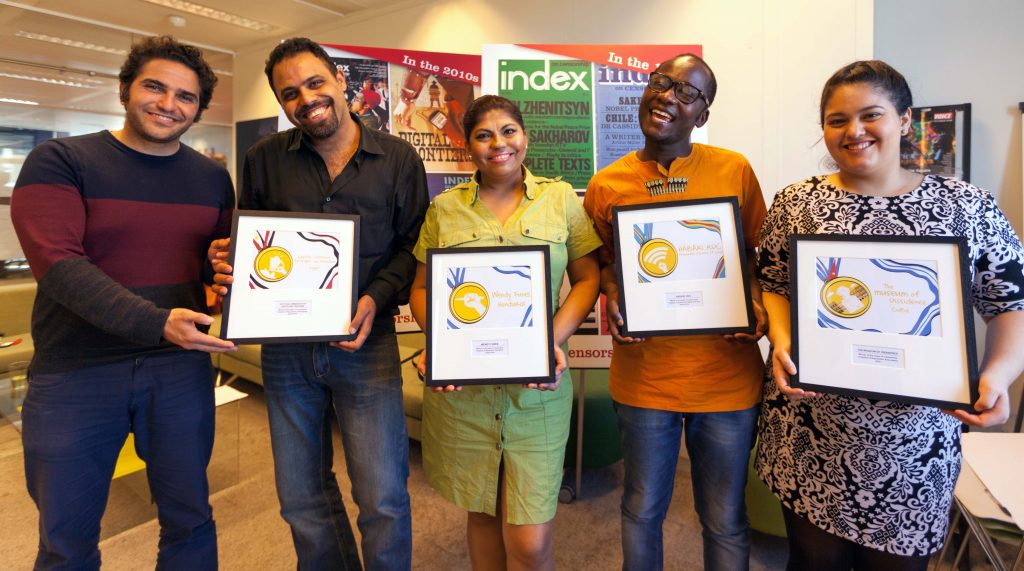
From right: Human rights defenders Mohamed Sameh and Ahmad Abdallah of 2018 Freedom of Expression Campaigning Award-winning Egypt Commission on Rights and Freedoms; 2018 Freedom of Expression Journalism Award-winning Honduran investigative journalist Wendy Funes; Congolese digital activist Guy Muyembe of 2018 Freedom of Expression Digital Activism Award-winning Habari RDC; Perla Hinojosa, Fellowship and Advocacy Officer at Index on Censorship, holds the 2018 Freedom of Expression Arts Award for Cuban arts collective Museum of Dissidence, who could not attend the Freedom of Expression Awards. (Photo: Index on Censorship)
“These winners deserve global recognition for their amazing work,” said Index on Censorship CEO Jodie Ginsberg. “Like all those nominated, they brave massive personal and political hurdles simply so that others can express themselves freely.”
Drawn from more than 400 public nominations, the winners were presented with their awards at a ceremony at The Mayfair Hotel, London, hosted by “stand-up poet” Kate Fox.
Actors, writers and musicians were among those celebrating with the winners. The guest list included The Times columnist and Chair of Index David Aaronovitch, BBC presenter Jonathan Dimbleby, comedian Shazia Mirza, social human rights activists Nimco Ali and Sara Khan, Serpentine Galleries CEO Yana Peel, poet Sabrina Mahfouz, Channel 4’s Lindsey Hilsum and more.
Winners were presented with cartoons created by Khalid Albaih, a Romanian-born Sudanese social media based political cartoonist who considers himself a virtual revolutionist.
Each of the award winners will become part of the fourth cohort of Freedom of Expression Awards fellows. They join last year’s winners — Chinese political cartoonist Rebel Pepper (arts); Russian human rights activist Ildar Dadin (campaigning); Digital collective Turkey Blocks (digital activism); news outlet Maldives Independent and its former editor Zaheena Rasheed (journalism) — as part of a world-class network of campaigners, activists and artists sharing best practices on tackling censorship threats internationally.
Through the fellowship, Index works with the winners – both during an intensive week in London and the rest of the awarding year – to provide longer term, structured support. The goal is to help winners maximise their impact, broaden their support and ensure they can continue to excel at fighting free expression threats on the ground.
This year’s panel of judges included Razia Iqbal, a journalist for BBC News, Tim Moloney QC, deputy head of Doughty Street Chambers, Yana Peel, CEO of the Serpentine Galleries, and Eben Upton CBE, a founder of the Raspberry Pi Foundation and CEO of Raspberry Pi.
Awards judge Eben Upton said: “”The ability to speak freely is a key foundation of democratic society and the rule of law: absent the ability to openly identify the abuse of power, extractive economic conditions, and exclusive political institutions, proliferate. This is why freedom of expression is so precious, and so often under attack from those in power.”
This is the 18th year of the Freedom of Expression Awards. Former winners include activist Malala Yousafzai, cartoonist Ali Ferzat, journalists Anna Politkovskaya and Fergal Keane, and Bahrain Center for Human Rights.
Ziyad Marar, President of Global Publishing at SAGE said: “The protection and promotion of free speech is a belief firmly entrenched within our values at SAGE. As both publisher of the magazine and sponsors of tonight’s awards, we are proud to support Index in their mission as they defend this right globally. We offer our warmest congratulations to those recognised and remain both humbled and awed by their inspirational achievements.”
Further details about the award winners are below.
For interviews with the award winners, who are in London until Friday 20 April, please contact Sean Gallagher at [email protected].
Photographs and other content related to the awards night will be available beginning 11am on Friday 20 April. Please contact Sean Gallagher at [email protected].
Index on Censorship is grateful for the support of the 2018 Freedom of Expression Awards sponsors: SAGE Publishing, Google, Private Internet Access, Edwardian Hotels, Vodafone, Vice News, Doughty Street Chambers and former Index Award-winning Psiphon.
Index on Censorship Freedom of Expression Awards 2018 – background on winners
Arts – The Museum of Dissidence (Cuba)
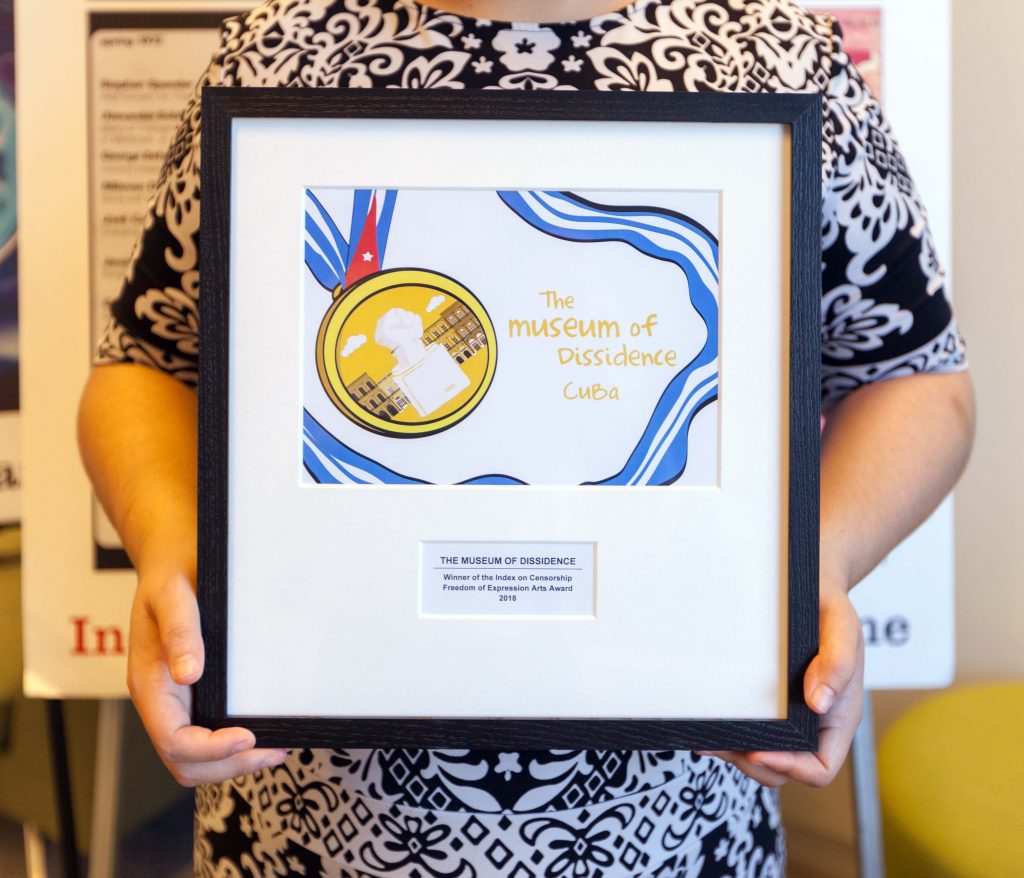
Perla Hinojosa, Fellowship and Advocacy Officer at Index on Censorship, holds the 2018 Freedom of Expression Arts Award for Cuban arts collective Museum of Dissidence, who could not attend the Freedom of Expression Awards. (Photo: Index on Censorship)
The Museum of Dissidence is a public art project and website celebrating dissent in Cuba. Set up in 2016 by acclaimed artist Luis Manuel Otero Alcántara and curator Yanelys Nuñez Leyva, their aim is to reclaim the word “dissident” and give it a positive meaning in Cuba. The museum organises radical public art projects and installations, concentrated in the poorer districts of Havana. Their fearlessness in opening dialogues and inhabiting public space has led to fierce repercussions: Nuñez was sacked from her job and Otero arrested and threatened with prison for being a “counter-revolutionary.” Despite this, they persist in challenging Cuba’s restrictions on expression.
CEO of Serpentine Galleries and 2018 Freedom of Expression Award judge Yana Peel said: The Museum of Dissidence in Cuba is incredibly important for the safe space that it is providing for unsafe ideas. It is a tremendous platform through which the great artists of Cuba bring Cuba to the global stage.”
Profile
Campaigning – The Egyptian Commission for Rights and Freedoms (Egypt). Award supported by Doughty Street Chambers
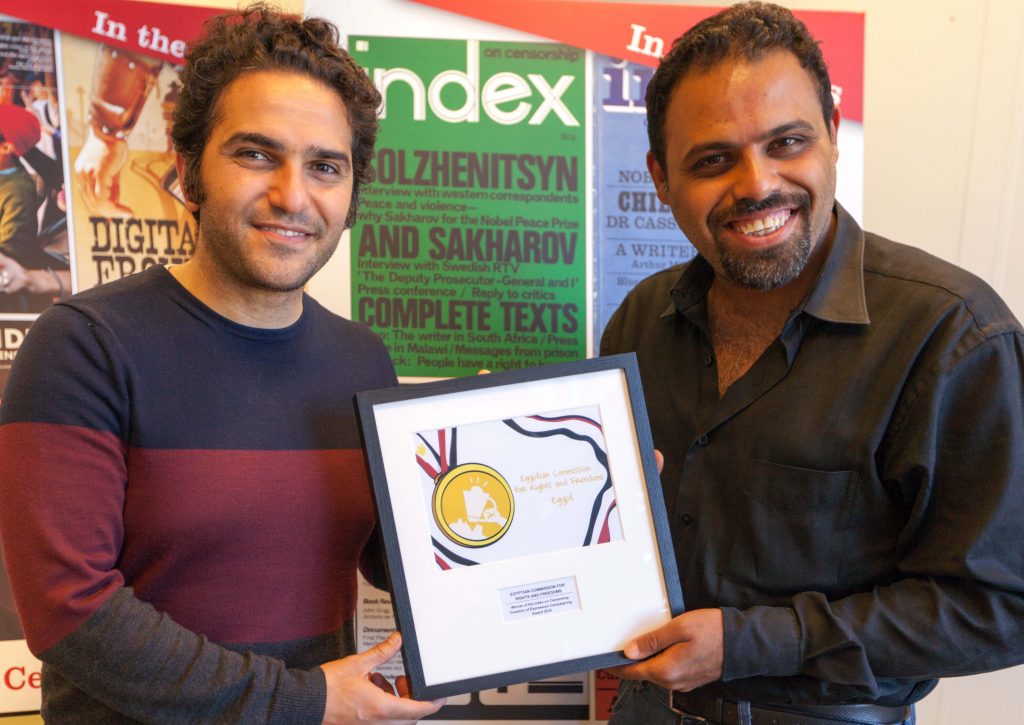
Human rights defenders Mohamed Sameh and Ahmad Abdallah of 2018 Freedom of Expression Campaigning Award-winning Egypt Commission on Rights and Freedoms. (Photo: Index on Censorship)
The Egyptian Commission for Rights and Freedoms is one of the few human rights organisations still operating in a country which has waged an orchestrated campaign against independent civil society groups. Egypt is becoming increasingly hostile to dissent, but ECRF continues to provide advocacy, legal support and campaign coordination, drawing attention to the many ongoing human rights abuses under the autocratic rule of President Abdel Fattah-el-Sisi. Their work has seen them subject to state harassment, their headquarters have been raided and staff members arrested. ECRF are committed to carrying on with their work regardless of the challenges.
CEO of Raspberry Pi and Freedom of Expression Awards 2018 judge Eben Upton said: “In an environment when organisations have had to step back or disappear altogether, they’ve managed to keep going and just that persistence over a period of time in a difficult environment is inspiring”.
Profile
Digital Activism – Habari RDC (Congo). Award sponsored by Private Internet Access
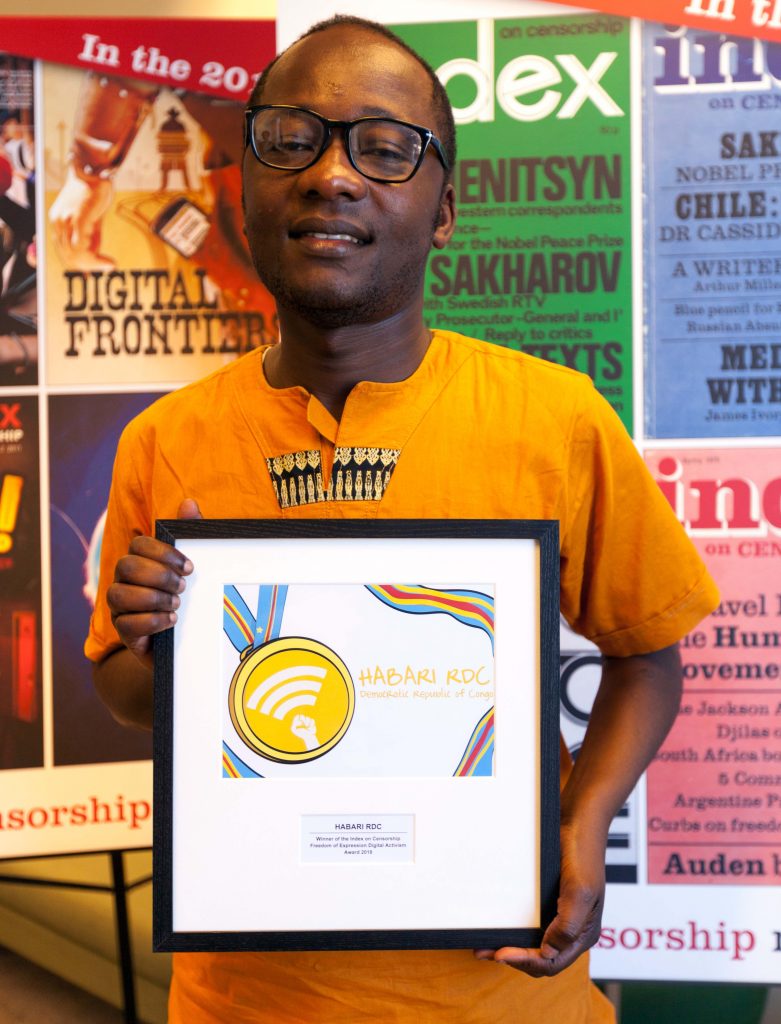
Congolese digital activist Guy Muyembe of 2018 Freedom of Expression Digital Activism Award-winning Habari RDC (Photo: Index on Censorship)
Launched in 2016, Habari RDC is a collective of more than 100 young Congolese bloggers and web activists, who use Facebook, Twitter and YouTube to give voice to the opinions of young people from all over the Democratic Republic of Congo. Their site posts stories and cartoons about politics, but it also covers football, the arts and subjects such as domestic violence, child exploitation, the female orgasm and sexual harassment at work. Habari RDC offers a distinctive collection of funny, angry and modern Congolese voices, who are demanding to be heard.
Journalist and 2018 Freedom of Expression Awards judge Razia Iqbal aid: “They’re doing something which is actually very hard to do, which is make sure that the future generation know what’s happening in their own country, are willing to speak to each other about it and be active politically”.
Profile
Journalism – Wendy Funes (Honduras). Award sponsored by VICE News
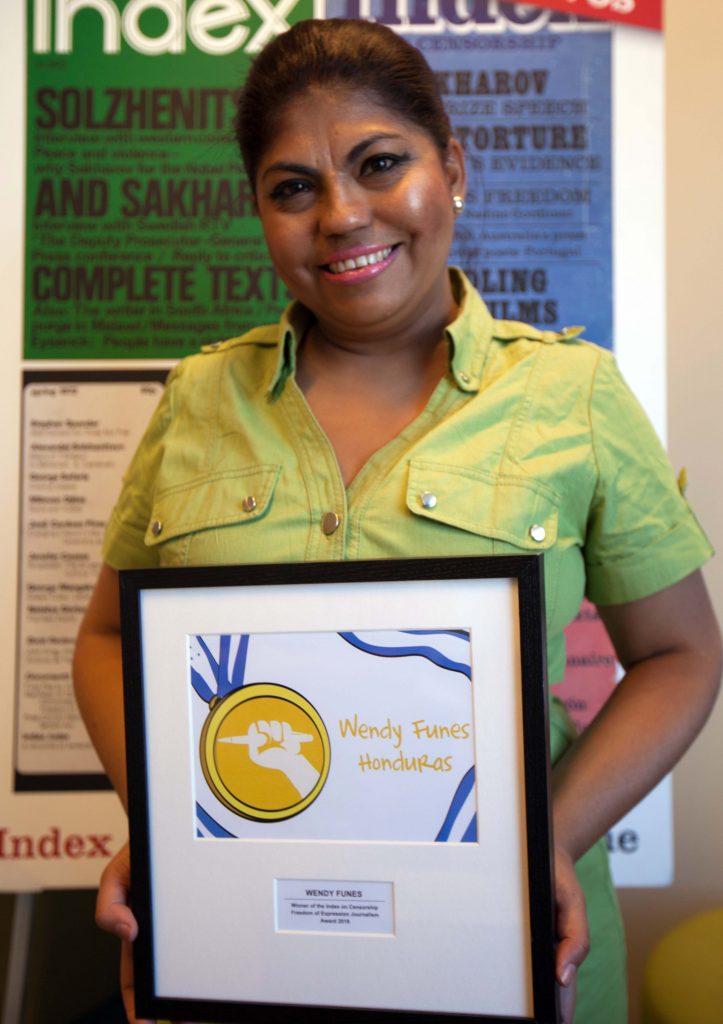
2018 Freedom of Expression Journalism Award-winning Honduran investigative journalist Wendy Funes. (Photo: Index on Censorship)
Wendy Funes is an investigative journalist from Honduras who regularly risks her life for her right to report on what is happening in the country, an extremely harsh environment for reporters. Two journalists were murdered in 2017 and her father and friends are among those who have met violent deaths in the country – killings for which no one has ever been brought to justice. Funes meets these challenges with creativity and determination. For one article she had her own death certificate issued to highlight corruption. Funes also writes about violence against women, a huge problem in Honduras where one woman is killed every 16 hours.
Journalist and 2018 Freedom of Expression Awards judge Razia Iqbal QC said: “She is courageous in the face of death threats. She is courageous in the face of censorship. She is courageous just in terms of getting up every morning and saying I’m going to continue to do what I am doing.”
Profile
ABOUT THE FREEDOM OF EXPRESSION AWARDS AND FELLOWSHIP
The Index on Censorship Freedom of Expression Awards recognise those individuals and groups making the greatest impact in tackling censorship worldwide. Established 18 years ago, the awards shine a light on work being undertaken in defence of free expression globally. Often these stories go unnoticed or are ignored by the mainstream press. Through the fellowship, Index works with the winners – both during an intensive week in London and the rest of the awarding year – to provide longer term, structured support. The goal is to help winners maximise their impact, broaden their support and ensure they can continue to excel at fighting free expression threats on the ground.
ABOUT INDEX ON CENSORSHIP
Index on Censorship is a UK-based nonprofit that campaigns against censorship and promotes free expression worldwide. Founded in 1972, Index has published some of the world’s leading writers and artists in its award-winning quarterly magazine, including Nadine Gordimer, Mario Vargas Llosa, Samuel Beckett and Kurt Vonnegut. Index promotes debate, monitors threats to free speech and supports individuals through its annual awards and fellowship program.
19 Apr 2018 | Awards, Cuba, Fellowship, Fellowship 2018
[vc_row][vc_column][vc_video link=”https://youtu.be/-UpVto-2Sf0″][vc_column_text]
Perla Hinojosa, Fellowship and Advocacy Officer at Index on Censorship, holds the 2018 Freedom of Expression Arts Award for Cuban arts collective Museum of Dissidence, who could not attend the Freedom of Expression Awards. (Photo: Index on Censorship)
Luis Manuel Otero Alcántara: First of all I would like to thank Index and everyone for being here. We had to do this via video because the bureaucracy, the embassies and the powers that be prevented us from being here to accept the award. It’s sad, because we would have liked to share this moment with all of you and the happiness that we feel receiving this award. This award for us means a lot but it also means a lot to all the artists who have preceded us and who are the reason why we have been able to work with a little bit more freedom and a little less fear. Antonia Eiriz, Tania Bruguera, Danilo Maldonado, Angel Delgado and all the artists who have suffered a lack of freedom of expression and creative freedom and who in one way or the other have never given up and have fought for their rights.
Yanelys Nuñez Leyva: On my part, I am happy because this is a boost, where the work of the museum is recognised internationally. This is not the work of just two people, it’s the work of a big collective. There’s a lot of artists but also many activists who are involved in the projects of the Museum of Dissidence. And for us, this is a recognition for them as well.
Luis Manuel: Freedom of expression is an integral part of all societies. It’s what allows us to question all the processes that can happen to an individual. From being able to tell a mother that her way of bringing up her children in a certain way is aggressive or not. To being able to say a political system is corrupt. To being able to express yourself to another person without facing violence or repression.
Yanelys: For me, freedom of expression is like breathing and being able to move every day. It’s something natural that enables us to improve ourselves and grow.
Luis Manuel: Freedom of expression also promotes love towards yourself, towards other people and all the people around you.[/vc_column_text][/vc_column][/vc_row][vc_row disable_element=”yes”][vc_column width=”1/2″][vc_single_image image=”84882″ img_size=”full” alignment=”center”][vc_column_text]
For his one-man protests, Ildar Dadin was sent to prison in December 2015 where he was tortured, before his conviction was quashed in February 2017. Read the full profile.[/vc_column_text][/vc_column][vc_column width=”1/2″][vc_single_image image=”84888″ img_size=”full” alignment=”center”][vc_column_text]
Despite the persecution he faces for his work, Rebel Pepper continues to satirise the Chinese state from a life in exile in Japan. Read the full profile
[/vc_column_text][/vc_column][/vc_row][vc_row disable_element=”yes”][vc_column width=”1/2″][vc_single_image image=”84889″ img_size=”full” alignment=”center”][vc_column_text]
Established in 2015, Turkey Blocks is an independent digital research organisation that monitors internet access restrictions in Turkey. Read the full profile.
[/vc_column_text][/vc_column][vc_column width=”1/2″][vc_single_image image=”84887″ img_size=”full” alignment=”center”][vc_column_text]
Maldives Independent, the Maldives’ premiere English publication and one of the few remaining independent media outlets, was formed in exile in Sri Lanka in 2004. Read the full profile.
[/vc_column_text][/vc_column][/vc_row][vc_row][vc_column][vc_basic_grid post_type=”post” max_items=”12″ style=”load-more” items_per_page=”4″ element_width=”6″ grid_id=”vc_gid:1524235545550-0aab9a14-081b-8″ taxonomies=”8935″][/vc_column][/vc_row]
19 Apr 2018 | Awards, Fellowship, Fellowship 2018
[vc_row][vc_column][vc_video link=”https://youtu.be/ShavP70VY4o”][vc_single_image image=”99812″ img_size=”full” add_caption=”yes” alignment=”center”][vc_column_text]The Egyptian Commission for Rights and Freedoms is one of the few human rights organisations still operating in a country which has waged an orchestrated campaign against independent civil society groups. Egypt is becoming increasingly hostile to dissent, but ECRF continues to provide advocacy, legal support and campaign coordination, drawing attention to the many ongoing human rights abuses under the autocratic rule of President Abdel Fattah-el-Sisi. Their work has seen them subject to state harassment, their headquarters have been raided and staff members arrested. ECRF are committed to carrying on with their work regardless of the challenges.
Ladies and Gentlemen, I am honoured being with you this evening, no words can explain my gratitude to Index on Censorship for such an opportunity to speak in front of you and for having this valuable prize on behalf of the Egyptian Commission for Rights and Freedoms. Such international recognition makes us stronger.
No matter how dark is the moment, love and hope are always possible.
And when I speak of love and hope, I have to speak about Hanan Badeldin, the young lady whose husband Khaled Hafez disappeared five years ago, and she persistently kept looking for him all this time through visiting all prisons, asking forcibly disappeared people who reappeared if they saw her husband in any detention facilities they had been to. During one of these visits, almost a year ago, Hanan was arrested and detained on charges of smuggling an illicit item into prison. This illicit item was a paper with the name of her husband and the date of his disappearance, asking to be circulated among prisoners so that anyone who might have seen her husband could give her any information about him
Did Hanan surrender? No, in every renewal of her detention session, she took the photo of her husband with her, raising it in the hope that any other prisoner there might identify where he was.
And when I speak of love and hope, I have to speak about Ibrahim Metwally, whose son Amr disappeared in 2013. Ibrahim kept looking for him for more than four years and Ibrahim is now in jail. Why? Because he formed the association of the families of the forcibly disappeared, and this has been sufficient reason for the authorities to lock him up in solitary confinement in a cell full of garbage for more than a year.
And when I speak of love and hope, I have to speak about Paola Regeni and her son Giulio, an Italian PhD student who lived in Egypt, who disappeared and was killed in Egypt in 2016. For more than two years she has sparked waves of hope and persistence both in Egypt and Italy, speaking each and every time about enforced disappearances in Egypt, speaking out for the truth for Giulio and the disappeared in Egypt.
And when I speak of love and hope, I have to speak about the great lawyers who spend a lot of sleepless nights trying to help victims in Egypt and the wonderful researchers and campaigners who remain the voice of the voiceless victims.
Love and hope were my cell mates when I was kept in solitary confinement at this time almost two years ago in a dark cell where I was deprived of even having a pillow and let me tell you, they were the perfect companions.
Love and hope are our sole weapons against our greatest enemy fear. Together we will conquer it, and it is not an anticipation, it is a promise.
Truth for Giulio Regeni and every Giulio in Egypt.
Ladies and Gentlemen, it’s an honour to be here with you tonight. Thank you so much.
Full profile[/vc_column_text][/vc_column][/vc_row][vc_row disable_element=”yes”][vc_column width=”1/2″][vc_single_image image=”84882″ img_size=”full” alignment=”center”][vc_column_text]
For his one-man protests, Ildar Dadin was sent to prison in December 2015 where he was tortured, before his conviction was quashed in February 2017. Read the full profile.[/vc_column_text][/vc_column][vc_column width=”1/2″][vc_single_image image=”84888″ img_size=”full” alignment=”center”][vc_column_text]
Despite the persecution he faces for his work, Rebel Pepper continues to satirise the Chinese state from a life in exile in Japan. Read the full profile
[/vc_column_text][/vc_column][/vc_row][vc_row disable_element=”yes”][vc_column width=”1/2″][vc_single_image image=”84889″ img_size=”full” alignment=”center”][vc_column_text]
Established in 2015, Turkey Blocks is an independent digital research organisation that monitors internet access restrictions in Turkey. Read the full profile.
[/vc_column_text][/vc_column][vc_column width=”1/2″][vc_single_image image=”84887″ img_size=”full” alignment=”center”][vc_column_text]
Maldives Independent, the Maldives’ premiere English publication and one of the few remaining independent media outlets, was formed in exile in Sri Lanka in 2004. Read the full profile.
[/vc_column_text][/vc_column][/vc_row][vc_row][vc_column][vc_basic_grid post_type=”post” max_items=”12″ style=”load-more” items_per_page=”4″ element_width=”6″ grid_id=”vc_gid:1524235546790-0bd59964-8ec6-6″ taxonomies=”8935″][/vc_column][/vc_row]
