14 Aug 2017 | Awards, Fellowship, Fellowship 2017, News
[vc_row][vc_column][vc_single_image image=”89311″ img_size=”full” alignment=”center”][vc_column_text]Freedom of Expression Campaigning Award-winner Ildar Dadin has returned to activism since his release from prison in February when his conviction was overturned by Russia’s constitutional and supreme courts.
Dadin was sentenced to three years in prison in December 2015 under a 2014 public assembly law. His crime was staging one-man pickets, often holding a billboard, in public. In November 2016, a letter from Dadin to his wife was published, exposing torture he experienced in prison. In April 2017, Dadin was prevented from attending the Index Freedom of Expression Awards in London.
When asked about the international attention his imprisonment received, Dadin expressed that he feels Russian civil society is part of a global society, rather than a totally isolated group. He believes that pressure from civil society both in Russia and abroad were partially responsible for his release. The ultimate goal of his activism shares this global view. He hopes for “justice for all people, not just Russians, humans”.
In June, Dadin was awarded the Boris Nemtsov Prize, which honours individuals who are “particularly committed to fighting for the freedom of expression and helping those who are persecuted on political, racial or religious grounds.” Dadin previously referenced Nemtsov as an example of a Russian opposition leader killed for his activism and beliefs in his Index Awards acceptance speech . Without proper travel documents, Dadin was unable to attend the awards ceremony.
A Russian court ordered the Russian Ministry of Finance to pay Dadin a compensation of 2.2 million rubles for unlawful criminal prosecution in May. He originally demanded five million rubles, and in June filed an appeal to increase the compensation.
Previous prosecution for his activism has not stopped Dadin from continuing to push for freedom of expression in Russia. In June, he read aloud from the Russian constitution on Red Square. He was fined 20,000 rubles ($350) for holding a public gathering without permission.
Moving forward, Index is helping Ildar with his transition to life outside of prison and prioritizing his health.
Additional reporting by Claire Kopsky[/vc_column_text][/vc_column][/vc_row][vc_row][vc_column][vc_basic_grid post_type=”post” max_items=”12″ style=”load-more” items_per_page=”4″ element_width=”6″ grid_id=”vc_gid:1502705474532-50095286-2580-2″ taxonomies=”9013″][/vc_column][/vc_row]
8 Aug 2017 | Artistic Freedom, Magazine, News, Russia, Volume 46.02 Summer 2017
[vc_row][vc_column][vc_custom_heading text=”Influential Soviet director Sergei Eisenstein is often portrayed as the godfather of propaganda in film. David Aaronovitch argues in the summer 2017 issue of Index on Censorship magazine that historical drama can also be manipulative when it ignores details of the past”][vc_row_inner][vc_column_inner][vc_column_text]
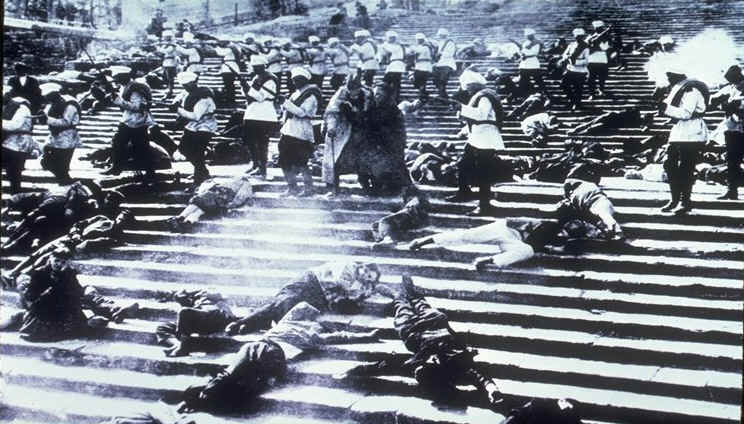
A still from Sergei Eisenstein’s 1925 film, Battleship Potemkin, portraying a massacre that never happened. Credit: Wikimedia
[/vc_column_text][/vc_column_inner][/vc_row_inner][/vc_column][/vc_row][vc_row][vc_column][vc_column_text]
My friend, a writer, reminded me of the English romantic poet John Keats’s axiom that “we hate poetry that has a palpable design upon us”. You could say, though, that Lenin and Mussolini – at least when it came to the poetry of film – knew differently. “Of all the arts, for us,” said Lenin, “the cinema is the most important”. “For us” meaning, of course, for the ruling Bolsheviks in the aftermath of the October 1917 revolution. When the Italian dictator Mussolini’s new super studios were opened in 1936 a sign was erected over the gate reading “Il cinema è l’arma più forte”, “cinema is the strongest weapon”.
It was George Orwell, not a dictator (though they doubtless would smilingly have agreed with him) who wrote that, “he who controls the past controls the future. He who controls the present controls the past.” It is pretty obvious that the way the powerful medium of film depicts the “then” has important implications for what people can be brought to believe about the “now”.
I was brought up partly on films made in the Soviet Union and saw some of the most celebrated early movies when I was young. The director Sergei Eisenstein was the most famous name and before I was 12 I’d seen almost all his films, from the silent Strike made in 1924 to the extraordinarily ambivalent and terrifying two-part classic Ivan the Terrible. Every single one of them can be said to have had some kind of agenda that dovetailed – sometimes perfectly, sometimes awkwardly – with that of the Soviet state.
[/vc_column_text][vc_row_inner][vc_column_inner width=”1/4″][vc_icon icon_fontawesome=”fa fa-quote-left” color=”custom” align=”right” custom_color=”#dd3333″][/vc_column_inner][vc_column_inner width=”3/4″][vc_custom_heading text=”The massacre on the Odessa steps (once seen, never forgotten) from the movie Potemkin didn’t actually happen” google_fonts=”font_family:Libre%20Baskerville%3Aregular%2Citalic%2C700|font_style:400%20italic%3A400%3Aitalic”][/vc_column_inner][/vc_row_inner][vc_column_text]
The two that were most obviously about Bolshevism and Russia were The Battleship Potemkin, dealing with events in the city of Odessa in 1905, and October, an account of the “ten days that shook the world” – the Bolshevik seizure of power – in Petrograd (St Petersburg) in 1917.
Both deploy Eisenstein’s famous techniques of intercutting, juxtaposition and montage to create mood and drama. Sometimes cutaways of objects or expressions are inserted to refer obliquely to what the viewer is supposed to think of the person or the moment being depicted.
And in both films the actual history is bent for the purposes of the filmmaker. The massacre on the Odessa steps (once seen, never forgotten) from the movie Potemkin didn’t actually happen. The film version of the storming of the Winter Palace in October involved many more actors than the actual event itself. And October was criticised in Keatsian terms by no less a luminary than Lenin’s widow, Nadezhda Konstantinovna Krupskaya.
The full article by David Aaronovitch is available with a print or online subscription.
[/vc_column_text][/vc_column][/vc_row][vc_row][vc_column][vc_custom_heading text=”Film and the Soviet state”][vc_column_text]
Sidebar by Margaret Flynn Sapia
[/vc_column_text][vc_video link=”https://www.youtube.com/watch?v=3UQMg3saU4Q&t=1s” title=”Strike (1925)”][vc_column_text]The Soviet version of Russian history had two goals: to legitimise the rise and rule of the current government, and to instil its values into future generations. Strike, the first film directed by Sergei Eisenstein, undoubtedly does both. The film, set before the revolution, tells the story of a group of factory workers as they rise up against their abusive management. It begins with a quote by Lenin – “The strength of the working class is organisation” – and ends with a violent strike cross cut with the slaughter of animals. From the first frame to the last, the message is clear.[/vc_column_text][vc_video link=”https://www.youtube.com/watch?v=JcJkHCihTmE” title=”Ivan the Terrible (1944)”][vc_column_text]It is fitting that Joseph Stalin regarded Tsar Ivan IV as his role model, given that the two men men are renowned as two of Russia’s cruelest and most feared leaders. Directed by Eisenstein and commissioned by Stalin himself, Ivan the Terrible takes a stab at telling Ivan’s story in a way that flatters the Stalin regime. The plot portrays the boyars, the highest of bourgeois aristocracy, as internal enemies seeking to undermine the singular strength of Ivan’s leadership, a less-than-subtle parallel for the one-party Soviet state of the 1940’s.[/vc_column_text][vc_video link=”https://www.youtube.com/watch?v=kS5kzTbNKjs” title=”Battleship Potemkin (1925)”][vc_column_text]Like a dozen other Soviet films, The Battleship Potemkin depicts the horrors of the tsarist regime and a subsequent popular revolt. It dramatises the true story of a 1905 mutiny by the crew on a Russian battleship, but its most famous and enduring scene, the massacre on the Odessa steps, was entirely invented. However, unlike many of its comrades, this movie was internationally celebrated for its technical excellence, and was ranked as the 11th best film of all time in a 2017 BFI critics poll. Through the film’s five acts, Eisenstein demonstrates that propaganda and art are not mutually exclusive, and that the confines of oppression can sometimes breed incredible creativity.[/vc_column_text][vc_video link=”https://www.youtube.com/watch?v=riOLSslKvxU” title=”October: 10 Days That Shook the World (1928)”][vc_column_text]A retelling of Russia’s 1917 Revolution, this film creates a fascinatingly skewed representation of the Soviet Union’s rise. While the series of major events in the film is historically accurate, the depictions of Soviet leaders and opposition give the film’s biases away, as key facets of character and decisions are highlighted and hidden. When watching the film, pay special attention to the portrayals of Lenin and the Bolsheviks. [/vc_column_text][vc_video link=”https://www.youtube.com/watch?v=R-QBqT9RQAM” title=”Panfilov’s 28 Men (2016)”][vc_column_text]Panfilov’s 28 Men demonstrates how Russian manipulation of history did not end with the Soviet Union. Released in 2016, this film is based on a famous but disputed incident in World War II wherein a small group of Russian soldiers purportedly warded off a wave of Nazi tanks and soldiers, all dying in the process. The events were heavily embellished by Soviet propagandists and later debunked, but the film based on them was partially funded by the Russian Ministry of Culture and is widely advertised as an accurate depiction of historical events. Times change, but the Russian regime continues to use cinema to its benefit.[/vc_column_text][/vc_column][/vc_row][vc_row][vc_column][vc_column_text]
This article is published in full in the Summer 2017 issue of Index on Censorship magazine. Print copies of the magazine are available on Amazon, or you can find information about print or digital subscriptions here. Copies are also available at the BFI, the Serpentine Gallery, MagCulture, (London), News from Nowhere (Liverpool), and Home (Manchester). Each magazine sale helps Index on Censorship continue its fight for free expression worldwide
[/vc_column_text][/vc_column][/vc_row][vc_row][vc_column][vc_custom_heading text=”From the Archives”][vc_row_inner][vc_column_inner width=”1/3″][vc_single_image image=”80560″ img_size=”213×289″ alignment=”center” onclick=”custom_link” link=”http://journals.sagepub.com/doi/pdf/10.1177/0306422014523227″][vc_custom_heading text=”Reel Drama: WWII propaganda” font_container=”tag:p|font_size:24|text_align:left” link=”url:http%3A%2F%2Fjournals.sagepub.com%2Fdoi%2Fpdf%2F10.1177%2F0306422014523227|||”][vc_column_text]March 2014
David Aaronovitch argues that all’s fair in war against fascist dictatorship, including seducing the United States into war with pretty faces and British accents.[/vc_column_text][/vc_column_inner][vc_column_inner width=”1/3″][vc_single_image image=”89184″ img_size=”213×289″ alignment=”center” onclick=”custom_link” link=”http://journals.sagepub.com/doi/pdf/10.1080/03064220512331339706″][vc_custom_heading text=”The ferghana canal” font_container=”tag:p|font_size:24|text_align:left” link=”url:http%3A%2F%2Fjournals.sagepub.com%2Fdoi%2Fpdf%2F10.1080%2F03064220512331339706|||”][vc_column_text]February 2005
The first 145 shots of a shooting-script by Sergei Eistenstein, a prologue to the modern drama of Uzbekistan’s reclamation of its desert wastes.[/vc_column_text][/vc_column_inner][vc_column_inner width=”1/3″][vc_single_image image=”98486″ img_size=”213×289″ alignment=”center” onclick=”custom_link” link=”http://journals.sagepub.com/doi/pdf/10.1080/03064229108535073″][vc_custom_heading text=”Iron fist, silver screen” font_container=”tag:p|font_size:24|text_align:left” link=”url:http%3A%2F%2Fjournals.sagepub.com%2Fdoi%2Fpdf%2F10.1080%2F03064229108535073|||”][vc_column_text]March 1991
An examination of how film is an arm of party propaganda in Saddam Hussein’s Iraq, highlighting the 1973 Law on Censorship of Foreign Films.[/vc_column_text][/vc_column_inner][/vc_row_inner][vc_separator][vc_row_inner][vc_column_inner width=”1/3″][vc_custom_heading text=”100 Years On” font_container=”tag:p|font_size:24|text_align:left” link=”url:https%3A%2F%2Fwww.indexoncensorship.org%2F2017%2F06%2F100-years-on%2F|||”][vc_column_text]Through a range of in-depth reporting, interviews and illustrations, the summer 2017 issue of Index on Censorship magazine explores how the consequences of the 1917 Russian Revolution still affect freedoms today, in Russia and around the world.
With: Andrei Arkhangelsky, BG Muhn, Nina Khrushcheva[/vc_column_text][/vc_column_inner][vc_column_inner width=”1/3″][vc_single_image image=”91220″ img_size=”medium” alignment=”center” onclick=”custom_link” link=”https://www.indexoncensorship.org/2017/06/100-years-on/”][/vc_column_inner][vc_column_inner width=”1/3″][vc_custom_heading text=”Subscribe” font_container=”tag:p|font_size:24|text_align:left” link=”url:https%3A%2F%2Fwww.indexoncensorship.org%2Fsubscribe%2F|||”][vc_column_text]In print, online. In your mailbox, on your iPad.
Subscription options from £18 or just £1.49 in the App Store for a digital issue.
Every subscriber helps support Index on Censorship’s projects around the world.
 SUBSCRIBE NOW[/vc_column_text][/vc_column_inner][/vc_row_inner][/vc_column][/vc_row]
2 Aug 2017 | Mapping Media Freedom, Media Freedom, media freedom featured, News
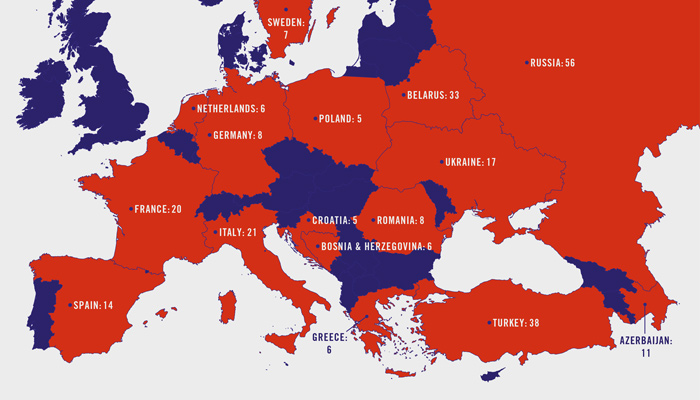
Journalists continue to face unprecedented pressure in Europe as reports submitted to Index on Censorship’s Mapping Media Freedom platform in the first quarter of 2017 demonstrate. Media professionals—primarily in Turkey, Russia, Belarus and Ukraine—were arrested at an alarming rate, more than a fourfold increase over the fourth quarter of 2016.
“During the first quarter of 2017, the MMF database registered several trends that we find to be acute challenges to media freedom. Some European governments have clearly interfered with media pluralism. Others have harassed, detained and intimidated journalists. All of these actions debase and devalue the work of the press and undermine a basic foundation of democracy,” Hannah Machlin, project manager at Mapping Media Freedom, said.
During Q1, authorities in multiple countries shut down critical and independent media outlets and intimidated reporters who asked challenging questions. Turkey continues to be the largest jailer of journalists in the world with a total of 148 journalists in prison by the end of March according to the Platform for Independent Journalists P24, a Turkey-based MMF partner, which monitors the number of arrests in the country.
Even reporters in countries often thought to respect freedom of the press, such as Sweden, France and Germany, faced obstacles to performing their professional duties. They were abused by the leaders of extreme populist movements and their supporters, who encouraged a distrust of “mainstream media”; and blocked by nervous politicians who were seeing, particularly in France, the old political certainties swept away.
Between 1 January and 31 March 2017, Mapping Media Freedom’s network of correspondents and other journalists submitted a total of 299 violations of press freedom to the database.
The full report can be found online at Mapping Media Freedom or in PDF format.
21 Jul 2017 | Bahrain, Middle East and North Africa, News
[vc_row][vc_column][vc_column_text]
Index on Censorship welcomes UK foreign secretary Boris Johnson’s interest in human rights. The UK Foreign and Commonwealth Office’s 2016 Annual Human Rights Report, released on Thursday 20 July, highlights the UK’s work to promote human rights around the world and sets out a list of 30 “Human Rights Priority Countries”, including Bahrain, Iran, Russia and Saudi Arabia.
In the report preface, Johnson writes: “Human rights are not inimical to development and prosperity; the opposite is true. Freedom of speech, freedom of association, freedom to practice whatever religion you want and live your life as you please, provided you do no harm, are the essential features of a dynamic and open society.”
Index agrees wholeheartedly and acknowledges that the report features many valiant efforts, including, for the first time, a section dedicated to modern slavery – a top priority for the UK government.
But the report – issued on “take out the trash” day, the last of the parliamentary sessions before a seven-week recess – does not, as it claims, seem to aspire to the “passionate advocacy” of Charles James Fox, the British Whig statesman and anti-slavery campaigner.
Instead, Johnson offers a watered-down endorsement of human rights and his department’s understanding of advocacy is seriously flawed. To borrow the foreign secretary’s own words, this is “unthinkable for anyone inspired by the example of Charles James Fox”.
Take Bahrain, for example. While the report does go some way to criticising a handful of the country’s human rights violations, this is not done not in nearly strong enough terms, and you’d be forgiven for thinking these violations are blips in an otherwise rosy picture. This is, after all, a country which has only “restricted some civil liberties”.
“There was a mixed picture on human rights in Bahrain in 2016,” the discussion of the Persian Gulf kingdom begins. “Compared with the region, Bahrain remains progressive in women’s rights, political representation, labour rights, religious tolerance and institutional accountability.”
Firstly, this is a faulty comparison. Looking at the region as a whole serves only to make Bahrain look better than it actually is. Bahrain may have 15% representation of women in parliament, as the report highlights, but this cannot be described as progressive. As of 2014, the government of Saudi Arabia, not known for its feminism, was made up of 19.9% women.
In April 2016, a royal decree that increased the rights of women in Bahrain only passed through parliament scrutiny on a technicality. In March of that year, Bahrain detained human rights activist and blogger Zainab al-Khawaja along with her one-year-old son. She was released in May but fled the country out of fear of re-arrest.
While the report does go on to criticise the dissolving of the country’s main Shia opposition party, Al Wefaq, it remains a mystery why the report would first highlight political representation and religious tolerance as positives in Bahrain.
The country certainly does not have enough institutional accountability, and this is not something it should be commended on.
Even the brief mention of Bahraini human rights activist Nabeel Rajab, sentenced to two-years in prison just for speaking to journalists 10 days before the government’s report was released, only refers to Index award-winner as having been arrested. The sheer scale of Rajab’s case is not accounted for.
On 3 February a coalition of 21 groups and individuals, including Index on Censorship, urged Johnson to call for Rajab’s release. In the time since, the US state department has called for Rajab’s release and condemned his sentencing. The UK government so far has only “voiced its concern” in the weakest possible terms, and as yet has not acknowledged Rajab’s sentencing.
When Theresa May became prime minister of the UK, Bahrain was one of the first countries she visited. As new documents reveal, UK contractors visited the country 28 times in 12 months amid Bahrain’s ongoing human rights crackdown. In all, “UK government contractors have spent more than 650 days in Bahrain training prison guards, including officers at the notorious Jau prison where death-row inmates are held and allegedly tortured,” the Middle East Eye reported earlier this month.
The UK government appears to be in no position to heap praise on Bahrain for strengthening the rule of law, justice reform, its independent human rights institutions, prisoners’ rights and improvements at Jau.
Many more issues in the Annual Human Rights Report must be scrutinised when MPs return in September. If the Bahrain section is anything to go by, the report should be found to fall far short of being “passionate” about human rights.
[/vc_column_text][/vc_column][/vc_row][vc_row][vc_column][vc_basic_grid post_type=”post” max_items=”4″ element_width=”6″ grid_id=”vc_gid:1500646119465-139983e0-dcda-4″ taxonomies=”716″][/vc_column][/vc_row]
