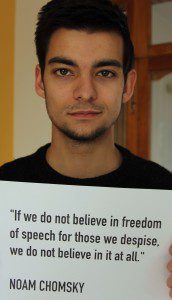
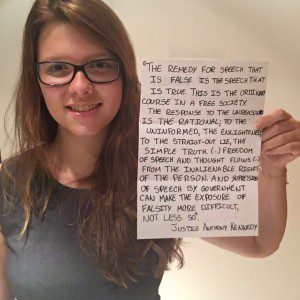
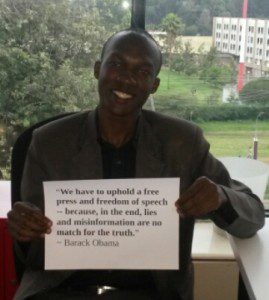
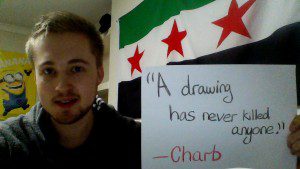
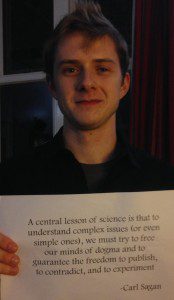
Index on Censorship recently appointed a new youth advisory board who attend monthly online meetings to discuss current freedom of expression issues and complete related tasks. As their first assignments they were asked to provide a short bio to introduce themselves, along with a photograph of them holding a quotation highlighting what free expression means to them.
Simon Engelkes
I am from Berlin, Germany, where I study political science at Free University Berlin. I have worked as an intern with Reporters Without Borders and RTL Television, which made me passionate about the importance of freedom of speech.
I believe that freedom of expression forms an important cornerstone of any effective democracy. Journalists and bloggers must live without fear and without interference from state or economic interests. Unfortunately, this is not the case. Journalists, authors and everyday citizens are imprisoned or killed by radicals, state agencies or drug cartels. Raif Badawi, James Foley, Khadija Ismayilova, Avijit Roy – the list is endless.
We need to remind ourselves and the powerful of today, that freedom of expression as well as freedom of information are basic human rights, which we have to defend at all costs.
Mariana Cunha e Melo
I am from Rio de Janeiro, Brazil. I graduated from law school in Rio and I have a degree from New York University School of Law. My family has taught me about the dangers of censorship and dictatorship, so I have always been interested in studying civil rights. This was the main reason I decided to study law.
I grew up listening to stories about the media censorship in Brazil during the military dictatorship. The fight against the ghost of state censorship has always sounded very natural to me – and, I believe, to all my generation. When I finished law school I found out that the new villain my generation has to face is the censorship based on constitutional values. The argument has changed, but the censorship is not all that different. So I decided to dedicate my academic and my professional life as a lawyer to fight all sorts of institutionalised censorship in Brazil.
Ephraim Kenyanito
I was born and raised in Kenya, and I am currently working as the sub-Saharan Africa policy analyst at Access Now, an international organisation that defends and extends the digital rights of users at risk around the world. My role involves working on the connection between internet policy and human rights in African Union member countries. I am an affiliate at the Internet Policy Observatory (IPO) at the Center for Global Communication Studies, University of Pennsylvania. I also currently serve as a member of the UN Secretary General’s Multi-stakeholder Advisory Group on internet governance.
The reason why I have always been passionate about protecting the open internet is that it is a cornerstone for advancing free speech in the post-millennium era and there is a great need to build common ground around a public interest-oriented approach to internet governance.
Emily Wright
I grew up in Portugal, and I am now based between London and Bogotá, Colombia. I am a freelance filmmaker and journalist. Working in documentary production and community-based, participatory journalism informed a growing interest in journalistic practices, freedom of expression and access to information.
I believe that one of the greatest threats to freedom of expression is the flagrant violation of civil liberties under the banner of national security. The war on terror, underscored by Bush’s declaration “You’re either for us or against us”, has collapsed the middle ground, suppressing any struggles that challenge that statement. Freedom of expression has become a pretext for silencing those who have the least access to it; those who do not fall in line with the global order’s supposed defence of freedom against barbarism and obscurantism.
Mark Crawford
I’m originally from Birmingham, and now a postgraduate student at University College London, specialising in Russian and post-Soviet politics. This has inevitably educated me on the pressures exerted upon freedom of expression in Russia, whose suffocated and disenfranchised opposition journalists I am currently investigating.
Hostility to free expression has become a staple of my university life. Rather than developing a coherent set of ideologies to challenge toxic values in the open, it has become mainstream for students of the most privileged universities in the world to veto them on behalf of everyone else, no-platforming and deriding free speech.
I am convinced that there is no point fighting for an egalitarian society if any monopolies over truth are permitted. Freedom of speech is, therefore, something I am keen to promote in whatever small way I can.
Madeleine Stone
My home is in south-east London but I spend most of my time in York, studying for my bachelor’s degree in English and related literature. I am currently the co-chair of York PEN, the University of York’s branch of English PEN, and a founding member of the Antione Collective, a human rights-focused theatre company.
Studying literature from across the globe has introduced me to issues of freedom and censorship, and the devastating effects censorship can have on national progress. Freedom of expression on campuses is hugely important to me as a student and it is currently under threat. Well-meaning individuals are shutting down the open debate that is vital to academic institutions. The only way to fight harmful ideas is to engage them head-on and destroy them through academic debate, not to ban them.
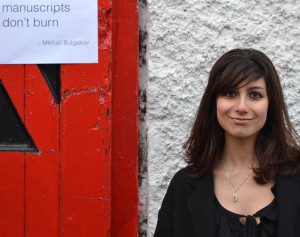
Layli Foroudi
I am a journalist and student currently studying for a MPhil in race, ethnicity and conflict at Trinity College Dublin. It was studying literary works from the Soviet period during my undergraduate degree in Russian and French at University College London that initially highlighted the issue of censorship for me. The quote I selected, “manuscripts don’t burn”, is from the book Master and Margarita by Russian author Mikhail Bulgakov. He wrote about the hardship that many writers faced as they had to adjust their own writing in accordance with the authority, as well as the fact that not all that is written can be taken to be true.
I think that these themes are very relevant today. Whether people are censored or self-censor out of fear of punishment or of being wrong, limiting freedom of expression results in loss of debate, of exchange and of creativity. Being denied freedom of expression is being denied the right to participation in society.
Ian Morse
I have been involved in journalism since I began studying at Lafayette College, Pennsylvania, USA, and have been engaged in press freedom and reporting in three countries since then. I studied in Turkey last spring, where I interviewed and wrote about journalists and press freedom. It motivated me to begin researching and writing on my own about these topics. Now, as I study for a semester in Cambridge in the UK, I continue to talk about and advocate for free speech and press.
I find it absolutely amazing the power words and information can have in a society. It becomes then extremely damaging to realise that some things cannot be published because they conflict with those in power. Free speech is now becoming a hot topic around the world, particularly among youth, and it makes it all the more important to be able to approach freedom of expression critically and objectively.
As the annual Index on Censorship Freedom of Expression Awards gala approaches, we’ve highlighted five of those who have won or been nominated for free expression awards, including the Freemuse Awards. From a Moroccan rapper to an Iranian folk singer, these artists refuse to be censored and continue to fight to have their voices heard.
El Haqed, Morocco
Winner of the 2015 Index on Censorship Freedom of Expression Award for arts
Mouad Belghouat, aka El Haqed, faced repression from the Moroccan government, including multiple arrests since the Arab Spring. His music focuses on poverty, oppression and political corruption in his country. He is currently living in Belgium, where he continues to write music.
Mayam Mahmoud, Egypt
Winner of the 2014 Index on Censorship Freedom of Expression Award for arts
Mayam Mahmoud, one of Egypt’s first and bravest female hip-hop artists, uses music to address some of the grievances in her country, from a lack of women’s rights to sexual harassment. After competing on the TV show Arabs Got Talent, she used her prominence to speak out against the misogyny she has witnessed and experienced.
Ferhat Tunç, Turkey
2010 Freemuse Award winner
Despite years of attempted censorship by the Turkish government, Ferhat Tunç has continued to release music and promote human rights in his homeland. He has released more than 20 albums, undeterred by numerous court summons and a prison sentence.
Songhoy Blues, Mali
Nominees for the 2015 Index on Censorship Freedom of Expression Award for arts
A group of musicians that fled northern Mali after the occupation by militant Islamist groups in spring 2012, Songhoy Blues are a rowdy blend of blues and rock. After Islamists banned music in their region, they went into exile and have since gone on to tour with Julian Casablancas and Damon Albarn. The band released their debut album, Music in Exile, in February 2015.
Pussy Riot, Russia
Nominees for the 2013 Index on Censorship Freedom of Expression Award for arts In February 2012, members of the feminist punk band Pussy Riot staged a brief demonstration through music at Moscow’s Christ the Saviour Cathedral, condemning the Russian Orthodox Church’s close ties to Vladimir Putin. In August of that year, three members were sentenced to two years in jail for hooliganism motivated by religious hatred. The verdict was a bitter blow for freedom of expression in Russia, which continues to be under attack today.
Index on Censorship has teamed up with the producers of an award-winning documentary about Mali’s musicians, They Will Have To Kill Us First, to create the Music in Exile Fund to support musicians facing censorship globally. You can donate here, or give £10 by texting “BAND61 £10” to 70070.
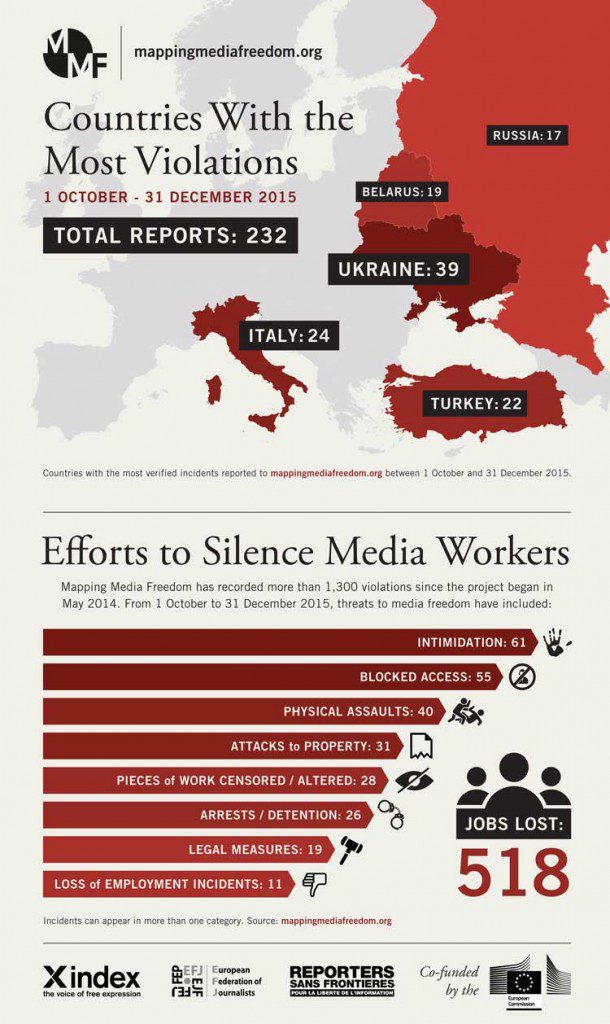
Pressure on Europe’s journalists as they do their jobs saw no let up during the fourth quarter of 2015, according to a survey of verified incidents of violations reported to Index on Censorship’s project Mapping Media Freedom.
Between 1 October and 31 December 2015, Mapping Media Freedom‘s network of 19 correspondents verified 232 reports that were submitted to the database. Each report is reviewed for factual accuracy and confirmed with local sources before an incident is publicly available on the map. The platform — a joint undertaking with the European Federation of Journalists and Reporters Without Borders and partially funded by the European Commission — covers 40 countries, including all EU member states, Albania, Belarus, Bosnia, Iceland, Kosovo, Macedonia, Montenegro, Norway, Russia, Serbia, Turkey and Ukraine. Since it was launched in May 2014, the map has recorded over 1,300 violations of media freedom.
During the fourth quarter of 2015: 518 media jobs were lost; two media workers reporting on the Syrian conflict were killed in Turkey; 40 reports of physical assaults on media professionals were confirmed; media workers were detained in 26 cases with criminal charges filed in 11 cases; media professionals were blocked from covering a story in 55 verified incidents; and journalists were subject to public denigration in 22 of the verified reports.
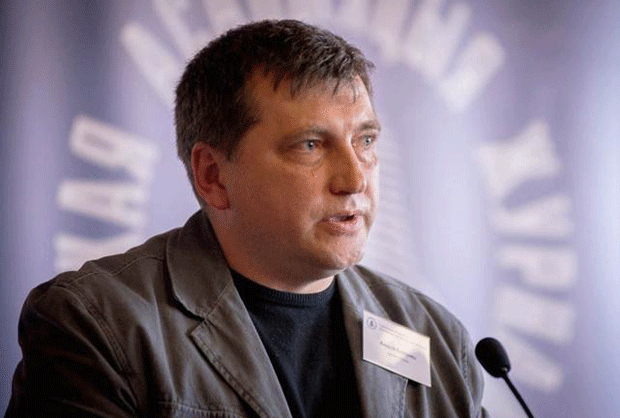
Andrei Bastunets, chairperson of the Belarusian Association of Journalists (Belarusian Association of Journalists)
Belarusian authorities were busy in 2015: the government introduced new laws aimed at restricting media outlets and distributors; freelance journalists contributing to foreign media outlets found themselves facing prosecution; and websites publishing material that “may harm the national interests of the Republic of Belarus” were extrajudicially blocked.
President Aleksandr Lukashenko may have won his fifth consecutive election on 11 October, but this also raised concerns. Observers noted the electoral process failed to meet certain international standards, including equal media access for candidates, highlighting the pressure media workers find themselves under to comply with tightening government control.
Andrei Bastunets, chairperson of the Belarusian Association of Journalists, spoke to Mapping Media Freedom Volha Siakhovich about the country’s freedom of expression climate.
Volha Siakhovich: How would you describe the situation with media freedom in Belarus in 2015?
Andrei Bastunets: Press freedom has never been easy in Belarus. The country has been ranked 157th out in 180 countries in the World Press Freedom Index by Reporters Without Borders for some years, which is the worst position among all European countries. We can also see the deterioration of the situation with press freedom and freedom of expression as a whole at the systemic level, with the further tightening of the legal framework for activities of the media set forth by new amendments to the Law on Mass Media came into force from the beginning of 2015. They had been adopted by the Belarusian parliament unexpectedly in December 2014 without any public discussion.
Why were the amendments made?
Andrei Bastunets: The Belarusian authorities are always in keeping with the trend of stifling freedom of speech through legal restrictions. The current authorities’ actions against the media are related to the 2015 presidential election campaign and economic crises in Belarus. These circumstances have provoked the tightening of state control over the media field. It affected traditional media, the web and the distribution of print outlets. Before the election, all media had been subjected to more strict limitations.
What problems are associated with state control over the distribution of media?
Andrei Bastunets: In accordance with new legal provisions all media outlets distributors (except for editorial boards) have been obliged to submit to the ministry of information the required information for their incorporation into the State Register until 1 July 2015. Any non-registered distributors’ activity is considered illegal. The ministry of information has various penalty tools that can be applied in relation to media distributors, including the banning of their activity. The distributors are now in fact forced to monitor the content of the distributed media under threat of sanctions. That may lead to the hidden censorship.
Several independent outlets that used to sell the major part of their print-runs through different trade companies and entrepreneurs have faced a reduction in sales since a significant part of press distributors have not agreed to apply to the ministry of information of Belarus for a special permit. At the same time, the “Belposhta” and “Sayuzdruk — state-owned monopolist press distributors — continue to discriminate against Belarusian independent media refusing to co-operate with them.
What negative consequences have followed the changes to the legal regulation regarding the web?
Andrei Bastunets: There is an active interference by the ministry of information of Belarus into the web, which has remained the freest segment in the Belarusian media space. According to the adopted amendments to the Law on Mass Media and provisions of presidential decree No.6 of 28 December 2014 On Urgent Actions to Counteract Illegal Drug Trafficking, which came into force at the beginning of 2015, the ministry of information was authorised to block access to websites extrajudicially for publishing information prohibited by law. It particularly includes the information, which ‘may harm the national interests of the Republic of Belarus’. Now owners of websites are obliged to monitor their web contents including comments of users.
Any state agency can contribute to the formation of a “black list” of websites. It is enough to inform the ministry of information that, in its opinion, a website violates the law. It is important to note that the process has been completely removed from the judicial sphere and has been assigned to the state agencies and the ministry of information. A procedure for judicial review of such decisions is not provided.
Not only are websites to be blocked, but blogs as well. It is a mechanism of a manifestly repressive character and it does not agree with the principles of freedom of expression. In addition, this mechanism is in the hands of the authorities who do not respect these basic principles. Now it is clear that there are no possibilities to appeal against their decisions in fact besides applications to the authorities themselves.
On 18 June 2015, the ministry of information used its power and blocked access to the website KYKY.org. As it was stated in the ministerial report, some KYKY online publications “contained derogatory statements concerning the Belarusian Victory Day public holiday, as well as the citizens of the country who celebrated it, thus… calling in question the significance of this event for the state and distorting the historical truth about the Great Patriotic War”. The editorial staff had to remove all publications that the ministerial officers disliked in order to get back online.
What were the main restrictions to media freedom facing Belarusian journalists last year?
Andrei Bastunets: We witnessed intensified persecution of freelance journalists contributing for foreign media, detentions of journalists by police, interference of the ministry of information in the work of media and the blocking of access to information for journalists. The situation remained highly unfavorable, and the intensification of pressure on journalists and media was recorded during in the course of the presidential election in Belarus in October 2015.
Although no new criminal cases were brought against journalist in 2015, Belarusian journalist Aliaksandr Alesin remains a suspect in an espionage case which has been going on since 25 November 2014, when he was first detained. Alesin is a military expert and a columnist of the weekly Belarusians and Market. At first, the journalist was charged with treason and co-operation with foreign secret services or intelligence agencies. The charge of treason was withdrawn and he was freed, but he still stands accused of co-operation with foreign intelligence services.
In your opinion, why do the Belarusian authorities chase freelancers co-operating with foreign media?
Andrei Bastunets: Prosecution of freelance journalists cooperating with foreign media started in 2014 was continuing in 2015. During 2015, Belarusian freelance journalists have been fined 28 times under Art. 22.9 of the Code of Administrative Offences for “illegal making and distributing mass media productions”. As before, the authorities repressed the independent media workers for the mere fact of publication of their pieces in foreign media. I believe, this is explained by the desire of the Belarusian authorities to restrict the influence of foreign media as the important independent sources of information in the conditions of the lack of independent audiovisual media in Belarus. All the fined freelance journalists worked for foreign radios or TV channels broadcasting for Belarus in Belarusian of Russian languages. As the Belarusian authorities are not able to control these media, they aim to control Belarusian citizens contributing to them.
The prosecution of freelance journalists dramatically intensified at the beginning of summer 2015. At the beginning of August 2015, after the president’s promise to look into the problem during his interview to journalists of independent media, initiating such cases was stopped. However, there were no legal guarantees that the situation would not repeat after the presidential election. And in December policemen in the Gomel region drew up three reports for cooperation with foreign media. Now we are expecting that the reports will be sent to the court.
What are the current main challenges with the Belarusian Association of Journalists?
Andrei Bastunets: As always, the challenges of Belarusian Association of Journalists are the protection of journalistic freedom and free speech values through interaction with state bodies, legal assistance and international advocacy.

 Mariana Cunha e Melo
  Ephraim Kenyanito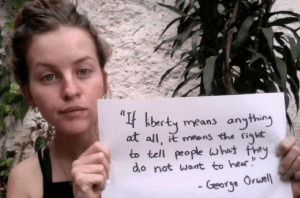
 Mark Crawford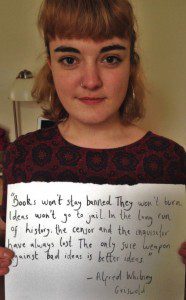
 Ian Morse