13 Feb 2019 | Magazine, News and features, Student Reading Lists
[vc_row][vc_column][vc_column_text]
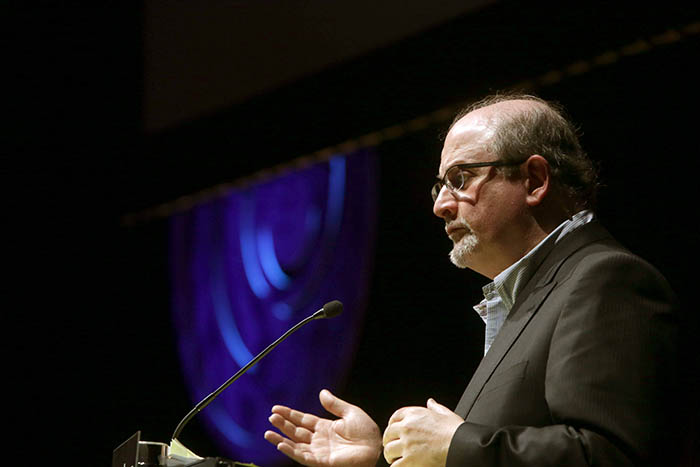
Salman Rushdie. Credit: Fronteiras do Pensamento
On 14 February 1989 Iran’s Ayatollah Khomeini issued a fatwa ordering Muslims to execute author Salman Rushdie over the publication of The Satanic Verses, along with anyone else involved with the novel.
Published in the UK in 1988 by Viking Penguin, the book was met with widespread protest by those who accused Rushdie of blasphemy and unbelief. Death threats and a $6 million bounty on the author’s head saw him take on a 24-hour armed guard under the British government’s protection programme.
The book was soon banned in a number of countries, from Bangladesh to Venezuela, and many died in protests against its publication, including on 24 February when 12 people lost their lives in a riot in Bombay, India. Explosions went off across the UK, including at Liberty’s department store, which had a Penguin bookshop inside, and the Penguin store in York.
Book store chains including Barnes and Noble stopped selling the book, and copies were burned across the UK, first in Bolton where 7,000 Muslims gathered on 2 December 1988, then in Bradford in January 1989. In May 1989 between 15,000 to 20,000 people gathered in Parliament Square in London to burn Rushdie in effigy.
In October 1993, William Nygaard, the novel’s Norwegian publisher, was shot three times outside his home in Oslo and seriously injured.
Rushdie came out of hiding after nine years, but as recently as February 2016, money has been raised to add to the fatwa, reminding the author that for many the Ayatollah’s ruling still stands.
Here, 30 years on, Index on Censorship magazine highlights key articles from its archives from before, during and after the issue of the fatwa, including two from Rushdie himself.
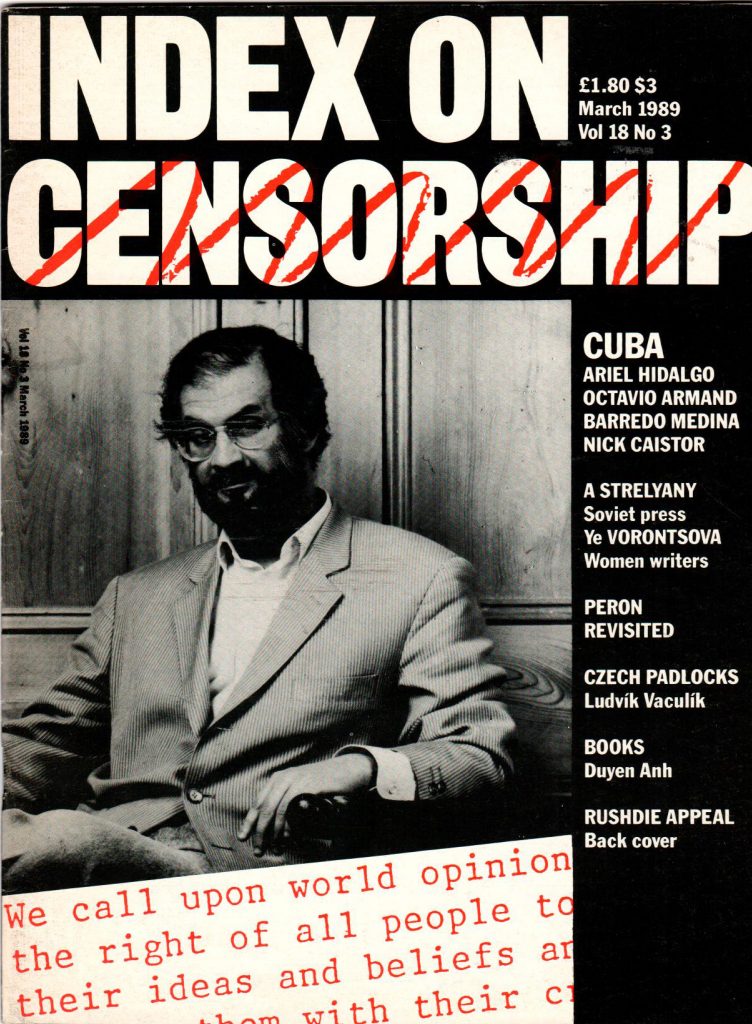
Cuba today, the March 1989 issue of Index on Censorship magazine.
World statement by the international committee for the defence of Salman Rushdie and his publishers
March 1989, vol. 18, issue 3
On 14 February the Ayatollah Khomeini called on all Muslims to seek out and execute Salman Rushdie, the author of The Satanic Verses, and all those involved in its publication. We, the undersigned, insofar as we defend the right to freedom of opinion and expression as embodied in the Universal Declaration of Human Rights, declare that we also are involved in the publication. We are involved whether we approve the contents of the book or not. Nonetheless, we appreciate the distress the book has aroused and deeply regret the loss of life associated with the ensuing conflict.
Read the full article

Islam & human rights, the May 1989 issue of Index on Censorship magazine.
Pandora’s box forced open
Amir Taheri
May 1989, vol. 18, issue 5
‘What Rushdie has done, as far as Muslim intellectuals are concerned, is to put their backs to the wall and force them to make the choice they have tried to avoid for so long’. Last year, when poor old Mr Manavi filled in his Penguin order form for 10 copies of Salman Rushdie’s third novel, The Satanic Verses, he could not have imagined that the book, described by its publishers as a reflection on the agonies of exile, would provoke one of the most bizarre diplomatic incidents in recent times. Mr Manavi had been selling Penguin books in Tehran for years. He had learned which authors to regard as safe and which ones to avoid at all costs.
Read the full article
Islam & human rights, the May 1989 issue of Index on Censorship magazine.
Jihad for freedom
Wole Soyinka
May 1989, vol. 18, issue 5
This statement is not, of course, addressed to the Ayatollah Khomeini who, except for a handful of fanatics, is easily diagnosed as a sick and dangerous man who has long forgotten the fundamental tenets of Islam. It is useful to address oneself, at this point, only to the real Islamic faithful who, in their hearts, recognise the awful truth about their erratic Imam and the threat he poses not only to the continuing acceptance of Islam among people of all religions and faiths but to the universal brotherhood of man, no matter the differing colorations of their piety. Will Salman Rushdie die? He shall not. But if he does, let the fanatic defenders of Khomeini’s brand of Islam understand this: The work for which he is now threatened will become a household icon within even the remnant lifetime of the Ayatollah. Writers, cineastes, dramatists will disseminate its contents in every known medium and in some new ones as yet unthought of.
Read the full article
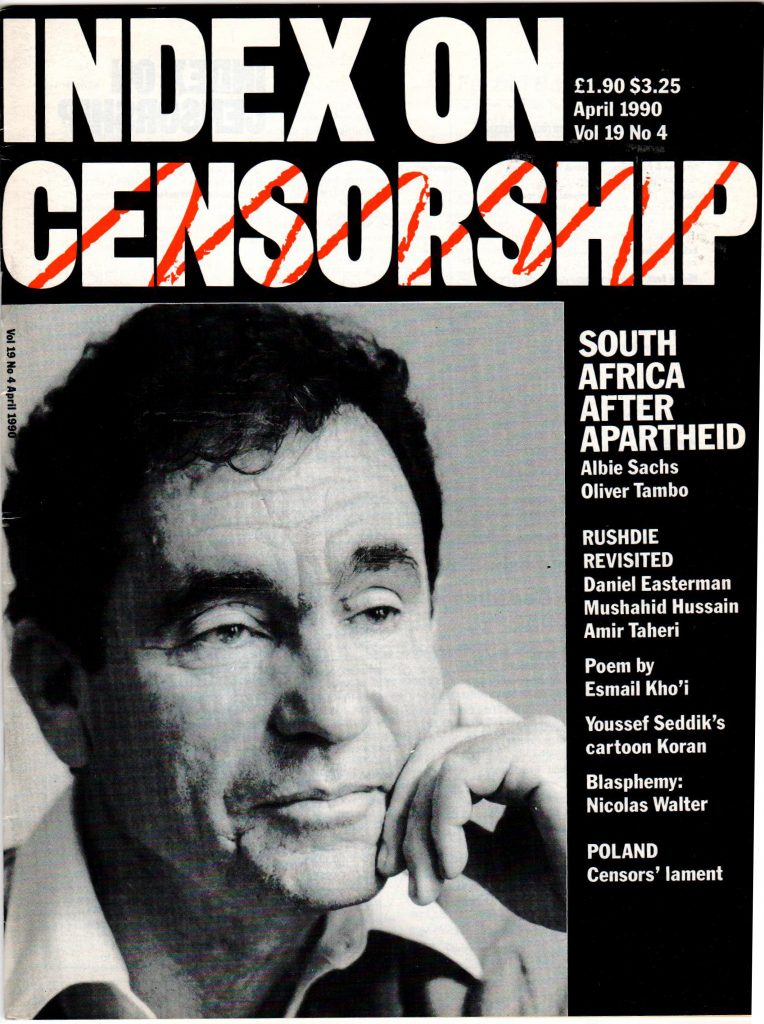
South Africa after Apartheid, the April 1990 issue of Index on Censorship magazine.
Reflections on an invalid fatwah
Amir Taheri
April 1990, vol. 19, issue 4
Broadly speaking, three predictions were made. The first was that Khomeini’s attempt at exporting terror might goad world public opinion into a keener understanding of Iran’s tragedy since the Islamic Revolution of 1979. The fact that the Ayatollah had executed thousands of people, including many writers and poets since his seizure of power in Tehran had provoked only mild rebuke from Western governments and public opinion. With the fatwa against Rushdie, we thought the whole world would mobilise against the ayatollah, turning his regime into an international pariah. Nothing of the kind happened, of course, and only one country, Britain, closed its embassy in Tehran – and that because the mullahs decided to sever.diplomatic ties. In the past twelve months Federal Germany and France have increased their trade with the Islamic Republic to the tune of II and 19 per cent respectively. The EEC countries and Japan have, in the meantime, provided the Islamic Republic with loans exceeding £2,000 million. The stream of European and Japanese businessmen and diplomats visiting Tehran turned into a mini-flood after Khomeini’s death last June.
Read the full article
South Africa after Apartheid, the April 1990 issue of Index on Censorship magazine.
Salman Rushdie and political expediency
Adel Darwish
April 1990, vol. 19, issue 4
When I reviewed Salman Rushdie’s Satanic Verses in September 1988, it never crossed my mind to make any reference to possible offence to Muslim readers, let alone to anticipate the unprecedented international crisis generated in the months that followed. I do not think I was naive – as an LBC radio reporter suggested when she interviewed me at the first public reading from The Satanic Verses in June 1989. On the contrary, I can claim more than many that I am able to understand what Mr Rushdie was trying to say in his book, and the way the crisis has developed. Like Mr Rushdie, I am a British writer, born to a Muslim family. Born in Egypt, I was educated and am employed in Britain, and have been preoccupied and engaged, mainly in the 1960s and 1970s, with the issues that Mr Rushdie has fought for and with which he seemed to be very much concerned in his book.
Read the full article
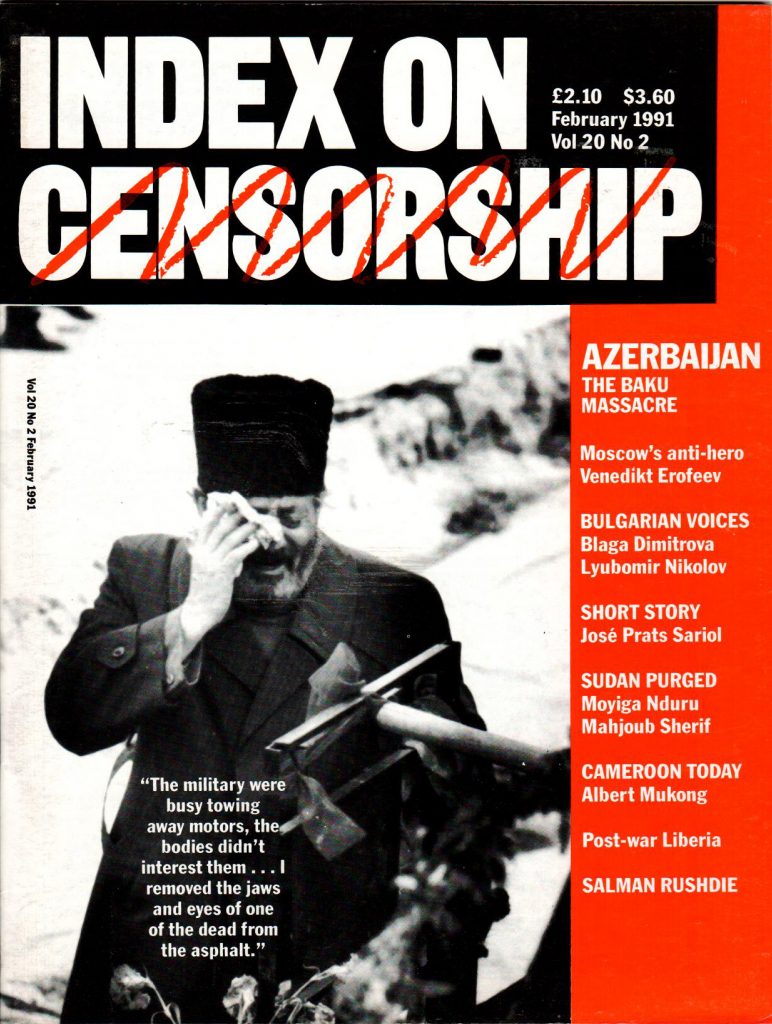
Azerbaijan, the February 1991 issue of Index on Censorship magazine.
My decision
Salman Rushdie
February 1991, vol. 20, issue 2
A man’s spiritual choices are a matter of conscience, arrived at after deep. reflection and in the privacy of his heart. They are not easy matters to speak of publicly. I should like, however, to say something about my decision to affirm the two central tenets of Islam — the oneness of God and the genuineness of the prophecy of the Prophet Muhammad —and thus to enter into the body of Islam after a lifetime spent outside it. Although I come from a Muslim family background, I was never brought up as a believer, and was raised in an atmosphere of what is broadly known as secular humanism. I still have the deepest respect for these principles. However, as I think anyone who studies my work will accept, I have been engaging more and more with religious belief, its importance and power, ever since my first novel used the Sufi poem Conference of the Birds by Farid ud-din Attar as a model. The Satanic Verses itself, with its portrait of the conflicts between the material and spiritual worlds, is a mirror of the conflict within myself.
Read the full article
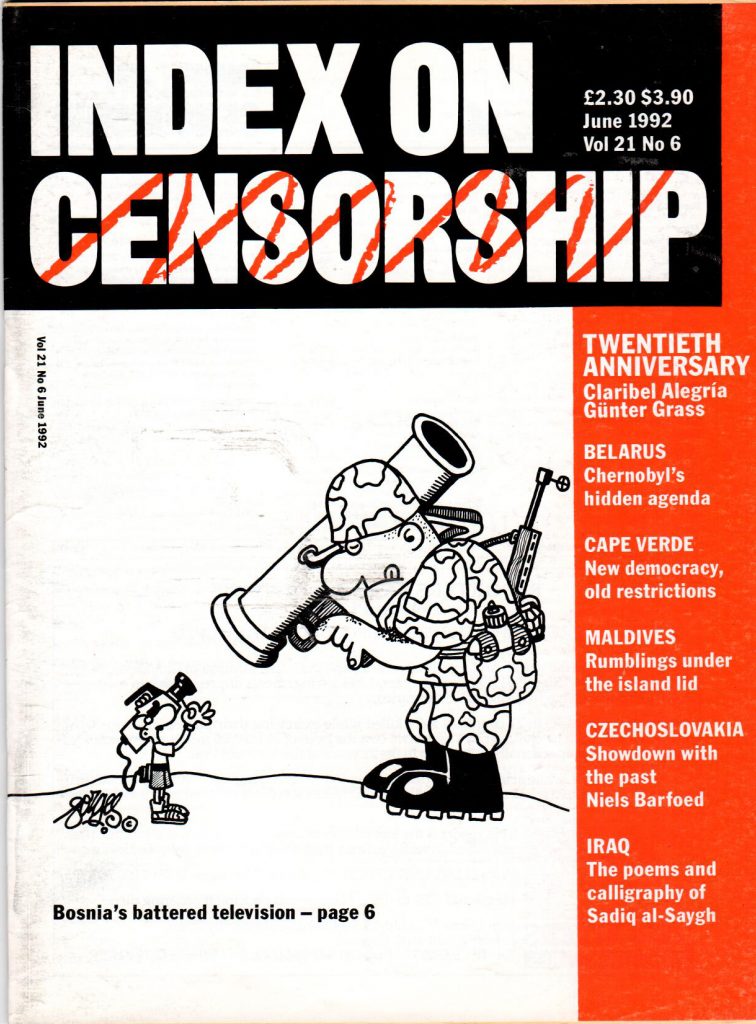
20th Anniversary: Reign of terror, the June 1992 issue of the Index on Censorship magazine.
Offending the high priests
Gunter Grass
June 1992, vol. 21, issue 6
When George Orwell returned from Spain in 1937, he brought with him the manuscript of Homage to Catalonia. It reflected the experiences he had gathered during the Civil War. At first, he was unable to find a publisher because a multitude of influential, left-wing intellectuals had no wish to acknowledge its shocking observations. They did not want to accept the Stalinist terror, the systematic liquidation of anarchists, Trotskyists and left-wing socialists. Orwell himself only narrowly escaped this terror. His stark accusations contradicted a world image of a flawless Soviet Union fighting against Fascism. Orwell’s report, this onslaught of terrible reality, tarnished the picture-book dream of Good and Evil. A year later, a bourgeois Western publisher brought out Homage to Catalonia; in the areas of Communist rule, Orwell’s works – among them the bitter Spanish truth – were banned for half a century. The minister responsible for state security= in the German Democratic Republic, right to its end, was Erich Mielke. During the Spanish Civil War, he was a member of the Communist cadre to whom purge through liquidation became commonplace. A fighter for Spain with an extraordinary capacity for survival.
Read the full article
[/vc_column_text][/vc_column][/vc_row][vc_row][vc_column][vc_column_text]

Russia’s choice, the November-December 1993 issue of Index on Censorship magazine.
The Rushdie affair: Outrage in Oslo
Hakon Harket
November 1993, vol. 22, issue 10
The terrorist state of Iran must face the consequences of refusing to lift the fatwa that condemns Salman Rushdie, and those associated with his work, to death. When someone, in accordance with the express order of the fatwa, attempts to murder one of the damned, the obvious consequence is that Iran must be held responsible for the crime it has called for, at least until there is conclusive proof that no connection exists. The shooting of William Nygaard has reminded the Norwegian public of what the Rushdie affair is really about: life and death; the abuse of religion; the fiction of a free mind. This war of terror against freedom of speech is not one we can afford to lose. Since the nightmare clearly will not disappear of its own accord, it must be engaged head-on.
Read the full article

New censors, the March 1996 issue of Index on Censorship magazine.
From Salman Rushdie
March 1996, vol. 25, issue 2
This statement is not, of course, addressed to the Ayatollah Khomeini who, except for a handful of fanatics, is easily diagnosed as a sick and dangerous man who has long forgotten the fundamental tenets of Islam. It is useful to address oneself, at this point, only to the real Islamic faithful who, in their hearts, recognise the awful truth about their erratic Imam and the threat he poses not only to the continuing acceptance of Islam among people of all religions and faiths but to the universal brotherhood of man, no matter the differing colorations of their piety. Will Salman Rushdie die? He shall not. But if he does, let the fanatic defenders of Khomeini’s brand of Islam understand this: The work for which he is now threatened will become a household icon within even the remnant lifetime of the Ayatollah. Writers, cineastes, dramatists will disseminate its contents in every known medium and in some new ones as yet unthought of.
Read the full article

Shadow of the Fatwa
Kenan Malik
December 2008, vol. 37, issue 4
The Satanic Verses was, Salman Rushdie said in an interview before publication, a novel about ‘migration, metamorphosis, divided selves, love, death’. It was also a satire on Islam, ‘a serious attempt’, in his words, ‘to write about religion and revelation from the point of view of a secular person’. For some that was unacceptable, turning the novel into ‘an inferior piece of hate literature’ as the British-Muslim philosopher Shabbir Akhtar put it. Within a month, The Satanic Verses had been banned in Rushdie’s native India, after protests from Islamic radicals. By the end of the year, protesters had burnt a copy of the novel on the streets of Bolton, in northern England. And then, on 14 February 1989, came the event that transformed the Rushdie affair – Ayatollah Khomeini issued his fatwa.’I inform all zealous Muslims of the world,’ proclaimed Iran’s spiritual leader, ‘that the author of the book entitled The Satanic Verses – which has been compiled, printed and published in opposition to Islam, the prophet and the Quran – and all those involved in its publication who were aware of its contents are sentenced to death.’
Read the full article
The right to publish
Peter Mayer
December 2008, vol. 37, issue 4
As publisher of The Satanic Verses, Peter Mayer was on the front line. He writes here for the first time about an unprecedented crisis:
Penguin published Salman Rushdie’s The Satanic Verses six months before Ayatollah Khomeini issues his fatwa. When we decided to continue publishing the novel in the aftermath, extraordinary pressures were focused on our company, based on fears for the author’s life and for the lives of everyone at Penguin around the world. This extended from Penguin’s management to editorial, warehouse, transport, administrative staff, the personnel in our bookshops and many others. The long-term political implications of that early signal regarding free speech in culturally diverse societies were not yet apparent to many when the Ayatollah, speaking not only for Iran but, seemingly, for all of Islam, issued his religious proclaimation.
Read the full article
Emblem of darkness
Bernard-Henri Lévy
December 2008, vol. 37, issue 4
As publisher of The Satanic Verses, Peter Mayer was on the front line. He writes here for the first time about an unprecedented crisis:
Salman Rushdie was not yet the great man of letters that he has since become. He and I are, though, pretty much the same age. We share a passion for India and Pakistan, as well as the uncommon privilege of having known and written about Zulfikar Ali Bhutto (Rushdie in Shame; I in Les Indes Rouges), the father of Benazir, former prime minister of Pakistan, executed ten years earlier in 1979 by General Zia. I had been watching from a distance, with infinite curiosity, the trajectory of this almost exact contemporary. One day, in February 1989, at the end of the afternoon, as I sat in a cafe in the South of France, in Saint Paul de Vence, with the French actor Yves Montand, sipping an orangeade, I heard the news: Ayatollah Khomeini, himself with only a few months to live, had just issued a fatwa, in which he condemned as an apostate the author of The Satanic Verses and invited all Muslims the world over to carry out the sentence, without delay.
Read the full article[/vc_column_text][/vc_column][/vc_row][vc_row][vc_column][vc_basic_grid post_type=”post” max_items=”4″ element_width=”6″ grid_id=”vc_gid:1623240200822-8c1bcd36-9835-10″ taxonomies=”8890″][/vc_column][/vc_row]
15 Jan 2019 | Fellowship 2019, News and features, Press Releases
[vc_row][vc_column][vc_single_image image=”104533″ img_size=”full”][vc_row_inner][vc_column_inner width=”1/4″][vc_single_image image=”104535″ img_size=”full”][/vc_column_inner][vc_column_inner width=”3/4″][vc_column_text]
- Judges include investigative journalist Maria Ressa, one of Time magazine’s people of the Year 2018; actor Khalid Abdalla
- Shortlist celebrates artists, campaigners and activists from Saudi Arabia to Serbia, Colombia to Cameroon
[/vc_column_text][/vc_column_inner][/vc_row_inner][vc_column_text]A self-exiled Saudi street artist who uses murals to challenge her homeland’s repression of women, a Nigerian organisation that fosters community radio, a group of digital activists tackling online trolls in Colombia, and a Serbian collective of investigative journalists exposing government corruption are among the individuals and organisations shortlisted for the 2019 Index on Censorship Freedom of Expression Awards Fellowships.
Drawn from more than 400 crowdsourced nominations, the shortlist celebrates artists, writers, journalists and campaigners fighting for freedom of expression against immense obstacles. Many of the 15 shortlisted nominees face regular death threats, others criminal prosecution or exile. Some are currently in prison for daring to speak out against the status quo.
“Free speech is the cornerstone of a free society – and it’s under increasing threat worldwide. That’s why it’s more important than ever to recognise the groups and individuals willing to stand up for it,” said Jodie Ginsberg, CEO of campaigning nonprofit Index on Censorship.
Awards fellowships are offered in four categories: arts, campaigning, digital activism and journalism.
Nominees include exiled street artist Ms. Saffaa whose murals highlight women’s rights and human rights violations in Saudi Arabia; Nigeria’s Institute for Media and Society, which goes to great lengths to improve the country’s media landscape by challenging government regulation and aiding the creation of community radio stations in rural areas; Colombia’s Fundación Karisma, which fights back against internet trolls and promotes freedom of expression online; and The Center for Investigative Journalism of Serbia (CINS), an independent group of investigative journalists exposing corruption in the country.
Other nominees include ArtLords, a grassroots movement of artists and volunteers in Afghanistan; P24 (Platform for Independent Journalism), a civil society organisation with an ambitious goal of neutralising censorship in Turkey; Mohammed al-Maskati, a Bahraini activist and digital security consultant who provides digital security training to activists in the Middle East and in North Africa; and Mehman Huseynov, an imprisoned journalist and human rights defender who documents corruption and human rights violations in Azerbaijan.
Judges for this year’s awards, now in its 19th year, are award-winning investigative journalist and Rappler.com Editor-in-Chief Maria Ressa, actor and filmmaker Khalid Abdalla, computer scientist and author Dr. Kate Devlin, and writer and social activist Nimco Ali.
Abdalla said: “The abyss we are facing all over the world requires acts of courage and intellect capable of changing the terms of how we think and respond to the challenges ahead. We have to celebrate those who inspire us and lead by example, not just because they have managed to break barriers in their own contexts, but because some part of what they do holds a key for us all.”
Winners, who will be announced at a gala ceremony in London on 4 April, become Index on Censorship Freedom of Expression Awards Fellows and are given year-long support for their work, including training in areas such as advocacy and communications.
“Many of the things that I dreamt of happening one day, in an idealistic way, have become reality, all thanks to Index,” Wendy Funes, 2018 Index on Censorship Freedom of Expression Journalism Fellow, said. “Solidarity, love and friendship are really the things that can move this world, and that is what Index is made of with all of the support they have extended to me.”
This year, the Freedom of Expression Awards are being supported by sponsors including SAGE Publishing, Google, Private Internet Access, Edwardian Hotels, Vodafone, France Médias Mondes and Psiphon. Illustrations of the nominees were created by Sebastián Bravo Guerrero.
Notes for editors:
- Index on Censorship is a UK-based non-profit organisation that publishes work by censored writers and artists and campaigns against censorship worldwide.
- More detail about each of the nominees is included below.
- The winners will be announced at a ceremony in London on 4 April.
For more information, or to arrange interviews with any of those shortlisted, please contact Sean Gallagher on 0207 963 7262 or [email protected]. More biographical information and illustrations of the nominees are available at indexoncensorship.org/indexawards2019.[/vc_column_text][vc_custom_heading text=”Index on Censorship Freedom of Expression Awards nominees 2019″ use_theme_fonts=”yes”][vc_column_text]
Arts
for artists and arts producers whose work challenges repression and injustice and celebrates artistic free expression
[/vc_column_text][vc_single_image image=”104530″ img_size=”full” alignment=”center”][vc_column_text]ArtLords
Afghanistan
ArtLords is a grassroots movement of artists and volunteers in Afghanistan who encourage ordinary citizens, especially women and children, to paint the issues that concern them on so-called blast walls: walls the country’s rich and the powerful have built around themselves to protect them from violence while the poor fend for themselves. Their work has turned a symbol of fear, tension and separation into a platform where social issues can be expressed visually and discussed in the street. ArtLords has completed over 400 murals in 16 provinces of Afghanistan. In March 2018, for International Women’s Day, ArtLords painted a tribute to Professor Hamida Barmaki, a human rights defender killed in a terrorist attack six years ago.
Zehra Doğan
Turkey
Zehra Doğan is an imprisoned Kurdish painter and journalist who — denied access to materials for her work — paints with dyes made from crushed fruit and herbs, even blood, and uses newspapers and milk cartons as canvases. When she realised her reports from Turkey’s Kurdish region were being ignored by mainstream media, Doğan began painting the destruction in town of Nusaybin and sharing it on social media. For this she was arrested and imprisoned. Imprisonment hasn’t stopped her from producing journalism and art. She collects and writes stories about female political prisoners, reports on human rights abuses in prison, and paints despite the prison administration’s refusal to supply her with art materials.
ElMadina for Performing and Digital Arts
Egypt
ElMadina is a group of artists and arts managers who combine art and protest by encouraging Egyptians to get involved in performances in public spaces, defying the country’s restrictive laws. ElMadina’s work encourages participation — through story-telling, dance and theatre — to transform public spaces and marginalised areas in Alexandria and beyond into thriving environments where people can freely express themselves. Their work encourages free expression in a country in which public space is shrinking under the weight of government distrust of the artistic sector. ElMadina also carry out advocacy and research work and provide a physical space for training programmes, residencies and performances.
Ms Saffaa
Saudi Arabia / Australia
Ms Saffaa is a self-exiled Saudi street artist living in Australia who uses murals to highlight women’s rights and human rights violations in Saudi Arabia. Collaborating with artists from around the world, she challenges Saudi authorities’ linear and limited narrative of women’s position in Saudi society, and offers a counter narrative through her art. Part of a new generation of Saudi activists who take to social media to spread ideas, Ms Saffaa’s work has acquired international reach. In November 2018, she collaborated with renowned American artist and writer Molly Crabapple on a mural celebrating murdered Saudi journalist Jamal Khashoggi that read, “We Saudis deserve better.” [/vc_column_text][vc_column_text]
Campaigning
for activists and campaigners who have had a marked impact in fighting censorship and promoting freedom of expression
[/vc_column_text][vc_single_image image=”104531″ img_size=”full” alignment=”center”][vc_column_text]Cartoonists Rights Network International
United States / International
Cartoonists Rights Network International (CRNI) is a small organisation with a big impact: monitoring threats and abuses against editorial cartoonists worldwide. Marshalling an impressive worldwide network, CRNI helps to focus international attention on cases in which cartoonists are persecuted and put pressure on the persecutors. CRNI tracks censorship, fines, penalties and physical intimidation – including of family members, assault, imprisonment, and even assassinations. Once a threat is detected, CRNI often partners with other human rights organisations to maximise the pressure and impact of a campaign to protect the cartoonist and confront those who seek to censor political cartoonists.
Institute for Media and Society
Nigeria
The Institute for Media and Society (IMS) is a Nigerian NGO that aims to improve the country’s media landscape by challenging government regulation and fostering the creation of community radio stations in rural areas at a time when local journalism globally is under threat. Three-quarters of television and radio stations in Nigeria are owned by politicians, and as a result they are divided along political lines, while rural communities are increasingly marginalised. IMS’s approach combines research and advocacy to challenge legal restrictions on the media as well as practical action to encourage Nigerians to use their voices, particularly via local radio. IMS also tracks violations of the rights of journalists in Nigeria.
Media Rights Agenda
Nigeria
Media Rights Agenda (MRA) is a non-profit organisation that has spent the last two decades working to improve media freedom and freedom of expression in Nigeria by challenging the government in courts. While the constitution guarantees the right to freedom of expression, other laws – including the sections of the Criminal Code, the Cybercrimes Act and the Official Secrets Act – limit and even criminalise expression. Through its active legal team, MRA has initiated strategic litigation targeting dozens of institutions, politicians and officials to improve the country’s legal framework around media freedom. Its persistent campaigning and lawsuits on freedom of information have helped improve access to government-held data.
P24 (Platform for Independent Journalism)
Turkey
P24 (Platform for Independent Journalism) is a civil society organisation that aims to neutralise censorship in Turkey — a country in which speaking freely courts fines, arrest and lengthy jail sentences. P24’s pro bono legal team defends journalists and academics who are on trial for exercising their right to free expression. It also undertakes coordinated social media and public advocacy work that includes live-tweeting from courtrooms and campaigning through an array of websites, newsletters and exhibition spaces. Its latest effort aims to provide spaces for collaboration and free expression in the form of a literature house and a project connecting lawyers and artists. [/vc_column_text][vc_column_text]
Digital Activism
for innovative uses of technology to circumvent censorship and enable free and independent exchange of information
[/vc_column_text][vc_single_image image=”104532″ img_size=”full” alignment=”center”][vc_column_text]Fundación Karisma
Colombia
Fundación Karisma is a civil society organisation that takes on online trolls by using witty online ‘stamps’ that flag up internet abuse. It’s an initiative that uses humour to draw attention to a serious problem: the growing online harassment of women in Colombia and its chilling effect. The organisation offers a rare space to discuss many issues at the intersection of human rights and technology in the country and then tackles them through a mix of research, advocacy and digital tools. Karisma’s “Sharing is not a crime” campaign supports open access to knowledge against the backdrop of Colombia’s restrictive copyright legislation.
Mohammed Al-Maskati
Middle East
Mohammed al-Maskati is a digital security consultant who provides training to activists in the Middle East and in North Africa. Working as Frontline Defenders’ Digital Protection Consultant for the MENA Region, Mohammed teaches activists – ranging from vulnerable minorities to renowned campaigners taking on whole governments – to communicate despite government attempt to shut them down. He educates them on the use of virtual private networks and how to avoid falling into phishing or malware traps, create safe passwords and keep accounts anonymous. As governments become more and more sophisticated in their attempts to track and crush dissent, the work of people like Al-Maskati is increasingly vital.
SFLC.in
India
SFLC.in (Software Freedom Law Centre) tracks internet shutdowns in India, a crucial service in a country with the most online blackouts of any country in the world. The tracker was the first initiative of its kind in India and has quickly become the top source for journalists reporting on the issue. As well as charting the sharp increase in the number and frequency of shutdowns in the country, the organisation has a productive legal arm and brings together lawyers, policy analysts and technologists to fight for digital rights in the world’s second most populous country. It also provides training and pro-bono services to journalists, activists and comedians whose rights have been curtailed.[/vc_column_text][vc_column_text]
Journalism
for courageous, high-impact and determined journalism that exposes censorship and threats to free expression
[/vc_column_text][vc_single_image image=”104534″ img_size=”full” alignment=”center”][vc_column_text]Bihus.info
Ukraine
Bihus.info is a group of independent investigative journalists in Ukraine who – despite threats and assaults – are fearlessly exposing the corruption of many Ukrainian officials. In the last two years alone, Bihus.info’s coverage has contributed to the opening of more than 100 legal cases against corrupt officials. Chasing money trails, murky real estate ownership and Russian passports, Bihus.info produces hard-hitting, in-depth TV reports for popular television programme, Nashi Hroshi (Our Money), which illuminates discrepancies between officials’ real wealth and their official income. One of the key objectives of the project is not just to inform, but to involve people in the fight against corruption by demonstrating how it affects their own well-being.
Center for Investigative Journalism of Serbia (CINS)
Serbia
Investigating corruption is one of the most dangerous jobs in journalism: three investigative reporters have been murdered in the European Union in the past year alone. In Serbia, journalists face death threats and smear campaigns portray investigative journalists as foreign-backed propagandists. Against this backdrop, Center for Investigative Journalism of Serbia (CINS) stands out as one of the last independent outlets left amid an increasingly partisan media. Using freedom of information requests, the CINS has created databases based on thousands of pages of documents to underpin its hard-hitting investigations. These include stories on loans provided to pro-government tabloids and TV channels. CINS also provides hands-on investigative journalism training for journalists and editors.
Mehman Huseynov
Azerbaijan
Mehman Huseynov is a journalist and human rights defender who documents corruption and human rights violations in Azerbaijan, consistently ranked among the world’s worst countries for press freedom. Sentenced to two years in prison in March 2017 after describing abuses he had suffered at a police station, Huseynov has put his life in danger to document sensitive issues. His work circulated widely on the internet, informing citizens about the real estate and business empires of the country’s government officials, and scrutinising the decisions of president Ilham Aliyev. Huseynov is still in prison and remains defiant, saying: “I am not here only for myself; I am here so that your children are not in my place tomorrow. If you uphold the judgement against me, you have no guarantees that you and your children will not be in my place tomorrow.”
Mimi Mefo
Cameroon
Mimi Mefo is one of less than a handful journalists working without fear or favour in Cameroon’s climate of repression and self-censorship. An award-winning broadcast journalist and the first-ever woman editor-in-chief of private media house Equinoxe TV and Radio, Mefo was arrested in November 2018 after she published reports that the military was behind the death of an American missionary in the country. Mefo reports on the escalating violence in the country’s western regions, a conflict that has become known as the “Anglophone Crisis” and is a leading voice in exposing the harassment of other Cameroonian journalists, calling publicly for the release of those jailed.[/vc_column_text][/vc_column][/vc_row]
15 Jan 2019 | Awards
[vc_row full_width=”stretch_row_content_no_spaces” css_animation=”fadeIn” css=”.vc_custom_1547219633236{padding-top: 250px !important;padding-bottom: 250px !important;background-image: url(https://www.indexoncensorship.org/wp-content/uploads/2019/01/freedom-of-expression-awards-2019-1460×490-with-year-1.jpg?id=104692) !important;background-position: center !important;background-repeat: no-repeat !important;background-size: cover !important;}”][vc_column][/vc_column][/vc_row][vc_row full_width=”stretch_row” css=”.vc_custom_1500449679881{margin-top: -50px !important;}”][vc_column][vc_custom_heading text=”2019 FREEDOM OF EXPRESSION AWARDS” font_container=”tag:h1|text_align:center” use_theme_fonts=”yes”][vc_row_inner disable_element=”yes”][vc_column_inner][vc_empty_space height=”15px”][vc_custom_heading text=”ABOUT THE AWARDS” font_container=”tag:h2|text_align:center” use_theme_fonts=”yes”][/vc_column_inner][/vc_row_inner][vc_row_inner equal_height=”yes” content_placement=”middle”][vc_column_inner el_class=”awards-inside-desc” width=”1/2″][vc_column_text]
Index on Censorship’s Freedom of Expression Awards exist to celebrate individuals or groups who have had a significant impact fighting censorship anywhere in the world.
Awards are offered in four categories: Arts, Campaigning, Digital Activism and Journalism. Anyone who has had a demonstrable impact in tackling censorship is eligible. Winners are honoured at a gala celebration in London. Winners join Index’s Awards Fellowship programme and receive dedicated training and support.
[/vc_column_text][/vc_column_inner][vc_column_inner width=”1/2″][vc_video link=”https://youtu.be/JeDl0BWXXOc”][/vc_column_inner][/vc_row_inner][/vc_column][/vc_row][vc_row][vc_column][vc_custom_heading text=”2019 FELLOWSHIP” font_container=”tag:h1|text_align:center” use_theme_fonts=”yes”][vc_column_text]
Selected from over 400 public nominations and a shortlist of 16, the 2019 Freedom of Expression Awards fellows exemplify courage in the face of censorship. Learn more about the fellowship.
[/vc_column_text][vc_row_inner][vc_column_inner width=”1/2″][vc_custom_heading text=”Arts” font_container=”tag:h3|text_align:center” use_theme_fonts=”yes”][vc_single_image image=”104529″ img_size=”full”][vc_column_text]Zehra Doğan | Turkey
Released from prison on 24 February 2019, Zehra Doğan is a Kurdish painter and journalist who, during her imprisonment, was denied access to materials for her work. She painted with dyes made from crushed fruit and herbs, even blood, and used newspapers and milk cartons as canvases. When she realised her reports from Turkey’s Kurdish region were being ignored by mainstream media, Doğan began painting the destruction in the town of Nusaybin and sharing it on social media. For this she was arrested and imprisoned. During her imprisonment she refused to be silenced and continued to produce journalism and art. She collected and wrote stories about female political prisoners, reported on human rights abuses in prison, and painted despite the prison administration’s refusal to supply her with art materials.
Full profile | Acceptance speech[/vc_column_text][/vc_column_inner][vc_column_inner width=”1/2″][vc_custom_heading text=”Campaigning” font_container=”tag:h3|text_align:center” use_theme_fonts=”yes”][vc_single_image image=”104518″ img_size=”full”][vc_column_text]Cartoonists Rights Network International | United States / International
Cartoonists Rights Network International (CRNI) is a small organisation with a big impact: monitoring threats and abuses against editorial cartoonists worldwide. Marshalling an impressive worldwide network, CRNI helps to focus international attention on cases in which cartoonists are persecuted and put pressure on the persecutors. CRNI tracks censorship, fines, penalties and physical intimidation – including of family members, assault, imprisonment and even assassinations. Once a threat is detected, CRNI often partners with other human rights organisations to maximise the pressure and impact of a campaign to protect the cartoonist and confront those who seek to censor political cartoonists.
Full profile | Acceptance speech[/vc_column_text][/vc_column_inner][/vc_row_inner][vc_row_inner][vc_column_inner width=”1/2″][vc_custom_heading text=”Digital Activism” font_container=”tag:h3|text_align:center” use_theme_fonts=”yes”][vc_single_image image=”104520″ img_size=”full”][vc_column_text]Fundación Karisma | Colombia
Fundación Karisma is a civil society organisation that challenges online trolls by using witty online ‘stamps’ that flag up internet abuse. It is an initiative that uses humour to draw attention to a serious problem: the growing online harassment of women in Colombia and its chilling effect. The organisation offers a rare space to discuss many issues at the intersection of human rights and technology in the country and then tackles them through a mix of research, advocacy and digital tools. Karisma’s “Sharing is not a crime” campaign supports open access to knowledge against the backdrop of Colombia’s restrictive copyright legislation.
Full profile | Acceptance speech[/vc_column_text][/vc_column_inner][vc_column_inner width=”1/2″][vc_custom_heading text=”Journalism” font_container=”tag:h3|text_align:center” use_theme_fonts=”yes”][vc_single_image image=”104523″ img_size=”full”][vc_column_text]Mimi Mefo | Cameroon
Mimi Mefo is one of less than a handful of journalists working without fear or favour in Cameroon’s climate of repression and self-censorship. An award-winning broadcast journalist at private media house Equinoxe TV and Radio, Mefo was arrested in November 2018 after she published reports that the military was behind the death of an American missionary in the country. Mefo reports on the escalating violence in the country’s western regions, a conflict that has become known as the “Anglophone Crisis” and is a leading voice in exposing the harassment of other Cameroonian journalists, calling publicly for the release of those jailed.
Full profile | Acceptance speech[/vc_column_text][/vc_column_inner][/vc_row_inner][/vc_column][/vc_row][vc_row][vc_column][awards_gallery_slider name=”2019 AWARDS GALA” images_url=”105882,105875,105876,105877,105878,105879,105880,105881,105883,105884,105885,106029,106030,106031,106032,106033,106034,106058,106057,106056,106055,106054,106053,106052,106051,106050,106059,106060,106063,106064,106065,106066,106067,106068,106069,106075,106070,106077,106078,106079,106080,106081,106091,106090,106089,106088,106087,106086,106085,106084,106083,106082,106092,106094″][vc_column_text]
The Awards were held at London’s May Fair Hotel on Thursday 4 April 2019.
High-resolution images are available for download via Flickr.
[/vc_column_text][vc_custom_heading text=”THE 2019 FELLOWSHIP SHORTLIST” font_container=”tag:h2|text_align:center” use_theme_fonts=”yes”][/vc_column][/vc_row][vc_row][vc_column][vc_tta_tabs][vc_tta_section title=”Arts” tab_id=”1554809902471-b3c9fc73-9d6d”][vc_row_inner][vc_column_inner width=”1/2″][vc_column_text]
ARTS
for artists and arts producers whose work challenges repression and injustice and celebrates artistic free expression
[/vc_column_text][/vc_column_inner][vc_column_inner width=”1/2″][vc_video link=”https://youtu.be/gL5qzotQJzI”][/vc_column_inner][/vc_row_inner][vc_row_inner][vc_column_inner width=”1/4″][vc_single_image image=”104515″ img_size=”full”][vc_column_text]ArtLords | Afghanistan[/vc_column_text][/vc_column_inner][vc_column_inner width=”1/4″][vc_single_image image=”104529″ img_size=”full”][vc_column_text]Zehra Doğan | Turkey[/vc_column_text][/vc_column_inner][vc_column_inner width=”1/4″][vc_single_image image=”104519″ img_size=”full”][vc_column_text]ElMadina for Performing and Digital Arts | Egypt[/vc_column_text][/vc_column_inner][vc_column_inner width=”1/4″][vc_single_image image=”104526″ img_size=”full”][vc_column_text]Ms Saffaa | Saudi Arabia / Australia[/vc_column_text][/vc_column_inner][/vc_row_inner][/vc_tta_section][vc_tta_section title=”Campaigning” tab_id=”1554809902549-60799150-d1e3″][vc_row_inner][vc_column_inner width=”1/2″][vc_column_text]
CAMPAIGNING
for activists and campaigners who have had a marked impact in fighting censorship and promoting freedom of expression
Sponsored by Mainframe
[/vc_column_text][/vc_column_inner][vc_column_inner width=”1/2″][vc_video link=”https://youtu.be/2dyUzhOE7Cw”][/vc_column_inner][/vc_row_inner][vc_row_inner][vc_column_inner width=”1/4″][vc_single_image image=”104518″ img_size=”full”][vc_column_text]Cartoonists Rights Network International | United States / International[/vc_column_text][/vc_column_inner][vc_column_inner width=”1/4″][vc_single_image image=”104521″ img_size=”full”][vc_column_text]Institute for Media and Society | Nigeria[/vc_column_text][/vc_column_inner][vc_column_inner width=”1/4″][vc_single_image image=”104525″ img_size=”full”][vc_column_text]Media Rights Agenda | Nigeria[/vc_column_text][/vc_column_inner][vc_column_inner width=”1/4″][vc_single_image image=”104527″ img_size=”full”][vc_column_text]P24 | Turkey[/vc_column_text][/vc_column_inner][/vc_row_inner][/vc_tta_section][vc_tta_section title=”Digital Activism” tab_id=”1554810071532-b8b029f3-2bd1″][vc_row_inner][vc_column_inner width=”1/2″][vc_column_text]
DIGITAL ACTIVISM
for innovative uses of technology to circumvent censorship and enable free and independent exchange of information
Sponsored by Private Internet Access
[/vc_column_text][/vc_column_inner][vc_column_inner width=”1/2″][vc_video link=”https://youtu.be/1K7rOcfma2c”][/vc_column_inner][/vc_row_inner][vc_row_inner][vc_column_inner width=”1/4″][vc_single_image image=”104520″ img_size=”full”][vc_column_text]Fundación Karisma | Colombia[/vc_column_text][/vc_column_inner][vc_column_inner width=”1/4″][vc_single_image image=”104524″ img_size=”full”][vc_column_text]Mohammed Al-Maskati | Middle East[/vc_column_text][/vc_column_inner][vc_column_inner width=”1/4″][vc_single_image image=”104528″ img_size=”full”][vc_column_text]SFLC.in | India[/vc_column_text][/vc_column_inner][vc_column_inner width=”1/4″][/vc_column_inner][/vc_row_inner][/vc_tta_section][vc_tta_section title=”Journalism” tab_id=”1554810135332-a68bcfef-814d”][vc_row_inner][vc_column_inner width=”1/2″][vc_column_text]
JOURNALISM
for courageous, high-impact and determined journalism that exposes censorship and threats to free expression
Sponsored by Daily Mail and General Trust, Daily Mirror, France Medias Monde, News UK, Telegraph Media Group, Society of Editors
[/vc_column_text][/vc_column_inner][vc_column_inner width=”1/2″][vc_video link=”https://youtu.be/w1ff5zMDnp8″][/vc_column_inner][/vc_row_inner][vc_row_inner][vc_column_inner width=”1/4″][vc_single_image image=”104516″ img_size=”full”][vc_column_text]Bihus.info | Ukraine[/vc_column_text][/vc_column_inner][vc_column_inner width=”1/4″][vc_single_image image=”104517″ img_size=”full”][vc_column_text]Center for Investigative Journalism of Serbia (CINS) | Serbia[/vc_column_text][/vc_column_inner][vc_column_inner width=”1/4″][vc_single_image image=”104522″ img_size=”full”][vc_column_text]Mehman Huseynov | Azerbaijan [/vc_column_text][/vc_column_inner][vc_column_inner width=”1/4″][vc_single_image image=”104523″ img_size=”full”][vc_column_text]Mimi Mefo | Cameroon[/vc_column_text][/vc_column_inner][/vc_row_inner][/vc_tta_section][/vc_tta_tabs][/vc_column][/vc_row][vc_row full_width=”stretch_row” css=”.vc_custom_1484569093244{background-color: #f2f2f2 !important;}”][vc_column][vc_custom_heading text=”JUDGING” font_container=”tag:h1|text_align:center” use_theme_fonts=”yes”][vc_row_inner el_class=”mw700″][vc_column_inner][vc_column_text]
Each year Index recruits an independent panel of judges – leading voices with diverse expertise across campaigning, journalism, the arts and human rights. Judges look for courage, creativity and resilience. We shortlist on the basis of those who are deemed to be making the greatest impact in tackling censorship in their chosen area, with a particular focus on topics that are little covered or tackled by others. Where a judge comes from a nominee’s country, or where there is any other potential conflict of interest, the judge will abstain from voting in that category.
The 2019 judging panel:
[/vc_column_text][/vc_column_inner][/vc_row_inner][/vc_column][/vc_row][vc_row full_width=”stretch_row” css=”.vc_custom_1510244917017{margin-top: 30px !important;}”][vc_column][vc_row_inner][vc_column_inner width=”1/4″][staff name=”Khalid Abdalla” title=”Actor and Filmmaker” profile_image=”104118″]Khalid Abdalla is an actor, producer and filmmaker. He has starred in award-winning films, including Paul Greengrass’s United 93 and Marc Forster’s The Kite Runner. He has producing credits on Hanan Abdalla’s In the Shadow of a Man and the upcoming film The Vote and has appeared in Jehane Noujaim’s Oscar-nominated The Square. Khalid is a founding member of three collaborative initiatives in Cairo – Cimatheque, Zero Production and Mosireen. Brought up in the UK to Egyptian parents, Cairo and London are his two cities.[/staff][/vc_column_inner][vc_column_inner width=”1/4″][staff name=”Nimco Ali” title=”Writer and Social Activist” profile_image=”104121″]Nimco Ali is a British Somali feminist, writer and social activist. She is co-founder and director of Daughters of Eve, a survivor-led organisation which has helped to transform the approach to ending female genital mutilation, and is the lead advisor to the UK’s APPG to End FGM. She is working to ban FGM in Somaliland, is a former ambassador for #MAKERSUK and was awarded Red Magazine’s Woman of the Year award 2014 and placed No. 6 in Woman’s Hour Power List. Her book ‘RUDE’ comes out in early 2019.[/staff][/vc_column_inner][vc_column_inner width=”1/4″][staff name=”Kate Devlin” title=”Writer and Academic” profile_image=”104081″]Kate Devlin is a writer and an academic in the department of Digital Humanities in King’s College London where she works on artificial intelligence and human-computer interaction. Her book, Turned On: Science, Sex and Robots, explores intimacy and ethics in the digital age.[/staff][/vc_column_inner][vc_column_inner width=”1/4″][staff name=”Maria Ressa” title=”CEO and Executive Editor” profile_image=”104085″]Maria Ressa is CEO and executive editor of social news network Rappler in the Philippines. She was CNN’s bureau chief in Manila then Jakarta, and became CNN’s lead investigative reporter focusing on terrorism in Southeast Asia. She is an author of two books on terrorism, co-founder of production company Probe and managed ABS-CBN News and Current affairs. Maria has won numerous awards for her work, including the prestigious Golden Pen of Freedom Awards in 2018.[/staff][/vc_column_inner][/vc_row_inner][vc_column_text][/vc_column_text][/vc_column][/vc_row][vc_row full_width=”stretch_row_content_no_spaces” css=”.vc_custom_1500453384143{margin-top: 20px !important;padding-top: 20px !important;padding-bottom: 20px !important;}”][vc_column][vc_row_inner][vc_column_inner][vc_custom_heading text=”SPONSORS” font_container=”tag:h1|text_align:center” use_theme_fonts=”yes” css=”.vc_custom_1484567001197{margin-bottom: 30px !important;}”][vc_column_text]
The Freedom of Expression Awards and Fellowship have massive impact. You can help by sponsoring or supporting a fellowship.
Index is grateful to those who are supporting the 2019 Awards:
[/vc_column_text][/vc_column_inner][/vc_row_inner][vc_row_inner equal_height=”yes” el_class=”container container980″][vc_column_inner width=”1/4″ offset=”vc_col-xs-6″][vc_single_image image=”80918″ img_size=”full” alignment=”center” onclick=”custom_link” img_link_target=”_blank” link=”https://uk.sagepub.com/”][/vc_column_inner][vc_column_inner width=”1/4″ offset=”vc_col-xs-6″][vc_single_image image=”80921″ img_size=”full” alignment=”center” onclick=”custom_link” img_link_target=”_blank” link=”https://www.google.co.uk/about/”][/vc_column_inner][vc_column_inner width=”1/4″][vc_single_image image=”85983″ img_size=”full” alignment=”center” onclick=”custom_link” link=”https://www.privateinternetaccess.com/”][/vc_column_inner][vc_column_inner width=”1/4″][vc_single_image image=”85977″ img_size=”full” alignment=”center” onclick=”custom_link” link=”http://www.edwardian.com/”][/vc_column_inner][/vc_row_inner][vc_row_inner equal_height=”yes” el_class=”container container980″][vc_column_inner width=”1/4″ offset=”vc_col-xs-6″][vc_single_image image=”105358″ img_size=”234×234″ alignment=”center” onclick=”custom_link” link=”https://mainframe.com/”][/vc_column_inner][vc_column_inner width=”1/4″ offset=”vc_col-xs-6″][vc_single_image image=”105536″ img_size=”full” alignment=”center” onclick=”custom_link” img_link_target=”_blank” link=”http://www.vodafone.com/content/index.html#”][/vc_column_inner][vc_column_inner width=”1/4″ offset=”vc_col-xs-6″][vc_single_image image=”105360″ img_size=”234×234″ alignment=”center” onclick=”custom_link” link=”https://www.francemediasmonde.com/”][/vc_column_inner][vc_column_inner width=”1/4″][vc_single_image image=”105359″ img_size=”234×234″ alignment=”center” onclick=”custom_link” link=”https://www.dailymail.co.uk/home/index.html”][/vc_column_inner][/vc_row_inner][vc_row_inner equal_height=”yes” el_class=”container container980″][vc_column_inner width=”1/4″ offset=”vc_col-xs-6″][vc_single_image image=”80924″ img_size=”200×200″ alignment=”center” onclick=”custom_link” img_link_target=”_blank” link=”https://psiphon.ca/”][/vc_column_inner][vc_column_inner width=”1/4″ offset=”vc_col-xs-6″][vc_single_image image=”105361″ img_size=”200×200″ alignment=”center” onclick=”custom_link” link=”https://www.telegraph.co.uk/”][/vc_column_inner][vc_column_inner width=”1/4″ offset=”vc_col-xs-6″][vc_single_image image=”105363″ img_size=”200×200″ alignment=”center” onclick=”custom_link” link=”https://www.societyofeditors.org/”][/vc_column_inner][vc_column_inner width=”1/4″][vc_single_image image=”105365″ img_size=”200×200″ alignment=”center” onclick=”custom_link” link=”https://www.news.co.uk/”][/vc_column_inner][/vc_row_inner][vc_row_inner equal_height=”yes” el_class=”container container980″][vc_column_inner width=”1/3″ offset=”vc_col-xs-6″][/vc_column_inner][vc_column_inner width=”1/3″ offset=”vc_col-xs-6″][vc_single_image image=”106100″ img_size=”200×200″ alignment=”center” onclick=”custom_link” link=”https://www.mirror.co.uk/” css=”.vc_custom_1569840872089{margin-top: -70px !important;}”][/vc_column_inner][vc_column_inner width=”1/3″ offset=”vc_col-xs-6″][/vc_column_inner][/vc_row_inner][vc_column_text]
If you are interested in sponsorship you can contact [email protected]
[/vc_column_text][/vc_column][/vc_row]
11 Jan 2019 | Azerbaijan, Azerbaijan Statements, Campaigns -- Featured, Statements
[vc_row][vc_column][vc_single_image image=”104696″ img_size=”full”][vc_column_text]We 39 human rights organisations from 13 Human Rights Houses call for urgent action from the international community to ensure the life, health, and rights of imprisoned Azerbaijani photojournalist, video blogger, and human rights defender Mehman Huseynov. We are deeply concerned about his critical condition and his imprisonment, and the psychological pressure and new criminal charges pursued against him. We urge the international community to raise this case as a priority in communications with the Azerbaijani authorities and show public support for Mehman Huseynov.
Mehman Huseynov began a hunger strike on 26 December 2018 in protest against facing further criminal charges – charges that we and many others, including the Council of Europe Commissioner for Human Rights, consider to not be credible. Since 2012, Mehman Huseynov has been subject to a travel ban and without identification and official documentation, preventing him from accessing public services such as healthcare and education. He has also faced harassment and pressure, but actions against him have escalated dramatically in the past two years, beginning with reports that he was abducted and tortured in police custody on 9 January 2017.
Following this abduction, Mehman Huseynov reported that he was tortured – which is consistent with the findings of an examination by an independent team of medical doctors, sent from Front Line Defenders and the Georgian Centre of Psychological and Medical Rehabilitation for Torture. He was sentenced to two years in prison for defamation on 3 March 2017 for stating that he was tortured. We regret that he was imprisoned when he should have received support and his allegations of abduction and torture investigated. Still in prison, he now faces new criminal charges for alleged violence against a member of prison staff. We are particularly concerned about the credibility of this allegation, in context of previous arbitrary actions against Mehman Huseynov – and indications that since August 2018 he has been under psychological pressure in prison and the basis laid for further charges against him.
The actions taken against Mehman Huseynov appear to be politically motivated and strongly linked to his legitimate work raising awareness of human rights and issues related to corruption. These actions have led directly to his current severe condition, as with seemingly no access to justice and arbitrary restriction of his freedom, Mehman Huseynov saw no other option than to go on hunger strike on 26 December 2018. Further contributing to his condition, we note that while Mehman Huseynov was allowed to attend his late Mother’s funeral in August 2018, he was prevented from visiting her while she was alive and ill in hospital – on accusations that he has not participated in “corrective work”, namely the prison’s “social life”, “cultural events”, and “maintenance work.” These accusations also surfaced during Mehman Huseynov’s hearing on application for parole in August 2018. During the hearing, Mehman Huseynov told that he had been summoned by the prison administration and made to understand that he could be punished for explaining rights to other prisoners. He explained that he decided to stay apart from others for this reason. We worry that the decision by authorities to prevent Mehman Huseynov from visiting his dying mother has taken its toll on him.
Years of escalating pressure by authorities has forced an ambitious young man wanting to improve Azerbaijani society to now be in a critical condition in prison. This is a situation that has gone too far, for both Mehman Huseynov and for Azerbaijan.
With urgency, we call on the international community to raise the following with Azerbaijani authorities in support of Mehman Huseynov.
- Mehman Huseynov needs to be transferred to a civilian hospital to be examined by independent medical professionals – with treatment of his health taking utmost priority.
- His right to visits and meetings with his lawyers and family members must be respected, and the international community must be allowed to visit him. We caution against reports being disseminated by Azerbaijani officials with regard to a “monitoring group of NGOs” named the “National Preventive Group of the Azerbaijani Ombudsman” visiting Mehman Huseynov in prison. While this visit has taken place, we hold that these NGOs are not independent of the authorities.
- The prosecution service must drop the new criminal charges put forward under 317.2 of the Azerbaijan Criminal Code as they lack credibility.
- Mehman Huseynov must be released from prison at the latest when his sentence for defamation ends on 2 March 2019.
- The escalation against Mehman Huseynov has an aim, and that is to silence him. We are particularly worried that the next step for the authorities may be to take measures aimed at silencing Mehman Huseynov more permanently, pressuring him by offering to drop the charges against him in return for him leaving Azerbaijan for exile or signing that he will put an end to his legitimate work, as this has been the issue in previous cases. We fear such measures may be put to him under duress and while he may be in a diminished capacity to make decisions. He must not be forced to take such action, and he needs protection from the international community in this regard.
- Human rights lawyers in Azerbaijan must be protected and free to do their work without pressure, harassment or retaliation. As outlined in a June 2017 Human Rights Council resolution, lawyers must be able to “discharge their functions freely, independently and without any fear of reprisal”. This is not the case in Azerbaijan, where lawyers who take politically sensitive cases face threats and disbarment. The result is that only a handful of human rights lawyers remain licensed to practice from the Bar Association of Azerbaijan. One lawyer representing Mehman Huseynov was suspended from the Bar in 2018. We are deeply concerned the same actions may be taken in retaliation against the two lawyers continuing to represent Mehman Huseynov. They need protection from the international community.
We also ask members of the international community to:
- Visit Mehman Huseynov in prison to enquire and report directly on his condition, challenging the Azerbaijani authorities to ensure that such visits are possible.
- Show public support for Mehman Huseynov and publicly respond to the new charges.
The following member organisations from the network Human Rights Houses call for support from the international to ensure the life, health, and rights of Mehman Huseynov.
Human Rights House Azerbaijan (signed by these member NGOs):
- Election Monitoring and Democracy Studies Center
- Legal Education Society
- Women’s Association for Rational Development (WARD)
Barys Zvozskau Belarusian Human Rights House, Vilnius (signed by these member NGOs):
Human Rights House Belgrade (signed by these member NGOs):
- Helsinki Committee for Human Rights in Serbia
- Gradjanske (Civic Initiatives)
Educational Human Rights House Chernihiv (signed by these member NGOs):
- Ahalar
- Almenda
- Association of Ukrainian human rights monitors on Law Enforcement
- East-SOS
- Chernihiv public committee of human rights protection
- Human Rights Information Centre
- MART
- No Borders Project
- Postup
- Transcarpathian Public Center
- Ukrainian Helsinki Human Rights Union
Human Rights House Crimea (signed by these member NGOs):
- Almenda
- Crimean Human Rights Group
- Human Rights Information Centre
- Regional Centre for Human Rights
Human Rights House Oslo (signed by these member NGOs):
- Den norske Burmakomité (The Norwegian Burma Committee)
- Fellesrådet for Afrika (The Norwegian Council for Africa)
- Health and Human Rights Info
- Human Rights House Foundation
- Kvinnefronten (The Women’s Front)
Human Rights House Tbilisi (signed by these member NGOs):
- Article 42 of the Constitution
- Georgian Centre for Psychosocial and Medical Rehabilitation of Torture Victims (GCRT)
- Human Rights Centre (HRIDC)
- Media Institute
- Sapari
Human Rights House Voronezh (signed by these member NGOs):
- Interregional Human Rights Group (Voronezh)
- Charitable Foundation “International Project – Youth Human Rights Movement”
Human Rights House Zagreb (signed by these member NGOs):
- Association for Promotion of Equal Opportunities (APEO)
- a.B.e. (Be active. Be emancipated.)
- Center for Peace Studies
- Croatian Platform for International Citizen Solidarity – CROSOL
- Documenta – Center for Dealing with the Past
Helsinki Foundation for Human Rights, Poland
Index on Censorship, United Kingdom
Rafto Foundation for Human Rights, Norway
Russian Research Centre for Human Rights, Russia[/vc_column_text][/vc_column][/vc_row][vc_row][vc_column][vc_basic_grid post_type=”post” max_items=”4″ element_width=”6″ grid_id=”vc_gid:1547220388132-791b0ba5-0ebf-4″][/vc_column][/vc_row]