19 Apr 2018 | Awards, Fellowship, Fellowship 2018
[vc_row][vc_column][vc_video link=”https://youtu.be/ShavP70VY4o”][vc_single_image image=”99812″ img_size=”full” add_caption=”yes” alignment=”center”][vc_column_text]The Egyptian Commission for Rights and Freedoms is one of the few human rights organisations still operating in a country which has waged an orchestrated campaign against independent civil society groups. Egypt is becoming increasingly hostile to dissent, but ECRF continues to provide advocacy, legal support and campaign coordination, drawing attention to the many ongoing human rights abuses under the autocratic rule of President Abdel Fattah-el-Sisi. Their work has seen them subject to state harassment, their headquarters have been raided and staff members arrested. ECRF are committed to carrying on with their work regardless of the challenges.
Ladies and Gentlemen, I am honoured being with you this evening, no words can explain my gratitude to Index on Censorship for such an opportunity to speak in front of you and for having this valuable prize on behalf of the Egyptian Commission for Rights and Freedoms. Such international recognition makes us stronger.
No matter how dark is the moment, love and hope are always possible.
And when I speak of love and hope, I have to speak about Hanan Badeldin, the young lady whose husband Khaled Hafez disappeared five years ago, and she persistently kept looking for him all this time through visiting all prisons, asking forcibly disappeared people who reappeared if they saw her husband in any detention facilities they had been to. During one of these visits, almost a year ago, Hanan was arrested and detained on charges of smuggling an illicit item into prison. This illicit item was a paper with the name of her husband and the date of his disappearance, asking to be circulated among prisoners so that anyone who might have seen her husband could give her any information about him
Did Hanan surrender? No, in every renewal of her detention session, she took the photo of her husband with her, raising it in the hope that any other prisoner there might identify where he was.
And when I speak of love and hope, I have to speak about Ibrahim Metwally, whose son Amr disappeared in 2013. Ibrahim kept looking for him for more than four years and Ibrahim is now in jail. Why? Because he formed the association of the families of the forcibly disappeared, and this has been sufficient reason for the authorities to lock him up in solitary confinement in a cell full of garbage for more than a year.
And when I speak of love and hope, I have to speak about Paola Regeni and her son Giulio, an Italian PhD student who lived in Egypt, who disappeared and was killed in Egypt in 2016. For more than two years she has sparked waves of hope and persistence both in Egypt and Italy, speaking each and every time about enforced disappearances in Egypt, speaking out for the truth for Giulio and the disappeared in Egypt.
And when I speak of love and hope, I have to speak about the great lawyers who spend a lot of sleepless nights trying to help victims in Egypt and the wonderful researchers and campaigners who remain the voice of the voiceless victims.
Love and hope were my cell mates when I was kept in solitary confinement at this time almost two years ago in a dark cell where I was deprived of even having a pillow and let me tell you, they were the perfect companions.
Love and hope are our sole weapons against our greatest enemy fear. Together we will conquer it, and it is not an anticipation, it is a promise.
Truth for Giulio Regeni and every Giulio in Egypt.
Ladies and Gentlemen, it’s an honour to be here with you tonight. Thank you so much.
Full profile[/vc_column_text][/vc_column][/vc_row][vc_row disable_element=”yes”][vc_column width=”1/2″][vc_single_image image=”84882″ img_size=”full” alignment=”center”][vc_column_text]
For his one-man protests, Ildar Dadin was sent to prison in December 2015 where he was tortured, before his conviction was quashed in February 2017. Read the full profile.[/vc_column_text][/vc_column][vc_column width=”1/2″][vc_single_image image=”84888″ img_size=”full” alignment=”center”][vc_column_text]
Despite the persecution he faces for his work, Rebel Pepper continues to satirise the Chinese state from a life in exile in Japan. Read the full profile
[/vc_column_text][/vc_column][/vc_row][vc_row disable_element=”yes”][vc_column width=”1/2″][vc_single_image image=”84889″ img_size=”full” alignment=”center”][vc_column_text]
Established in 2015, Turkey Blocks is an independent digital research organisation that monitors internet access restrictions in Turkey. Read the full profile.
[/vc_column_text][/vc_column][vc_column width=”1/2″][vc_single_image image=”84887″ img_size=”full” alignment=”center”][vc_column_text]
Maldives Independent, the Maldives’ premiere English publication and one of the few remaining independent media outlets, was formed in exile in Sri Lanka in 2004. Read the full profile.
[/vc_column_text][/vc_column][/vc_row][vc_row][vc_column][vc_basic_grid post_type=”post” max_items=”12″ style=”load-more” items_per_page=”4″ element_width=”6″ grid_id=”vc_gid:1524235546790-0bd59964-8ec6-6″ taxonomies=”8935″][/vc_column][/vc_row]
19 Apr 2018 | Awards, Fellowship, Fellowship 2018
[vc_row][vc_column][vc_video link=”https://youtu.be/mCmRy7htLos”][vc_column_text]
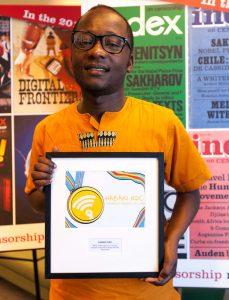
Congolese digital activist Guy Muyembe of 2018 Freedom of Expression Digital Activism Award-winning Habari RDC (Photo: Index on Censorship)
Launched in 2016, Habari RDC is a collective of more than 100 young Congolese bloggers and web activists, who use Facebook, Twitter and YouTube to give voice to the opinions of young people from all over the Democratic Republic of Congo. Their site posts stories and cartoons about politics, but it also covers football, the arts and subjects such as domestic violence, child exploitation, the female orgasm and sexual harassment at work. Habari RDC offers a distinctive collection of funny, angry and modern Congolese voices, who are demanding to be heard.
In the early 2000s a young teenager wanted to share what he thought of Congolese society. It was so important to him. He had so much to say. He, the boy who grew up in the mining region of Katanga in the south-east of the Democratic Republic of Congo, wanted only one thing: to finally speak.
The Democratic Republic of Congo is almost 10 times the size of the United Kingdom. One of the European explorers described this immense territory as a geological scandal. Little did he know how accurate he was being. This country is a scandal. In a country that supplies minerals needed to make your smartphones more than two million of its children are victims of malnutrition and its young people are idled by massive unemployment.
In the mid-2000s, I discovered the internet and its applications like blogs and social networks. It was great. I immediately realised the power of this tool. Finally, I had in my hands a means of allowing me to denounce these scandals.
In a country like mine, there are multiple polarisations, and at all scales of power. The Guardian, last year mentioned the transition to the era of the post-truth, people no longer believe the facts. In the DRC, we have been pioneers in this area. The spread of the rumour was there before social networks, it has only grown since.
It is in this context that Habari, our organisation was formed around 100 bloggers distributed around the country. We are a team of editors who verify the facts that we rely on. We may not always agree because we have diverse opinions, but we all work together for the greater good of our country.
Great is my joy on this day to receive, on behalf of the Congolese blogging community Habari DRC, this Index on Censorship Digital Activism Award. I consider this honour more a recognition than a reward. In my opinion, all the Congolese bloggers are invited on this day to redouble their efforts to make freedom of expression on the internet triumph.
First and foremost, I would like to thank the team that I have the chance to coordinate. All bloggers who see Habari as a big Congolese family and our hundreds of thousands of readers and commentators.
I would like to thank Index for recognising our work, our activism and, above all, our honesty, which is our are our cardinal value.
I would also like to thank RNW Media, the Dutch organisation that supports us on a daily basis.
My thoughts are with all those who are imprisoned, tortured and humiliated for exercising their freedom of expression.
Long live Habari DRC! Long live Index Censorship!
Full profile.[/vc_column_text][/vc_column][/vc_row][vc_row disable_element=”yes”][vc_column width=”1/2″][vc_single_image image=”84882″ img_size=”full” alignment=”center”][vc_column_text]
For his one-man protests, Ildar Dadin was sent to prison in December 2015 where he was tortured, before his conviction was quashed in February 2017. Read the full profile.[/vc_column_text][/vc_column][vc_column width=”1/2″][vc_single_image image=”84888″ img_size=”full” alignment=”center”][vc_column_text]
Despite the persecution he faces for his work, Rebel Pepper continues to satirise the Chinese state from a life in exile in Japan. Read the full profile
[/vc_column_text][/vc_column][/vc_row][vc_row disable_element=”yes”][vc_column width=”1/2″][vc_single_image image=”84889″ img_size=”full” alignment=”center”][vc_column_text]
Established in 2015, Turkey Blocks is an independent digital research organisation that monitors internet access restrictions in Turkey. Read the full profile.
[/vc_column_text][/vc_column][vc_column width=”1/2″][vc_single_image image=”84887″ img_size=”full” alignment=”center”][vc_column_text]
Maldives Independent, the Maldives’ premiere English publication and one of the few remaining independent media outlets, was formed in exile in Sri Lanka in 2004. Read the full profile.
[/vc_column_text][/vc_column][/vc_row][vc_row][vc_column][vc_basic_grid post_type=”post” max_items=”12″ style=”load-more” items_per_page=”4″ element_width=”6″ grid_id=”vc_gid:1524235551501-336b69ac-5b19-5″ taxonomies=”8935″][/vc_column][/vc_row]
19 Apr 2018 | Awards, Fellowship, Fellowship 2018
[vc_row][vc_column][vc_video link=”https://youtu.be/Cc3K8Bcvt6Y”][vc_column_text]
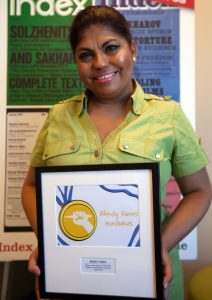
2018 Freedom of Expression Journalism Award-winning Honduran investigative journalist Wendy Funes. (Photo: Index on Censorship)
Wendy Funes is an investigative journalist from Honduras who regularly risks her life for her right to report on what is going on in the country. She is a courageous female voice, writing in a violent and corrupt society where two journalists have been killed this year and where women are regularly subjected to severe domestic violence and often killed. Funes is an inventive and passionate human rights reporter. For one article she got her own death certificate issued so that she could show up with the corruption in the civil registration office. For another one, they will be forced to fight for an investigation into children being forced to take to the streets of the country’s capital.
Looking out of one of the windows of my house a few days ago, while thinking about what to say this afternoon, I remembered the paradise tree in the garden which my childhood swing used to hang from. When it withered and died, I felt devastated. But now, forty years later, there are four big trees growing in its place and are all fruit-bearing.
For me, this award is so immense and significant that I can only explain it and express my thanks for it with a story that I have never told until now.
It is a story about a small fatherless child, yet another child left fatherless by the armed violence in Honduras. It is a story about a childhood filled with sadness. But the child learnt that whatever the circumstances, courage and strength are necessary to achieve one’s dreams: and the first step is always to dream.
In 2002 she began her first investigations as a journalist and it gave meaning to her life. But in 2008, censorship forced her to leave her dream job at the newspaper and by 2011 her constant fight for free expression and to tell the truth meant that all the doors to the media monopoly was closed to her.
But once again journalism saved her. She discovered that frustration with censorship is not the way. Rather, the way to overcome censorship is with the word, and although some doors were closed to her, doors to a more humane, less commercial, more rigorous kind of journalism were opened. The kind of journalism that investigates and pauses on each word, that does not proclaim impartiality but seeks the truth. The kind of journalism that is capable of showing her people that their society is being governed by drug trafficking and ruthless groups who since the 2009 coup have sacrificed lawyers, doctors, women, 70 journalists and executed young people in an almost invisible genocide.
The kind of journalism that can identify with a nation governed by someone who was rejected at the polls. Someone who controls the press that, in turn, covers up military assassinations, the corruption of officials and the everyday cruel realities for the Honduran people. Realities such as the 14-year-old girl sold by her father for a litre of alcohol whilst already pregnant, or the new-born baby who died of malnutrition and weighed more when he was born than when he died. In short, so many stories to tell. So many stories that the press is censored from telling.
But the young girl with whom this story began has been so fortunate that by refusing to remain silent and refusing to become part of this cruel system, by telling stories that a journalist should tell, she is being shown once again that the courage to dream is well-rewarded. That there is always someone willing to extend their hand and say “Come on, it’s worth resisting, it’s worth dreaming and fighting to transform all of this pain into a reward.” A reward which gives me hope.
I dedicate this prize to my fellow people of Honduras who demonstrate every day that they wish to move forward and overcome the violence, impunity and corruption which have been afflicting us for more than three decades.[/vc_column_text][/vc_column][/vc_row][vc_row disable_element=”yes”][vc_column width=”1/2″][vc_single_image image=”84882″ img_size=”full” alignment=”center”][vc_column_text]
For his one-man protests, Ildar Dadin was sent to prison in December 2015 where he was tortured, before his conviction was quashed in February 2017. Read the full profile.[/vc_column_text][/vc_column][vc_column width=”1/2″][vc_single_image image=”84888″ img_size=”full” alignment=”center”][vc_column_text]
Despite the persecution he faces for his work, Rebel Pepper continues to satirise the Chinese state from a life in exile in Japan. Read the full profile
[/vc_column_text][/vc_column][/vc_row][vc_row disable_element=”yes”][vc_column width=”1/2″][vc_single_image image=”84889″ img_size=”full” alignment=”center”][vc_column_text]
Established in 2015, Turkey Blocks is an independent digital research organisation that monitors internet access restrictions in Turkey. Read the full profile.
[/vc_column_text][/vc_column][vc_column width=”1/2″][vc_single_image image=”84887″ img_size=”full” alignment=”center”][vc_column_text]
Maldives Independent, the Maldives’ premiere English publication and one of the few remaining independent media outlets, was formed in exile in Sri Lanka in 2004. Read the full profile.
[/vc_column_text][/vc_column][/vc_row][vc_row][vc_column][vc_column_text]Mirando por una de las ventanas de mi casa, un par de días atrás, mientras pensaba en qué decir esta tarde, me acordé del árbol de Paraíso del jardín, desde el cual colgaba el columpio de mi niñez. Cuando se marchitó y se murió, me sentí desconsolada. Sin embargo ahora, unos treinta años después, ahí hay cuatro árboles grandes creciendo en su lugar y todos rinden fruta.
Para mí, este premio es tan inmenso e importante que solo puedo explicar y expresar mi agradecimiento con un cuento que, hasta ahora, nunca he relatado.
Es un cuento de una niña chiquita sin padre. Otro niño más dejado sin padre por la violencia armada en Honduras. Es un cuento de una niñez llena de tristeza. Pero la niña aprendió que en toda circunstancia, la alegría, el coraje y la fuerza son necesarios para lograr sus sueños: y el primer paso siempre es soñar.
En 2002 ella empezó sus primeras investigaciones como periodista y eso le dió un significado a su vida. Pero en 2008, la censura la obligó a dejar el trabajo de sus sueños en el periódico y en 2011, su constante lucha por la libertad de expresión y de exponer la verdad, significó que todas las puertas del monopolio le fueron cerradas.
Pero una vez más, el periodismo la salvó. Ella descubrió que luchar contra la censura, no era el mejor método. Más bien, el mejor método de combatir la censura era a través de la palabra, y a pesar de que algunas puertas le fueron cerradas, se le abrieron otras a otro tipo de periodismo más humano, menos comercial y más riguroso. El tipo de periodismo que investigaba y que hacía una pausa en cada palabra, el que no proclamaba la imparcialidad pero que buscaba la verdad. El tipo de periodismo capaz de enseñar a su pueblo que la sociedad está siendo gobernada por el tráfico de drogas y grupos despiadados, quienes, desde el golpe de Estado del 2009, han sacrificado a abogados, médicos, mujeres, unos setenta periodistas y han ejecutado a jóvenes en un casi invisible genocidio.
El tipo de periodismo que puede identificarse con una nación gobernada por una persona que fue rechazada en las elecciones. Una persona que controla la prensa, y que por ende encubre asesinatos, la corrupción de los oficiales y las crueles realidades cotidianas que sufre el pueblo de Honduras. Realidades tales como la muchacha de catorce años vendida por su padre por un litro de alcohol y mientras estaba embarazada, o el infante recién nacido que murió por la malnutrición y cuyo cuerpo pesaba más cuando nació que cuando murió.
Pero la jóven muchacha con quien empezó este cuento, ha sido tan afortunada que, por negarse a mantenerse callada y por negarse a ser parte de este cruel sistema, por contar cuentos que un periodista debería contar, está comprobando una vez más que el coraje de soñar está bien recompensado. En resumidas cuentas, hay tantos cuentos que contar. Tantos cuentos que la prensa está censurada de contar. Que siempre haya alguien que esté dispuesto a extender la mano y decir, Vamos, vale la pena resistir, vale la pena soñar y luchar para transformar todo este dolor en una recompensa>. Una recompensa que me da esperanza.
Dedico este premio a mis compatriotas de Honduras porque ellos demuestran todos los días, el deseo de salir adelante y vencer la violencia, impunidad y corrupción que nos han estado afligiendo con mayor calamidad en las últimas tres décadas.[/vc_column_text][/vc_column][/vc_row][vc_row][vc_column][vc_basic_grid post_type=”post” max_items=”12″ style=”load-more” items_per_page=”4″ element_width=”6″ grid_id=”vc_gid:1524235559634-0014c057-81cc-3″ taxonomies=”8935″][/vc_column][/vc_row]
16 Apr 2018 | Campaigns -- Featured, Media Freedom, media freedom featured, Statements
[vc_row][vc_column][vc_column_text]
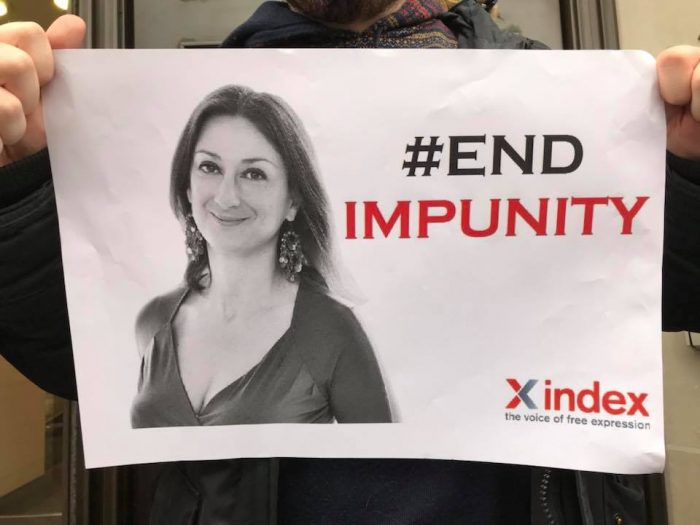
Daphne Caruana Galizia, the Maltese investigative journalist who was assassinated in October 2017, had numerous lawsuits pending at the time of her murder.
Around the world, big business and corrupt politicians are using threats of legal action to silence journalists and other critics — including NGOs and activists.
Usually this starts with a letter threatening expensive proceedings unless online articles are rewritten or removed altogether, and demanding an agreement not to publish anything similar in the future. The letters often tell the recipient that they cannot even report the fact that they have received the letter.
This process is known as a SLAPP (Strategic Lawsuit Against Public Participation). SLAPPs are designed to intimidate and silence critics by burdening defendants with huge legal costs. The purpose of SLAPPs is not to win the case. They are vexatious and are designed to eat up time and resources. They are a way to harass and intimidate journalists and others and dissuade them from reporting.
SLAPP suits are a particular problem for independent media outlets and other small organisations. They are financially draining and can take years to process. Faced with the threat of a lengthy litigation battle and expensive legal fees, many who receive SLAPPs are simply forced into silence.
Don’t let them silence you
Index believes that by encouraging journalists and media outlets to talk more openly about these threats, we can begin to put an end to the use of these vexatious lawsuits that threaten democracy.
We support an initiative by members of the European Parliament for a new directive to tackle SLAPPs.
We also know that getting such changes takes time. But it can be done. In the United States, 34 states have enacted laws to combat SLAPPs. California, which adopted its anti-SLAPP legislation in 2009, enables defendants to sue the original plaintiff for malicious prosecution or abuse of process.
In 2015 Canada passed the Protection of Public Participation Act, which aimed to implement a fast-track review process to identify and end vexatious lawsuits.
In the meantime, there are some steps that all journalists can take to help put an end to this practice.
1. Know you are not alone
Journalists from Albania to Japan have received such letters. In Malta, for example, The Shift News website received a letter late last year from law firm Henley and Partners demanding an article be removed. Henley and Partners also stated that the letter was not to be made public.
Daphne Caruana Galizia, the Maltese investigative journalist who was assassinated in October 2017, had numerous lawsuits pending at the time of her murder. She was being sued by Pilatus Bank, a Maltese-based financial institution she frequently criticised. The lawsuit was filed in the USA and dropped following the killing.
Other Maltese media groups, faced with legal threats, have complied with Pilatus Bank’s requests, and deleted and amended articles in their online archives. Pilatus denies any wrongdoing.
In the UK, Appleby, the firm associated with the Paradise Papers, is threatening legal action against the Guardian and the BBC, demanding they disclose any of the six million Appleby documents that informed their reporting and seeking damages for the disclosure of what it says are confidential legal documents.
2. Tell others if you receive a letter
Speak to someone you trust. This could be a colleague at your place of work, your local union or a representative from a nonprofit organisation working in your country or region. Nonprofit organisations and others working in the field of journalist safety include:
Article 19
Committee to Protect Journalists
European Centre for Press and Media Freedom
European Federation of Journalists
International Press Institute
Index on Censorship
Reporters Without Borders
SEEMO
A major fear when receiving a SLAPP letter from a large law firm can be a sinking feeling that you might indeed have something wrong with your story. This casts a long shadow of self-doubt and can prevent journalists even from discussing the letters with each other within the same newsroom.
If you receive these legal threats, discuss them with journalists from other publications who are working on similar stories. This is often the only way to find out that the subject of your investigations is trying to shut down the public discussion systematically. “Discovering that pattern is not only a story in itself, but critically important in helping journalists work together to defend themselves,” says investigative reporter Matthew Caruana Galizia.
3. Report it
If you work in one of the countries covered by the project, you should report such threats to the Index on Censorship Mapping Media Freedom platform, which documents threats to media freedom. Index works with other organisations to raise the worst cases with the Council of Europe so that the council can raise cases directly with the governments concerned.
When you document these threats on Mapping Media Freedom, you help to show that they exist and are a problem for journalists and the public, who are robbed of their right to know. Once we have that documentary evidence, we can push harder for a change in legislation. We believe that the number of threats would speak for themselves, if everyone in the countries we cover reported them.
4. Know your rights
Get expert legal advice but remember that not all lawyers are the same. There are lawyers who are experienced in dealing with SLAPPs. For example, the European Centre for Press and Media Freedom has a legal team that can advise on SLAPP lawsuits and Doughty Street Chambers has an International Media Defence Panel who regularly assist journalists and NGOs faced with these kinds of threats.
Have you received a SLAPP letter? Let us know. Spreading the word about this cases is important in tackling the problem. The more we can document the extent of this issue, the easier it will be to address it. Please let us know by contacting Joy Hyvarinen, Head of Advocacy, at [email protected]. [/vc_column_text][/vc_column][/vc_row][vc_row][vc_column][vc_basic_grid post_type=”post” max_items=”12″ style=”load-more” items_per_page=”4″ element_width=”6″ grid_id=”vc_gid:1523875014232-cb75410f-355e-4″ taxonomies=”8996″][/vc_column][/vc_row]
