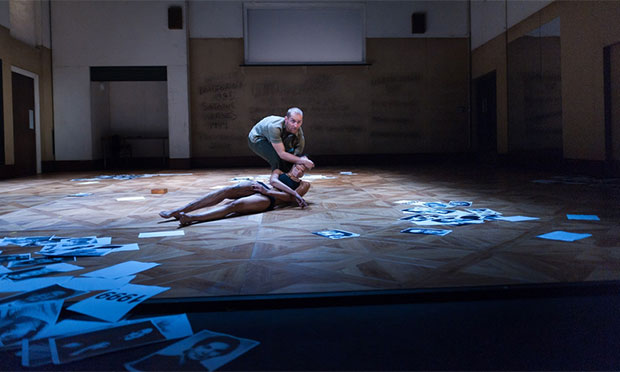
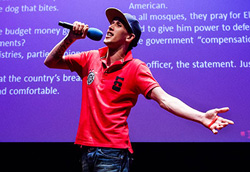
A scene from Can We Talk About This? (Photo: Matt Nettheim for DV8)
As part of our work on art, offence and the law, Julia Farrington, associate arts producer, Index on Censorship, interviewed Eva Pepper, DV8’s executive producer about how she prepared for potential hostility that the show Can We Talk About This? might provoke as it went on tour around the world in 2011-12.
Background
Can We Talk About This?, created by DV8’s Artistic Director Lloyd Newson, deals with freedom of speech, censorship and Islam. The production premiered in August 2011 at Sydney Opera House, followed by an international tour of 15 countries — Sweden, Australia, Hong Kong, France, Italy, Austria, Germany, Greece, Slovenia, Hungry, Spain, Norway, Taiwan and Korea and the UK between August 2011 and June 2012 — and was seen by a 60,000 people.
Extract from publicity of the show:
“From the 1989 book burnings of Salman Rushdie’s The Satanic Verses, to the murder of filmmaker Theo Van Gogh and the controversy of the ‘Muhammad cartoons’ in 2005, DV8’s production examined how these events have reflected and influenced multicultural policies, press freedom and artistic censorship. In the follow up to the critically acclaimed To Be Straight With You, this documentary-style dance-theatre production used real-life interviews and archive footage. Contributors include a number of high profile writers, campaigners and politicians.”
Q&A
Farrington: How did you set about working with the police for this tour?
Pepper: We focused on the UK with policing; I didn’t speak to any police forces in other countries at all, just in the UK cities we toured to: West Yorkshire Playhouse in Leeds; Warwick Arts Centre; Brighton Corn Exchange; The Lowry in Manchester and the National Theatre in London. But we did have a risk assessment and risk protocol that we shared with every venue we went to. We let them know the subject matter and the potential risks: security, safety of the audiences, media storms, safety of the people who were working on the show. They dealt either with their in-house security, or, in the UK, they would often alert the police as well.
Farrington: How did your preparations with police vary around the UK?
Pepper: We started with the Metropolitan Police, about six months before and told them our plans and that we would also contact other police forces. The National Theatre had their own contacts with the police who were already on standby. We still kept the MET events unit informed, but they [National Theatre] dealt with the police themselves. They were much more clued up, they had a head of security whom I briefed; we talked quite a lot. I made sure that he was copied in when anything a bit weird came up on the internet.
Our first venue was Leeds and we approached them about six weeks before the UK premiere. There was a bit of nervousness around Leeds, because of the larger Muslim population in the area. But we were only just beginning our liaison with the police and it took a little time to get a response. In the end we approached senior officers, but they often didn’t engage personally, just put us in touch with the appropriate unit to deal with.
Farrington: They didn’t see it as that important?
Pepper: They liked to be alerted that something might happen and they assured us that they were preparing. The venues also had their own police liaison; sometimes there was a bit of conflict if they had their own. I probably ruffled a few feathers when I went to a more senior officer.
Our starting point to the police was a very carefully worded letter which set out who we were. We didn’t ask permission to put it on we just alerted them that we might need police involvement. I did have some calls and a couple of meetings with officers, where they reiterated what is often said, which is that the police’s mandate is to keep the peace. It was made clear that they have as much of a duty to those people who want to protest or potentially might want to protest, as they have to allow us to exercise our freedom of expression. In Leeds nothing happened but there was a certain amount of nervousness around it.
Farrington: Where – at the venue?
Pepper: I think we were probably a bit nervous, and the police took it seriously enough. We had contact numbers to call. They were very much in the loop of the risk assessment.
Farrington: Was there a police presence on the night?
Pepper: I don’t remember seeing anybody. There was security of the venue of course, but regional venues only go so far with security. With some venues we were a little insistent that they get somebody upstairs and downstairs for example.
Farrington: And search bags, that kind of thing?
Pepper: We insisted people check in bags. The risk protocols weren’t invented for Can We Talk About This? They were really invented for To Be Straight With You [DV8’s previous show] and just tightened up for Can We Talk About This?. The risk protocols are just bullet points to get people thinking through scenarios.
Farrington: In general how would you describe your dealings with the police?
Pepper: I think generally supportive but we came to alert them that we might need them – there wasn’t a crisis. They said ‘thanks for letting us know let us deal with it.’ We would have quite liked to go through their risk assessments, but that didn’t happen. I think we were a little bit on their radar. They offered to send round liaison people to discuss practicalities around the office – stuff we hadn’t really thought about. It was a little bit tricky to get their attention.
The things we asked them to look out for were internet activity, if there was something brewing; sounds terribly paranoid. If there were issues around our London office or tour venues like hate mail, suspicious packages and then protests. So protest was just one thing our board was concerned about.
Farrington: Did you do anything else with the venue to prepare them for a possible hostile response from the media or a member of the public?
Pepper: I asked every venue artistic director or chief executive to prepare a statement. Lloyd would have been the main spokesperson for us if anything went wrong, but for a regional venue it is important that you are ready with a response and they all did that.
Farrington: What kind of thing did they say?
Pepper: We have supported this artist for the last 20 years. Lloyd has always been challenging in one way or another. This time he is challenging about this and we are going with him.
Farrington: Did you have any contact with lawyers?
Pepper: We looked carefully at the contents of the show. We had used interviews with real people and we wanted to be sure that nothing said was libellous or factually incorrect. So we had things looked at. The lawyer would say have you thought about that, did you get a release for this, are you using this from the BBC, do you have permission, have you spoken to this person, does he know you are doing it? And sometimes it is yes and sometimes it was a no.
Farrington: They pointed out some bases you hadn’t covered?
Pepper: Maybe one. We were really good and a bit obsessive. Sometimes we thought we didn’t have to ask because the information was in the public domain anyway, based on an interview that has been online for ten years for example. And the lawyer would or wouldn’t agree with that. It was good for peace of mind. That’s the thing with legal advice it doesn’t mean that nobody comes after you, because the law isn’t black and white.
Farrington: Were there some venues that you took the show to that didn’t think it was necessary to make special preparations?
Pepper: We always made them aware and we let them handle it. There are certain things that we always did. We asked them to consider security, and certainly PR. I was quite concerned that it would be a big PR story and then out of the PR story, as we saw with Exhibit B, comes the police. The protests don’t come from nowhere usually, somebody comes and stirs things up.
Farrington: Did you prepare the venue press departments?
Pepper: Yes we did, and we quite consciously had interviews, preview pieces before hand, where Lloyd could give candid interviews about the show. Almost to take the wind out of people’s sails, to put it out in the open so nobody could say they were surprised.
Farrington: How did you prepare with the performers for potential hostility?
Pepper: We talked through the risk procedure with them. We also got some advice from a security specialist, about being more vigilant than usual, noticing things that are out of the ordinary; if somebody picks a fight in the bar after the show, find a way to alert the others. So yes, the security specialist had a meeting with us here in the office, but also came up to Leeds to talk to the performers.
Farrington: Did it create a difficult atmosphere?
Pepper: It did yes, it got a bit edgy. Next time I would not do it around the UK premiere. It took a long time to set all of this up. To find the right people, to get people to take it seriously, to have meetings scheduled.
Farrington: It took time to find the right kind of security specialist?
Pepper: It also took a little while to get straight what we needed. We probably tried to figure it out for ourselves for a long time. And then got somebody in after all, just as maybe we, or the board got a bit more nervous. When you talk about protests you always worry about the general public, but as an employer there are the people who you send on tour who have to defend the show in the bar afterwards, potentially they are the targets.
Farrington: But they were behind the show?
Pepper: Yes, undoubtedly. But it’s an uncomfortable debate. There were so many voices in that show and you didn’t agree with every voice and it was never really said what really is Lloyd’s or DV8’s line. I would say that all the dancers were fine, but sometimes if somebody corners you in a bar it gets squirmy. No one is comfortable with everything.
Farrington: Can you summarise the response to the show?
Pepper: We had everything from 1 to 5 stars. We had people that loved the dance and hated the politics, who loved the politics and hated the dance. Occasionally somebody liked both. Occasionally somebody hated both. The show was discussed in the dance pages, in the theatre pages and in the comments pages. So in terms of the breadth and depth of the discussion we couldn’t have been more thrilled. Then we had dozens of blogs written about the show. For us Twitter really started with Can We Talk About This? and it was a great instrument for us. Social media was largely positive, though some people were picking a fight on Facebook at some point. It was very, very broad and very widely discussed.
Farrington: And did you interact with Twitter or did you let it roll?
Pepper: Mostly we let it roll. As part of the risk strategy we had a prepared statement from Lloyd which was very similar to the forward in the programme and anybody who had any beef would be redirected to the statement.
Farrington: Did the venues take this performance as an opportunity to have post show discussion and debate?
Pepper: Lloyd prefers preshow talks because he doesn’t like people to tell him what they thought of the shows. Quite often there is a quick Q&A before. In UK, we had one in Brighton [organised by Index] and one at the National. We had fantastic ones in Norway after the Breivik killings. In Norway they weren’t sure it was relevant and then the killings happened and then I got the call to say now we need to talk about it.
But having pre-show talks is certainly how we decided to deal with it. There is a conflict with having a white middle-aged atheist put on a show about Islam. But the majority of voices in the show were Muslim voices of all shades of opinion. It wasn’t fiction. It was based on his research and based on people’s stories – writers, intellectuals, journalists, politicians and who had a personal story to tell
Farrington: How did you prepare work with the board regarding potential controversies?
Pepper: Really the work with the board started with the previous show To Be Straight With You that already dealt with homosexuality and religion and culture; how different communities and religious groups make the life of gay people quite unbearable, internationally and in this country. And even then, we started to say, ‘can we say this? are we allowed to criticise these people like this?’ and out of that grew the ‘yes, I do want to talk about this’ because if we don’t a chill develops. Can We Talk About This? was a history about people who had spoken out about aspects of Islam that they were uncomfortable with or against and what happened to them.
Farrington: What kind of board do you need if you are going to be an organisation that explores taboos like this?
Pepper: We have got a fantastic board; it is incredibly responsible and so is Lloyd. There is a very strong element of trust in Lloyd’s work. They wouldn’t be on the board if they didn’t support him. But, as employers, they are aware of their responsibilities to everyone who works for us. As a company we have to be prepared in the eventuality that there is a PR or security disaster. What we were really trying to do was avoid that eventuality. We will never know. Maybe nothing bad would have happened. I think that Lloyd now wishes more people had seen it, that a film had been made, that it was more accessible to study by those who want to. He thinks that maybe we were a bit too careful. But as an organisation, as DV8, as an employer I think that we did the right thing by looking after people.
Farrington: What advice could you give to prepare the ground for doing work that you know will divide opinion and you know could provoke hostility?
Pepper:
E: If you can anticipate this you already have an advantage, but it’s not always possible to second-guess who might find what offensive. But if you know, I would suggest you ask yourself what buttons you are likely to push; you have to be confident why you are pushing them – usually in order to make an important point. It’s a good idea to articulate this reasoning very well in your head and on paper. Then you have got to be brave and get on with your project. Strong partners are invaluable, so try to get support. But in the end it is about standing up and being able to defend what you do.
Farrington: So you think you could have gone a bit further?
Pepper: I think if you prepare well you could go a bit further. I don’t think there is a law in this country that would stop you from being more offensive than we were. Every artist has to decide for themselves what they want to say and why they are saying it, and if they can justify it they can go for it.
A scene from Can We Talk About This? (Photo: Matt Nettheim for DV8)
By Julia Farrington
July 2015
As part of our work on art, offence and the law, Julia Farrington, associate arts producer, Index on Censorship, interviewed Eva Pepper, DV8’s executive producer about how she prepared for potential hostility that the show Can We Talk About This? might provoke as it went on tour around the world in 2011-12.
Background
Can We Talk About This?, created by DV8’s Artistic Director Lloyd Newson, deals with freedom of speech, censorship and Islam. The production premiered in August 2011 at Sydney Opera House, followed by an international tour of 15 countries — Sweden, Australia, Hong Kong, France, Italy, Austria, Germany, Greece, Slovenia, Hungry, Spain, Norway, Taiwan and Korea and the UK between August 2011 and June 2012 — and was seen by a 60,000 people.
Extract from publicity of the show:
“From the 1989 book burnings of Salman Rushdie’s The Satanic Verses, to the murder of filmmaker Theo Van Gogh and the controversy of the ‘Muhammad cartoons’ in 2005, DV8’s production examined how these events have reflected and influenced multicultural policies, press freedom and artistic censorship. In the follow up to the critically acclaimed To Be Straight With You, this documentary-style dance-theatre production used real-life interviews and archive footage. Contributors include a number of high profile writers, campaigners and politicians.”
Q&A
Farrington: How did you set about working with the police for this tour?
Pepper: We focused on the UK with policing; I didn’t speak to any police forces in other countries at all, just in the UK cities we toured to: West Yorkshire Playhouse in Leeds; Warwick Arts Centre; Brighton Corn Exchange; The Lowry in Manchester and the National Theatre in London. But we did have a risk assessment and risk protocol that we shared with every venue we went to. We let them know the subject matter and the potential risks: security, safety of the audiences, media storms, safety of the people who were working on the show. They dealt either with their in-house security, or, in the UK, they would often alert the police as well.
Farrington: How did your preparations with police vary around the UK?
Pepper: We started with the Metropolitan Police, about six months before and told them our plans and that we would also contact other police forces. The National Theatre had their own contacts with the police who were already on standby. We still kept the MET events unit informed, but they [National Theatre] dealt with the police themselves. They were much more clued up, they had a head of security whom I briefed; we talked quite a lot. I made sure that he was copied in when anything a bit weird came up on the internet.
Our first venue was Leeds and we approached them about six weeks before the UK premiere. There was a bit of nervousness around Leeds, because of the larger Muslim population in the area. But we were only just beginning our liaison with the police and it took a little time to get a response. In the end we approached senior officers, but they often didn’t engage personally, just put us in touch with the appropriate unit to deal with.
Farrington: They didn’t see it as that important?
Pepper: They liked to be alerted that something might happen and they assured us that they were preparing. The venues also had their own police liaison; sometimes there was a bit of conflict if they had their own. I probably ruffled a few feathers when I went to a more senior officer.
Our starting point to the police was a very carefully worded letter which set out who we were. We didn’t ask permission to put it on we just alerted them that we might need police involvement. I did have some calls and a couple of meetings with officers, where they reiterated what is often said, which is that the police’s mandate is to keep the peace. It was made clear that they have as much of a duty to those people who want to protest or potentially might want to protest, as they have to allow us to exercise our freedom of expression. In Leeds nothing happened but there was a certain amount of nervousness around it.
Farrington: Where – at the venue?
Pepper: I think we were probably a bit nervous, and the police took it seriously enough. We had contact numbers to call. They were very much in the loop of the risk assessment.
Farrington: Was there a police presence on the night?
Pepper: I don’t remember seeing anybody. There was security of the venue of course, but regional venues only go so far with security. With some venues we were a little insistent that they get somebody upstairs and downstairs for example.
Farrington: And search bags, that kind of thing?
Pepper: We insisted people check in bags. The risk protocols weren’t invented for Can We Talk About This? They were really invented for To Be Straight With You [DV8’s previous show] and just tightened up for Can We Talk About This?. The risk protocols are just bullet points to get people thinking through scenarios.
Farrington: In general how would you describe your dealings with the police?
Pepper: I think generally supportive but we came to alert them that we might need them – there wasn’t a crisis. They said ‘thanks for letting us know let us deal with it.’ We would have quite liked to go through their risk assessments, but that didn’t happen. I think we were a little bit on their radar. They offered to send round liaison people to discuss practicalities around the office – stuff we hadn’t really thought about. It was a little bit tricky to get their attention.
The things we asked them to look out for were internet activity, if there was something brewing; sounds terribly paranoid. If there were issues around our London office or tour venues like hate mail, suspicious packages and then protests. So protest was just one thing our board was concerned about.
Farrington: Did you do anything else with the venue to prepare them for a possible hostile response from the media or a member of the public?
Pepper: I asked every venue artistic director or chief executive to prepare a statement. Lloyd would have been the main spokesperson for us if anything went wrong, but for a regional venue it is important that you are ready with a response and they all did that.
Farrington: What kind of thing did they say?
Pepper: We have supported this artist for the last 20 years. Lloyd has always been challenging in one way or another. This time he is challenging about this and we are going with him.
Farrington: Did you have any contact with lawyers?
Pepper: We looked carefully at the contents of the show. We had used interviews with real people and we wanted to be sure that nothing said was libellous or factually incorrect. So we had things looked at. The lawyer would say have you thought about that, did you get a release for this, are you using this from the BBC, do you have permission, have you spoken to this person, does he know you are doing it? And sometimes it is yes and sometimes it was a no.
Farrington: They pointed out some bases you hadn’t covered?
Pepper: Maybe one. We were really good and a bit obsessive. Sometimes we thought we didn’t have to ask because the information was in the public domain anyway, based on an interview that has been online for ten years for example. And the lawyer would or wouldn’t agree with that. It was good for peace of mind. That’s the thing with legal advice it doesn’t mean that nobody comes after you, because the law isn’t black and white.
Farrington: Were there some venues that you took the show to that didn’t think it was necessary to make special preparations?
Pepper: We always made them aware and we let them handle it. There are certain things that we always did. We asked them to consider security, and certainly PR. I was quite concerned that it would be a big PR story and then out of the PR story, as we saw with Exhibit B, comes the police. The protests don’t come from nowhere usually, somebody comes and stirs things up.
Farrington: Did you prepare the venue press departments?
Pepper: Yes we did, and we quite consciously had interviews, preview pieces before hand, where Lloyd could give candid interviews about the show. Almost to take the wind out of people’s sails, to put it out in the open so nobody could say they were surprised.
Farrington: How did you prepare with the performers for potential hostility?
Pepper: We talked through the risk procedure with them. We also got some advice from a security specialist, about being more vigilant than usual, noticing things that are out of the ordinary; if somebody picks a fight in the bar after the show, find a way to alert the others. So yes, the security specialist had a meeting with us here in the office, but also came up to Leeds to talk to the performers.
Farrington: Did it create a difficult atmosphere?
Pepper: It did yes, it got a bit edgy. Next time I would not do it around the UK premiere. It took a long time to set all of this up. To find the right people, to get people to take it seriously, to have meetings scheduled.
Farrington: It took time to find the right kind of security specialist?
Pepper: It also took a little while to get straight what we needed. We probably tried to figure it out for ourselves for a long time. And then got somebody in after all, just as maybe we, or the board got a bit more nervous. When you talk about protests you always worry about the general public, but as an employer there are the people who you send on tour who have to defend the show in the bar afterwards, potentially they are the targets.
Farrington: But they were behind the show?
Pepper: Yes, undoubtedly. But it’s an uncomfortable debate. There were so many voices in that show and you didn’t agree with every voice and it was never really said what really is Lloyd’s or DV8’s line. I would say that all the dancers were fine, but sometimes if somebody corners you in a bar it gets squirmy. No one is comfortable with everything.
Farrington: Can you summarise the response to the show?
Pepper: We had everything from 1 to 5 stars. We had people that loved the dance and hated the politics, who loved the politics and hated the dance. Occasionally somebody liked both. Occasionally somebody hated both. The show was discussed in the dance pages, in the theatre pages and in the comments pages. So in terms of the breadth and depth of the discussion we couldn’t have been more thrilled. Then we had dozens of blogs written about the show. For us Twitter really started with Can We Talk About This? and it was a great instrument for us. Social media was largely positive, though some people were picking a fight on Facebook at some point. It was very, very broad and very widely discussed.
Farrington: And did you interact with Twitter or did you let it roll?
Pepper: Mostly we let it roll. As part of the risk strategy we had a prepared statement from Lloyd which was very similar to the forward in the programme and anybody who had any beef would be redirected to the statement.
Farrington: Did the venues take this performance as an opportunity to have post show discussion and debate?
Pepper: Lloyd prefers preshow talks because he doesn’t like people to tell him what they thought of the shows. Quite often there is a quick Q&A before. In UK, we had one in Brighton [organised by Index] and one at the National. We had fantastic ones in Norway after the Breivik killings. In Norway they weren’t sure it was relevant and then the killings happened and then I got the call to say now we need to talk about it.
But having pre-show talks is certainly how we decided to deal with it. There is a conflict with having a white middle-aged atheist put on a show about Islam. But the majority of voices in the show were Muslim voices of all shades of opinion. It wasn’t fiction. It was based on his research and based on people’s stories – writers, intellectuals, journalists, politicians and who had a personal story to tell
Farrington: How did you prepare work with the board regarding potential controversies?
Pepper: Really the work with the board started with the previous show To Be Straight With You that already dealt with homosexuality and religion and culture; how different communities and religious groups make the life of gay people quite unbearable, internationally and in this country. And even then, we started to say, ‘can we say this? are we allowed to criticise these people like this?’ and out of that grew the ‘yes, I do want to talk about this’ because if we don’t a chill develops. Can We Talk About This? was a history about people who had spoken out about aspects of Islam that they were uncomfortable with or against and what happened to them.
Farrington: What kind of board do you need if you are going to be an organisation that explores taboos like this?
Pepper: We have got a fantastic board; it is incredibly responsible and so is Lloyd. There is a very strong element of trust in Lloyd’s work. They wouldn’t be on the board if they didn’t support him. But, as employers, they are aware of their responsibilities to everyone who works for us. As a company we have to be prepared in the eventuality that there is a PR or security disaster. What we were really trying to do was avoid that eventuality. We will never know. Maybe nothing bad would have happened. I think that Lloyd now wishes more people had seen it, that a film had been made, that it was more accessible to study by those who want to. He thinks that maybe we were a bit too careful. But as an organisation, as DV8, as an employer I think that we did the right thing by looking after people.
Farrington: What advice could you give to prepare the ground for doing work that you know will divide opinion and you know could provoke hostility?
Pepper:
E: If you can anticipate this you already have an advantage, but it’s not always possible to second-guess who might find what offensive. But if you know, I would suggest you ask yourself what buttons you are likely to push; you have to be confident why you are pushing them – usually in order to make an important point. It’s a good idea to articulate this reasoning very well in your head and on paper. Then you have got to be brave and get on with your project. Strong partners are invaluable, so try to get support. But in the end it is about standing up and being able to defend what you do.
Farrington: So you think you could have gone a bit further?
Pepper: I think if you prepare well you could go a bit further. I don’t think there is a law in this country that would stop you from being more offensive than we were. Every artist has to decide for themselves what they want to say and why they are saying it, and if they can justify it they can go for it.
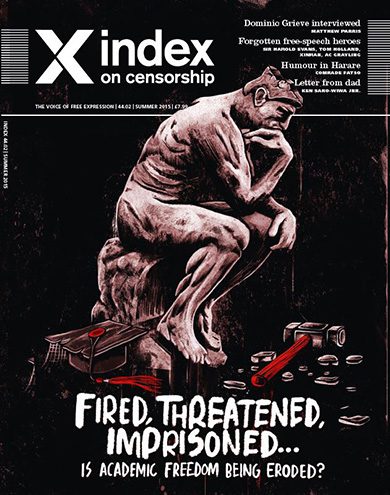
The summer 2015 issue of Index on Censorship magazine focusing on academic freedom will be available from 12 June.
With threats ranging from “no-platforming” controversial speakers, to governments trying to suppress critical voices, and corporate controls on research funding, academics and writers from across the world have signed Index on Censorship’s open letter on why academic freedom needs urgent protection.
Academic freedom is the theme of a special report in the summer issue of Index on Censorship magazine, featuring a series of case studies and research, including stories of how setting an exam question in Turkey led to death threats for one professor, to lecturers in Ukraine having to prove their patriotism to a committee, and state forces storming universities in Mexico. It also looks at how fears of offence and extremism are being used to shut down debate in the UK and United States, with conferences being cancelled and “trigger warnings” proposed to flag potentially offensive content.
Signatories on the open letter include authors AC Grayling, Monica Ali, Kamila Shamsie and Julian Baggini; Jim Al-Khalili (University of Surrey), Sarah Churchwell (University of East Anglia), Thomas Docherty (University of Warwick), Michael Foley (Dublin Institute of Technology), Richard Sambrook (Cardiff University), Alan M. Dershowitz (Harvard Law School), Donald Downs (University of Wisconsin-Madison), Professor Glenn Reynolds (University of Tennessee), Adam Habib (vice chancellor, University of the Witwatersrand), Max Price (vice chancellor of University of Cape Town), Jean-Paul Marthoz (Université Catholique de Louvain), Esra Arsan (Istanbul Bilgi University) and Rossana Reguillo (ITESO University, Mexico).
The letter states:
We the undersigned believe that academic freedom is under threat across the world from Turkey to China to the USA. In Mexico academics face death threats, in Turkey they are being threatened for teaching areas of research that the government doesn’t agree with. We feel strongly that the freedom to study, research and debate issues from different perspectives is vital to growing the world’s knowledge and to our better understanding. Throughout history, the world’s universities have been places where people push the boundaries of knowledge, find out more, and make new discoveries. Without the freedom to study, research and teach, the world would be a poorer place. Not only would fewer discoveries be made, but we will lose understanding of our history, and our modern world. Academic freedom needs to be defended from government, commercial and religious pressure.
Index will also be hosting a debate in London, Silenced on Campus, on 1 July, with panellists including journalist Julie Bindel, Nicola Dandridge of Universities UK, and Greg Lukianoff, president and CEO of Foundation for Individual Rights in Education, US.
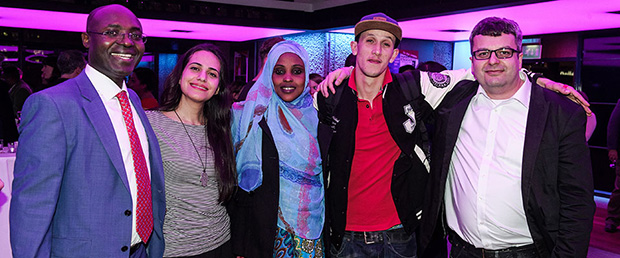
Rafael Marques de Morais, Safa Al Ahmad, Amran Abdundi, Mouad “El Haqed” Belghouat and Tamas Bodokuy (Photo: Alex Brenner for Index on Censorship)
A Kenyan woman standing up for women’s rights in one of the world’s most dangerous regions. A Hungarian journalist and his investigative news site. A documentary filmmaker who exposed an unreported uprising in Saudi Arabia. An Angolan journalist who has been repeatedly prosecuted for his work uncovering government and industry corruption. A Moroccan rapper whose music tackles widespread poverty and endemic government corruption.
These were the five individuals named Index on Censorship Freedom of Expression Award winners on 18 March 2015. Three months later, here are updates on their ongoing work.
Rafael Marques de Morais / Journalism
Rafael Marques de Morais (Photo: Alex Brenner for Index on Censorship)
International signatories, from Tiffany & Co and Leber Jewellers to Oscar-winning film director Steve McQueen, and from Blood Diamond film stars David Harewood and Michael Sheen to journalist Sir Harold Evans, recently called on Angolan president José Eduardo dos Santos to abandon the prosecution of investigative journalist Rafael Marques de Morais.
The campaigning journalist returned from collecting his award in London to face trial linked to his book Blood Diamonds. He filed a criminal complaint against a group of generals who he held morally responsible for human rights abuses he uncovered within the country’s diamond trade. For this, they filed a series of libel suits against him in Angola and Portugal.
The media attention that Marques won off the back of his award “helped a great deal” he said. “It raised my profile in the days before my trial and maybe helped to make it an international cause.” In a rare sight for Angola, a number of anti-corruption protesters publicly gathered outside of the Luanda courthouse as his trial opened and covert protests have continued under the cover of darkness since.
Marques’ trial played out in a Kafkaesque way over the subsequent weeks, with behind-the-scenes negotiations leading to criminal defamation charges first being dropped, only for him to suddenly discover that he would instead be sentenced for the alternative crime of malicious prosecution.
The American Bar Association, who monitored the trial throughout, published a report stating that the court had failed to meet international fair trial standards on at least three counts. The ABA Center for Human Rights report found that “throughout the proceedings, the defendant was denied the right to present a defense, induced to make a statement on the basis of false pretenses and compelled to bear the burden of proving his innocence, all in violation of international law.”
Marques’ sentence finally came down on 25 May: six-months imprisonment, suspended for a term of two years. Marques is now appealing against this punishment that effectively seeks to silence him until 2017; coincidentally the same year as Angola’s next elections.
The court also attempted to censor Marques’ book from republication and further distribution but these efforts have blatantly failed with copies of the book widely circulated online and an English language version becoming available for the first time less than a week after his sentence.
Despite the international attention, the situation for Marques and his peers in Angola’s human rights and journalism communities remains grim. Recounting the experience of taking his car to the local garage for repairs recently, the fear is palpable in his voice. “There were two members of the ruling party there, by coincidence. They walked across to the mechanic and warned him not to fix my car unless he wanted to risk becoming collateral damage.”
Marques’ email has also recently been repeatedly hacked and his website www.makaangola.org is presently subject to over 250 attacks per day, forcing him to desist from updating it for the time being.
Marques continues to work closely with Index on Censorship and a number of other international organisations. His recent report on the massacre of a sect at Mount Sumi was published by The Guardian, he continues to keep a close eye on both the persecution of journalists and corruption at the highest levels in Angola, and he is expecting to hear back from the Supreme Court about his appeal in the next few weeks.
Hugely grateful for the support of the international community, Marques remains determined “to continue the good fight for change”.
“I have only the interests of my people at heart,” he says, “and to experience all this persecution, it must mean you are doing something positive, something right.”
Safa Al Ahmad (Photo: Alex Brenner for Index on Censorship)
Joint winner of the Index on Censorship Freedom of Expression Award for Journalism, Safa Al Ahmad has spent much of the past three months in the editing studio.
Applauded for her documentary Saudi’s Secret Uprising, Al Ahmad’s new film The Rise of the Houthis – first distributed at this year’s Index on Censorship Freedom of Expression Awards Gala and since screened by both the BBC and PBS Frontline – has won wide critical acclaim.
Next month, on 6 July, BBC worldwide will also premiere a follow-up film that Al Ahmad has produced and directed, with Gaith Abdulahad exploring the present situation in the south of Yemen.
Now regularly invited to attend international public meetings, from Copenhagen to Geneva to Washington DC, Al Ahmad says she thinks that the award has brought more exposure – both for credible investigative journalism from Saudi Arabia, and for her work.
Is that a good thing for a journalist who has made her name through operating undercover? It is a challenge, she says, to find ways to do credible journalism about Saudi Arabia and the region without being on the ground. But there are complex stories, beyond TV, that Al Ahmad would increasingly like to focus on.
Abdundi, who knows many students from the college, immediately joined with other women leaders to organise strong community protests against Al-Shabaab.
“It was a barbaric attack done by a crazy group who have no respect for human life,” she said. “It was a sad day for the people of Kenya and the victims of the attack. But it will not scare [the] people of northern Kenya as we will continue and fight to overcome them”.
Abdundi hopes to help further through her ongoing work with her grassroots community organisation Frontier Indigenous Rights Network, tracking arms movements across the dangerous border with Sudan and travelling to meetings in Nairobi to report observations. “Security is improving now,” says Abdundi.
Winning the Index on Censorship Freedom of Expression Award for Campaigning, and sharing the story of the people of northern Kenya with the wider world, “made me so happy” she says. “The award ceremony was aired by all community radios in northern Kenya and reached many people. I am happy because it will give women courage to stand up for their rights”.
Spending a week in Index on Censorship’s office in London was “an opportunity to see how you work” Abdundi said, and has inspired her to want to develop a new website for her work, helping her to “spread her message to all corner[s] of northern Kenya”.
Tamas Bodoky (Photo: Alex Brenner for Index on Censorship)
Atlatszo.hu, Tamas Bodoky’s investigative news website in Hungary has continued to gather praise and acclaim, including another award, the Theodor Heuss Medal.
“All of this recognition is very helpful,” said Bodoky. “We are always afraid of retaliation and this offers us a level of protection… Hungarian authorities are very aware of this international attention and it is less likely that they will attack as we continue with our investigative projects.”
Atlatszo continues to publish three to four articles and numerous blog posts each week, including an English newsletter, often drawing on FOI requests to try to bring more transparency to Hungarian public life.
The campaigning journalists scored a major recent success with their campaign to demand political party foundations make information on their beneficiaries, income and spending publicly available. When political party Jobbik’s foundation refused to comply, Atlatszo took action. It began legal proceedings that proved sufficient to make them capitulate.
Bodoky’s organisation is now using this newly available information to research deeper, exploring “far right networks” and, he says, some curious connections between governing party Fidesz and football club Ferencvarosi TC.
As he looks ahead, Bodoky is especially concerned by the looming threat of a foreign NGO law – holding all NGO’s with foreign funding “accountable and transparent” by forcing them to register.
“We don’t know exactly when they will seek to expose and limit foreign funding, but the Russian recipe is definitely on the table,” says Bodoky. Fortunately his organisation has been totally open and transparent since 2013.
Rapper El Haqed (Photo: Alex Brenner for Index on Censorship)
Rapper Mouad Belghouat, better known as El Haqed (“the enraged” in Arabic) continues to rail against the endemic corruption and widespread poverty he says he sees in Morocco.
Imprisoned three times since 2011, El Haqed was not only prohibited from performing publicly in his homeland but had also been struggling to obtain visas to travel or perform internationally.
The good news is that his visit to the UK has helped him to overcome this obstacle, recently spending five weeks touring Norway, Sweden and Denmark. Highlights included performing live during Oslo’s 1 May celebrations and working with the organisation Freemuse to record a new Fela Kuti cover as part of a group of Arab and Iranian revolutionary artists (listen here). “It was much easier to be there because I went to England and came back,” said Belghouat.
Until recently limited to publishing and sharing his work via YouTube and Facebook, El Haqed has also begun something of an offline resurgence back home. Approached by promoters in his home town of Casablanca after winning the Index on Censorship Freedom of Expression Arts Award brought him widespread local media coverage, El Haqed now hopes to stage his first live concert on home soil in a long time this Friday 19 June. (Update 22 June 2015: Morocco: Police block concert by Index award-winning rapper El Haqed)
“Usually people find many excuses not to work with him,” according to Belghouat’s brother and manager Abderrahim Belghouat, “but so far this time no people have yet come and told the venue ‘don’t work with him’…”
Update 23 June 2015: El Haqed has now cancelled his planned tour of five of Morocco’s least affluent towns. The planned series of concerts would have teamed El Haqed with six other local musicians to “bring joy to poorer people in cities without theatres, cinemas and cultural areas, in the old Moroccan way, by making music for free outdoors”.
El Haqed is determinedly hopeful, “the Index award has shown Moroccan authorities that you can’t stop me,” he said, “the more of an effort they make to silence me, the more my voice arrives everywhere.”