In May 2007 Sabeen Mahmud founded The Second Floor (now known as T2F), a coffee house and “community space for open dialogue” in Karachi, Pakistan.
In April 2015, Mahmud was shot dead by unidentified gunmen. Travelling home after hosting a panel discussion on the missing people of Balochistan, a poor but resource rich province of Pakistan, armed motorcyclists surrounded her car and opened fire.
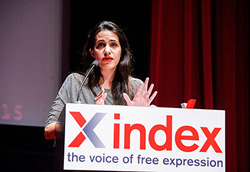
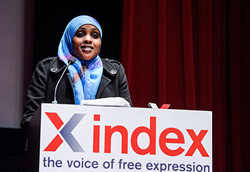
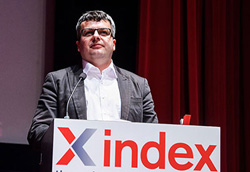
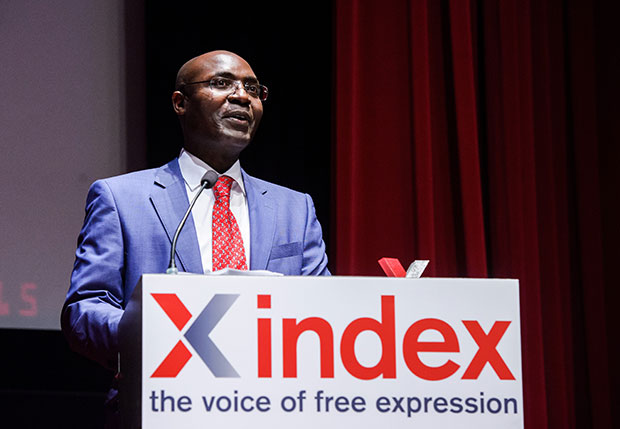
Three months after this brutal act, Index on Censorship are working together with Yasmin Whittaker-Khan, Anneqa Malik and the Sabeen Mahmud Foundation to commemorate and celebrate an extraordinary woman.
Featuring prominent speakers alongside live art, music, poetry and Pakistani food.
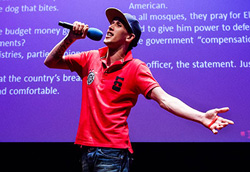
Hosted by British-Pakistani stand-up comedian and TV presenter Aatif Nawaz. With:
Ali Dayan Hasan, Pakistani human rights activist
Annie Zaman, Bytes for All
Declan Walsh, New York Times
Dr Ayesha Siddiqa, University of Oxford
Jodie Ginsberg, Index on Censorship
Kali Chandrasegaram, classical dancer
Hyder Cheema, musician
Kamila Shamsie, novelist
Omer Tariq, DJ
Shaan Taseer, Pakistan for All (and son of late Salman Taseer)
Sonia Metha, singer
Students from City And Islington Sixth Form College
Suniya Qureshi, Qismat Foundation
Tehmina Kazi, British Muslims for Secular Democracy
Ustad Roshan Abbas Khan, musician
Yasmin Whittaker-Khan, playwright
Ziad Zafar, Sabeen Mahmud Foundation
When: Thursday 23 July, 7:00pm Where: Conway Hall, 25 Red Lion Square, London WC1R 4RL (Map/directions) Tickets: Free, book here
Presented in partnership with Conway Hall Ethical Society and the Sabeen Mahmud Foundation
Rafael Marques de Morais, Safa Al Ahmad, Amran Abdundi, Mouad “El Haqed” Belghouat and Tamas Bodokuy (Photo: Alex Brenner for Index on Censorship)
A Kenyan woman standing up for women’s rights in one of the world’s most dangerous regions. A Hungarian journalist and his investigative news site. A documentary filmmaker who exposed an unreported uprising in Saudi Arabia. An Angolan journalist who has been repeatedly prosecuted for his work uncovering government and industry corruption. A Moroccan rapper whose music tackles widespread poverty and endemic government corruption.
These were the five individuals named Index on Censorship Freedom of Expression Award winners on 18 March 2015. Three months later, here are updates on their ongoing work.
Rafael Marques de Morais / Journalism
Rafael Marques de Morais (Photo: Alex Brenner for Index on Censorship)
International signatories, from Tiffany & Co and Leber Jewellers to Oscar-winning film director Steve McQueen, and from Blood Diamond film stars David Harewood and Michael Sheen to journalist Sir Harold Evans, recently called on Angolan president José Eduardo dos Santos to abandon the prosecution of investigative journalist Rafael Marques de Morais.
The campaigning journalist returned from collecting his award in London to face trial linked to his book Blood Diamonds. He filed a criminal complaint against a group of generals who he held morally responsible for human rights abuses he uncovered within the country’s diamond trade. For this, they filed a series of libel suits against him in Angola and Portugal.
The media attention that Marques won off the back of his award “helped a great deal” he said. “It raised my profile in the days before my trial and maybe helped to make it an international cause.” In a rare sight for Angola, a number of anti-corruption protesters publicly gathered outside of the Luanda courthouse as his trial opened and covert protests have continued under the cover of darkness since.
Marques’ trial played out in a Kafkaesque way over the subsequent weeks, with behind-the-scenes negotiations leading to criminal defamation charges first being dropped, only for him to suddenly discover that he would instead be sentenced for the alternative crime of malicious prosecution.
The American Bar Association, who monitored the trial throughout, published a report stating that the court had failed to meet international fair trial standards on at least three counts. The ABA Center for Human Rights report found that “throughout the proceedings, the defendant was denied the right to present a defense, induced to make a statement on the basis of false pretenses and compelled to bear the burden of proving his innocence, all in violation of international law.”
Marques’ sentence finally came down on 25 May: six-months imprisonment, suspended for a term of two years. Marques is now appealing against this punishment that effectively seeks to silence him until 2017; coincidentally the same year as Angola’s next elections.
The court also attempted to censor Marques’ book from republication and further distribution but these efforts have blatantly failed with copies of the book widely circulated online and an English language version becoming available for the first time less than a week after his sentence.
Despite the international attention, the situation for Marques and his peers in Angola’s human rights and journalism communities remains grim. Recounting the experience of taking his car to the local garage for repairs recently, the fear is palpable in his voice. “There were two members of the ruling party there, by coincidence. They walked across to the mechanic and warned him not to fix my car unless he wanted to risk becoming collateral damage.”
Marques’ email has also recently been repeatedly hacked and his website www.makaangola.org is presently subject to over 250 attacks per day, forcing him to desist from updating it for the time being.
Marques continues to work closely with Index on Censorship and a number of other international organisations. His recent report on the massacre of a sect at Mount Sumi was published by The Guardian, he continues to keep a close eye on both the persecution of journalists and corruption at the highest levels in Angola, and he is expecting to hear back from the Supreme Court about his appeal in the next few weeks.
Hugely grateful for the support of the international community, Marques remains determined “to continue the good fight for change”.
“I have only the interests of my people at heart,” he says, “and to experience all this persecution, it must mean you are doing something positive, something right.”
Safa Al Ahmad (Photo: Alex Brenner for Index on Censorship)
Joint winner of the Index on Censorship Freedom of Expression Award for Journalism, Safa Al Ahmad has spent much of the past three months in the editing studio.
Applauded for her documentary Saudi’s Secret Uprising, Al Ahmad’s new film The Rise of the Houthis – first distributed at this year’s Index on Censorship Freedom of Expression Awards Gala and since screened by both the BBC and PBS Frontline – has won wide critical acclaim.
Next month, on 6 July, BBC worldwide will also premiere a follow-up film that Al Ahmad has produced and directed, with Gaith Abdulahad exploring the present situation in the south of Yemen.
Now regularly invited to attend international public meetings, from Copenhagen to Geneva to Washington DC, Al Ahmad says she thinks that the award has brought more exposure – both for credible investigative journalism from Saudi Arabia, and for her work.
Is that a good thing for a journalist who has made her name through operating undercover? It is a challenge, she says, to find ways to do credible journalism about Saudi Arabia and the region without being on the ground. But there are complex stories, beyond TV, that Al Ahmad would increasingly like to focus on.
Abdundi, who knows many students from the college, immediately joined with other women leaders to organise strong community protests against Al-Shabaab.
“It was a barbaric attack done by a crazy group who have no respect for human life,” she said. “It was a sad day for the people of Kenya and the victims of the attack. But it will not scare [the] people of northern Kenya as we will continue and fight to overcome them”.
Abdundi hopes to help further through her ongoing work with her grassroots community organisation Frontier Indigenous Rights Network, tracking arms movements across the dangerous border with Sudan and travelling to meetings in Nairobi to report observations. “Security is improving now,” says Abdundi.
Winning the Index on Censorship Freedom of Expression Award for Campaigning, and sharing the story of the people of northern Kenya with the wider world, “made me so happy” she says. “The award ceremony was aired by all community radios in northern Kenya and reached many people. I am happy because it will give women courage to stand up for their rights”.
Spending a week in Index on Censorship’s office in London was “an opportunity to see how you work” Abdundi said, and has inspired her to want to develop a new website for her work, helping her to “spread her message to all corner[s] of northern Kenya”.
Tamas Bodoky (Photo: Alex Brenner for Index on Censorship)
Atlatszo.hu, Tamas Bodoky’s investigative news website in Hungary has continued to gather praise and acclaim, including another award, the Theodor Heuss Medal.
“All of this recognition is very helpful,” said Bodoky. “We are always afraid of retaliation and this offers us a level of protection… Hungarian authorities are very aware of this international attention and it is less likely that they will attack as we continue with our investigative projects.”
Atlatszo continues to publish three to four articles and numerous blog posts each week, including an English newsletter, often drawing on FOI requests to try to bring more transparency to Hungarian public life.
The campaigning journalists scored a major recent success with their campaign to demand political party foundations make information on their beneficiaries, income and spending publicly available. When political party Jobbik’s foundation refused to comply, Atlatszo took action. It began legal proceedings that proved sufficient to make them capitulate.
Bodoky’s organisation is now using this newly available information to research deeper, exploring “far right networks” and, he says, some curious connections between governing party Fidesz and football club Ferencvarosi TC.
As he looks ahead, Bodoky is especially concerned by the looming threat of a foreign NGO law – holding all NGO’s with foreign funding “accountable and transparent” by forcing them to register.
“We don’t know exactly when they will seek to expose and limit foreign funding, but the Russian recipe is definitely on the table,” says Bodoky. Fortunately his organisation has been totally open and transparent since 2013.
Rapper El Haqed (Photo: Alex Brenner for Index on Censorship)
Rapper Mouad Belghouat, better known as El Haqed (“the enraged” in Arabic) continues to rail against the endemic corruption and widespread poverty he says he sees in Morocco.
Imprisoned three times since 2011, El Haqed was not only prohibited from performing publicly in his homeland but had also been struggling to obtain visas to travel or perform internationally.
The good news is that his visit to the UK has helped him to overcome this obstacle, recently spending five weeks touring Norway, Sweden and Denmark. Highlights included performing live during Oslo’s 1 May celebrations and working with the organisation Freemuse to record a new Fela Kuti cover as part of a group of Arab and Iranian revolutionary artists (listen here). “It was much easier to be there because I went to England and came back,” said Belghouat.
Until recently limited to publishing and sharing his work via YouTube and Facebook, El Haqed has also begun something of an offline resurgence back home. Approached by promoters in his home town of Casablanca after winning the Index on Censorship Freedom of Expression Arts Award brought him widespread local media coverage, El Haqed now hopes to stage his first live concert on home soil in a long time this Friday 19 June. (Update 22 June 2015: Morocco: Police block concert by Index award-winning rapper El Haqed)
“Usually people find many excuses not to work with him,” according to Belghouat’s brother and manager Abderrahim Belghouat, “but so far this time no people have yet come and told the venue ‘don’t work with him’…”
Update 23 June 2015: El Haqed has now cancelled his planned tour of five of Morocco’s least affluent towns. The planned series of concerts would have teamed El Haqed with six other local musicians to “bring joy to poorer people in cities without theatres, cinemas and cultural areas, in the old Moroccan way, by making music for free outdoors”.
El Haqed is determinedly hopeful, “the Index award has shown Moroccan authorities that you can’t stop me,” he said, “the more of an effort they make to silence me, the more my voice arrives everywhere.”
Journalist and human rights activist Rafael Marques de Morais (Photo: Alex Brenner for Index on Censorship)
International signatories from the worlds of technology, journalism, publishing, theatre, film and business, including jewellers Tiffany & Co, called on Angolan president José Eduardo dos Santos on Tuesday to drop the prosecution of award-winning investigative journalist Rafael Marques de Morais.
“Rafael’s trial was a sham. He was told charges would be dropped, only for him to be hit with new charges out of the blue, and he was not allowed to present his evidence or call witnesses,” said Jodie Ginsberg, CEO of freedom of expression group Index on Censorship, which organised the letter.
“Rafael is a courageous journalist, working with little support to expose corruption in Angola. This absurd trial and verdict is meant to stop him from speaking out. We want to make sure that does not happen.”
Marques was awarded an Index on Censorship Freedom of Expression award in March for his work. Signatories to the letter include jewellers Tiffany & Co.; tech entrepreneurs Martha Lane Fox, one of the judges of the awards, and Wikipedia founder Jimmy Wales; authors Philip Pullman, Neil Gaiman and Elif Shafak; actors Janet Suzman, Juliet Stevenson, and Simon Callow; playwrights Howard Brenton and Timberlake Wertenbaker; as well as Steve McQueen, director of Oscar-winning film 12 Years a Slave. Other signatories included journalists Sir Harold Evans and Christina Lamb; and artists and writers with direct experience of censorship, such as Syrian political cartoonist Ali Ferzat and Azerbaijani journalist Idrak Abbasov.
The letter will be delivered by Index on Censorship to the Embassy of Angola in London on Tuesday, June 2.
For more information, contact David Heinemann on 0207 260 2664 or email [email protected].
The letter
We, the undersigned, call on Angolan President José Eduardo dos Santos to drop the prosecution of journalist Rafael Marques de Morais.
Marques’ vital investigations into human rights abuses should not be impeded by the threat of jail, which is set to loom over him for two years under the court’s terms.
His conviction and six-month suspended sentence are a clear violation of the rights to free expression, to a free press and to a fair trial.
Marques’ reporting is fundamental not only to Angola, but to the world at large.
We call on you to ensure standards of international law are applied during the appeal process.
Yours faithfully,
Ali Ferzat, cartoonist
Angela Quintal, editor, Mail & Guardian, South Africa
Dame Ann Leslie, journalist
Anthony Barling, lawyer
Art Kaufman, World Movement for Democracy
Bob Fu, founder and president, ChinaAid
Brilliant Earth Jewellery
Carl Gershman, president, National Endowment for Democracy
Chantal Uwimana, Transparency International
Chie Murakami, director general, Diamonds for Peace, Japan
Christopher Hird, film producer
Christophe Deloire, secretary-general, Reporters Without Borders
Christina Lamb OBE, journalist
David Aaronovitch, columnist
David Harewood MBE, actor
David McCune, publisher
David Schlesinger, founder, Tripod Advisors
Dreda Say Mitchell, author
Edward Fitzgerald CBE QC, lawyer
Elaine Potter, journalist
Elif Shafak, author
Geoffrey Hosking OBE, historian
Grigory Pasko, journalist
Sir Harold Evans, journalist
Howard Brenton, playwright
Idrak Abbasov, journalist
Janet Suzman, actor and director
Jesper Højberg, executive director, International Media Support
Jeffrey Smith, Robert F Kennedy Centre for Justice & Human Rights
Jimmy Wales, founder, Wikipedia
Jodie Ginsberg, chief executive, Index on Censorship
John Witherow, editor, The Times, UK
Juliet Stevenson, actor
Kamila Shamsie, author
Kostas Vaxevanis, journalist
Lara Pawson, author of In the Name of the People: Angola’s Forgotten Massacre
Larry Kilman, secretary-general, World Association of Newspapers and News Publishers
Leber Jeweler Inc
Lee Hirsch, film director
Lindsey Hilsum, journalist
Louise Redvers, journalist
Mariane Pearl, journalist
Mark Stephens CBE, senior member, Howard Kennedy LLP
Martha Lane Fox CBE, House of Lords
Mary Lawlor, executive director, Front Line Defenders
Maya Wolfe-Robinson, journalist
Matthew d’Ancona, journalist
Matthew Parris, journalist
Mohamed Al-Dharadji, film director
Neil Gaiman, author
Paul Webster, film producer
Peter Oborne, journalist
Peter Kellner, president, YouGov
Peter Pomerantsev, author
Peter Tatchell, director, Peter Tatchell Foundation
Philip Pullman, author
Rahim Haciyev, editor, Azadliq, Azerbaijan
Richard Sambrook, director, Centre for Journalism, Cardiff University
Ronald Deibert, academic
Robert McCrum, writer and editor
Sanar Yurdatapan, Initiative for Freedom of Expression, Turkey
Shubhranshu Choudhary, journalist
Simon Callow CBE, actor
Steve McQueen CBE, film director
Sue Woodford-Hollick OBE, businesswoman
Sue Valentine, Committee to Protect Journalists Africa Programme
Suzanne Nossel, executive director, PEN American Centre
What if your job, your career, was winding up an entire nation?
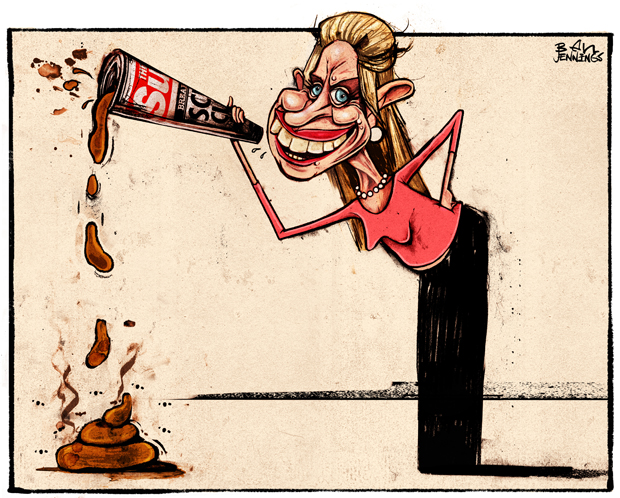
That’s it. Sure, you have a column in a national newspaper. But what can you really do with it? You can’t really share your thoughts on the common toad, or tell delightful stories about your children misunderstanding foreign words, much less offer some insight into the workings of the modern world. Sure, you can chuck the odd piece of light relief in the sidebar or the basement, but that’s not what people are here for. We’ve come to your column to be thrilled by your outrageous views, and thrilled we will be.
Last time round it was people giving food to, and receiving food from, charity.
“SAY the words food bank” La Dolce ‘Opkina began, “and I am supposed to put on my concerned face and proffer up a can of beans.”
Where’s this going Katie? Where could this possibly be going?
“But all I’ve found in the back of my cupboard is two fingers. And they don’t belong to a Kit Kat.”
BOOM! Gotcha. I mean, it makes no sense. If it’s the fingers at the end of her arm she’s using, why are they in the back of the cupboard? Unless, maybe, she is SO outrageous that she keeps a special V-flipping apparatus in her cupboard, as her doctor has advised her that the constant extension and retraction of her index and middle finger was putting her in serious risk of chronic RSI. But then, if you were using it that much, you wouldn’t keep it in the back of the cupboard. You’d have it on the hall table, perhaps. Or in a little belt-mounted pouch, like a techie’s mobile phone, ready to unleash, cosh-style, upon passing do-gooders, bed-wetters, namby-pambies, oiks, poshos, hippies, liberal elitists, ignorant yokels, EUROCRATS, trendy vicars, Trots, gypsies, useless husbands, trashy wives, “gay rights” activists, lesbo-feminists and everyone else you might bump into at a reasonably-sized community festival in a reasonably-sized town.
It must be exhausting keeping track of this roll call of resentment. It must be wearing to have to be angry every week. How draining to have a public persona dedicated to hating everything and everyone.
And then there is the fact that outrage is a substance which can be addictive, but to which people can also develop a considerable tolerance. In order to keep us interested — and quite possibly to keep herself interested also — Hopkins has to keep upping the dose, until eventually we get to the point where she’s describing poor African people drowning in the sea as cockroaches and everyone suddenly stops and thinks “oh”.
The problem the serial controversialist who has nothing else to trade on faces is that the only way to go is down. The very nature of the job and the stuff you are peddling means you must, inevitably, end up overstepping the mark. In the case of Jeremy Clarkson, a carnival of boorishness ended in violence, where it had to. Hopkins seems to have survived, but she’s Zugzwanged herself: tone down the schtick and she becomes pointless; the only other move available is directly into the abyss. This is the fate of the wind-up merchant.
The exception to this rule is the satirist. The essential difference between the satirist and the controversialist is that the controversialist puts herself forward, from the beginning, as the stoic truthteller, striving alone in a world gone mad. Controversialists tend to be declinists: the world is steadily getting worse. The converse of this is the belief that at some point, usually in the period of the controversialist’s late adolescence, the world was right.
Satirists hold out no such (perverse) hope. The world is awful, the world has always been awful, and the only way to get through it is to laugh and hope we can make some tweaks around the edges. It is curious then, that from Private Eye to Charlie Hebdo, satire is often linked to campaigning journalism in the same publication.
Charlie has once again been in the news after several US-based authors refused to take part in a gala in honour of the magazine hosted by PEN American Center.
The writers’ heckles were raised by what they saw as racist cartoons run by Charlie in the past. Among these were one of a black politician portrayed as a monkey, and Nigeria girl victims of Boko Haram portrayed as “welfare queens”. Of course, at face value, these seem racist (though it is worth noting that it was not racist cartoons that saw Charlie’s staff slain: it was cartoons that refused to obey religious taboo).
What the US critics failed to acknowledge was that all satire is reactive: the cartoons did not simply spring unprompted from the cartoonists’ pens. The case of the ape cartoon was a reaction to far right portrayals of the minister, and the accompanying text very clearly mocked the Front National’s leader Marine Le Pen. As Irish novelist and Charlie columnist Robert McLiam Wilson pointed out:
“Without the snipped-off text underneath, and the knowledge of the lamentable tosh it was lampooning, of course Charlie would seem racist. It would seem racist to me too. But to strip the image of its fundamental components like this is akin to saying the incomparable Jonathan Swift was a baby-eating Nazi and that A Modest Proposal was actually a cookbook.”
Satire must toy with what it sets out to mock: otherwise it is meaningless and unintelligible. Sometimes the controversy of the likes of Hopkins and the irony of Charlie can look, at first glance, identical.
And sometimes not: While Hopkins was describing “cockroaches” drowning in the Mediterranean, Charlie was echoing the refrain of many: “A Titanic every week,” with a cartoon depicting a white woman singing My Heart Will Go On while a despairing migrant begs her to “shut up” (Ta Guelle).
Bracing? Sure. But humanising, too. As satire should be and controversialism never is.