The Syria coordinator for the Institute of War and Peace Reporting (IWPR), Ms Erhaim has been recognised by a number of organisations internationally – including Reporters Without Borders (RSF) in 2015 – for her work training citizen journalists to report on the conflict within Aleppo.
Ms Erhaim had her old passport, which remains valid but is effectively unusable because the pages are filled, and was able to enter the UK for the debate. Further travel may be impossible, however, as Ms Erhaim no longer has a passport with which to apply for a new visa to enter Europe.
When Ms Erhaim challenged this decision, she was told to seek consular advice from the Syrian government in Damascus.
“It seems quite astonishing that the UK would accede to a request from a government whom it has only this week accused of being complicit in war crimes – especially when it is clear that the Syrian government is using tools, such as passport cancellations, to harass those who oppose or expose its behaviour,” Jodie Ginsberg, CEO of Index on Censorship, said.
Anthony Borden, IWPR executive director and managing director, said: “Zaina Ehraim is internationally recognized as one of the most courageous and professional independent voices from Syria – working at great personal risk to support media and civic society inside the country to inform the world about this terrible conflict and keep hope alive for some kind of positive future.”
“The idea that the British government – which has directly supported our work in Syria – should accede to the demands of the Syrian authorities to seize her passport is profoundly offensive to any democratic thinking, directly undermines the effort to build civic options inside Syria, and sends precisely the wrong message to the criminal regime in Damascus,” he added.
Four organisations – the Council for Arab-British Understanding, Index on Censorship, IWPR, and RSF – have raised the matter with the Home Office and Foreign and Commonwealth Office.
“We are appalled that the UK authorities have allowed our system to be manipulated in this way. British law is meant to protect freedom of expression, not to be used to harass critical journalists at the urging of repressive regimes. We call on the Home Office to take immediate steps to assist Erhaim and issue a public statement in her support,” said Rebecca Vincent, RSF’s UK Bureau Director.
Chris Doyle, Director, Council for Arab-British Understanding said: “The precedent set by seizing Erhaim’s passport and the message it sends to oppressive governments around the world is alarming. In theory, any vicious regime could demand the return of a passport from any government merely by fraudulently claiming that the passport is stolen.”
The Frontline Club is also supporting a campaign to raise awareness of the issue.
If you would like to write a letter in support of Zaina Erhaim, address your correspondence to:
The family of murdered journalist and Sunday Times correspondent Marie Colvin has filed a lawsuit against the Syrian government, accusing it of being responsible for her death while she was reporting in the country in 2012.
The suit, filed to a federal court in Washington, alleges that Colvin was killed in a deliberate attack, planned by President Bashar al-Assad’s government, to silence the media “as part of its effort to crush political opposition”.
Colvin, a veteran war reporter, was killed alongside French photojournalist Remi Ochlik when a rocket attack was launched against a makeshift broadcast studio in the rebel-controlled area of Baba Amr in Homs, the country’s third city.
Colvin’s work and legacy is discussed in the latest issue of Index on Censorship magazine, which has a special report on the risks of reporting worldwide. In a piece debating whether journalists should work in war zones, Channel 4 New’s Lindsey Hilsum writes: “In February 2012, Marie and photographer Paul Conroy crawled through a sewer to get to Homs, as the Syrian regime’s bombs turned the buildings of rebel-controlled Baba Amr to burnt-out carcasses and rubble. In her dispatches, Marie described the makeshift beds on which children slept underground to avoid the bombs, the operations without anaesthetic, the despair of people who felt they had been abandoned by the world. It was classic, old-fashioned eyewitness reporting […]
“Marie felt she had a responsibility to report; she refused to leave it to YouTube. Yet, on this occasion, the risk was too great. Was she brave, or – in her own words – was it bravado? Either way, we are all the poorer because Marie Colvin is no longer reporting from Syria.”
Syria’s Rebellious Women was filmed by the Syrian journalist over an 18-month period to offer a rare insight into the difficulties faced by women living and working in rebel-held parts of Syria.
The films, which show a side of Syria rarely seen in the media, tell the individual stories of heroic women who continue to document war, provide medical services and deliver supplies to civilians despite disapproval from their families and the male-dominated society.
Erhaim told the audience that she decided to make the films after failing to find anything about Syrian women throughout history during her own research, and wanting to ensure the work of these women was remembered.
She said: “The main reason I made the films is because I am Syrian, and I’m a woman. I tried to do some research six years ago about Syrian women who participated in Syrian history and I couldn’t find anything.
“So I felt like we had to capture this work that the women are doing because in the future the men are going to be writing the history and these heroines are going to be forgotten.”
As a female journalist Erhaim faced many struggles when making the films, including being forbidden from filming in certain locations, just for being female; meaning she had to teach a male friend to use a camera in order to film scenes for her. Her friend was then hit by a missile after helping her.
She said: “Sometimes you need a hand and there are plenty of people willing to do that, free of charge; even if they are sacrificing their lives for you.”
Erhaim has spent the last two years training hundreds of citizen journalists, many of them women. She is also the Syria project coordinator for the Institute for War and Peace Reporting (IWPR), an international organisation that supports journalists in countries undergoing conflict, crisis, or transition, who co-presented the event with Index and the Frontline Club.
When asked if she was optimistic about Syria’s future she replied: “No, I’m not. I think I’m being realistic; I don’t see any change happening, at least for better. Not for women, not for men, not for Syrians.”
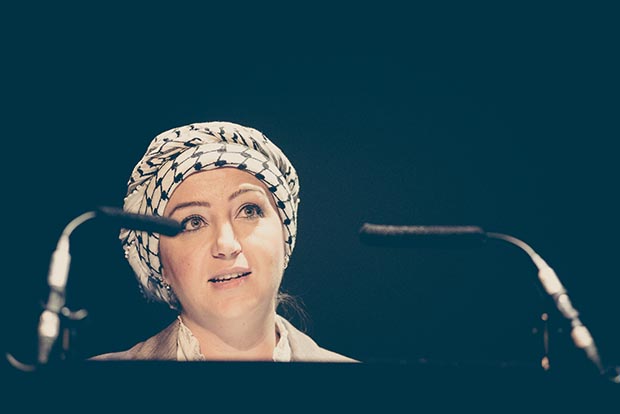
2016 Freedom of Expression Journalism Award winner Zaina Erhaim (Photo: Elina Kansikas for Index on Censorship)
While journalists and citizens fled, Syrian-native Zaina Erhaim returned to her war-ravaged country and the city of Aleppo in 2013 to ensure those remaining were not forgotten. She is now one of the few female journalists braving the twin threat of violence from both ISIS and the president, Bashar al-Assad.
I am honoured to receive this award here today. I believe this is not for Zaina as a person, but to the Syrian journalists and citizen journalists who refused to be turned into propagandists to the Assad regime, instead they chose to report the truth and the facts despite the very high price of that.
That’s why here I should be mentioning my great friends and colleagues who are greatly missed, Obaida Battal who has been kidnapped by ISIL in Aleppo for more than three years, Ossama Hassan also abducted by ISIL in Raqqa for more than 2 years. We don’t know whether they are alive or dead.
Baseel Safadi, who won this award and is still being detained in the regime’s prisons for his activism.
Hasan Azhari, who was killed by Assad forces under torture in Latakia; Basel Shehad, killed in an Assadi air strike in Homs; Wasim Al Idel, killed by a Russian strike; and sadly the list is too long to be cited. Different means of killing and killers all for one cause, and one crime: Journalism, freedom of expression, echoing the silenced voices of Syrians demanding their freedom.
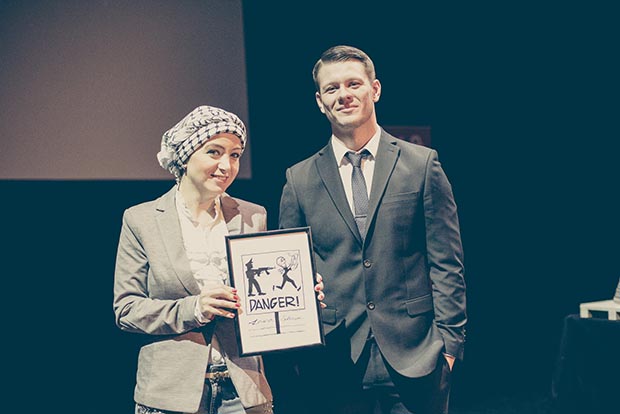
2016 Freedom of Expression Journalism Award winner Zaina Erhaim and Jake Hanrahan of Vice News (Photo: Elina Kansikas for Index on Censorship)
Those are the ones who I believe deserve all the honouring awards in the world.
I want to give this award to the Syrians who are being terrorised by one of the worst tyrants, ISIL, international jihadists and strikes, and above all those trying to flee and are being treated as potential terrorists themselves, and are being discriminated against for demanding justice, peace and a respected life in a free, democratic country.
This award is for the journalists and citizen journalists still taking this dangerous, difficult path, sacrificing everything, playing hide and seek with death to get the stories of the Syrian people out. So please keep your eyes on our news, pictures and videos, because great heroes are dying to get them to you.