2 Sep 2022 | Opinion, Russia, Ruth's blog
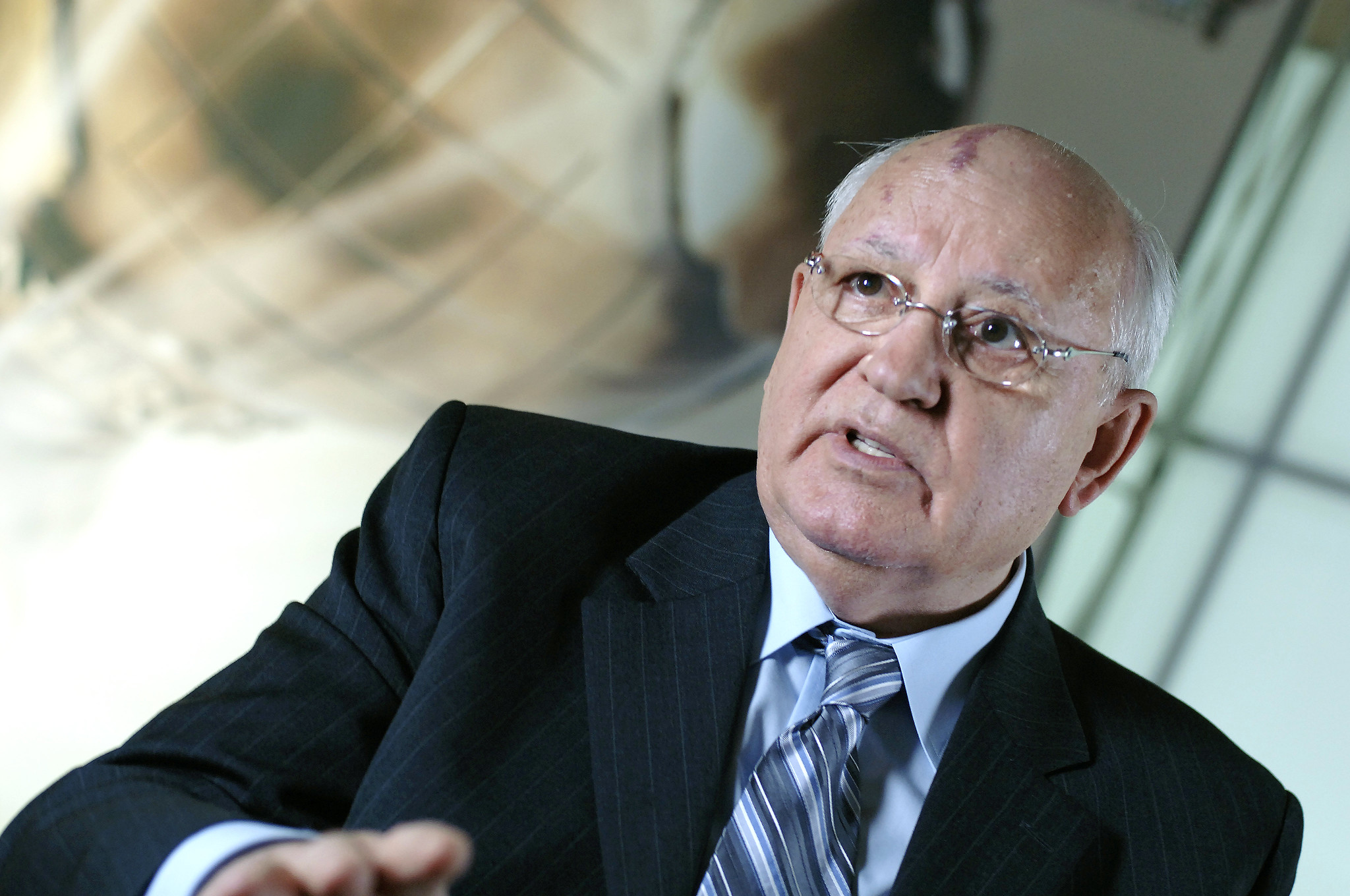
Mikhail Gorbachev in 2008. The former president of the Soviet Union passed away on 30 August. Credit: European Parliament
In every field there are people who become living legends, people who inspire their colleagues and shape their chosen field. They add to our collective knowledge, they shape the world we live in and their contributions ensure that we both question the status-quo and think again about our individual and collective core values.
Sometimes these people reach further than their own fields. Sometimes they inspire or challenge the world. Whether as thinkers, writers or leaders. Sometimes their experiences and their contributions come to define an era of history – for some maybe even just one year.
1989. A year of deep turmoil. A year that reshaped the world. A year that defined the next generation. A year of both hope and horror. And on a personal level, a year that defined the type of world that I was going to live in.
1989 saw the fall of the Berlin Wall, the Tiananmen Square protests, the Velvet Revolution, the Hillsborough disaster, the Exxon Valdez spill, Solidarity was elected in Poland, FW de Klerk was elected in South Africa, Sky TV was launched and the Ayatollah Khomeini issued a fatwa against Salman Rushdie. In different ways each of these events shaped the world we live in today – 33 years later.
I often write that there has been too much news. Too many issues for the Index team to cover. Too many crises. In 1989 we published nine editions of the magazine, to keep up with the news and to ensure that voices of dissidents were being heard, as authoritarian regimes began to fall.
In the last month I have found myself thinking a great deal about the events of 1989 and what they led to. The path of history that was chosen on those pivotal days and the actions of our leaders whose immediate responses to these events had long-term consequences. Whilst there are many global figures who dominated the news during my childhood, two of them have this month caused me to pause and consider what the world would have been like if they hadn’t been brave enough to challenge the status quo.
Sir Salman Rushdie and Mikhail Gorbachev.
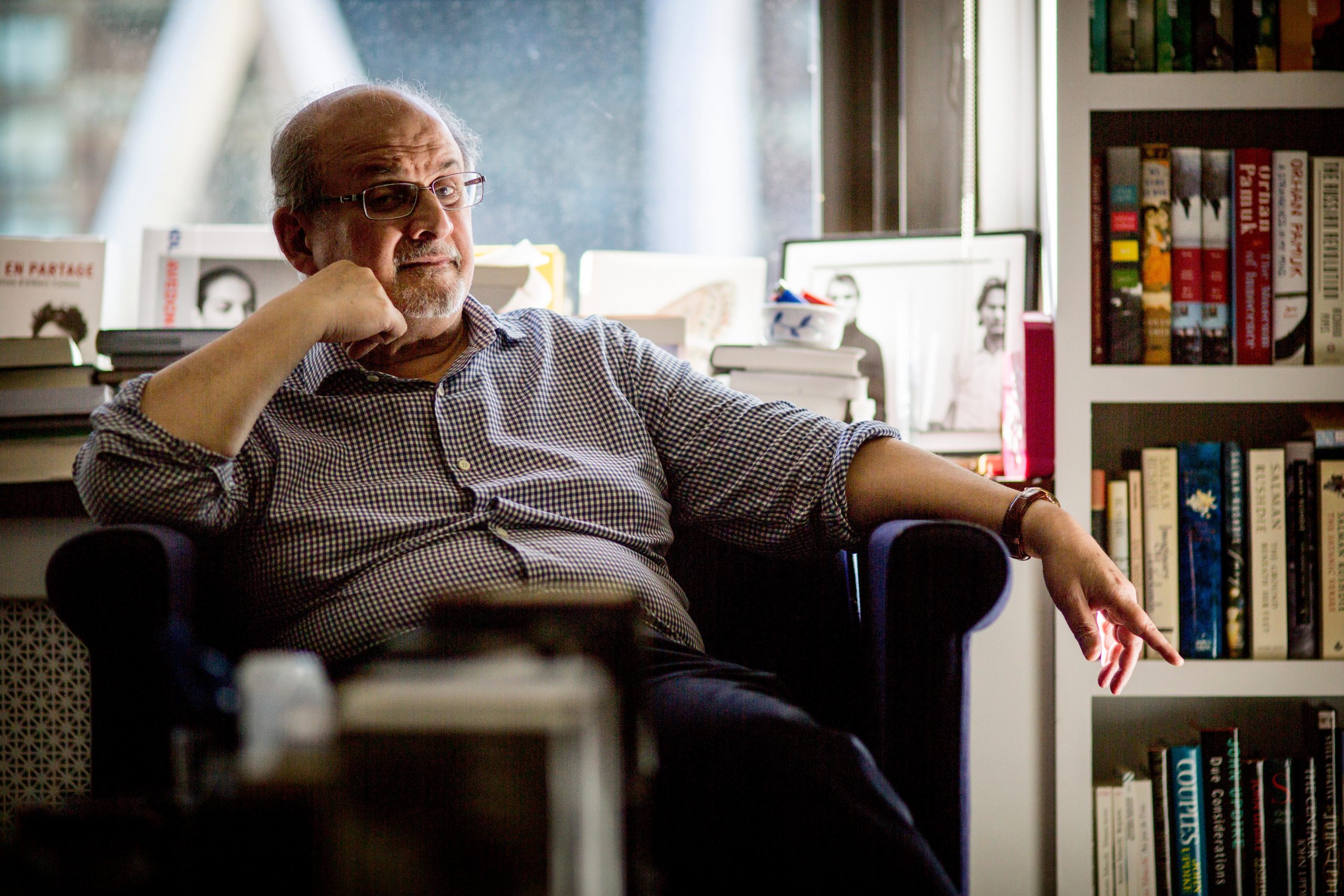
Salman Rushdie pictured in New York in 2016. Credit: Orjan Ellingvag/Alamy
Every day since the horrendous attack on Sir Salman, last month, Index has received messages of support for him as he recovers from his injuries. The messages have been touching, political and occasionally controversial – just like his writings! What they have demonstrated is regardless of people’s associations with him and their feelings towards him, his bravery and commitment to the values of freedom of expression in the face of the gravest of threats inspired a generation.
For over three decades he has refused to be intimidated, to be cowed. He continued to write, to speak and stay true to his values. He embodies the fight of the dissident, the determination to be heard and the power of words. He has shaped my approach to the world we live in and more importantly he has provided a role model for all of those that Index seeks to support and promote every day. I am so pleased that those who sought to assassinate him failed and we still have him amongst us.
In a different way Mikhail Gorbachev is just as fundamental to the history of Index. I’m not sure that Michael Scammell, the first editor of Index, would have believed that within a decade of Gorbachev’s coming to power in the USSR his writing would be in Index. His bravery in embracing glasnost provided hope for a generation.
The fall of the Berlin Wall without military repercussions provided hope of a peaceful transition to democracy – not just in central and eastern Europe but throughout the world.
This isn’t to say he wasn’t flawed. He was and his actions in the Baltics and the Caucuses were as expected from an authoritarian leader, and his support for the 2014 annexation of Crimea will forever tarnish his legacy.
But… Index was founded to provide a platform for samizdat, to provide a voice for dissidents who lived behind the Iron Curtain, to campaign for the right to freedom of expression both in the USSR and around the world. His bravery in embracing glasnost provided space for people to speak freely, to write and to be heard, even if Putin once again has shut the door. Gorbachev enabled people to get a taste of what they were missing. We can only hope that in the long arch of history glasnost will win out.
12 Aug 2022 | Magazine, News, Student Reading Lists
Salman Rushdie. Credit: Fronteiras do Pensamento
On 12 August 2022, Salman Rushdie, the author of the book The Satanic Verses, was attacked as he prepared to give a lecture at the Chautauqua Institution, an arts and education centre in New York state.
Index on Censorship has supported Rushdie’s right to express himself ever since he came into the public eye more than three decades ago.
On 14 February 1989 Iran’s Ayatollah Khomeini issued a fatwa ordering Muslims to execute Rushdie over the publication of The Satanic Verses, along with anyone else involved with the novel.
Published in the UK in 1988 by Viking Penguin, the book was met with widespread protest by those who accused Rushdie of blasphemy and unbelief. Death threats and a $6 million bounty on the author’s head saw him take on a 24-hour armed guard under the British government’s protection programme.
The book was soon banned in a number of countries, from Bangladesh to Venezuela, and many died in protests against its publication, including on 24 February when 12 people lost their lives in a riot in Bombay, India. Explosions went off across the UK, including at Liberty’s department store, which had a Penguin bookshop inside, and the Penguin store in York.
Book store chains including Barnes and Noble stopped selling the book, and copies were burned across the UK, first in Bolton where 7,000 Muslims gathered on 2 December 1988, then in Bradford in January 1989. In May 1989 between 15,000 to 20,000 people gathered in Parliament Square in London to burn Rushdie in effigy.
In October 1993, William Nygaard, the novel’s Norwegian publisher, was shot three times outside his home in Oslo and seriously injured.
Rushdie came out of hiding after nine years, but as recently as February 2016, money has been raised to add to the fatwa, reminding the author As that for many the Ayatollah’s ruling still stands.
As his supporters around the world, including Index, pray for a positive outcome, we highlight key articles from our archives from before, during and after the issue of the fatwa, including two from Rushdie himself.
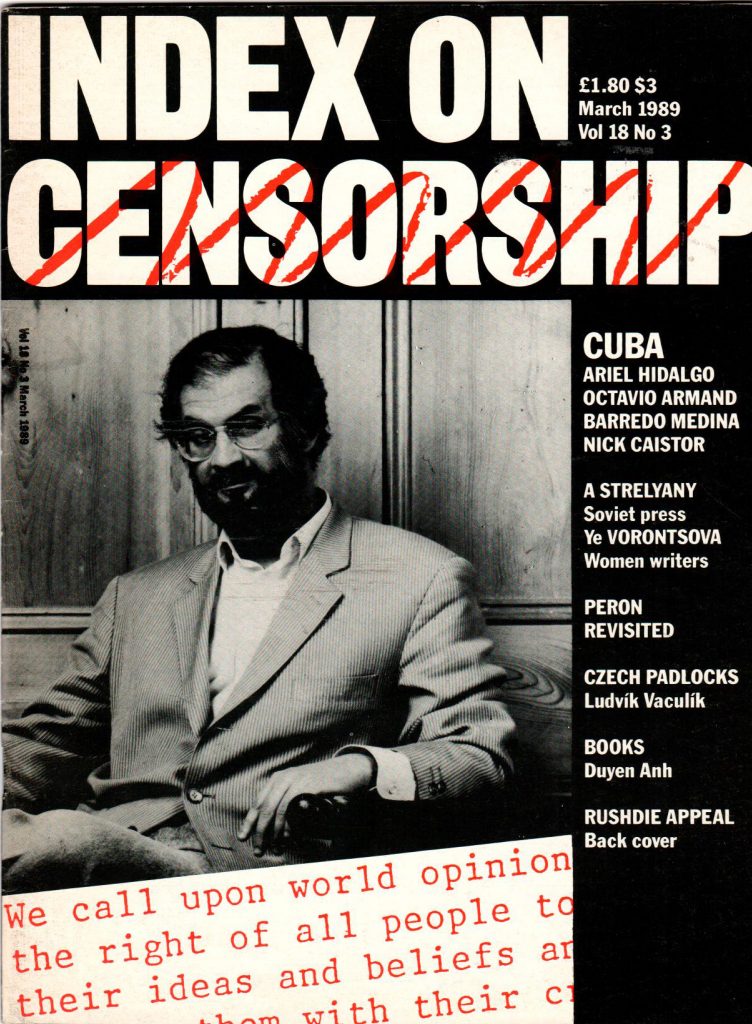
Cuba today, the March 1989 issue of Index on Censorship magazine.
World statement by the international committee for the defence of Salman Rushdie and his publishers
March 1989, vol. 18, issue 3
On 14 February the Ayatollah Khomeini called on all Muslims to seek out and execute Salman Rushdie, the author of The Satanic Verses, and all those involved in its publication. We, the undersigned, insofar as we defend the right to freedom of opinion and expression as embodied in the Universal Declaration of Human Rights, declare that we also are involved in the publication. We are involved whether we approve the contents of the book or not. Nonetheless, we appreciate the distress the book has aroused and deeply regret the loss of life associated with the ensuing conflict.
Read the full article

Islam & human rights, the May 1989 issue of Index on Censorship magazine.
Pandora’s box forced open
Amir Taheri
May 1989, vol. 18, issue 5
‘What Rushdie has done, as far as Muslim intellectuals are concerned, is to put their backs to the wall and force them to make the choice they have tried to avoid for so long’. Last year, when poor old Mr Manavi filled in his Penguin order form for 10 copies of Salman Rushdie’s third novel, The Satanic Verses, he could not have imagined that the book, described by its publishers as a reflection on the agonies of exile, would provoke one of the most bizarre diplomatic incidents in recent times. Mr Manavi had been selling Penguin books in Tehran for years. He had learned which authors to regard as safe and which ones to avoid at all costs.
Read the full article
Islam & human rights, the May 1989 issue of Index on Censorship magazine.
Jihad for freedom
Wole Soyinka
May 1989, vol. 18, issue 5
This statement is not, of course, addressed to the Ayatollah Khomeini who, except for a handful of fanatics, is easily diagnosed as a sick and dangerous man who has long forgotten the fundamental tenets of Islam. It is useful to address oneself, at this point, only to the real Islamic faithful who, in their hearts, recognise the awful truth about their erratic Imam and the threat he poses not only to the continuing acceptance of Islam among people of all religions and faiths but to the universal brotherhood of man, no matter the differing colorations of their piety. Will Salman Rushdie die? He shall not. But if he does, let the fanatic defenders of Khomeini’s brand of Islam understand this: The work for which he is now threatened will become a household icon within even the remnant lifetime of the Ayatollah. Writers, cineastes, dramatists will disseminate its contents in every known medium and in some new ones as yet unthought of.
Read the full article
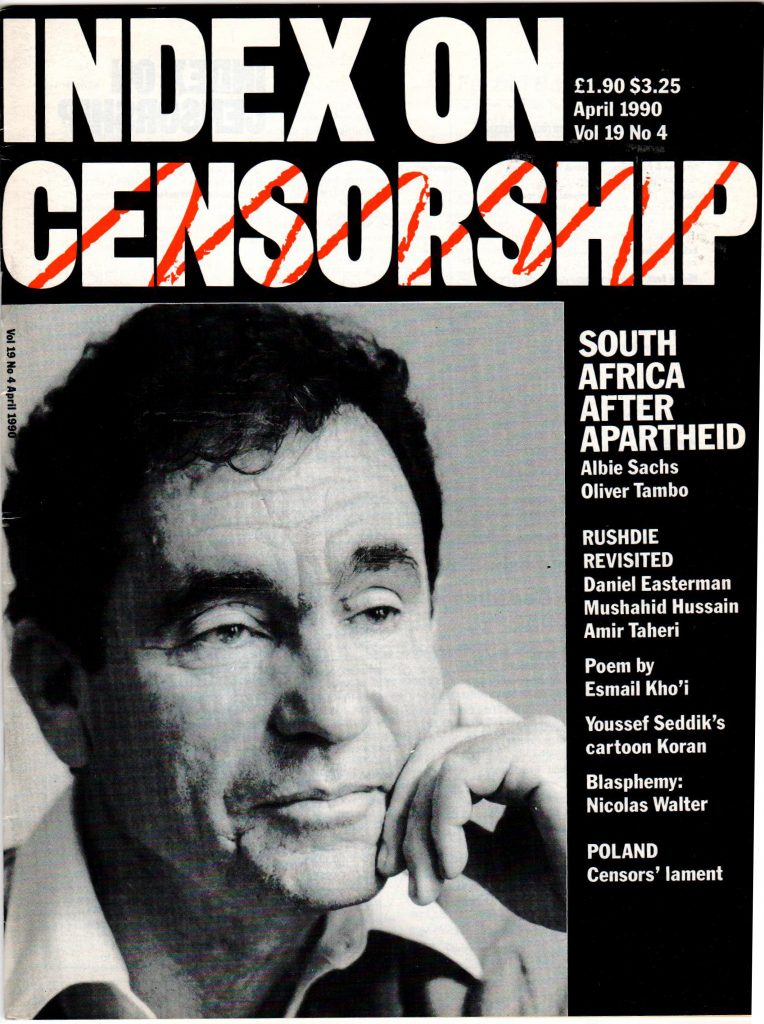
South Africa after Apartheid, the April 1990 issue of Index on Censorship magazine.
Reflections on an invalid fatwah
Amir Taheri
April 1990, vol. 19, issue 4
Broadly speaking, three predictions were made. The first was that Khomeini’s attempt at exporting terror might goad world public opinion into a keener understanding of Iran’s tragedy since the Islamic Revolution of 1979. The fact that the Ayatollah had executed thousands of people, including many writers and poets since his seizure of power in Tehran had provoked only mild rebuke from Western governments and public opinion. With the fatwa against Rushdie, we thought the whole world would mobilise against the ayatollah, turning his regime into an international pariah. Nothing of the kind happened, of course, and only one country, Britain, closed its embassy in Tehran – and that because the mullahs decided to sever.diplomatic ties. In the past twelve months Federal Germany and France have increased their trade with the Islamic Republic to the tune of II and 19 per cent respectively. The EEC countries and Japan have, in the meantime, provided the Islamic Republic with loans exceeding £2,000 million. The stream of European and Japanese businessmen and diplomats visiting Tehran turned into a mini-flood after Khomeini’s death last June.
Read the full article
South Africa after Apartheid, the April 1990 issue of Index on Censorship magazine.
Salman Rushdie and political expediency
Adel Darwish
April 1990, vol. 19, issue 4
When I reviewed Salman Rushdie’s Satanic Verses in September 1988, it never crossed my mind to make any reference to possible offence to Muslim readers, let alone to anticipate the unprecedented international crisis generated in the months that followed. I do not think I was naive – as an LBC radio reporter suggested when she interviewed me at the first public reading from The Satanic Verses in June 1989. On the contrary, I can claim more than many that I am able to understand what Mr Rushdie was trying to say in his book, and the way the crisis has developed. Like Mr Rushdie, I am a British writer, born to a Muslim family. Born in Egypt, I was educated and am employed in Britain, and have been preoccupied and engaged, mainly in the 1960s and 1970s, with the issues that Mr Rushdie has fought for and with which he seemed to be very much concerned in his book.
Read the full article
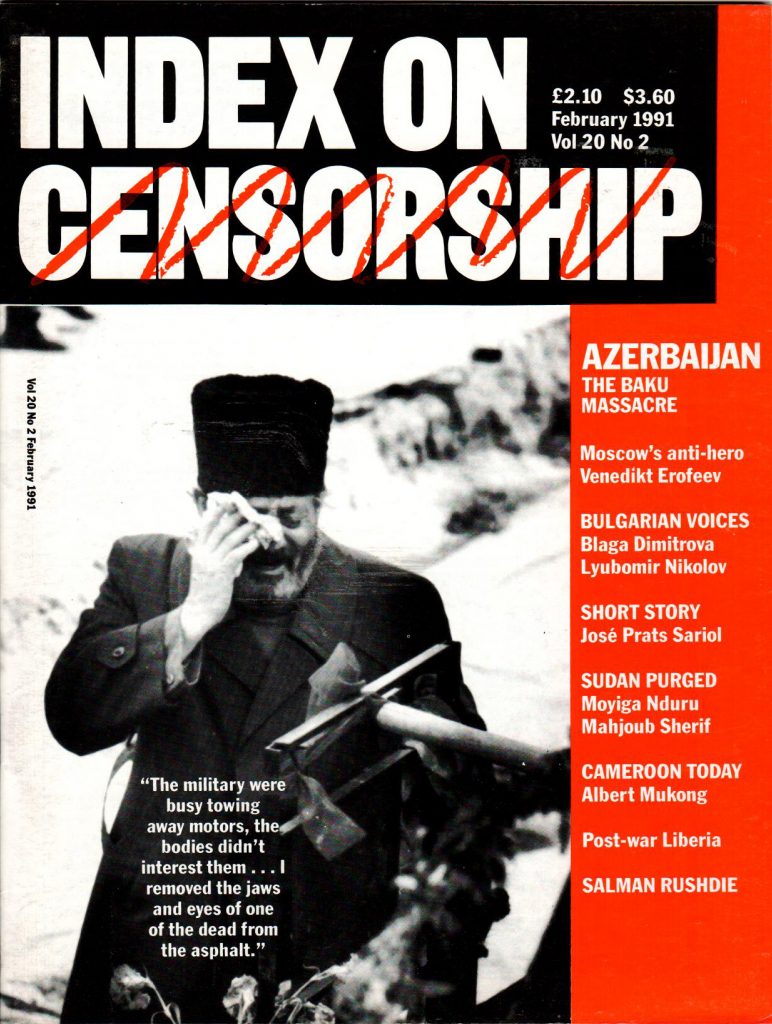
Azerbaijan, the February 1991 issue of Index on Censorship magazine.
My decision
Salman Rushdie
February 1991, vol. 20, issue 2
A man’s spiritual choices are a matter of conscience, arrived at after deep. reflection and in the privacy of his heart. They are not easy matters to speak of publicly. I should like, however, to say something about my decision to affirm the two central tenets of Islam — the oneness of God and the genuineness of the prophecy of the Prophet Muhammad —and thus to enter into the body of Islam after a lifetime spent outside it. Although I come from a Muslim family background, I was never brought up as a believer, and was raised in an atmosphere of what is broadly known as secular humanism. I still have the deepest respect for these principles. However, as I think anyone who studies my work will accept, I have been engaging more and more with religious belief, its importance and power, ever since my first novel used the Sufi poem Conference of the Birds by Farid ud-din Attar as a model. The Satanic Verses itself, with its portrait of the conflicts between the material and spiritual worlds, is a mirror of the conflict within myself.
Read the full article
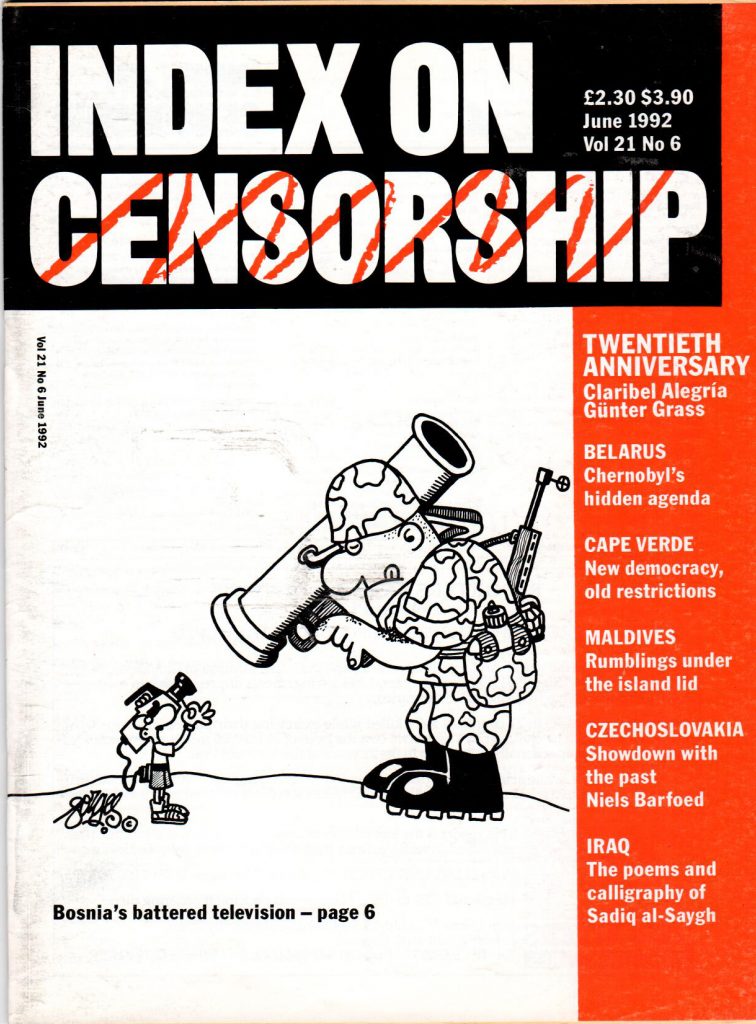
20th Anniversary: Reign of terror, the June 1992 issue of the Index on Censorship magazine.
Offending the high priests
Gunter Grass
June 1992, vol. 21, issue 6
When George Orwell returned from Spain in 1937, he brought with him the manuscript of Homage to Catalonia. It reflected the experiences he had gathered during the Civil War. At first, he was unable to find a publisher because a multitude of influential, left-wing intellectuals had no wish to acknowledge its shocking observations. They did not want to accept the Stalinist terror, the systematic liquidation of anarchists, Trotskyists and left-wing socialists. Orwell himself only narrowly escaped this terror. His stark accusations contradicted a world image of a flawless Soviet Union fighting against Fascism. Orwell’s report, this onslaught of terrible reality, tarnished the picture-book dream of Good and Evil. A year later, a bourgeois Western publisher brought out Homage to Catalonia; in the areas of Communist rule, Orwell’s works – among them the bitter Spanish truth – were banned for half a century. The minister responsible for state security= in the German Democratic Republic, right to its end, was Erich Mielke. During the Spanish Civil War, he was a member of the Communist cadre to whom purge through liquidation became commonplace. A fighter for Spain with an extraordinary capacity for survival.
Read the full article[/vc_column_text][/vc_column][/vc_row][vc_row][vc_column][vc_column_text]

Russia’s choice, the November-December 1993 issue of Index on Censorship magazine.
The Rushdie affair: Outrage in Oslo
Hakon Harket
November 1993, vol. 22, issue 10
The terrorist state of Iran must face the consequences of refusing to lift the fatwa that condemns Salman Rushdie, and those associated with his work, to death. When someone, in accordance with the express order of the fatwa, attempts to murder one of the damned, the obvious consequence is that Iran must be held responsible for the crime it has called for, at least until there is conclusive proof that no connection exists. The shooting of William Nygaard has reminded the Norwegian public of what the Rushdie affair is really about: life and death; the abuse of religion; the fiction of a free mind. This war of terror against freedom of speech is not one we can afford to lose. Since the nightmare clearly will not disappear of its own accord, it must be engaged head-on.
Read the full article

New censors, the March 1996 issue of Index on Censorship magazine.
From Salman Rushdie
March 1996, vol. 25, issue 2
This statement is not, of course, addressed to the Ayatollah Khomeini who, except for a handful of fanatics, is easily diagnosed as a sick and dangerous man who has long forgotten the fundamental tenets of Islam. It is useful to address oneself, at this point, only to the real Islamic faithful who, in their hearts, recognise the awful truth about their erratic Imam and the threat he poses not only to the continuing acceptance of Islam among people of all religions and faiths but to the universal brotherhood of man, no matter the differing colorations of their piety. Will Salman Rushdie die? He shall not. But if he does, let the fanatic defenders of Khomeini’s brand of Islam understand this: The work for which he is now threatened will become a household icon within even the remnant lifetime of the Ayatollah. Writers, cineastes, dramatists will disseminate its contents in every known medium and in some new ones as yet unthought of.
Read the full article
The Rushdie affair: Outrage in Oslo
Hakon Harket
November 1993, vol. 22, issue 10
The terrorist state of Iran must face the consequences of refusing to lift the fatwa that condemns Salman Rushdie, and those associated with his work, to death. When someone, in accordance with the express order of the fatwa, attempts to murder one of the damned, the obvious consequence is that Iran must be held responsible for the crime it has called for, at least until there is conclusive proof that no connection exists. The shooting of William Nygaard has reminded the Norwegian public of what the Rushdie affair is really about: life and death; the abuse of religion; the fiction of a free mind. This war of terror against freedom of speech is not one we can afford to lose. Since the nightmare clearly will not disappear of its own accord, it must be engaged head-on.
Read the full article
New censors, the March 1996 issue of Index on Censorship magazine.
From Salman Rushdie
March 1996, vol. 25, issue 2
This statement is not, of course, addressed to the Ayatollah Khomeini who, except for a handful of fanatics, is easily diagnosed as a sick and dangerous man who has long forgotten the fundamental tenets of Islam. It is useful to address oneself, at this point, only to the real Islamic faithful who, in their hearts, recognise the awful truth about their erratic Imam and the threat he poses not only to the continuing acceptance of Islam among people of all religions and faiths but to the universal brotherhood of man, no matter the differing colorations of their piety. Will Salman Rushdie die? He shall not. But if he does, let the fanatic defenders of Khomeini’s brand of Islam understand this: The work for which he is now threatened will become a household icon within even the remnant lifetime of the Ayatollah. Writers, cineastes, dramatists will disseminate its contents in every known medium and in some new ones as yet unthought of.
Read the full article

Tolerance and the intolerable, the May 1994 issue of Index on Censorship magazine
Bosnia on my mind
Salman Rushdie
May 1994, vol. 23, issue 1-2
When the Balkans War broke out, Rushdie had never been to Sarajevo, but felt that he belonged to it. He imagined a Sarajevo of the mind, whose ruination and torment exiled everyone.
He wrote: “Sarajevo’s truth is that its citizens, who reject definition by religion or confession, who wish to be simply Bosnians, have for their pains been labelled by the outside world as ‘Muslims’. It is instructive to imagine how things might have gone in former Yugoslavia if the Bosnians had been Christians and the Serbs had been Muslims, even Muslims ‘in name only’. Would Europe have supported a ‘Serbian Muslim’ carve-up of the defunct state? It’s only a guess, but I guess that it would not. Which being true, it must also be true that the ‘Muslim’ tag is part of the reason for Europe’s indifference to Sarajevo’s fate.”
Read the full article
 The right to publish
Peter Mayer
December 2008, vol. 37, issue 4
As publisher of The Satanic Verses, Peter Mayer was on the front line. He writes here for the first time about an unprecedented crisis:
Penguin published Salman Rushdie’s The Satanic Verses six months before Ayatollah Khomeini issues his fatwa. When we decided to continue publishing the novel in the aftermath, extraordinary pressures were focused on our company, based on fears for the author’s life and for the lives of everyone at Penguin around the world. This extended from Penguin’s management to editorial, warehouse, transport, administrative staff, the personnel in our bookshops and many others. The long-term political implications of that early signal regarding free speech in culturally diverse societies were not yet apparent to many when the Ayatollah, speaking not only for Iran but, seemingly, for all of Islam, issued his religious proclaimation.
Read the full article
Emblem of darkness
Bernard-Henri Lévy
December 2008, vol. 37, issue 4
As publisher of The Satanic Verses, Peter Mayer was on the front line. He writes here for the first time about an unprecedented crisis:
Salman Rushdie was not yet the great man of letters that he has since become. He and I are, though, pretty much the same age. We share a passion for India and Pakistan, as well as the uncommon privilege of having known and written about Zulfikar Ali Bhutto (Rushdie in Shame; I in Les Indes Rouges), the father of Benazir, former prime minister of Pakistan, executed ten years earlier in 1979 by General Zia. I had been watching from a distance, with infinite curiosity, the trajectory of this almost exact contemporary. One day, in February 1989, at the end of the afternoon, as I sat in a cafe in the South of France, in Saint Paul de Vence, with the French actor Yves Montand, sipping an orangeade, I heard the news: Ayatollah Khomeini, himself with only a few months to live, had just issued a fatwa, in which he condemned as an apostate the author of The Satanic Verses and invited all Muslims the world over to carry out the sentence, without delay.
Read the full article
40 years of Index on Censorship March 2012
Last chance?
Salman Rushdie
March 2012, vol. 41, issue 1
Salman Rushdie’s first memories of censorship are cinematic: screen kisses brutalised by prudish scissors which chopped out the moments of actual contact. (Briefly, before comprehension dawned, he wondered if that were all there was to kissing, the languorous approach and then the sudden turkey-jerk away.) The effect was usually somewhat comic, and censorship still retains, in contemporary Pakistan, a strong element of comedy. When the Pakistani censors found that the movie El Cid ended with a dead Charlton Heston leading the Christians to victory over live Moslems, they nearly banned it until they had the idea of simply cutting out the entire climax, so that the film as screened showed El Cid mortally wounded. El Cid dying nobly, and then it ended. Muslims 1, Christians 0.
Read the full article
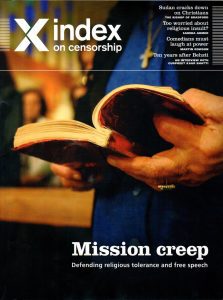
The winter 2013 issue of Index on Censorship magazine.
Defending the right to be offended
Samira Ahmed
December 2013, vol. 42, issue 4
The tensions between freedom of speech and religious belief remain acute – and they are systematically exploited by political groups of all stripes, from the English Defence League to radical Islamists who threaten to disrupt the repatriation of dead British soldiers at Wootton Bassett. The story consistently makes the headlines. The idea that there is an Islamist assault on British freedoms and values is widespread.
The Muslim campaign against Salman Rushdie’s The Satanic Verses in 1988 was the crucial moment in all this. It forced writers and artists from an Asian or Muslim background, whether they defined themselves that way or not, to take sides. They had to declare loyalty – or otherwise – to the offended.
Read the full article
5 Aug 2022 | Afghanistan, Belarus, Brazil, Indonesia, Kenya, News, Poland, Russia, South Africa, United Kingdom
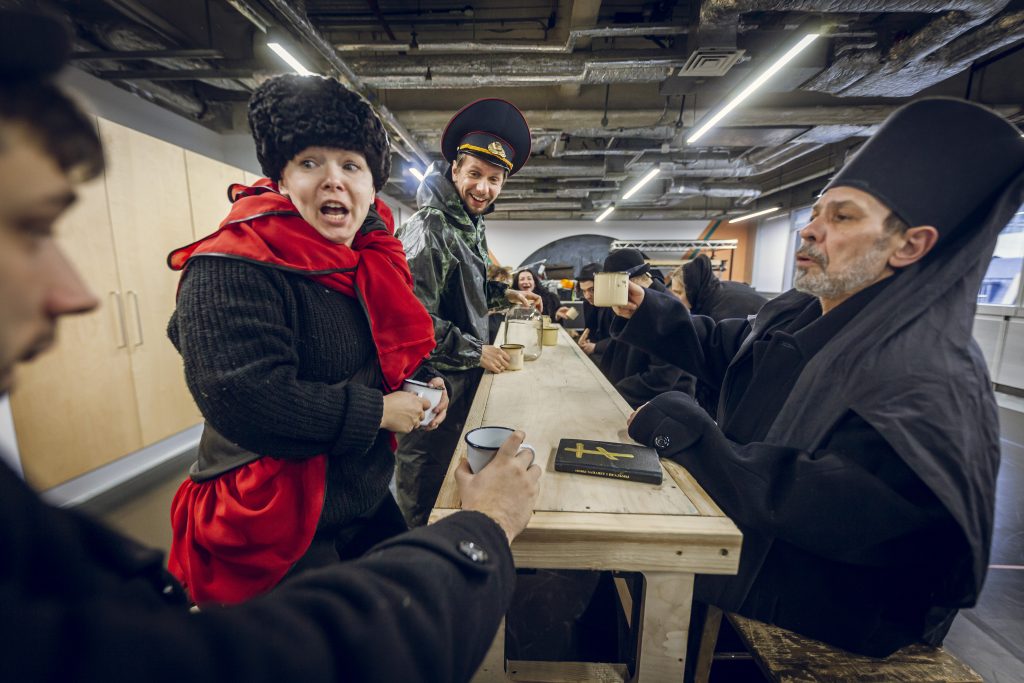
Belarus Free Theatre’s Dogs of Europe in rehearsal. Photo: Mikalai Kuprych
Index on Censorship has always supported the theatre of resistance, and our Winter 2021 magazine even had this issue as its main theme.
In Belarus, for example, organisations such as Belarus Free Theatre are crucial to fighting Lukashenka’s ruthless regime. Playwrights in Turkey have also faced government censorship throughout history and have to find their way around it.
In the UK, theatre censorship was officially abolished in 1968, putting an end to over 200 years of control by the Lord Chamberlain. Countries like Brazil are also making things harder for the arts and theatre sector through a kind of financial censorship linked to ideological values.
Now, we explore the universe of theatre and censorship, looking back at pieces published in our magazine.
Staging dissent: When a British prime minister was not amused by satire, theatre censorship followed. We revisit plays that riled him, 50 years after the abolition of the state censor
In this piece published in 2018, actor and director Simon Callow revisited the struggle to officially abolish censorship in theatre in the UK, which happened in 1968, after lasting for almost 200 years.
He explains why vigilance is still needed nowadays and writes about other forms of censorship, such as self-censorship.
Theatre Censorship
In August 1980, Anna Tamarchenko wrote a piece about the strict and recurrent censorship in Russian theatre.
She exemplifies her point of view citing Russian plays that only hit the stage years after being written, such as Boris Godunov, first staged in 1870, 45 years after it was published. Alexander Pushkin, its author, had already passed away 30 years earlier.
“Under the Soviet regime censorship has gained new opportunities to exert pressure on theatrical life,” Tamarchenko wrote.
Alternative theatre
In this piece published in 1985, theatre critic Agnieszka Wójcik (pseudonym) dives deeply into the censorship and repression against student theatre in Poland, especially following the introduction of Martial Law in December 1981, when student theatre began to be considered a threat to public order.
“The repressions following December 13 therefore somehow ‘objectively’ defined the status of student theatre as suspect, if not downright illegal. After the banning of NZS (the independent student union) which had taken most student groups under its wing during the Solidarity period, they lost the foundations of their material existence,” Wójcik wrote for Index.
Why the Taliban wanted my brave mother dead…
For the 2021 Winter issue of Index magazine, Associate Editor Mark Frary reported on the play The Boy with Two Hearts, written by Afghan author Hamed Amiri and inspired by his memories of his mother’s campaigns for women’s rights and why they had to leave Afghanistan behind.
“When Hamed Amiri was 10 years old he watched his mother Fariba give a speech in his hometown of Herat, Afghanistan, speaking out for women’s rights and education and against the ruling Taliban. A day later, a mullah gave the order for Fariba’s execution and the family began a gruelling 18-month journey through Europe,” Frary writes.
Testament to the power of theatre as rebellion
In December 2021, critic, columnist and cultural historian Kate Maltby wrote about Belarus Free Theatre’s journey towards performing at the Barbican in London in 2022.
She talked to Nikolai Khalezin, playwright and journalist, and Natalia Koliada, theatre producer. Both founded Belarus Free Theatre in March 2005 and told Index about the rollercoaster they’ve been through after going into exile in order to escape from Lukashenka’s dictatorship.
“Since 2011, Khalezin and Koliada have held political asylum in the UK, a necessity for survival in the face of repeated harassment and imprisonment at the hands of Lukashenka’s regime”, writes Maltby.
Where silence is the greatest fear
Published in December 2021, this piece written by Issa Sikiti da Silva, Index contributing editor based in West Africa, looks at the censorship suffered by Kenyan theatre and how it has dragged under a series of corrupt leaders.
He also investigates the legacy left by colonial Britain in Kenya and how it still impacts theatre in the country.
“There was hope that Jomo Kenyatta’s ascension to the presidency in 1964 would help heal the wounds inflicted by the British and pave the way to tolerance, social justice, freedom and prosperity,” Da Silva writes.
God waits in the wings…ominously
Brazil is also home to its share of theatre censorship and free speech issues. In December 2021, Index’s editorial assistant Guilherme Osinski and former associate editor Mark Seacombe reported on a presidential decree that art must be sacred. They explored how it has affected Brazilian theatres across the country.
Osinski and Seacombe interviewed two Brazilian theatre companies, which shared their thoughts on president Jair Bolsonaro’s approach to art in Brazil, comparing the current situation to when the country faced a bloody dictatorship from 1964 to 1985.
“While the overt and ruthless censorship of the military dictatorship that ended in 1985 is now history, theatre today has to comply with a nebulous concept known as “sacred art” or be starved of public funds”, writes Osinski.
Desegregating the theatre
In August 1985, Professor Stephen Gray wrote for Index and explained how theatre in South Africa was shaped and controlled by the law, before this censorship was eventually relaxed and became less strict.
“Theatre itself is debate, and in South Africa, where sensitive issues ignite like flash-paper, to each show its own controversy,” Gray writes.
Play politics: policing theatre in Indonesia
At the beginning of the 1990s, Indonesia’s government had promised more openness and freedom for theatre companies in the country. However, president Suharto closed the doors on Jakarta’s popular theatre and other plays began to be banned across Indonesia.
Andrea Webster reported on that issue for Index in July 1991, emphasising the ironies between Suharto’s speech for democracy and the bans and curbs on theatres.
“The ban occurred just over a month after President Suharto himself made an Independence Day speech on 17 August where he spoke of ‘openness’ and democracy, where ‘differences of opinion had their place in Indonesian society,’” Webster wrote on the occasion.
Sending out a message in a bottle: Actor Neil Pearson, who shot to international fame as the sexist boss in the Bridget Jones films, talks about book banning and how the fight against theatre censorship still goes on
In June 2019, then editor in chief of Index on Censorship, Rachael Jolley, interviewed actor Neil Pearson about why governments fear books being published and how the fight against theatre censorship still goes on.
Among many things, they discussed self-censorship and the boundaries between a play which is acceptably controversial and unacceptably controversial.
“If you are genuinely against censorship, you have to be evenhanded against censorship. If your idea of freedom of speech is only allowing people to say what you already agree with, then Goebbels would have no problem with that definition of speech,” Pearson told Index.
‘Humpty Dumpty has maybe had the last word…’
One of the biggest names in British theatre recently wrote for Index on Censorship. Sir Tom Stoppard, playwright and screenwriter and whose work covers themes such as human rights, censorship and political freedom, wrote in December 2021 on how the battleship over freedom still lies between the individual and the state.
17 Mar 2022 | 50 years of Index, Afghanistan, Africa, Americas, Asia and Pacific, Bosnia, Brazil, China, Greece, Hong Kong, India, Iran, Magazine, Magazine Contents, Mexico, Nigeria, Northern Ireland, Philippines, Russia, Rwanda, South Africa, Turkey, Uganda, Ukraine, United Kingdom, United States, Volume 51.01 Spring 2022 Extras
The spring issue of Index magazine is special. We are celebrating 50 years of history and to such a milestone we’ve decided to look back at the thorny path that brought us here.
Editors from our five decades of life have accepted our invitation to think over their time at Index, while we’ve chosen pieces from important moments that truly tell our diverse and abundant trajectory.
Susan McKay has revisited an article about the contentious role of the BBC in Northern Ireland published in our first issue, and compares it to today’s reality.
Martin Bright does a brilliant job and reveals fascinating details on Index origin story, which you shouldn’t miss.
Index at 50, by Jemimah Steinfeld: How Index has lived up to Stephen Spender’s founding manifesto over five decades of the magazine.
The Index: Free expression around the world today: the inspiring voices, the people who have been imprisoned and the trends, legislation and technology which are causing concern.
“Special report: Index on Censorship at 50”][vc_column_text]Dissidents, spies and the lies that came in from the cold, by Martin Bright: The story of Index’s origins is caught up in the Cold War – and as exciting
Sound and fury at BBC ‘bias’, by Susan McKay: The way Northern Ireland is reported continues to divide, 50 years on.
How do you find 50 years of censorship, by Htein Lin: The distinguished artist from Myanmar paints a canvas exclusively for our anniversary.
Humpty Dumpty has maybe had the last word, by Sir Tom Stoppard: Identity politics has thrown up a new phenonemon, an intolerance between individuals.
The article that tore Turkey apart, by Kaya Genç: Elif Shafak and Ece Temulkuran reflect on an Index article that the nation.
Of course it’s not appropriate – it’s satire, by Natasha Joseph: The Dame Edna of South Africa on beating apartheid’s censors.
The staged suicided that haunts Brazil, by Guilherme Osinski: Vladimir Herzog was murdered in 1975. Years on his family await answers – and an apology.
Greece haunted by spectre of the past, by Tony Rigopoulos: Decades after the colonels, Greece’s media is under attack.
Ugandans still wait for life to turn sweet, by Issa Sikiti da Silva: Hopes were high after Idi Amin. Then came Museveni …People in Kampala talk about their
problems with the regime.
How much distance from Mao? By Rana Mitter: The Cultural Revolution ended; censorship did not.
Climate science is still being silenced, by Margaret Atwood: The acclaimed writer on the fiercest free speech battle of the day.
God’s gift to who? By Charlie Smith: A 2006 prediction that the internet would change China for the better has come to pass.
50 tech milestones of the past 50 years, by Mark Frary: Expert voices and a long-view of the innovations that changed the free speech landscape.
Censoring the net is not the answer, but… By Vint Cerf: One of the godfathers of the internet reflects on what went right and what went wrong.[/vc_column_text][vc_custom_heading text=”Five decades in review”][vc_column_text]An arresting start, by Michael Scammell: The first editor of Index recounts being detained in Moscow.
The clockwork show: Under the Greek colonels, being out of jail didn’t mean being free.
Two letters, by Kurt Vonnegut: His books were banned and burned.
Winning friends, making enemies, influencing people, by Philip Spender: Index found its stride in the 1980s. Governments took note.
The nurse and the poet, by Karel Kyncl: An English nurse and the first Czech ‘non-person’.
Tuning in to revolution, by Jane McIntosh: In revolutionary Latin America, radio set the rules.
‘Animal can’t dash me human rights’, by Fela Kuti: Why the king of Afrobeat scared Nigeria’s regime.
Why should music be censorable, by Yehudi Menuhin: The violinist laid down his own rules – about muzak.
The snake sheds its skin, by Judith Vidal-Hall: A post-USSR world order didn’t bring desired freedoms.
Close-up of death, by Slavenka Drakulic: We said ‘never again’ but didn’t live up to it in Bosnia. Instead we just filmed it.
Bosnia on my mind, by Salman Rushdie: Did the world look away because it was Muslims?
Laughing in Rwanda, by François Vinsot: After the genocide, laughter was the tonic.
The fatwa made publishers lose their nerve, by Jo Glanville: Long after the Rushdie aff air, Index’s editor felt the pinch.
Standing alone, by Anna Politkovskaya: Chechnya by the fearless journalist later murdered.
Fortress America, by Rubén Martínez: A report from the Mexican border in a post 9/11 USA.
Stripsearch, by Martin Rowson: The thing about the Human Rights Act …
Conspiracy of silence, by Al Weiwei: Saying the devastation of the Sichuan earthquake was partly manmade was not welcome.
To better days, by Rachael Jolley: The hope that kept the light burning during her editorship.
Plays, protests and the censor’s pencil, by Simon Callow: How Shakespeare fell foul of dictators and monarchs. Plus: Katherine E McClusky.
The enemies of those people, by Nina Khrushcheva: Khrushchev’s greatgranddaughter on growing up in the Soviet Union and her fears for the US press.
We’re not scared of these things, by Miriam Grace A Go: Trouble for Philippine
journalists.
Windows on the world, by Nazanin Zaghari-Ratcliffe and Golrokh Ebrahimi Iraee: Poems from Iran by two political prisoners.
Beijing’s fearless foe with God on his side, by Jimmy Lai: Letters from prison by the Hong Kong publisher and activist.
We should not be put up for sale, by Aishwarya Jagani: Two Muslim women in India on being ‘auctioned’ online.
Cartoon, by Ben Jennings: Liberty for who?
Amin’s awful story is much more than popcorn for the eyes, by Jemimah Steinfeld: Interview with the director of Flee, a film about an Afghan refugee’s flight and exile.
Women defy gunmen in fight for justice, by Témoris Grecko: Relatives of murdered Mexican journalist in brave campaign.
Chaos censorship, by John Sweeney: Putin’s war on truth, from the Ukraine frontline.
In defence of the unreasonable, by Ziyad Marar: The reasons behind the need
to be unreasonable.
We walk a very thin line when we report ‘us and them’, by Emily Couch: Reverting to stereotypes when reporting on non-Western countries merely aids dictators.
It’s time to put down the detached watchdog, by Fréderike Geerdink: Western newsrooms are failing to hold power to account.
A light in the dark, by Trevor Philips: Index’s Chair reflects on some of the magazine’s achievements.
Our work here is far from done, by Ruth Smeeth: Our CEO says Index will carry on fighting for the next 50 years.
In vodka veritas, by Nick Harkaway and Jemimah Steinfeld: The author talks about Anya’s Bible, his new story inspired by early Index and Moscow bars.
A ghost-written tale of love, by Ariel Dorfman and Jemimah Steinfeld: The novelist tells the editor of Index about his new short story, Mumtaz, which we publish.
‘Threats will not silence me’, by Bilal Ahmad Pandow and Madhosh Balhami: A Kashmiri poet talks about his 30 years of resistance.
A classic case of cancel culture, by Marc Nash: Remember Socrates’ downfall.
