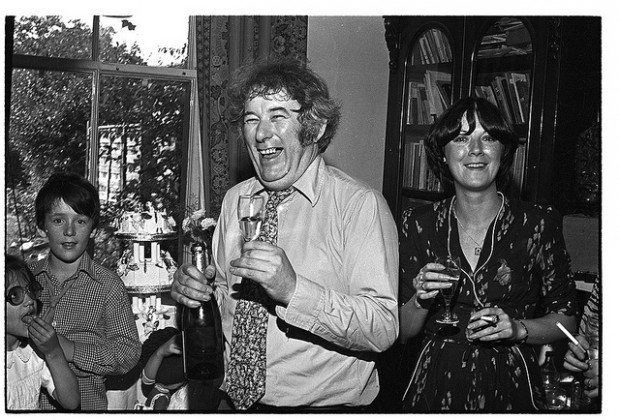
Seamus Heaney with his family and at a party at home in Dublin, 1979. Photographer: Bobbie Hanvey
It’s the 17th annual World Poetry Day, which was first declared by Unesco in 1999 to help meet the world’s aesthetic needs by promoting the reading, writing and teaching of poetry. This year, Unesco director-general Irina Bokova said: “By paying tribute to the men and women whose only instrument is free speech, who imagine and act, Unesco recognises in poetry its value as a symbol of the human spirit’s creativity. […] The voices that carry poetry help to promote linguistic diversity and freedom of expression.”
One poet of this calibre was Seamus Heaney.
The Irish poet, playwright and lecturer was as prolific a translator of poetry as he was a writer. In September 1998, his translation of Gile na Gile, a poem written by Irish language poet Aodhagán Ó Rathaille (1670–1726) was published exclusively in Index on Censorship under the title The Glamoured.
“It is a classic example of a genre known as the aisling (pronounced ashling) which was as characteristic of Irish language poetry in the late seventeenth and eighteenth centuries as rhymed satire was in England at the same time,” Heaney wrote in Index. “The aisling was in effect a mixture of samizdat and allegory, a form which mixed political message with passionate vision.”
This month, Heaney, who died in August 2013, offers us a gift from the afterlife: the publication of his translation of Aeneid’s Book VI, the Roman poet Virgil’s epic on mythic Trojan Aeneas’s journey to Hades. In the poem, Sibyl of Cumae, a guide to the underworld, “chanted menacing riddles” in an attempt to confuse our hero:
Then as her fit passed away and her raving went quiet,
Heroic Aeneas began: ‘No ordeal, O Sibyl, no new
Test can dismay me, for I have foreseen
And foresuffered all. But one thing I pray for
Especially: since here the gate opens, they say,
To the King of the Underworld’s realms, and here
In these shadowy marshes the Acheron floods
To the surface, vouchsafe me one look,
One face-to-face meeting with my dear father.
In the introduction to Aeneid’s Book VI, published posthumously, Heaney describes the poem – which he began working on in 1986 after the death of his father – as “like classics homework, the result of a lifelong desire to honour the memory of my Latin teacher at St Columb’s College, Father Michael McGlinchey”.
St Columb’s is a Roman Catholic grammar school for boys in Derry. Heaney formed part of the school’s “golden generation” in the 1940s and 1950s, which included the dramatist Brian Friel and politician John Hume.
When I attended St Columb’s between 1999 and 2006, pupils were reminded of the school’s alumni illustrissimi — especially Nobel laureates Heaney and Hume — at many a class, assembly and function. One of the highlights of my time as a pupil was attending an after-school discussion with Heaney and the classicist Peter Jones. They spoke of the positive effect reading poetry has on thought processes and the irrelevancy of the poet’s intention when a reader encounters the poem. It is, he said, our own unique experience with a work that truly matters.
Afterward, Heaney signed my copy of Redress of Poetry, a collection 10 lectures he gave between 1989 and 1994 while a professor of poetry at Oxford.
“Poetry cannot afford to lose its fundamentally self-delighting inventiveness, its joy at being a process of language as well as a representation of things in the world,” Heaney writes in the opening chapter. “[P]oetry is understandably pressed to give voice to much that has hitherto been denied expression in the ethnic, social, sexual and political life.”
Redress of Poetry’s predecessor, the collection of literary criticism essays from 1978-1987 titled Government of the Tongue, discusses in much more depth those who have been denied such expression in their political and social lives. The book is perhaps best known for its celebration of poets of the Eastern Bloc, the former communist states of central and eastern Europe. The discovery of poets such as Czesław Miłosz, Osip Mandelstam, Joseph Brodsky and Zbigniew Herbert had an impact on Heaney’s own work. As a Northern Irish Catholic, Heaney could easily identify with the religion, culture and history of Polish poets Miłosz, whose work was banned by Poland’s communist government, and Herbert, who organised protests against censorship in the Eastern Bloc.
One poem Heaney references is Miłosz’s Child of Europe, which reads:
We, from the fiery furnaces, from behind barbed wires
On which the winds of endless autumns howled,
We, who remember battles where the wounded air roared in
paroxysms of pain.
We, saved by our own cunning and knowledge.
It brings to mind the experiences of many in Northern Ireland. Throughout the Troubles, Heaney was known for expressing both clarity and humanity amid chaos. He tells a story in Government of the Tongue, however, of his personal difficulties in creating art amid violence. He was on his way to a recording session at the BBC studios in Belfast sometime in 1972 with folksinger David Hammond when the pair heard bombs go off.
“[T]he very notion of beginning to sing at the moment when others were beginning to suffer seemed like an offence against their suffering,” he wrote.
This tension in the poet’s mind seemingly had no bearing on his ability to capture the mood of an entire nation through his work. In The Cure at Troy, Heaney’s telling of Sophocles’ Philoctetes, the story of how Odysseus tricked Achilles’ son into joining the Greek forces at Troy, expressed the hope felt by many in his country in 1991, a year of ceasefires and all-party talks.
The poem contains the often-quoted and poignant words:
History says, don’t hope
On this side of the grave.
But then, once in a lifetime
The longed-for tidal wave
Of justice can rise up,
And hope and history rhyme
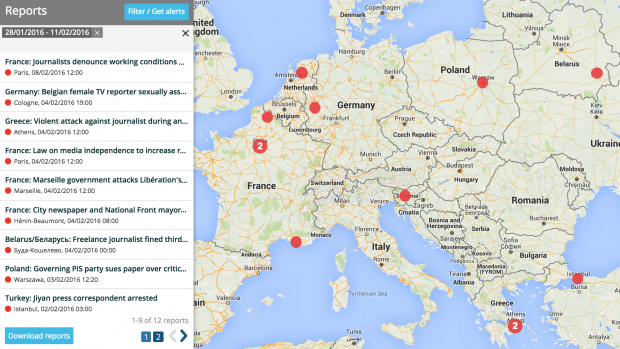
Freedom of the press has always been a pretty reliable litmus test for the state of any democracy. However, as Index on Censorship’s Mapping Media Freedom project shows, countries that are seen as traditionally open, with constitutions protecting freedom of expression, are currently rife with violations against the media.
“It is extremely troubling that media workers have been physically and sexually assaulted, arrested and denied access to key reporting areas in countries with strong democratic institutions,” Hannah Machlin, Index’s Mapping Media Freedom project officer, said. “We hope governments take action to prevent these types of violations from occurring at such a frightening rate.”
So far this year, Mapping Media Freedom has verified 61 media violations. Here are just five examples from the last fortnight that highlight some of the failures of these democracies to live up to their own standards.
1. Germany: Belgian TV reporter assaulted live on air
Just weeks after hundreds of women were sexually assaulted on the streets of Cologne, a journalist, Esmeralda Labye, was sexually assaulted while reporting from the Cologne carnival for Belgian TV station RTBF on 4 February. One man grabbed her breast and another kissed her neck while she was live on air.
“Two or three men gathered behind me and attempted to make themselves the centre of my attention,” Labye told The Guardian. “I was focusing on the broadcast, and then I felt a kiss on my neck.”
Writing for RTBF online, Labye condemned the “wretched and cowardly men” who assaulted her and complained of the increasing difficulty for female journalists to do their job without being harassed.
2. France: Proposed law will increase role of government’s media watchdog
On 4 February, plans to increase the role of the CSA — the French broadcast watchdog whose members are chosen by the government — as a guarantor of the independence of the media were discussed in the French National Assembly.
The French journalists’ union SNJ criticized the planned bill, written by a Parti Socialiste MP, stressing that the CSA is not independent from political influence. They wrote: “The CSA has no responsibility and legitimacy on matters related to the control of information or journalists. It should have none!”
3. Greece: Violent attack against journalist during anti-austerity demonstration
Protests against the Greek government’s plan to change its pension policy as part of the country’s third international bailout brought an estimated 40,000 people onto the streets of Athens and other cities, including journalists. On 4 February, Dimitris Perros, a journalist from the local radio station Athens 9,84, was violently attacked by unknown assailants while covering the demonstration. He was transported to the hospital with major injuries.
Newspapers reported that the attack was denounced in statements from across the political spectrum including Syriza,PASOK and the Greek Communist Party and the Journalist’s Union of the Athens Daily Newspapers. “The strangers who approached him asked him first if he is a journalist and when he answered affirmatively they started beating him with planks, while the police looked on,” the union stressed in an announcement.
4. The Netherlands: Journalists denied access to meeting on housing asylum seekers under “extremist” ban
On 28 January, several journalists were denied access to a citizens’ meeting about the possible creation of a new asylum seeker centre in the village of Luttelgeest, according to newspaper reports. An emergency regulation was issued to refuse journalists access to the meeting. The mayor also banned journalists from travelling within a radius of five kilometres of the village.
The Dutch Association of Journalists, the NVJ, condemned the measure saying that it was not the first time journalists have been banned. “It has happened many times now,” NVJ secretary Thomas Bruning said. “If journalists are denied access, they are obstructed from doing their job. This is alarming and should not happen in a democracy.”
5. Poland: Government uses defamation law to stop media critics
Even Europe’s youngest democracies are fighting off attacks on media freedom.
As Index on Censorship has previously reported, there is a growing trend in Poland of the government using defamation actions to stop criticism in the media. The most recent example, on 3 February, saw Poland’s ruling Law and Justice party, PiS, file a libel suit against the largest daily newspaper in the country, Gazeta Wyborcza about an opinion piece it disliked.
The article argued that PiS and Poland’s president Andrej Duda have behaved like a “mafia state” for pardoning former anti-corruption official Mariusz Kaminski, for abuse of power. Duda issued the pardon before Kaminski had exhausted the appeals process, a point that the author of the piece, Wojciech Czuchnowski, criticised in his opinion piece.
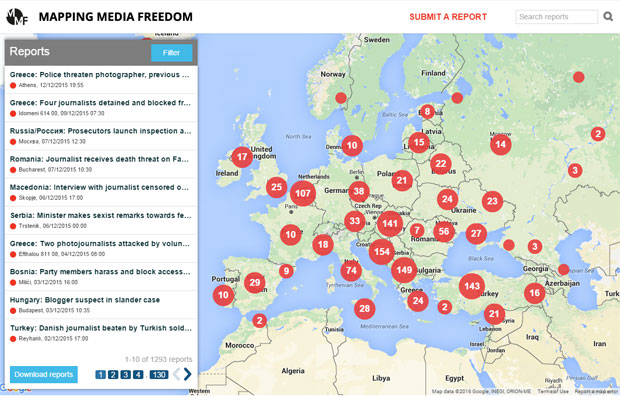
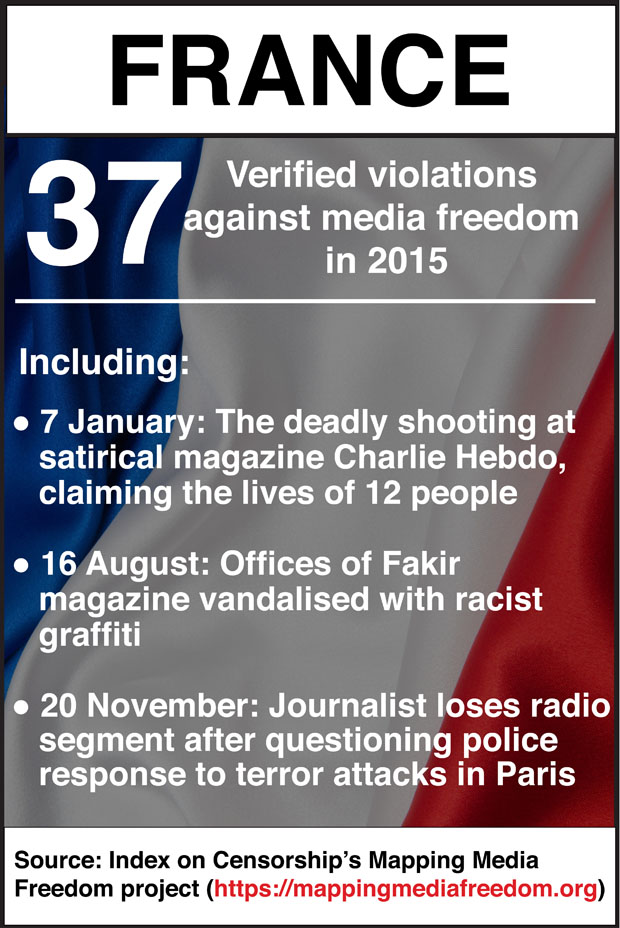
The attacks on the offices of satirical magazine Charlie Hebdo in Paris in January set the tone for conditions for media professionals in 2015. Throughout the year, Index on Censorship’s Mapping Media Freedom correspondents verified a total of 745 violations of media freedom across Europe.
From the murders of journalists in Russia, Poland and Turkey to the growing threat posed by far-right extremists in Germany and government interference in Hungary — right down to the increasingly harsh legal measures imposed on reporters right across the continent — Mapping Media Freedom exposed many difficulties media workers face in simply doing their jobs.
“Last year was a tumultuous one for press freedom; from the attacks at Charlie Hebdo to the refugee crisis-related aggressions, Index observed many threats to the media across Europe,” said Hannah Machlin, Index on Censorship’s project officer for the Mapping Media Freedom project. “To highlight the important cases and trends of the year, we’ve asked our correspondents, who have been carefully monitoring the region, to discuss one violation each that stood out to them.”
Belarus / 19 verified reports between May-Dec 2015 Journalist blocked from shooting entrance to polling station
“It demonstrates the Belarusian authorities’ attitude to media as well as ‘transparency’ of the presidential election – the most important event in the current year.” — Ольга К.-Сехович
Greece / 15 verified reports in 2015 Four journalists detained and blocked from covering refugee operation
“This is important because it is typical ‘attempt to limit press freedom’, as the Union wrote in a statement and it is not very hopeful for the future. The way refugees and migrants are treated is very sensitive and media should not be prevented from covering this issue.” — Christina Vasilaki
Hungary / 57 verified reports in 2015 Serbian camera crew beaten by border police
“These physical attacks, the harsh treatment and detention of journalists are striking because the Hungarian government usually uses ‘soft censorship’ to control media and journalists, they rarely use brute force.” — Zoltan Sipos
Italy / 72 verified reports in 2015 Italian journalists face up to eight years in prison for corruption investigation
“I chose it because this case is really serious: the journalists Emiliano Fittipaldi and Gianluigi Nuzzi are facing up to eight years in prison for publishing books on corruption in the Vatican. This case could have a chilling effect on press freedom. It is really important that journalists investigate and they must be free to do that.” — Rossella Ricchiuti
Lithuania / 9 verified reports in 2015 Journalist repeatedly harassed and pushed out of local area
“I chose it because I found it relevant to my personal experience and the fellow journalist has been the only one to have responded to my hundreds of e-mails — including requests to fellow Lithuanian journalists to share their personal experience on media freedom.” — Linas Jegelevicius
Macedonia / 27 verified reports in 2015 Journalist publicly assaults another journalist
“I have chosen this incident because it best describes the recent trend not only in Macedonia and my other three designated countries, Croatia, Bosnia and Montenegro, but also in the whole region. And that is polarization among journalists, more and more verbal and, like in this unique case, physical assaults among colleagues. It best describes the ongoing trend where journalists are not united in safeguarding public interest but are nothing more than a tool in the hands of political and financial elites. It describes the division between pro-opposition and pro-government journalists. It is a clear example of absolute deviation from the journalistic ethic.” — Ilcho Cvetanoski
Poland / 11 verified reports in 2015 Law on public service broadcasting removes independence guarantees
“The new media law, which was passed through Poland`s two-chamber parliament in the last week of December, constitutes a severe threat to pluralism of opinions in Poland, as it is aimed at streamlining public media along the lines of the PiS party that holds the overall majority. The law is currently only awaiting president Duda’s signature, who is a close PiS ally.” — Martha Otwinowski
Portugal / 9 verified reports in 2015 Two-thirds of newspaper employees will be laid off
“It’s a clear picture of the media in Portugal, which depends on investors who show no interest in a healthy, well-informed democracy, but rather in how owning a newspaper can help them achieve their goals — and when these are not met they don’t hesitate to jump boat, leaving hundreds unemployed.” — João de Almeida Dias
Russia / 37 verified reports between May-Dec 2015 Media freedom NGO recognised as foreign agent, faces closure
“The most important trend of the 2015 in Russia is the continuing pressure over the civil society. More than 100 Russian civil rights advocacy NGOs were recognized as organisations acting as foreign agents which leads to double control and reporting, to intimidation and insulting of activists, e.g., by the state-owned media. Many of them faced large fines and were forced to closure.” — Andrey Kalikh
Russia / 37 verified reports between May-Dec 2015 TV2 loses counter claim to renew broadcasting license Roskomnadzor
“It illustrates the crackdown on independent local media, which can not fight against the state officials even if they have support from the audience and professional community.” — Ekaterina Buchneva
Serbia / 41 verified reports in 2015 Investigative journalist severely beaten with metal bars
“It’s a disgrace and a flash-back to Serbia’s dark past that a journalist, who’s well known for investigating high-level corruption, get’s beaten up with metal bars late at night by ‘unknown men’.” — Mitra Nazar
Turkey / 97 verified reports in 2015 Police storm offices of Koza İpek, interrupting broadcast
“The raid on Bugün and Kanaltürk’s offices just days ahead of parliamentary elections was a drastic example — broadcasts were cut by police and around 100 journalists ended up losing their jobs over the next month — of how the current Turkish government tries to strong-arm media organisations.” — Catherine Stupp
Mapping Media Freedom
Click on the bubbles to view reports or double-click to zoom in on specific regions. The full site can be accessed at https://mappingmediafreedom.org/
When I started working at Index on Censorship, some friends (including some journalists) asked why an organisation defending free expression was needed in the 21st century. “We’ve won the battle,” was a phrase I heard often. “We have free speech.”
There was another group who recognised that there are many places in the world where speech is curbed (North Korea was mentioned a lot), but most refused to accept that any threat existed in modern, liberal democracies.
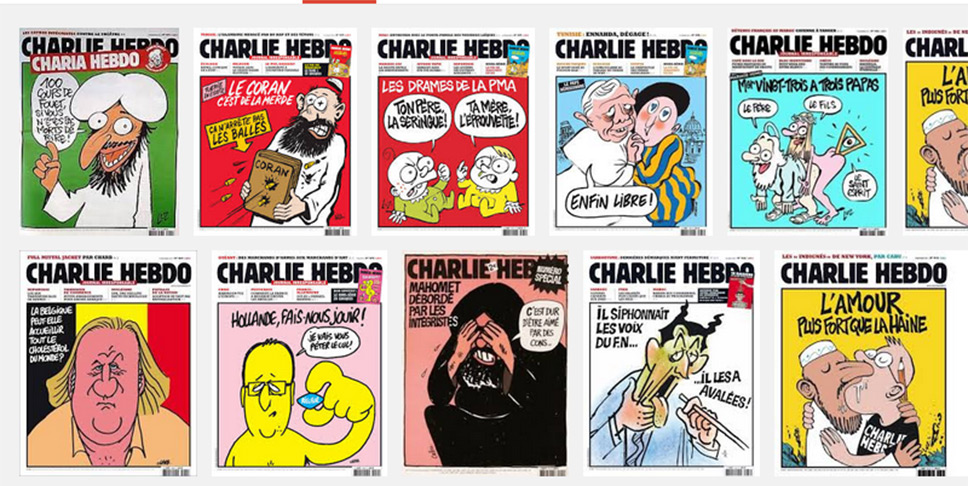
After the killing of 12 people at the offices of French satirical magazine Charlie Hebdo, that argument died away. The threats that Index sees every day – in Bangladesh, in Iran, in Mexico, the threats to poets, playwrights, singers, journalists and artists – had come to Paris. And so, by extension, to all of us.
Those to whom I had struggled to explain the creeping forms of censorship that are increasingly restraining our freedom to express ourselves – a freedom which for me forms the bedrock of all other liberties and which is essential for a tolerant, progressive society – found their voice. Suddenly, everyone was “Charlie”, declaring their support for a value whose worth they had, in the preceding months, seemingly barely understood, and certainly saw no reason to defend.
The heartfelt response to the brutal murders at Charlie Hebdo was strong and felt like it came from a united voice. If one good thing could come out of such killings, I thought, it would be that people would start to take more seriously what it means to believe that everyone should have the right to speak freely. Perhaps more attention would fall on those whose speech is being curbed on a daily basis elsewhere in the world: the murders of atheist bloggers in Bangladesh, the detention of journalists in Azerbaijan, the crackdown on media in Turkey. Perhaps this new-found interest in free expression – and its value – would also help to reignite debate in the UK, France and other democracies about the growing curbs on free speech: the banning of speakers on university campuses, the laws being drafted that are meant to stop terrorism but which can catch anyone with whom the government disagrees, the individuals jailed for making jokes.
And, in a way, this did happen. At least, free expression was “in vogue” for much of 2015. University debating societies wanted to discuss its limits, plays were written about censorship and the arts, funds raised to keep Charlie Hebdo going in defiance against those who would use the “assassin’s veto” to stop them. It was also a tense year. Events discussing hate speech or cartooning for which six months previously we might have struggled to get an audience were now being held to full houses. But they were also marked by the presence of police, security guards and patrol cars. I attended one seminar at which a participant was accompanied at all times by two bodyguards. Newspapers and magazines across London conducted security reviews.
But after the dust settled, after the initial rush of apparent solidarity, it became clear that very few people were actually for free speech in the way we understand it at Index. The “buts” crept quickly in – no one would condone violence to deal with troublesome speech, but many were ready to defend a raft of curbs on speech deemed to be offensive, or found they could only defend certain kinds of speech. The PEN American Center, which defends the freedom to write and read, discovered this in May when it awarded Charlie Hebdo a courage award and a number of novelists withdrew from the gala ceremony. Many said they felt uncomfortable giving an award to a publication that drew crude caricatures and mocked religion.
Index’s project Mapping Media Freedom recorded 745 violations against media freedom across Europe in 2015.
The problem with the reaction of the PEN novelists is that it sends the same message as that used by the violent fundamentalists: that only some kinds of speech are worth defending. But if free speech is to mean anything at all, then we must extend the same privileges to speech we dislike as to that of which we approve. We cannot qualify this freedom with caveats about the quality of the art, or the acceptability of the views. Because once you start down that route, all speech is fair game for censorship – including your own.
As Neil Gaiman, the writer who stepped in to host one of the tables at the ceremony after others pulled out, once said: “…if you don’t stand up for the stuff you don’t like, when they come for the stuff you do like, you’ve already lost.”
Index believes that speech and expression should be curbed only when it incites violence. Defending this position is not easy. It means you find yourself having to defend the speech rights of religious bigots, racists, misogynists and a whole panoply of people with unpalatable views. But if we don’t do that, why should the rights of those who speak out against such people be defended?
In 2016, if we are to defend free expression we need to do a few things. Firstly, we need to stop banning stuff. Sometimes when I look around at the barrage of calls for various people to be silenced (Donald Trump, Germaine Greer, Maryam Namazie) I feel like I’m in that scene from the film Lock, Stock and Two Smoking Barrels where a bunch of gangsters keep firing at each other by accident and one finally shouts: “Could everyone stop getting shot?” Instead of demanding that people be prevented from speaking on campus, debate them, argue back, expose the holes in their rhetoric and the flaws in their logic.
Secondly, we need to give people the tools for that fight. If you believe as I do that the free flow of ideas and opinions – as opposed to banning things – is ultimately what builds a more tolerant society, then everyone needs to be able to express themselves. One of the arguments used often in the wake of Charlie Hebdo to potentially excuse, or at least explain, what the gunmen did is that the Muslim community in France lacks a voice in mainstream media. Into this vacuum, poisonous and misrepresentative ideas that perpetuate stereotypes and exacerbate hatreds can flourish. The person with the microphone, the pen or the printing press has power over those without.
It is important not to dismiss these arguments but it is vital that the response is not to censor the speaker, the writer or the publisher. Ideas are not challenged by hiding them away and minds not changed by silence. Efforts that encourage diversity in media coverage, representation and decision-making are a good place to start.
Finally, as the reaction to the killings in Paris in November showed, solidarity makes a difference: we need to stand up to the bullies together. When Index called for republication of Charlie Hebdo’s cartoons shortly after the attacks, we wanted to show that publishers and free expression groups were united not by a political philosophy, but by an unwillingness to be cowed by bullies. Fear isolates the brave – and it makes the courageous targets for attack. We saw this clearly in the days after Charlie Hebdo when British newspapers and broadcasters shied away from publishing any of the cartoons featuring the Prophet Mohammed. We need to act together in speaking out against those who would use violence to silence us.
As we see this week, threats against freedom of expression in Europe come in all shapes and sizes. The Polish government’s plans to appoint the heads of public broadcasters has drawn complaints to the Council of Europe from journalism bodies, including Index, who argue that the changes would be “wholly unacceptable in a genuine democracy”.
In the UK, plans are afoot to curb speech in the name of protecting us from terror but which are likely to have far-reaching repercussions for all. Index, along with colleagues at English PEN, the National Secular Society and the Christian Institute will be working to ensure that doesn’t happen. This year, as every year, defending free speech will begin at home.