19 Apr 2018 | Awards, Fellowship, Fellowship 2018
[vc_row][vc_column][vc_video link=”https://youtu.be/Cc3K8Bcvt6Y”][vc_column_text]
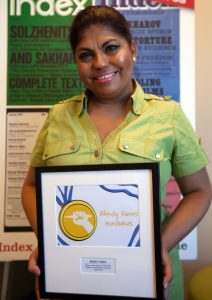
2018 Freedom of Expression Journalism Award-winning Honduran investigative journalist Wendy Funes. (Photo: Index on Censorship)
Wendy Funes is an investigative journalist from Honduras who regularly risks her life for her right to report on what is going on in the country. She is a courageous female voice, writing in a violent and corrupt society where two journalists have been killed this year and where women are regularly subjected to severe domestic violence and often killed. Funes is an inventive and passionate human rights reporter. For one article she got her own death certificate issued so that she could show up with the corruption in the civil registration office. For another one, they will be forced to fight for an investigation into children being forced to take to the streets of the country’s capital.
Looking out of one of the windows of my house a few days ago, while thinking about what to say this afternoon, I remembered the paradise tree in the garden which my childhood swing used to hang from. When it withered and died, I felt devastated. But now, forty years later, there are four big trees growing in its place and are all fruit-bearing.
For me, this award is so immense and significant that I can only explain it and express my thanks for it with a story that I have never told until now.
It is a story about a small fatherless child, yet another child left fatherless by the armed violence in Honduras. It is a story about a childhood filled with sadness. But the child learnt that whatever the circumstances, courage and strength are necessary to achieve one’s dreams: and the first step is always to dream.
In 2002 she began her first investigations as a journalist and it gave meaning to her life. But in 2008, censorship forced her to leave her dream job at the newspaper and by 2011 her constant fight for free expression and to tell the truth meant that all the doors to the media monopoly was closed to her.
But once again journalism saved her. She discovered that frustration with censorship is not the way. Rather, the way to overcome censorship is with the word, and although some doors were closed to her, doors to a more humane, less commercial, more rigorous kind of journalism were opened. The kind of journalism that investigates and pauses on each word, that does not proclaim impartiality but seeks the truth. The kind of journalism that is capable of showing her people that their society is being governed by drug trafficking and ruthless groups who since the 2009 coup have sacrificed lawyers, doctors, women, 70 journalists and executed young people in an almost invisible genocide.
The kind of journalism that can identify with a nation governed by someone who was rejected at the polls. Someone who controls the press that, in turn, covers up military assassinations, the corruption of officials and the everyday cruel realities for the Honduran people. Realities such as the 14-year-old girl sold by her father for a litre of alcohol whilst already pregnant, or the new-born baby who died of malnutrition and weighed more when he was born than when he died. In short, so many stories to tell. So many stories that the press is censored from telling.
But the young girl with whom this story began has been so fortunate that by refusing to remain silent and refusing to become part of this cruel system, by telling stories that a journalist should tell, she is being shown once again that the courage to dream is well-rewarded. That there is always someone willing to extend their hand and say “Come on, it’s worth resisting, it’s worth dreaming and fighting to transform all of this pain into a reward.” A reward which gives me hope.
I dedicate this prize to my fellow people of Honduras who demonstrate every day that they wish to move forward and overcome the violence, impunity and corruption which have been afflicting us for more than three decades.[/vc_column_text][/vc_column][/vc_row][vc_row disable_element=”yes”][vc_column width=”1/2″][vc_single_image image=”84882″ img_size=”full” alignment=”center”][vc_column_text]
For his one-man protests, Ildar Dadin was sent to prison in December 2015 where he was tortured, before his conviction was quashed in February 2017. Read the full profile.[/vc_column_text][/vc_column][vc_column width=”1/2″][vc_single_image image=”84888″ img_size=”full” alignment=”center”][vc_column_text]
Despite the persecution he faces for his work, Rebel Pepper continues to satirise the Chinese state from a life in exile in Japan. Read the full profile
[/vc_column_text][/vc_column][/vc_row][vc_row disable_element=”yes”][vc_column width=”1/2″][vc_single_image image=”84889″ img_size=”full” alignment=”center”][vc_column_text]
Established in 2015, Turkey Blocks is an independent digital research organisation that monitors internet access restrictions in Turkey. Read the full profile.
[/vc_column_text][/vc_column][vc_column width=”1/2″][vc_single_image image=”84887″ img_size=”full” alignment=”center”][vc_column_text]
Maldives Independent, the Maldives’ premiere English publication and one of the few remaining independent media outlets, was formed in exile in Sri Lanka in 2004. Read the full profile.
[/vc_column_text][/vc_column][/vc_row][vc_row][vc_column][vc_column_text]Mirando por una de las ventanas de mi casa, un par de días atrás, mientras pensaba en qué decir esta tarde, me acordé del árbol de Paraíso del jardín, desde el cual colgaba el columpio de mi niñez. Cuando se marchitó y se murió, me sentí desconsolada. Sin embargo ahora, unos treinta años después, ahí hay cuatro árboles grandes creciendo en su lugar y todos rinden fruta.
Para mí, este premio es tan inmenso e importante que solo puedo explicar y expresar mi agradecimiento con un cuento que, hasta ahora, nunca he relatado.
Es un cuento de una niña chiquita sin padre. Otro niño más dejado sin padre por la violencia armada en Honduras. Es un cuento de una niñez llena de tristeza. Pero la niña aprendió que en toda circunstancia, la alegría, el coraje y la fuerza son necesarios para lograr sus sueños: y el primer paso siempre es soñar.
En 2002 ella empezó sus primeras investigaciones como periodista y eso le dió un significado a su vida. Pero en 2008, la censura la obligó a dejar el trabajo de sus sueños en el periódico y en 2011, su constante lucha por la libertad de expresión y de exponer la verdad, significó que todas las puertas del monopolio le fueron cerradas.
Pero una vez más, el periodismo la salvó. Ella descubrió que luchar contra la censura, no era el mejor método. Más bien, el mejor método de combatir la censura era a través de la palabra, y a pesar de que algunas puertas le fueron cerradas, se le abrieron otras a otro tipo de periodismo más humano, menos comercial y más riguroso. El tipo de periodismo que investigaba y que hacía una pausa en cada palabra, el que no proclamaba la imparcialidad pero que buscaba la verdad. El tipo de periodismo capaz de enseñar a su pueblo que la sociedad está siendo gobernada por el tráfico de drogas y grupos despiadados, quienes, desde el golpe de Estado del 2009, han sacrificado a abogados, médicos, mujeres, unos setenta periodistas y han ejecutado a jóvenes en un casi invisible genocidio.
El tipo de periodismo que puede identificarse con una nación gobernada por una persona que fue rechazada en las elecciones. Una persona que controla la prensa, y que por ende encubre asesinatos, la corrupción de los oficiales y las crueles realidades cotidianas que sufre el pueblo de Honduras. Realidades tales como la muchacha de catorce años vendida por su padre por un litro de alcohol y mientras estaba embarazada, o el infante recién nacido que murió por la malnutrición y cuyo cuerpo pesaba más cuando nació que cuando murió.
Pero la jóven muchacha con quien empezó este cuento, ha sido tan afortunada que, por negarse a mantenerse callada y por negarse a ser parte de este cruel sistema, por contar cuentos que un periodista debería contar, está comprobando una vez más que el coraje de soñar está bien recompensado. En resumidas cuentas, hay tantos cuentos que contar. Tantos cuentos que la prensa está censurada de contar. Que siempre haya alguien que esté dispuesto a extender la mano y decir, Vamos, vale la pena resistir, vale la pena soñar y luchar para transformar todo este dolor en una recompensa>. Una recompensa que me da esperanza.
Dedico este premio a mis compatriotas de Honduras porque ellos demuestran todos los días, el deseo de salir adelante y vencer la violencia, impunidad y corrupción que nos han estado afligiendo con mayor calamidad en las últimas tres décadas.[/vc_column_text][/vc_column][/vc_row][vc_row][vc_column][vc_basic_grid post_type=”post” max_items=”12″ style=”load-more” items_per_page=”4″ element_width=”6″ grid_id=”vc_gid:1524235559634-0014c057-81cc-3″ taxonomies=”8935″][/vc_column][/vc_row]
19 Apr 2018 | Malta, Mapping Media Freedom, Media Freedom, News, United Kingdom
[vc_row][vc_column][vc_column_text]
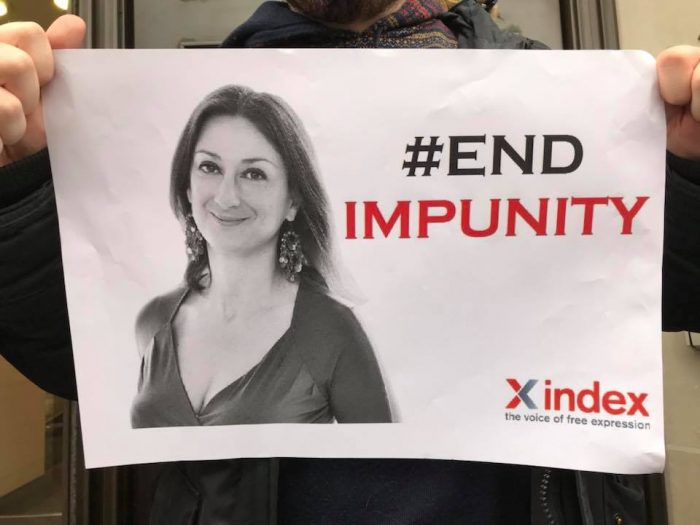
Daphne Caruana Galizia, the Maltese investigative journalist who was assassinated in October 2017, had numerous lawsuits pending at the time of her murder.
Maltese libel laws are having an incredibly chilling effect on journalism and free speech, said British MP Tom Brake at a parliamentary meeting.
On the six-month anniversary of the killing of Maltese journalist Daphne Caruana Galizia, the meeting was told that her sons are facing 34 libel cases that were originally made against their mother. Under Maltese law the cases then roll over against other members of the family and the plaintiffs can seek damages against their estate.
Daphne’s son Paul Caruana Galizia said: “We want to stop the abuse of libel law: magistrates should throw out cases that are obviously vexatious, designed only to harass journalists and restrict freedom of expression.”
He added: “I also think that plaintiffs seeking damages against dead people shouldn’t continue.
At her death Daphne Caruana Galizia faced 47 libel suits in all – five of those were dropped automatically after her death but there are still 34 pending civil cases against the family.
Daphne’s son Paul, who was speaking on 16 April 2018 about his mother’s killing from a car bomb, said: “There was three decades of relentless harassment”.
Paul and his family also face threats against them, and are having to take personal security measures.
Brake, a Liberal Democrat MP, who chaired a discussion between NGOs and the writer’s family, said he would put together another Early Day Motion to call attention to the case in the UK parliament. Brake said he would seek to meet with Maltese MPs, who are visiting Britain in the next few weeks, to highlight his worries about the case. He will also be writing to the Maltese authorities about the weaknesses in the investigation.
The MP also called the situation a “tragedy that is happening within our EU borders”.
Paul Caruana Galizia said that the response from the government in Malta had been “weak” and “ineffective” and outlined many concerns with the investigation.
He highlighted the conflict of interest in the enquiry: “We are in this difficult situation now where the people our mother investigated – the police, the government, anti-money-laundering authorities – are now in charge of the investigation into her own assassination”.
Rebecca Vincent, London director of Reporters without Borders, said: “The fact that this could happen in the EU was a wakeup call I think to many of us. But six months later, unfortunately, it’s not so shocking, this is sadly becoming a new reality”.
This also follows the death of another investigative reporter Jan Kuciak who was shot dead in Slovenia in a hitman-style shooting in February.
The Guardian has also recently reported that Daphne Caruana Galizia’s husband, Peter Caruana Galizia, believes that those behind the killing are being shielded by the Maltese government.[/vc_column_text][/vc_column][/vc_row][vc_row][vc_column][vc_basic_grid post_type=”post” max_items=”12″ style=”load-more” items_per_page=”4″ element_width=”6″ grid_id=”vc_gid:1524143013537-57a1643f-a0e9-4″ taxonomies=”18782″][/vc_column][/vc_row]
19 Apr 2018 | Awards, News
[vc_row][vc_column][vc_column_text]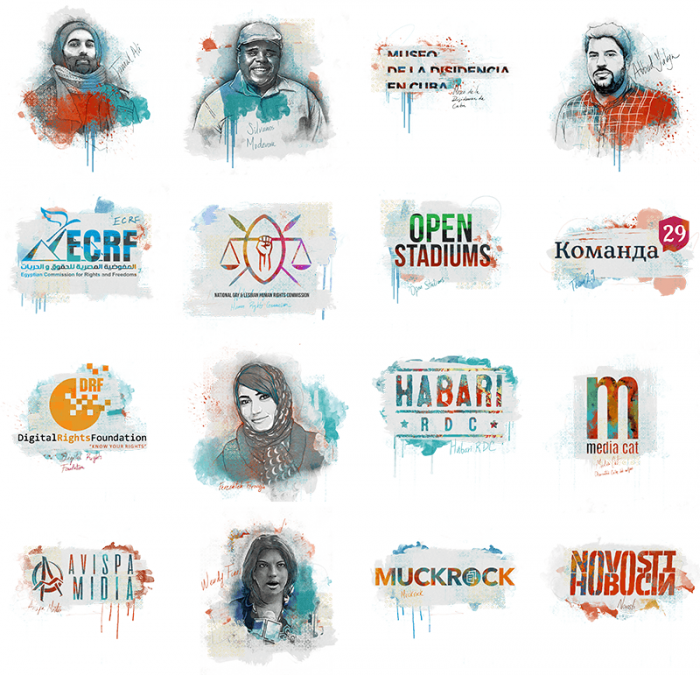
Each year, the Index on Censorship Freedom of Expression Awards gala honours courageous champions who fight for free speech around the world.
Drawn from more than 400 crowdsourced nominations, this year’s nominees include artists, journalists, campaigners and digital activists tackling censorship and fighting for freedom of expression. Many of the 16 shortlisted are regularly targeted by authorities or by criminal and extremist groups for their work: some face regular death threats, others criminal prosecution.
The gala takes place on Thursday 19 April in London and will be hosted by stand-up poet Kate Fox.
We will be live tweeting throughout the evening on @IndexCensorship. Get involved in the conversation using the hashtag #IndexAwards2018. Listen LIVE beginning at 7:30pm BST on Resonance FM
Index on Censorship Freedom of Expression Awards nominees 2018
Arts
Jamal Ali, Azerbaijan
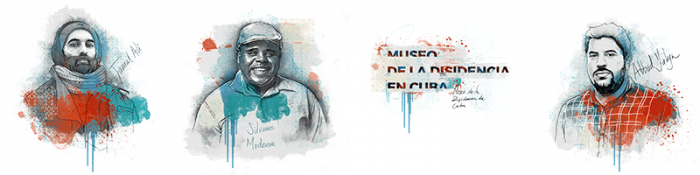
Jamal Ali is an exiled rap musician with a history of challenging Azerbaijan’s authoritarian regime. Ali was one of many who took to the streets in 2012 to protest spending around the country’s hosting of the Eurovision song contest. Detained and tortured for his role in the protests, he went into exile after his life was threatened. Ali has persisted in challenging the government by releasing music critical of the country’s dynastic leadership. Following the release of one song, Ali’s mother was arrested in a senseless display of aggression. In provoking such a harsh response with a single action, Ali has highlighted the repressive nature of the regime and its ruthless desire to silence all dissent.
Full profile
Silvanos Mudzvova, Zimbabwe
Playwright and activist Silvanos Mudzvova uses performance to protest against the repressive regime of recently toppled President Robert Mugabe and to agitate for greater democracy and rights for his country’s LGBT community. Mudzvova specialises in performing so-called “hit-and-run” actions in public places to grab the attention of politicians and defy censorship laws, which forbid public performances without police clearance. His activism has seen him be traumatically abducted: taken at gunpoint from his home he was viciously tortured with electric shocks. Nonetheless, Mudzvova has resolved to finish what he’s started and has been vociferous about the recent political change in Zimbabwe.
Full profile
The Museum of Dissidence, Cuba
The Museum of Dissidence is a public art project and website celebrating dissent in Cuba. Set up in 2016 by acclaimed artist Luis Manuel Otero Alcántara and curator Yanelys Nuñez Leyva, their aim is to reclaim the word “dissident” and give it a positive meaning in Cuba. The museum organises radical public art projects and installations, concentrated in the poorer districts of Havana. Their fearlessness in opening dialogues and inhabiting public space has led to fierce repercussions: Nuñez was sacked from her job and Otero arrested and threatened with prison for being a “counter-revolutionary.” Despite this, they persist in challenging Cuba’s restrictions on expression.
Full profile
Abbad Yahya, Palestine
Abbad Yahya is a Palestinian author whose novel, Crime in Ramallah, was banned by the Palestinian Authority in 2017. The book tackles taboo issues such as homosexuality, fanaticism and religious extremism. It provoked a rapid official response and all copies of the book were seized. The public prosecutor issued a summons for questioning against Yahya while the distributor of the novel was arrested and interrogated. Yahya also received threats and copies of the book were burned. Despite this, he has spent the last year raising awareness of freedom of expression and the lives of young people in the West Bank and Gaza, particularly in relation to their sexuality.
Full profile
Campaigning
Egyptian Commission for Rights and Freedoms, Egypt
The Egyptian Commission for Rights and Freedoms is one of the few human rights organisations still operating in a country which has waged an orchestrated campaign against independent civil society groups. Egypt is becoming increasingly hostile to dissent, but ECRF continues to provide advocacy, legal support and campaign coordination, drawing attention to the many ongoing human rights abuses under the autocratic rule of President Abdel Fattah-el-Sisi. Their work has seen them subject to state harassment, their headquarters have been raided and staff members arrested. ECRF are committed to carrying on with their work regardless of the challenges.
Full profile
National Gay and Lesbian Human Rights Commission, Kenya
The National Gay and Lesbian Human Rights Commission is the only organisation in Kenya challenging and preventing LGBTI discrimination through the country’s courts. Even though homosexuality isn’t illegal in Kenya, homosexual acts are. Homophobia is commonplace and men who have sex with men can be punished by up to 14 years in prison, and while no specific laws relate to women, former Prime Minister Raila Odinga has said lesbians should also be imprisoned. NGLHRC has had an impact by successfully lobbying MPs to scrap a proposed anti-homosexuality bill and winning agreement from the Kenya Medical Association to stop forced anal examination of clients.
Full profile
Open Stadiums, Iran
The women behind Open Stadiums risk their lives to assert a woman’s right to attend public sporting events in Iran. The campaign challenges the country’s political and religious regime, and engages women in an issue many human rights activists have previously thought unimportant. Iranian women face many restrictions on using public space. Open Stadiums has generated broad support for their cause in and out of the country. As a result, MPs and people in power are beginning to talk about women’s rights to attend sporting events in a way that would have been taboo before.
Full profile
Team 29, Russia
Team 29 is an association of lawyers and journalists that defends those targeted by the state for exercising their right to freedom of speech in Russia. It is crucial work in a climate where hundreds of civil society organisations have been forced to close and where increasingly tight restrictions have been placed on public protest and political dissent since mass demonstrations rocked Russia in 2012. Team 29 conducts about 50 court cases annually, many involving accusations of high treason. Aside from litigation, they offer legal guides for activists and advice on what to do when summoned by state security for interrogation.
Full profile
Digital Activism
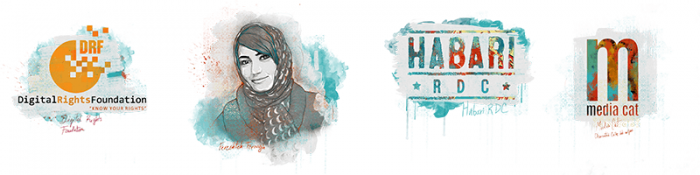
Digital Rights Foundation, Pakistan
In late 2016, the Digital Rights Foundation established a cyber-harassment helpline that supported more than a thousand women in its first year of operation alone. Women make up only about a quarter of the online population in Pakistan but routinely face intense bullying including the use of revenge porn, blackmail, and other kinds of harassment. Often afraid to report how badly they are treated, women react by withdrawing from online spaces. To counter this, DRF’s Cyber Harassment Helpline team includes a qualified psychologist, digital security expert, and trained lawyer, all of whom provide specialised assistance.
Full profile
Fereshteh Forough, Afghanistan
Fereshteh Forough is the founder and executive director of Code to Inspire, a coding school for girls in Afghanistan. Founded in 2015, this innovative project helps women and girls learn computer programming with the aim of tapping into commercial opportunities online and fostering economic independence in a country that remains a highly patriarchal and conservative society. Forough believes that with programming skills, an internet connection and using bitcoin for currency, Afghan women can not only create wealth but challenge gender roles and gain independence.
Full profile
Habari RDC, Congo
Launched in 2016, Habari RDC is a collective of more than 100 young Congolese bloggers and web activists, who use Facebook, Twitter and YouTube to give voice to the opinions of young people from all over the Democratic Republic of Congo. Their site posts stories and cartoons about politics, but it also covers football, the arts and subjects such as domestic violence, child exploitation, the female orgasm and sexual harassment at work. Habari RDC offers a distinctive collection of funny, angry and modern Congolese voices, who are demanding to be heard.
Full profile
Mèdia.cat, Spain
Mèdia.cat is a Catalan website devoted to highlighting media freedom violations and investigating under-reported stories. Unique in Spain, it was a particularly significant player in 2017 when the disputed independence referendum brought issues of censorship and the impartiality of news under the spotlight. The website provides an online platform that systematically catalogues censorship perpetrated in the region. Its map on censorship offers a way for journalists to report on abuses they have personally suffered.
Journalism
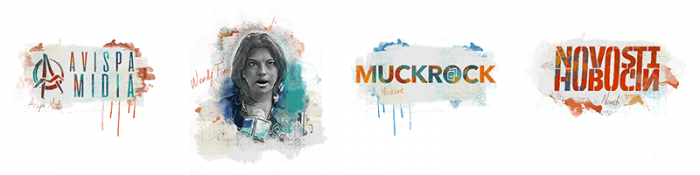
Avispa Midia, Mexico
Avispa Midia is an independent online magazine that prides itself on its use of multimedia techniques to bring alive the political, economic and social worlds of Mexico and Latin America. It specialises in investigations into organised crime and the paramilitaries behind mining mega-projects, hydroelectric dams and the wind and oil industry. Many of Avispa’s reports in the last 12 months have been focused on Mexico and Central America, where the media group has helped indigenous and marginalised communities report on their own stories through audio and video training.
Wendy Funes, Honduras
Wendy Funes is an investigative journalist from Honduras who regularly risks her life for her right to report on what is happening in the country, an extremely harsh environment for reporters. Two journalists were murdered in 2017 and her father and friends are among those who have met violent deaths in the country – killings for which no one has ever been brought to justice. Funes meets these challenges with creativity and determination. For one article she had her own death certificate issued to highlight corruption. Funes also writes about violence against women, a huge problem in Honduras where one woman is killed every 16 hours.
MuckRock, United States
MuckRock is a non-profit news site used by journalists, activists and members of the public to request and share US government documents in pursuit of more transparency. MuckRock has shed light on government surveillance, censorship and police militarisation among other issues. MuckRock produces its own reporting, and helps others learn more about requesting information. Last year the site produced a Freedom of Information Act 4 Kidz lesson plan to help educators to start discussions about government transparency. Since then, they have expanded their reach to Canada. The organisation hopes to continue increasing their impact by putting transparency tools in the hands of journalists, researchers and ordinary citizens.
Novosti, Croatia
Novosti is a weekly Serbian-language magazine in Croatia. Although fully funded as a Serb minority publication by the Serbian National Council, it deals with a whole range of topics, not only those directly related to the minority status of Croatian Serbs. In the past year, the outlet’s journalists have faced attacks and death threats mainly from the ultra-conservative far-right. For its reporting, the staff of Novosti have been met with protest under the windows of the magazine’s offices shouting fascist slogans and anti-Serbian insults, and told they would end up killed like Charlie Hebdo journalists. Despite the pressure, the weekly persists in writing the truth and defending freedom of expression.[/vc_column_text][/vc_column][/vc_row][vc_row][vc_column][vc_basic_grid post_type=”post” max_items=”12″ style=”load-more” items_per_page=”4″ element_width=”6″ grid_id=”vc_gid:1524073803130-58a2be32-5f5a-7″ taxonomies=”8935″][/vc_column][/vc_row]
